Managed Float
A managed float—commonly referred to as a 'dirty float'—is an exchange rate regime where a currency's market value is primarily driven by market supply and demand, but the central bank reserves the right to intervene opportunistically to prevent excessive volatility and steer the currency toward policy objectives.
What Is a Managed Float?
A managed float (informally known in financial markets as a “dirty float”) is an exchange rate regime that occupies the middle ground between a completely free-floating currency and a rigid, legally mandated fixed peg. Under a managed float, the national central bank allows market forces—such as foreign trade balances, cross-border investment flows, and macroeconomic interest rate expectations—to establish the day-to-day spot exchange rate.
However, unlike a pure “clean float” (where monetary authorities never intervene in the currency market), the central bank under a managed float retains full discretion to execute foreign exchange market interventions. When the currency experiences rapid, disorderly appreciation (which damages domestic export competitiveness) or steep depreciation (which inflates imported commodity costs and fuels domestic inflation), the central bank steps into the spot market, deploying its foreign exchange reserves or altering domestic interest rates to smooth volatility and guide the exchange rate toward an unannounced target corridor.
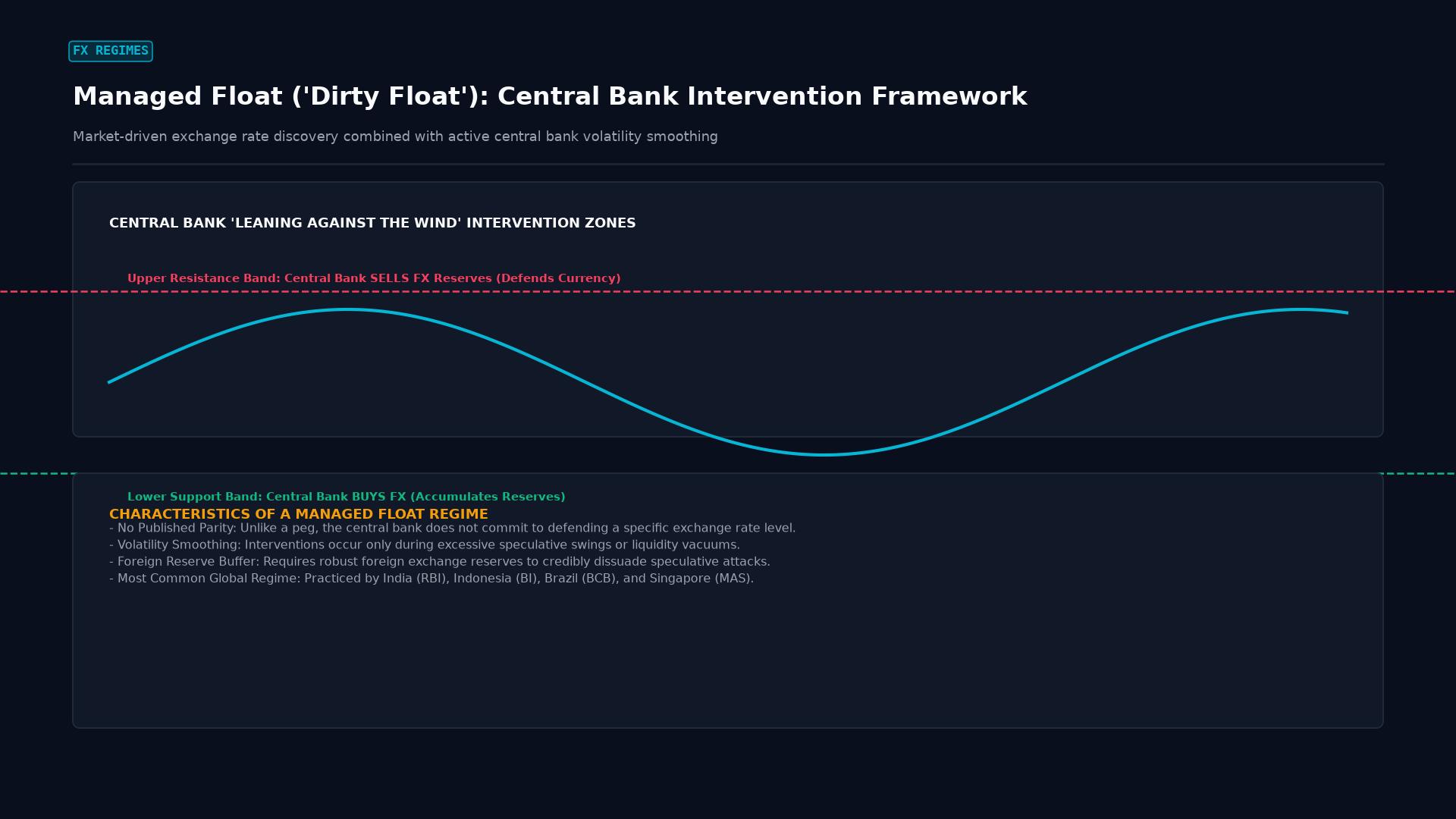 Figure: Market-driven exchange rate discovery combined with active central bank volatility smoothing
Key Takeaways
- Opportunistic Central Bank Intervention: The hallmark of a managed float is periodic, strategic intervention: central banks buy foreign currency to halt unwanted appreciation or sell reserves to halt rapid currency depreciation.
- Absence of an Explicit Parity Target: Unlike formal currency pegs, a managed float central bank rarely publishes a hard line in the sand, preserving strategic ambiguity that deters one-way speculative attacks by hedge funds.
- Foreign Reserve Depletion Risk: Defending a managed float against aggressive currency depreciation requires continuous sales of foreign currency reserves, creating vulnerability to balance-of-payments crises if reserves run low.
- Sterilized vs. Unsterilized Action: Central banks typically execute sterilized interventions—conducting offsetting domestic open-market operations in treasury bonds to prevent FX intervention from disrupting domestic monetary supply.
- International Scrutiny: Heavy, persistent one-sided intervention under a managed float frequently leads to accusations of currency manipulation and monitoring by the U.S. Department of the Treasury.
Comparative Taxonomy: Exchange Rate Regimes
| Characteristic | Free Float (“Clean Float”) | Managed Float (“Dirty Float”) | Fixed / Pegged Regime |
|---|---|---|---|
| Market Determination | 100% Market Supply & Demand | Primarily market; guided by central bank | Fixed by government decree |
| Intervention Frequency | Virtually never (except systemic crisis) | Periodic, unannounced, or rule-based | Continuous / Mandatory |
| Reserve Consumption | Minimal reserve deployment | Moderate to heavy reserve utilization | Extreme reserve utilization |
| Monetary Sovereignty | Complete domestic policy freedom | High policy freedom with FX trade-offs | Zero (Subordinated to defending peg) |
| Speculative Target | Hard to corner; deep liquidity | Vulnerable if interventions become predictable | Prime target for speculative runs |
| Key Global Examples | USD, EUR, GBP, AUD, CAD | JPY (Japan), SGD (Singapore), INR (India) | HKD (Hong Kong), SAR (Saudi Arabia) |
The Mechanics: Singapore’s S$NEER Managed Float Model
While many central banks operate managed floats through discretionary, ad-hoc spot market interventions, the Monetary Authority of Singapore (MAS) operates the world’s most sophisticated and transparent institutional managed float model.
Because Singapore is an ultra-open trade economy where imports and exports dwarf domestic GDP, the MAS does not use domestic interest rates as its primary monetary policy tool. Instead, it manages the Singapore Dollar Nominal Effective Exchange Rate (S$NEER)—a trade-weighted currency basket:
$$S\text{$NEER} = \sum_{i=1}^{n} w_i \cdot \ln(S_i)$$
Where $w_i$ represents the trade weight of trading partner $i$, and $S_i$ is the bilateral exchange rate.
- The Policy Band: The MAS establishes an undisclosed policy band around the S$NEER parity level.
- Three Levers: The MAS adjusts the slope (rate of appreciation), the midpoint, and the width of the band during biannual policy statements.
- Intervention Trigger: If global capital surges push the S$NEER above the upper bound, the MAS intervenes by selling Singapore Dollars and buying foreign reserves, maintaining orderly economic stability without an outright fixed peg.
Real-World Case Study: The Bank of Japan’s “Dirty Float” Interventions (2022–2024)
Japan officially operates a floating exchange rate regime. However, when widening interest rate differentials between the Federal Reserve and the Bank of Japan triggered an historic slide in the Japanese Yen:
- The Depreciation Surge: Between early 2021 and late 2022, USD/JPY surged from 103.00 to over 151.90, inflicting severe imported energy and food inflation on Japanese households.
- The Direct Interventions: In September and October 2022, the Japanese Ministry of Finance (MOF) and the BOJ carried out massive direct interventions, selling over $60 billion USD in foreign reserves to buy Yen, knocking USD/JPY down by over 500 pips in single sessions.
- The 2024 Sequel: When USD/JPY breached 160.00 in April 2024, Japan executed another record ¥9.8 trillion ($62 billion) intervention.
- Market Outcome: While the interventions demonstrated the power of a managed float to punish aggressive speculative short-sellers, they also highlighted its limitation: currency interventions cannot permanently reverse a trend if underlying macroeconomic interest rate differentials remain overwhelmingly wide.
Trading Risks in Managed Float Currencies
- Intervention Risk (“Jaws of the Central Bank”): Forex traders holding short or long positions in managed float currencies face sudden, violent counter-trend gap risks when central bank execution desks drop multi-billion-dollar market orders into the order book without warning.
- Verbal Intervention (“Jawboning”) Traps: Central bank officials frequently attempt to move managed float currencies through aggressive speeches, rate-check calls to bank desks, and warnings of “decisive action,” generating false breakout traps on intraday charts.
Frequently Asked Questions (FAQ)
Why is a managed float called a “dirty float”?
The term “dirty float” was coined by financial economists to distinguish it pejoratively from a “clean float.” It implies that while the currency appears to float freely on an open exchange, the “clean” market price discovery is continuously distorted and manipulated behind the scenes by central bank intervention.
How does sterilized intervention work in a managed float?
When a central bank sells foreign currency to strengthen its domestic currency, it absorbs domestic cash from the banking system, which would naturally cause domestic interest rates to spike. In a sterilized intervention, the central bank simultaneously conducts open-market operations (buying domestic government bonds) to inject that liquidity back into the banking system, leaving the domestic money supply unchanged.
Can managed float currencies be traded by retail forex traders?
Yes. Most major emerging market pairs (such as USD/INR, USD/MXN, and USD/ZAR) as well as developed pairs subject to managed float tactics (such as USD/JPY and EUR/CHF) are actively traded on retail brokerage platforms.
Ready to trade forex?
Open a free demo account with a regulated broker. Practice with virtual funds before risking real money.