DZD
DZD is the ISO 4217 currency code for the Algerian Dinar, the official currency of Algeria, issued and managed under tight foreign exchange controls by the Banque d'Algérie.
The Algerian Dinar (ISO code: DZD, symbol: DA) is the national legal tender of the People’s Democratic Republic of Algeria, the largest country in Africa by land area. Administered by the central bank, the Banque d’Algérie, the dinar operates under a tightly managed crawling peg regime characterized by strict foreign exchange controls and non-convertibility on the capital account. The domestic currency’s valuation is inextricably tied to the global hydrocarbon cycle, as crude oil and natural gas exports generate the overwhelming majority of Algeria’s foreign exchange earnings and sovereign fiscal revenues.
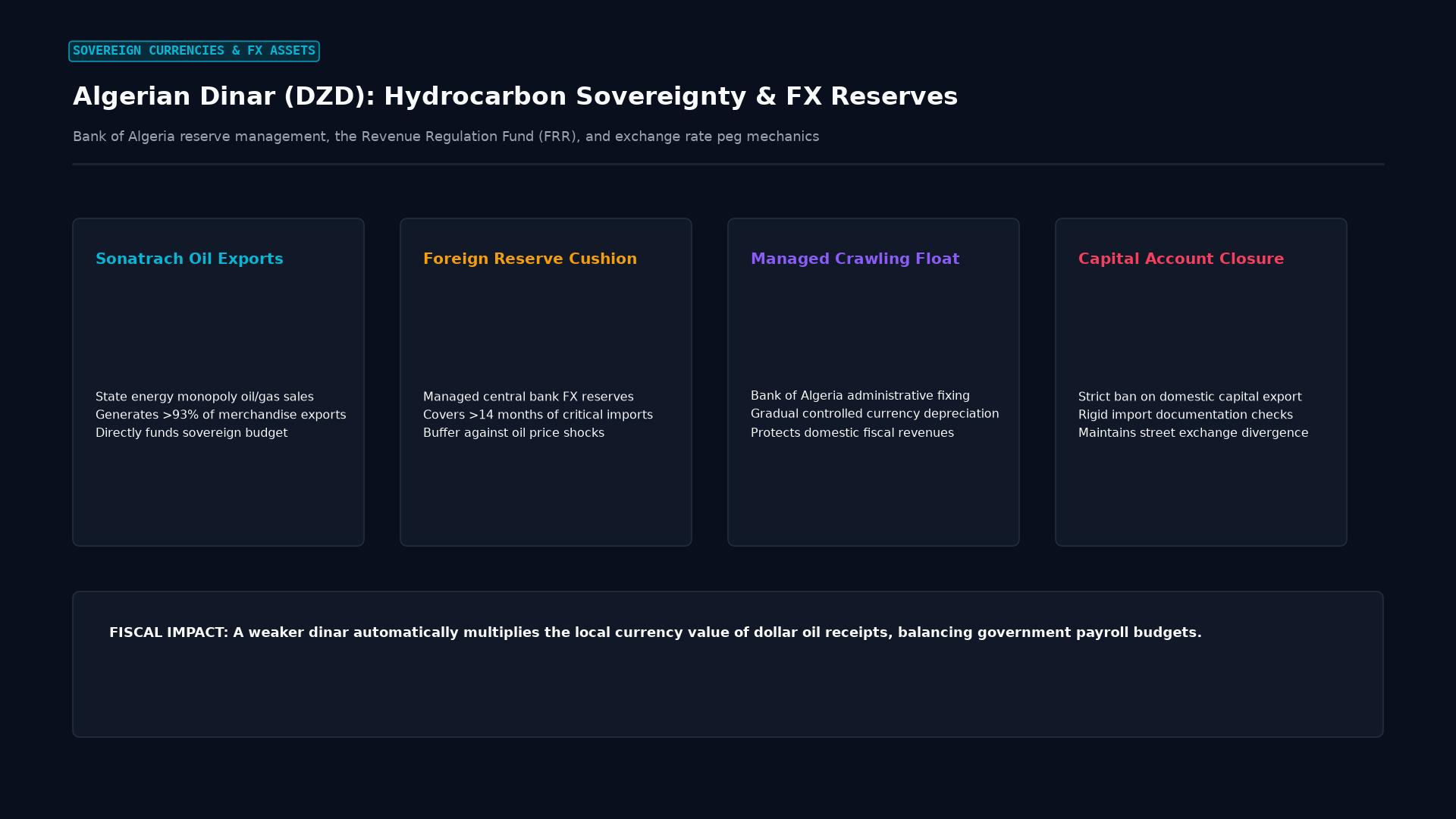 Figure: Sovereign resource funding: state energy monopoly Sonatrach oil revenues, foreign exchange reserve cushions, and managed crawling peg adjustments.
Historical Trajectory and Decolonization
The Algerian Dinar was established on April 10, 1964, replacing the Algerian New Franc at par following the nation’s independence from France in 1962. Initially, Algeria remained part of the Franc Zone, with the dinar pegged to the French Franc. However, seeking full monetary sovereignty and non-aligned economic independence, Algerian authorities decoupled the dinar from the French Franc in 1973.
Between 1974 and the late 1980s, the Banque d’Algérie pegged the dinar to a trade-weighted basket of international currencies. The state operated a centralized socialist command economy, where import licenses and foreign exchange were strictly rationed by state ministries.
The collapse of global crude oil prices in 1986 triggered a catastrophic balance-of-payments crisis for Algeria. Hydrocarbon export revenues dropped by more than 50 percent, depleting foreign exchange reserves and rendering the country unable to service its external debt obligations. Under an International Monetary Fund (IMF) standby arrangement in the early 1990s, Algeria enacted massive devaluations of the dinar, transitioning from a rigid pegged system to a managed floating regime with crawling depreciation to restore external competitiveness.
Hydrocarbon Dependency and the Dutch Disease Dynamic
Algeria exemplifies the macroeconomic phenomenon known as Dutch Disease, where a dominant natural resource sector distorts domestic economic incentives and currency pricing.
State-owned energy conglomerate Sonatrach exercises a state monopoly over the exploration, extraction, pipeline transit, and export of crude oil, liquefied natural gas (LNG), and dry gas via subsea pipelines to Italy (Transmed) and Spain (Medgaz). Hydrocarbons consistently account for:
- Over 90 to 93 percent of total merchandise export receipts.
- Roughly 40 to 50 percent of domestic state budgetary revenues.
- Over 80 percent of gross domestic foreign exchange inflows.
Because export earnings arrive exclusively in US dollars and euros, the Banque d’Algérie uses the exchange rate as a fiscal balancing mechanism. When international crude oil prices decline, the central bank administratively depreciates the official value of the dinar against the US dollar. Because hydrocarbon taxes and export duties are collected in dollars and converted to dinars for domestic state expenditure, a weaker dinar mathematically inflates the local currency value of energy revenues, allowing the Algerian Treasury to cover civil service payrolls and national food subsidies without triggering immediate nominal fiscal deficits.
$$\text{Local Fiscal Revenue} = \text{Hydrocarbon Export Volume} \times \text{World Oil Price (USD)} \times \text{USD/DZD Rate}$$
Strict Foreign Exchange Controls and Capital Restrictions
To protect its international reserves from capital flight, the Algerian government maintains some of the most restrictive foreign exchange regulations in North Africa:
- Non-Convertibility of Capital Account: Residents are legally prohibited from transferring capital abroad to purchase foreign real estate, securities, or overseas financial assets.
- Import Rationing and Bureaucratic Approvals: Businesses requiring foreign currency to pay overseas suppliers must obtain verified import licenses and process transactions through documentary letters of credit (crédit documentaire) approved by commercial banks and customs authorities.
- Rigid Tourist FX Allowances: Algerian citizens traveling abroad are legally entitled to an annual foreign currency travel allowance (droit de change touristique) capped at approximately 15,000 DZD (roughly equivalent to 100 to 115 euros), an amount unchanged for decades and wholly insufficient for modern international travel.
- Mandatory Foreign Currency Surrender: Non-hydrocarbon private exporters must surrender a substantial portion of their foreign exchange proceeds to domestic banks at the official exchange rate, disincentivizing non-oil industrial export diversification.
The Dual Exchange Market: Square Port-Saïd
The direct consequence of severe foreign exchange rationing and non-convertibility is the entrenched existence of an open-air informal parallel market. The epicenter of this parallel foreign exchange market is Square Port-Saïd, a historic public square in downtown Algiers.
At Square Port-Saïd and regional trading nodes in Oran, Constantine, and Sétif, informal foreign currency dealers buy and sell physical banknote bundles of euros and US dollars. The informal parallel market rate trades at a massive premium over the official banking rate, frequently between 40 percent and 65 percent above the central bank’s published fixing.
| Feature | Official Banking Market | Square Port-Saïd Parallel Market |
|---|---|---|
| Legal Status | Legally recognized and supervised by Banque d’Algérie | Technically illegal but de facto tolerated by authorities |
| Participants | State enterprises, registered importers, authorized banks | Private citizens, informal merchants, diaspora travelers |
| Transaction Types | Electronic bank transfers, letters of credit, treasury bills | Physical cash notes (predominantly 50, 100, and 200 EUR notes) |
| Pricing Mechanism | Banque d’Algérie administrative crawling fixings | Pure supply and demand of physical hard currency banknotes |
| Spread vs Official | Baseline 0% | 40% to 65% premium over official rate |
The parallel market is nourished by three structural liquidity streams:
- Diaspora Remittances: Millions of Algerians living in France, Belgium, and Canada bypass formal banks to avoid unfavorable official rates, exchanging cash with informal brokers when visiting Algeria.
- Informal Container Importers: Small-scale commercial traders (les trabendistes) who travel to Turkey, Dubai, or southern Europe to purchase apparel, consumer electronics, and auto parts buy hard currency on the parallel market to finance unrecorded imports.
- Flight Capital and Domestic Savings: Wealthy domestic households convert surplus dinars into physical euro banknotes as a hedge against domestic inflation and currency depreciation.
Monetary Policy Tools of the Banque d’Algérie
Unlike advanced economy central banks that steer market liquidity through interbank repo rates, the Banque d’Algérie conducts monetary policy primarily through reserve requirements and direct liquidity mop-up operations.
During periods of high crude oil prices, state expenditures inject vast amounts of dinar liquidity into commercial state banks (such as Banque Nationale d’Algérie, BEA, and CPA). To prevent this excess liquidity from igniting runaway inflation, the central bank issues structural liquidity absorption facilities and adjusts the mandatory reserve ratio (coefficient des réserves obligatoires).
Conversely, when oil prices fall, liquidity dries up across the banking system, prompting the central bank to activate refinancing windows and lower reserve requirements to keep credit flowing to state-sponsored infrastructure projects.
Trading Realities for International Forex Participants
For global corporate treasurers and speculative currency desks, the Algerian Dinar represents a restricted, non-deliverable exotic currency:
- No Spot Market Access: International banks cannot execute spot trades in DZD outside the borders of Algeria.
- Non-Deliverable Forwards (NDFs): Offshore NDF contracts for USD/DZD are exceptionally illiquid and priced with wide spreads, reflecting high regulatory risk and the difficulty of hedging underlying domestic interest rates.
- Foreign Investment Repatriation: Multinational corporations operating in Algeria (predominantly in oil and gas extraction concessions or engineering joint ventures) must satisfy rigorous bureaucratic compliance protocols administered by the Banque d’Algérie and the tax authority to convert dinar earnings back into hard currency for dividend repatriation.
Frequently Asked Questions
Why doesn’t the Algerian government unify the official and parallel exchange rates?
Unifying the exchange rates would require floating the dinar and permitting free capital convertibility. Doing so would cause an immediate sharp nominal depreciation of the official rate toward the parallel market price. While this would eliminate the black market, it would dramatically increase the domestic cost of imported food (wheat, cooking oil, dairy), triggering severe inflation and potential social unrest.
Can international tourists use credit cards and ATMs in Algeria?
While international Visa and Mastercard debit and credit cards function at select upscale international hotels and modern bank branches in Algiers, their practical utility is limited. Transactions processed through international cards are converted at the official central bank exchange rate, making expenses roughly 40 to 50 percent more costly compared to exchanging physical cash notes on the domestic market.
What is the Sovereign Wealth Fund of Algeria?
Algeria established the Fonds de Régulation des Recettes (FRR) in 2000 to manage excess hydrocarbon revenues. When world oil prices exceeded a budgetary reference price, surplus export revenues flowed into the FRR to cushion future fiscal deficits. However, years of low oil prices following the 2014 commodity crash exhausted the fund’s liquid assets, requiring the central bank to rely directly on its gross foreign exchange reserves to protect the currency.
Ready to trade forex?
Open a free demo account with a regulated broker. Practice with virtual funds before risking real money.