EGP
EGP is the ISO 4217 currency code for the Egyptian Pound, the official currency of the Arab Republic of Egypt, managed under a flexible exchange rate regime by the Central Bank of Egypt.
The Egyptian Pound (ISO code: EGP, symbol: E£ or ج.م) is the official currency of the Arab Republic of Egypt, the most populous nation in the Arab world. Issued and regulated by the Central Bank of Egypt (CBE), the Egyptian Pound has experienced recurring cycles of managed pegs, structural foreign exchange shortages, parallel market premiums, and sharp structural devaluations. The landmark float on March 6, 2024, coupled with an aggressive 600-basis-point interest rate hike and massive foreign direct investment inflows, marked a historic turning point toward a flexible, market-determined exchange rate framework backed by the International Monetary Fund (IMF).
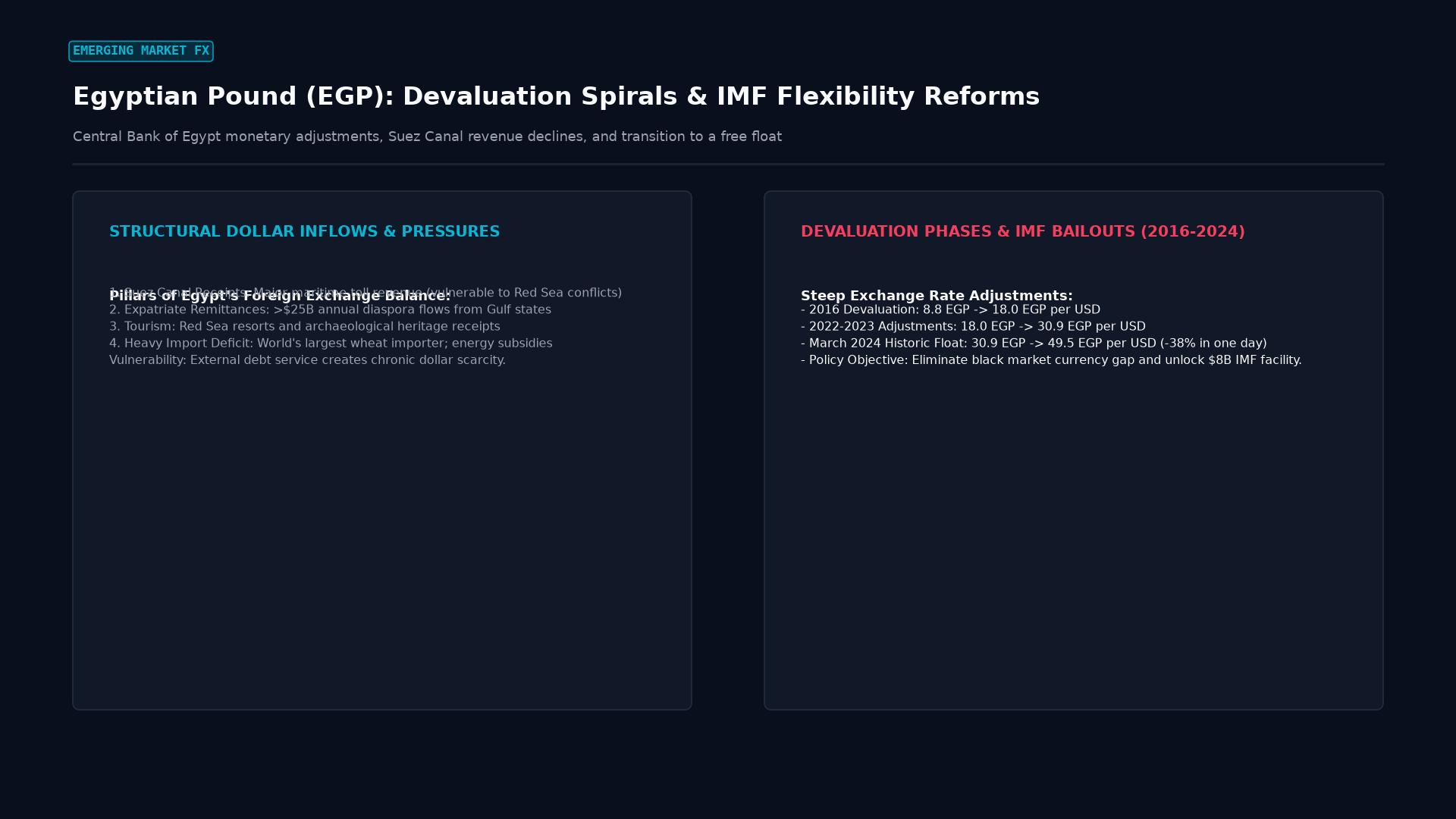 Figure: Emerging market FX pressures: Suez Canal revenues and diaspora remittances versus multi-phase central bank currency devaluations under IMF programs.
Historical Context and Currency Evolution
The Egyptian Pound was established by khedivial decree in 1834, replacing the Ottoman piastre as the chief accounting unit of Egypt. In 1836, gold and silver standard coins were minted, establishing the pound as a gold-standard currency subdivided into 100 piastres (ersh) or 1,000 milliemes.
During the British protectorate, the National Bank of Egypt issued paper currency backed by sterling securities. In 1914, the Egyptian Pound was legally pegged to the British Pound Sterling at a fixed parity of 1 E£ = £1 0s 6d. Egypt remained in the sterling area until 1947, when it decoupled from London and pegged the pound to the US Dollar at a rate of 1 E£ = 2.87156 USD.
For decades following the 1952 revolution, Egypt operated a centrally planned foreign exchange system characterized by complex multiple exchange rates: an official rate for government wheat imports, an educational rate for overseas students, and an incentive commercial rate for private trade. These disparate rates were consolidated in the early 1990s under an IMF-backed economic reform package.
The Era of Recurring Devaluation Waves
Modern Egyptian financial history is defined by recurring attempts to maintain a managed peg against the US dollar, which ultimately exhausted foreign exchange reserves and necessitated sharp, discrete devaluations:
The November 2016 Liberalization
Faced with dwindling reserves and a burgeoning black market following political upheavals in 2011-2013, the CBE floated the pound on November 3, 2016, as a prerequisite for a 12 billion dollar IMF Extended Fund Facility. The pound depreciated immediately from 8.88 EGP per USD to approximately 18 EGP per USD, stabilizing near 15.70 EGP per USD by 2019 as high domestic interest rates attracted foreign portfolio investors into Egyptian Treasury bills.
The 2022-2023 External Shocks
The outbreak of war in Ukraine in early 2022 dealt a catastrophic blow to Egypt’s balance of payments:
- Capital Flight: Foreign institutional investors pulled more than 20 billion dollars of short-term portfolio capital (“hot money”) out of local-currency treasury debt in a matter of weeks.
- Import Inflation: As the world’s largest importer of wheat, Egypt faced skyrocketing global grain and fertilizer prices, accompanied by high crude oil import costs.
- Reserve Depletion: The CBE permitted phased devaluations throughout 2022 and early 2023, moving the pound from 15.70 to 19.50, then to 24.50, and stabilizing it administratively at 30.90 EGP per USD.
However, freezing the official rate at 30.90 created a severe dollar shortage. Goods piled up at ports, commercial banks halted letter-of-credit issuance, and an aggressive parallel market emerged. By January 2024, the black market rate climbed above 70 EGP per USD, while official banking channels dried up as Egyptian expatriates in the Gulf diverted billions of dollars in remittances into informal hawala networks.
The Watershed Float of March 6, 2024
On March 6, 2024, the Central Bank of Egypt enacted an aggressive monetary reset:
- Unscheduled Rate Hike: The Monetary Policy Committee increased key overnight deposit and lending rates by 600 basis points to 27.25 percent and 28.25 percent, respectively.
- Commitment to Exchange Rate Flexibility: The CBE eliminated the peg, announcing that the exchange rate would be determined by market forces. The official USD/EGP rate plunged from 30.90 to approximately 49.50 to 50.00 EGP per USD in a single trading session, instantly wiping out the parallel market premium.
- The Ras El Hekma Catalyst: Weeks earlier, Egypt signed a historic 35 billion dollar sovereign investment agreement with Abu Dhabi developmental holding company ADQ to develop the Mediterranean coastal peninsula of Ras El Hekma. This agreement provided immediate, non-debt foreign exchange liquidity, replenishing central bank reserves.
- Expanded IMF Accord: The liberalization unlocked an augmented 8 billion dollar IMF financing program, along with over 10 billion dollars in complementary funding from the European Union and the World Bank.
| Component | Pre-March 2024 Regime | Post-March 2024 Framework |
|---|---|---|
| Exchange Rate Mechanism | De facto fixed peg at 30.90 USD/EGP | Flexible, market-clearing floating exchange rate |
| Overnight Deposit Rate | 21.25% | 27.25% (raised by 600 bps) |
| Parallel Market Spread | 100%+ spread (black market peaked at 70+) | Zero; unified interbank market clears demand |
| Expatriate Remittances | Diverted into informal cash networks | Re-routed back through formal banking system |
| Import Letter of Credit Backlog | Tens of billions in cargo stuck at ports | Cleared through fresh central bank foreign reserves |
Structural Foreign Currency Inflow Pillars
The long-term equilibrium of the Egyptian Pound depends on four structural sources of external liquidity:
1. Expatriate Remittances
Millions of Egyptian professionals and workers reside in Gulf Cooperation Council (GCC) countries, primarily Saudi Arabia, the United Arab Emirates, and Kuwait. Remittance flows represent Egypt’s largest foreign exchange source, historically generating between 25 billion and 32 billion dollars annually. Currency unification is essential to ensure these transfers flow through formal bank accounts rather than informal street brokers.
2. Suez Canal Transit Fees
The Suez Canal provides critical passage between Asia and Europe. Canal tolls, levied in IMF Special Drawing Rights (SDR) and settled in hard currencies, generated a record 9.4 billion dollars in fiscal year 2022-2023. However, geopolitical unrest in the southern Red Sea in late 2023 and 2024 caused international container lines to divert around the Cape of Good Hope, temporarily slashing canal receipts by over 50 percent.
3. Tourism Receipts
Egypt’s historical monuments and Red Sea beach resorts attract over 14 million visitors annually, generating between 12 billion and 14 billion dollars in hard currency revenues.
4. Natural Gas and Fertilizer Exports
Following the discovery of the giant offshore Zohr gas field in the Mediterranean, Egypt expanded its export capacity of liquefied natural gas (LNG) via liquefaction plants at Idku and Damietta, alongside nitrogen fertilizer production.
Trading Dynamics and the Treasury Carry Trade
For global hedge funds, sovereign wealth managers, and frontier market specialists, EGP offers one of the most lucrative and volatile carry trades in emerging markets.
Foreign institutional investors enter the market primarily by purchasing Egyptian Treasury bills (T-bills) issued by the Ministry of Finance with maturities of 3, 6, 9, and 12 months. When domestic benchmark interest rates exceed 25 to 28 percent, foreign investors borrow in low-yielding funding currencies (such as USD or EUR) and convert into EGP to capture double-digit carry yields.
To hedge against future devaluations, institutional investors trade Non-Deliverable Forwards (NDFs) settled offshore in US dollars. The pricing of EGP NDF curves reflects market expectations of forward inflation differentials and sovereign credit default swap (CDS) spreads.
$$\text{Implied Forward Rate} = \text{Spot Rate} \times \frac{1 + r_{\text{EGP}} \times \frac{d}{360}}{1 + r_{\text{USD}} \times \frac{d}{360}}$$
Frequently Asked Questions
What triggered the parallel black market for US dollars in Egypt prior to March 2024?
The parallel market emerged because the Central Bank of Egypt pegged the official exchange rate at 30.90 EGP per USD while domestic inflation surpassed 35 percent. Facing an acute dollar shortage, local banks rationed foreign exchange, denying dollars to importers. Businesses were forced to turn to informal black market dealers to acquire dollars, driving the parallel rate above 70 EGP per USD.
How does the Egyptian Pound affect global commodities and trade?
Egypt is the world’s largest sovereign importer of wheat, purchasing millions of metric tons annually to supply its national subsidized bread program (baladi bread). A depreciating pound drastically inflates the local-currency budgetary cost of food and fuel subsidies, placing immediate strain on the government’s fiscal deficit.
Can international investors freely repatriate profits earned in Egyptian Treasury bills?
Yes. The Central Bank of Egypt operates a dedicated Foreign Investor Repatriation Mechanism. Following the March 2024 liberalization and fresh capital injections, international investors can convert their principal and coupon earnings from Egyptian sovereign debt back into US dollars and repatriate capital without delays.
Ready to trade forex?
Open a free demo account with a regulated broker. Practice with virtual funds before risking real money.