ERN
ERN is the ISO 4217 currency code for the Eritrean Nakfa, the official legal tender of the State of Eritrea, issued and managed under strict capital controls by the Bank of Eritrea.
The Eritrean Nakfa (ISO code: ERN, symbol: Nfk) is the official legal tender of the State of Eritrea, a nation on the Red Sea coast of the Horn of Africa. Introduced in November 1997 to replace the Ethiopian Birr, the Nakfa is administered by the Bank of Eritrea, the nation’s central bank. The currency operates under a rigid official peg to the United States Dollar at approximately 15.00 ERN per 1 USD. Characterized by strict capital controls, severe foreign exchange rationing, and non-convertibility on the capital account, the Nakfa’s domestic circulation is heavily regulated by state monetary authorities.
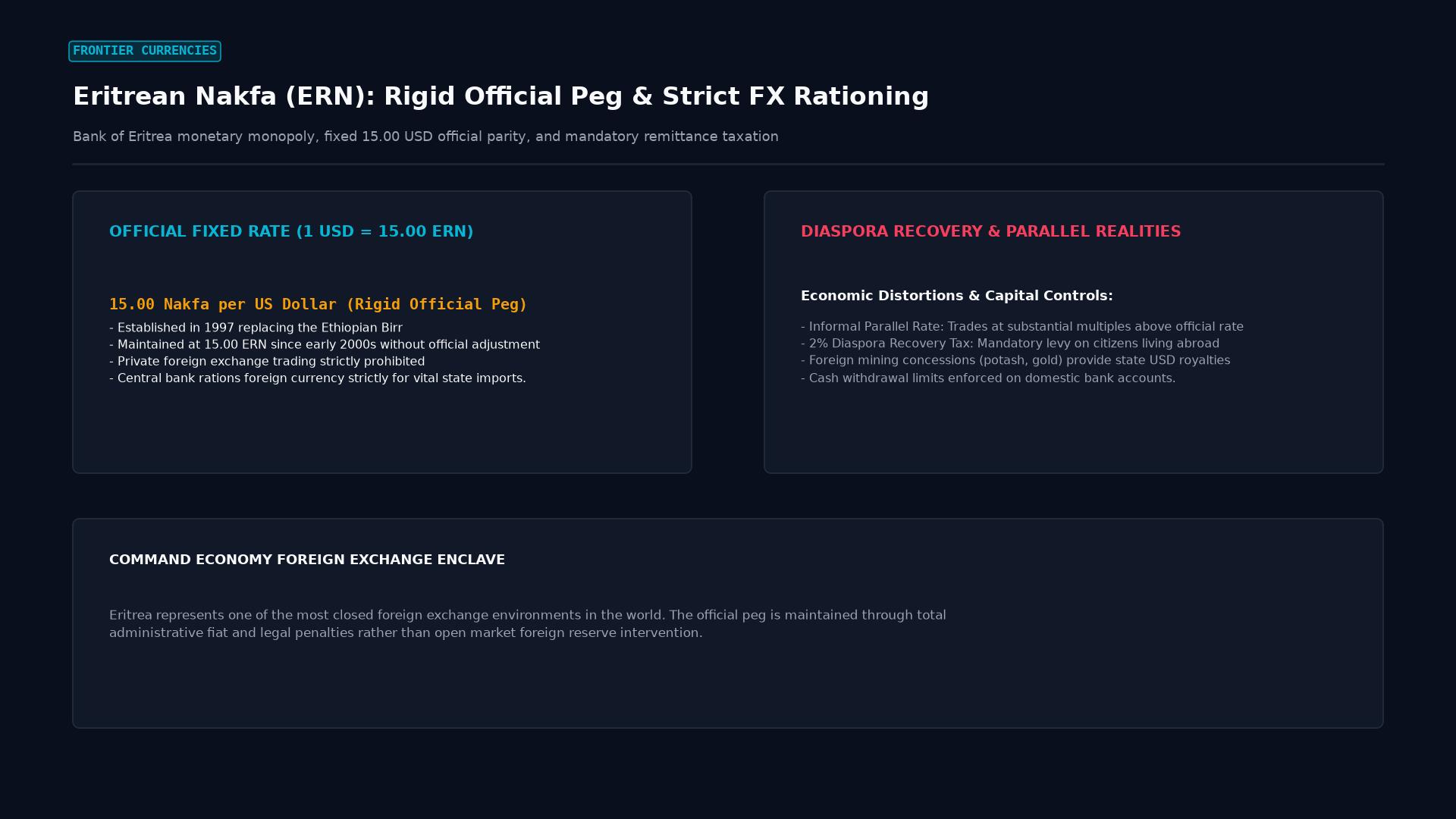 Figure: Command economy currency framework: rigid 15.00 ERN per USD official peg, mandatory diaspora recovery taxes, and administrative foreign exchange rationing.
Historical Inception and Regional Geopolitics
Eritrea achieved de facto independence from Ethiopia in 1991 following a thirty-year liberation struggle, formalized through an internationally monitored referendum in 1993. For the first four years of sovereignty, Eritrea opted not to create its own currency immediately. Instead, it continued to utilize the Ethiopian Birr (ETB), forming a de facto monetary union with Ethiopia.
On November 8, 1997, the Eritrean government introduced the Nakfa, naming the currency after the historic town of Nakfa, which had served as the fortified bastion and headquarters of the Eritrean People’s Liberation Front (EPLF) during the war. The currency was launched at par (1 ERN = 1 ETB).
However, the introduction of the Nakfa fractured economic relations with Addis Ababa:
- The Eritrean government sought to maintain seamless bilateral trade using domestic currencies alongside hard currency accounts.
- The Ethiopian government insisted that all cross-border trade transactions exceeding 2,000 Birr be conducted exclusively through documentary letters of credit settled in US dollars.
- Disagreements over currency redemption, trade settlement mechanisms, and disputed border boundaries escalated rapidly, culminating in the outbreak of the devastating 1998-2000 Eritrean-Ethiopian War.
The conflict severed all commercial relations between the two neighbors, ending the common economic zone and cementing Eritrea’s isolated monetary system.
The Monetary Architecture and the Fixed USD Peg
Initially permitted to fluctuate on a managed basis, the Nakfa traded near 7.50 to 9.50 ERN per USD during the late 1990s. In January 2005, facing mounting inflationary pressures, foreign exchange depletion, and trade deficits, the Bank of Eritrea imposed a rigid fixed exchange rate:
$$\text{Official Fixing} = 15.00 \text{ ERN per } 1 \text{ USD}$$
The currency is subdivided into 100 cents. Banknotes circulate in denominations of 1, 5, 10, 20, 50, and 100 nakfa, designed with imagery commemorating the country’s diverse ethnic nationalities and agricultural heritage.
Under Bank of Eritrea regulations, the official rate of 15.00 ERN per USD applies to all authorized state transactions, government budget allocations, and official import letters of credit. However, because foreign exchange reserves are constrained, the central bank strictly limits the ability of private commercial entities or individual citizens to purchase foreign currency at the official rate.
The 2015 Currency Demonetization Reform
In November 2015, the Eritrean government announced an extraordinary monetary reset: Legal Notice No. 124/2015 mandated that all existing Nakfa banknotes in circulation be declared void and surrendered to domestic banks in exchange for newly printed notes within a strict six-week window.
The demonetization had clear strategic objectives:
- Dismantling Informal Hoarding: Decades of foreign exchange shortages had encouraged merchants, contraband traders, and citizens to hoard vast amounts of physical paper cash outside the formal banking system. Unregistered cash held beyond strict household ceilings had to be deposited into bank accounts with verified identification.
- Combating Counterfeiting and Smuggling: Porous border regions witnessed the accumulation of counterfeit currency and unauthorized hard currency trading rings. The sudden note replacement rendered illegal cash hoards valueless overnight.
- Imposing Cash Withdrawal Restrictions: To prevent liquidity from immediately leaving the banking system, authorities imposed strict monthly ceilings on commercial bank cash withdrawals (initially capped at 5,000 Nakfa per month for individuals). Any retail transaction exceeding standard thresholds was legally required to settle via bank check or domestic electronic transfer.
While the reform succeeded in forcing billions of nakfa into the state-supervised banking network, it resulted in acute cash shortages for everyday consumer transactions.
Macroeconomic Inflows and Hard Currency Anchors
Because Eritrea maintains a command-oriented economy with limited private enterprise, the state’s external balance of payments relies on three primary economic conduits:
1. Mining Concessions and Mineral Exports
The primary generator of sovereign hard currency reserves is the mining sector. The Bisha open-pit mine, situated 150 kilometers west of Asmara and operated as a joint venture between China’s Zijin Mining Group and the state-owned Eritrean National Mining Corporation (ENAMCO), produces substantial commercial quantities of gold, copper concentrate, and zinc. Additional mineral deposits, including the Asmara Project and the Colluli potash basin in the Danakil Depression, represent long-term strategic foreign currency assets. Concession royalties, mineral export sales, and state corporate dividends flow directly into government treasury accounts in US dollars.
2. The 2% Diaspora Rehabilitation Tax
Eritrea maintains an extensive diaspora across Europe, North America, and the Middle East. Under the 1993 Proclamation on the Recovery and Rehabilitation Tax, the Eritrean government levies an official 2 percent tax on the net annual income of Eritrean citizens living abroad. Payment of this tax is required to access consular services, renew national passports, transfer inheritance, and purchase real estate within Eritrea. This tax provides a steady, non-debt stream of foreign exchange to the state.
3. Diaspora Family Remittances
Beyond official tax payments, hundreds of millions of dollars in private family assistance are sent by diaspora members to relatives in Eritrea. Due to the wide gap between the official 15.00 peg and purchasing power realities on the ground, significant portions of these flows have historically traversed informal settlement networks (hawala).
| Economic Channel | Hard Currency Flow | Central Bank & State Role |
|---|---|---|
| Bisha Mining Exports | USD (Gold, Zinc, Copper) | Managed by ENAMCO; primary source of sovereign FX reserves |
| 2% Diaspora Tax | USD, EUR, GBP, SEK | Collected via overseas diplomatic missions; deposited in state accounts |
| Family Remittances | Hard currencies | Transferred through official banks or informal overseas networks |
| State Food & Energy Imports | USD Outflow | Centralized state allocations for subsidized wheat, fuel, and diesel |
FX Restrictions and International Financial Engagement
For global financial institutions, currency traders, and multinational corporations, the Eritrean Nakfa represents one of the most closed currency regimes in the world:
- No International Trading: The Nakfa does not trade on international forex matching engines, multi-bank portals, or frontier market swap desks. There is no active deliverable forward or offshore Non-Deliverable Forward (NDF) market.
- Strict Anti-Money Laundering Frameworks: International wire transfers into and out of Eritrean banks undergo extensive compliance checks by foreign correspondent banks due to regional sanctions regimes and strict financial monitoring.
- Capital Repatriation Constraints: Foreign entities investing in joint ventures must negotiate contractual repatriation guarantees backed by the Ministry of Energy and Mines or the Bank of Eritrea before deploying hard capital into the country.
Frequently Asked Questions
Why does a divergence exist between the official and parallel market rates for the Nakfa?
The Bank of Eritrea maintains a rigid official peg of 15.00 ERN per USD, but access to foreign exchange at this rate is restricted to priority state imports. Private citizens and small enterprises requiring hard currency to travel, study abroad, or import consumer goods cannot purchase dollars from commercial banks, driving them to informal markets where the price of hard currency reflects its actual scarcity.
Can tourists use credit cards or ATMs in Asmara?
No. International credit and debit cards, including Visa, Mastercard, and American Express, are not processed by Eritrean automated teller machines (ATMs) or local point-of-sale terminals. Foreign visitors must carry physical cash (preferably US dollars or euros in clean, unblemished banknotes) and convert funds at authorized foreign exchange counters (Himbol) or licensed banks.
What was the economic impact of the 2018 Eritrea-Ethiopia peace accord on the Nakfa?
The historic July 2018 peace declaration between Eritrean President Isaias Afwerki and Ethiopian Prime Minister Abiy Ahmed temporarily reopened land border crossings at Zalambessa and Omhajer, triggering a surge in cross-border trade. However, because formal banking and currency exchange agreements were never finalized, large exchange rate disparities led to trade disruptions, and border checkpoints were subsequently closed pending formal regulatory harmonization.
Ready to trade forex?
Open a free demo account with a regulated broker. Practice with virtual funds before risking real money.