ETB
ETB is the ISO 4217 currency code for the Ethiopian Birr, the official legal tender of the Federal Democratic Republic of Ethiopia, issued by the National Bank of Ethiopia.
The Ethiopian Birr (ISO code: ETB, symbol: Br) is the official currency of the Federal Democratic Republic of Ethiopia, the second-most populous nation in Africa. Regulated by the National Bank of Ethiopia (NBE), the birr underwent a historic monetary transformation on July 29, 2024, when the government abandoned decades of a strictly controlled crawling peg and foreign exchange rationing. In coordination with a multi-billion-dollar International Monetary Fund (IMF) and World Bank macroeconomic reform package, Ethiopia transitioned to a market-based floating exchange rate regime, fundamentally altering the nation’s financial architecture.
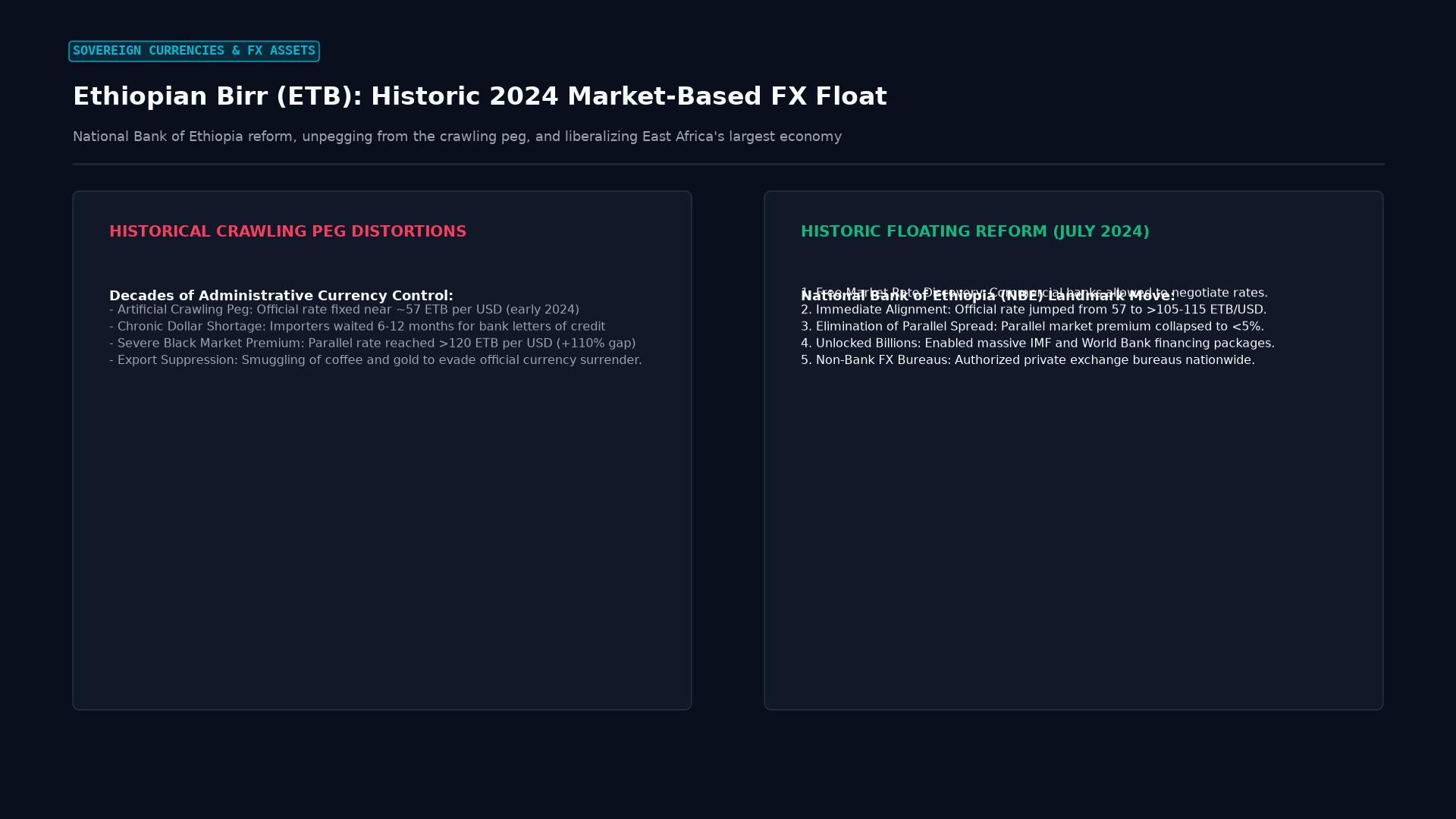 Figure: Landmark monetary reform: National Bank of Ethiopia unpegging the Birr in July 2024, eliminating the parallel market spread and liberalizing East Africa’s economy.
Historical Background of Ethiopian Currency
The Ethiopian Birr boasts a rich monetary lineage that long predates modern African colonial borders. During the eighteenth and nineteenth centuries, Ethiopia operated extensively on the Austrian Maria Theresa Thaler, a silver trade coin prized for its consistent silver purity.
In 1894, Emperor Menelik II introduced the first modern indigenous coins, minted with his effigy and inscribed in Amharic. The currency was called the birr, which translates to “silver” in Amharic, alongside Ge’ez terminology. In 1905, the establishment of the Bank of Abyssinia, managed under an agreement with the National Bank of Egypt, led to the issuance of the first paper banknotes.
Following the brief Italian occupation (1936-1941) and the temporary use of the East African Shilling, Ethiopia restored its monetary sovereignty in 1945 by establishing the Ethiopian Dollar, which was pegged to gold and the US dollar. In 1976, the socialist Derg regime renamed the currency the Ethiopian Birr, retaining the 1:1 parity with the former dollar and enforcing a rigid peg of 2.07 Birr per 1 USD that lasted until the collapse of the military regime in 1991.
In 1992, the transitional government executed a major devaluation, setting the exchange rate to 5.00 Birr per USD and initiating a tightly managed crawling peg system that persisted for more than three decades.
The Chronic Foreign Exchange Crisis and the Parallel Market
Between 2005 and 2023, Ethiopia pursued an ambitious, state-led infrastructure development model, financing massive capital projects such as the Grand Ethiopian Renaissance Dam (GERD), railway lines connecting Addis Ababa to Djibouti, and industrial manufacturing parks.
While this model delivered high rates of headline GDP growth, it generated severe structural imbalances:
- Severe Import Hunger: State megaprojects required massive imports of steel, turbines, cement, and electrical equipment, far exceeding the nation’s export earnings.
- Overvalued Official Currency: The National Bank of Ethiopia allowed the birr to depreciate only gradually (often 5 to 10 percent annually) against the US dollar, despite domestic consumer price inflation consistently exceeding 20 to 35 percent.
- Rationing and Queues: To protect dwindling gross foreign reserves, the NBE instituted stringent exchange controls. Importers were placed on priority queues at state-owned Commercial Bank of Ethiopia (CBE) and private commercial lenders. Companies frequently waited 12 to 24 months to secure letters of credit for basic raw materials.
- Explosive Parallel Market: By mid-2024, the official exchange rate hovered near 57.50 ETB per USD, while the informal street market in Addis Ababa exceeded 120 ETB per USD. Exporters hoarded earnings, diaspora workers avoided official banks, and contraband trading flourished.
In December 2023, squeezed by foreign exchange shortages and rising debt service costs, Ethiopia defaulted on a 33 million dollar coupon payment for its 1 billion dollar sovereign Eurobond, accelerating the imperative for radical monetary restructuring.
The Landmark Floating Reform of July 2024
On July 29, 2024, Prime Minister Abiy Ahmed and NBE Governor Mamo Mihretu enacted a comprehensive reform of the foreign exchange regime:
1. Market-Driven Exchange Rate Determination
The NBE revoked the crawling peg, authorizing licensed commercial banks to quote their own buying and selling foreign exchange rates based on customer demand and supply. In the opening sessions of the market-clearing float, the birr depreciated from approximately 57.50 to over 100 ETB per USD, instantly wiping out the 100 percent parallel market premium.
2. Elimination of Surrender Requirements
The NBE dismantled the punitive foreign exchange surrender requirements that had mandated exporters surrender 50 percent of their foreign currency earnings to the central bank and 20 percent to commercial banks at the official rate. Exporters were granted the right to retain 100 percent of foreign earnings in foreign currency accounts for their own operational imports or sell them to banks at market-clearing prices.
3. Introduction of Foreign Exchange Bureaus
The central bank legalized independent, private foreign exchange bureaus, allowing non-bank entities to buy and sell physical foreign currency banknotes and traveler’s checks at negotiated rates.
4. Transition to Interest Rate Monetary Policy
The NBE retired its legacy tool of imposing administrative credit ceilings on commercial bank balance sheets. In its place, the central bank introduced an explicit Monetary Policy Rate (MPR), establishing bi-weekly open market repo auctions and standing overnight lending facilities to manage banking liquidity through price mechanisms rather than physical rationing.
$$\text{Implied Real Rate} = \text{Nominal NBE Policy Rate} - \text{Expected Inflation Rate}$$
This structural overhaul unlocked an initial 3.4 billion dollar Extended Credit Facility from the IMF, alongside a 1.5 billion dollar development policy operation from the World Bank, providing immediate dollar liquidity to buffer public spending.
Key Macroeconomic Pillars Supporting the Birr
Ethiopia’s long-term external stability depends on five core hard-currency earners:
1. Coffee Exports
Ethiopia is the birthplace of Arabica coffee and Africa’s premier coffee producer. Specialty varieties such as Yirgacheffe, Sidama, and Harrar generate over 1.2 billion to 1.5 billion dollars in export revenues annually.
2. Ethiopian Airlines
State-owned Ethiopian Airlines is the largest and most profitable airline network in Africa. Flying to over 130 international passenger and cargo destinations from its hub at Bole International Airport in Addis Ababa, the carrier generates over 6 billion to 7 billion dollars in gross annual commercial revenue, providing a vital source of foreign currency to the sovereign ecosystem.
3. Expatriate Remittances
An estimated three million Ethiopians reside abroad, with major diaspora populations in Washington, D.C., Los Angeles, London, and Frankfurt. Under the floating regime, official banking channels can now capture billions of dollars in annual remittances that previously traveled through informal networks.
4. Gold and Mineral Extraction
The NBE operates an official gold-purchasing window, acquiring artisanal and commercial gold from regions such as Oromia, Benishangul-Gumuz, and Tigray. By paying small-scale miners market-clearing rates in birr, the central bank accumulates physical gold reserves to bolster national foreign exchange buffers.
5. Agriculture, Floriculture, and Textiles
Export of fresh-cut roses to European flower auctions (Aalsmeer), sesame seeds, oilseeds, and garments manufactured in Hawassa Industrial Park contribute hundreds of millions of dollars in annual inflows.
| Pillar | Inflow Magnitude (USD) | Strategic Role in External Balance |
|---|---|---|
| Ethiopian Airlines | $6B - $7B | Operational corporate revenue; world-class logistics self-sufficiency |
| Expatriate Remittances | $4B - $6B | Direct retail dollar supply, revitalized by currency unification |
| Coffee Exports | $1.2B - $1.5B | High-margin agricultural export; benefits directly from birr float |
| Physical Gold Procurement | $500M - $1B | Domestic gold mining reserves purchased directly by the NBE |
| Cut Flowers & Oilseeds | $800M+ | Perishable horticulture air-freighted daily to Europe and the Middle East |
Frequently Asked Questions
Why did Ethiopia float the Birr in July 2024?
Ethiopia floated the birr to eliminate severe foreign exchange shortages that had paralyzed commercial imports, fueled an aggressive black market, and caused the country to default on its sovereign Eurobond. Floating the currency unified the exchange rates, unlocked 10.7 billion dollars in IMF and World Bank support, and incentivized exporters and diaspora workers to route hard currency through official banks.
What are the main inflation risks of floating the Ethiopian Birr?
Because Ethiopia imports virtually all refined petroleum products, specialized machinery, fertilizer, and pharmaceuticals, a 75%+ nominal depreciation of the official exchange rate raises the domestic price of fuel and imported inputs. To mitigate this shock, the government instituted temporary petroleum subsidies and social safety net cash transfers for vulnerable urban households.
Can foreign investors repatriate profits from Ethiopia under the new regime?
Under the new foreign exchange regulations, the NBE removed restrictions on commercial banks allocating foreign exchange for dividend and capital repatriation by foreign direct investors. However, repatriation remains subject to interbank hard currency availability, requiring multinational corporations to coordinate liquidity schedules with local commercial banks.
Ready to trade forex?
Open a free demo account with a regulated broker. Practice with virtual funds before risking real money.