FJD
FJD is the ISO 4217 currency code for the Fiji Dollar, the official currency of the Republic of Fiji, pegged to a trade-weighted currency basket by the Reserve Bank of Fiji.
The Fiji Dollar (ISO code: FJD, symbol: FJ$) is the official legal tender of the Republic of Fiji, an archipelago of more than 330 islands in the South Pacific Ocean. Administered and regulated by the Reserve Bank of Fiji (RBF), the nation’s central bank in Suva, the currency operates under a pegged exchange rate regime anchored to a trade-weighted basket of major international currencies. As the dominant financial and transport hub of the South Pacific island economies, Fiji relies on the stability of the FJD to cushion domestic consumer prices against imported inflation while supporting vital tourism, bottled mineral water, gold, and agricultural export industries.
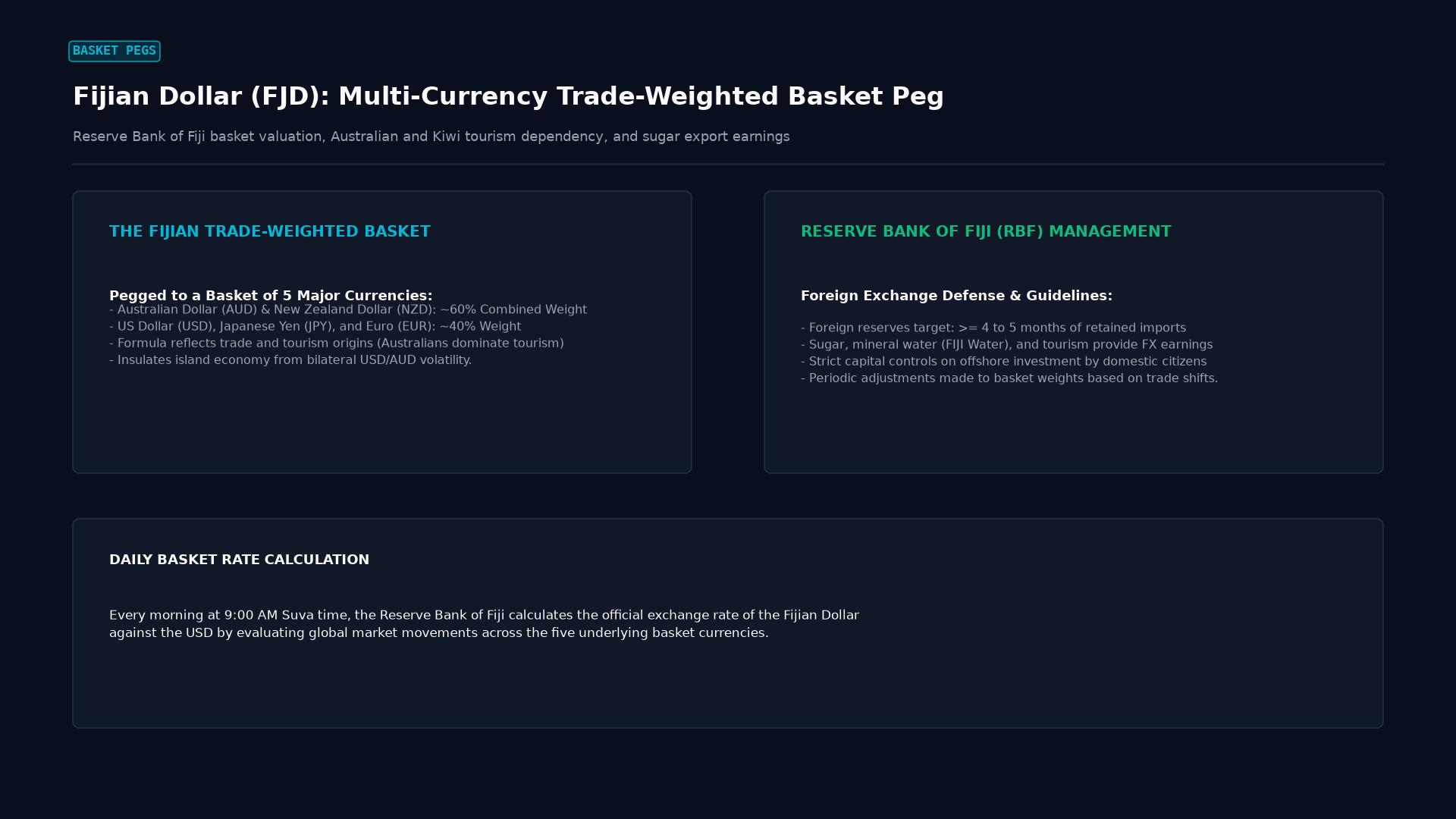 Figure: Pacific island basket peg: Reserve Bank of Fiji trade-weighted valuation basket (AUD, NZD, USD, JPY, EUR) backed by tourism and sugar export earnings.
Historical Lineage and Monetary Evolution
Prior to modern currency arrangements, trade across the Fijian islands operated on traditional commodity currencies, notably polished sperm whale teeth known as tabua, which continue to hold profound cultural and ceremonial importance in indigenous Fijian society.
During the British colonial era, the colonial administration established the Fijian Pound in 1874, maintaining parity with the British Pound Sterling. Following global trends toward decimalization, Fiji decimalized its currency on January 15, 1969, replacing the pound with the modern Fiji Dollar at a conversion rate of 1 pound to 2 dollars (setting 1 dollar equal to 10 shillings).
Following national independence in 1970, the newly established Central Monetary Authority of Fiji (which was transformed into the Reserve Bank of Fiji in 1984 under the Reserve Bank of Fiji Act) assumed monetary oversight. Initially pegged to the US dollar, Fiji transitioned in April 1975 to a trade-weighted currency basket framework. This structural shift was designed to prevent bilateral currency swings from destabilizing the domestic economy, as Fiji imported the majority of its manufactured goods and food from Australia and New Zealand while invoicing its sugar and mineral exports in US dollars.
The currency is subdivided into 100 cents. Banknotes circulate in denominations of 5, 10, 20, 50, and 100 dollars. Following a sovereign redesign in 2012, portraiture of the British monarch was replaced across all circulating banknotes and coins with indigenous flora, fauna, and cultural icons, including the crested iguana, the kula bird, and the tagimoucia flower.
The Trade-Weighted Currency Basket Mechanism
The valuation of the Fiji Dollar is not determined by free-floating open market matching. Instead, the Reserve Bank of Fiji sets the daily official exchange rate using a confidential trade-weighted basket of five primary currencies:
- Australian Dollar (AUD): Holds the largest weight due to Australia being Fiji’s primary source of inbound tourists and manufactured consumer imports.
- United States Dollar (USD): Represents the dominant currency for petroleum billing, external sovereign debt service, and mineral water exports.
- New Zealand Dollar (NZD): Reflects extensive bilateral food trade, business investment, and regional tourism.
- Japanese Yen (JPY): Accounts for vehicle imports and bilateral developmental financing.
- Euro (EUR): Accommodates European tourist expenditures and multilateral trade arrangements.
$$\text{FJD Basket Value} = \sum_{i=1}^{5} w_i \times \left(\frac{e_i}{e_{i,0}}\right)$$
The RBF updates the specific weights ($w_i$) periodically based on multi-year rolling reviews of direction-of-trade statistics and international payments data. Every morning in Suva, the central bank calculates and publishes official exchange rate fixings against these currencies, within which licensed commercial banks are permitted to quote retail and commercial customer spreads.
The primary objective of the basket peg is nominal exchange rate stability. By averaging out fluctuations between the US dollar and Australasian currencies, the basket minimizes domestic price shocks from international currency volatility.
Strategic Economic Drivers and External Inflows
Fiji represents the second-largest economy in the Pacific Islands region after Papua New Guinea. The balance of payments and foreign exchange reserve adequacy of the RBF rely on four structural pillars:
1. International Tourism
Tourism is the undisputed engine of the Fijian economy, directly and indirectly contributing nearly 40 percent of national GDP and providing employment to over one-third of the workforce. Luxury resort hubs on Viti Levu, Denarau Island, and the Mamanuca and Yasawa groups attract over 900,000 international visitors annually, predominantly from Australia and New Zealand. Foreign visitors convert AUD and NZD into FJD, providing commercial banks with steady supplies of hard currency.
2. Premium Bottled Water Exports
Natural artesian water bottled by the Wonderful Company under the FIJI Water brand in the Yaqara Valley of Viti Levu is one of the nation’s premier industrial merchandise exports. Shipped globally and invoiced in US dollars, bottled water exports generate hundreds of millions of dollars in corporate revenues, local tax receipts, and foreign exchange reserves.
3. Diaspora Family Remittances
Hundreds of thousands of Fijians reside overseas, including skilled professionals in Australia and New Zealand, British Army service members in the United Kingdom, and security contractors in the Middle East. Private remittances exceed 1 billion FJD annually, representing approximately 8 to 10 percent of GDP and providing critical income support to rural island households.
4. Sugar and Agriculture
Historically the cornerstone of colonial Fiji, the sugar industry, managed by the state-controlled Fiji Sugar Corporation (FSC), remains a major employer across western Viti Levu and Vanua Levu. Raw sugar is exported under preferential access quotas to international refiners. Additional exports include ginger, taro, and kava (yaqona).
| Economic Pillar | Primary Inflow Currency | Structural Contribution to Reserves |
|---|---|---|
| Resort Tourism | AUD / NZD / USD | Over $1.5B annual receipts; primary driver of commercial banking FX |
| FIJI Water Bottling | USD | Major industrial export; provides consistent US dollar receivables |
| Expatriate Remittances | AUD / NZD / GBP / USD | Private household consumption support; countercyclical safety buffer |
| Vatukoula Gold Mining | USD | High-value commodity export; cushions against tourism downturns |
Exchange Control Regulations and Banking Structure
To safeguard its foreign exchange reserves, the Reserve Bank of Fiji maintains a comprehensive foreign exchange control framework under the Exchange Control Act. While current account transactions (paying for verified commercial imports, medical treatment abroad, and educational expenses) are fully permitted, transactions are subject to delegated administrative limits:
- Commercial banks (including Australian majors ANZ, Westpac, and Bank of South Pacific) hold delegated authority from the RBF to approve routine trade payments and travel allowances up to defined thresholds.
- Transactions exceeding delegated ceilings, such as major capital account investments overseas, offshore real estate acquisitions, or large corporate dividend repatriations by foreign multinationals, require explicit advance approval from the Reserve Bank of Fiji.
During periods of external strain, such as after severe category 5 tropical cyclones (e.g., Cyclone Winston in 2016) or the global travel halt during the 2020 pandemic, the RBF adjusts its delegated exchange control limits and credit facilities to preserve international reserve cover above its statutory minimum of three months of imports.
Frequently Asked Questions
Can travelers use Australian or US Dollars directly in Fiji?
While duty-free shops at Nadi International Airport and select luxury private island resorts quote prices or accept payment in Australian or US dollars, the Fiji Dollar (FJD) is the only legal tender for everyday commercial transactions. Local taxis, restaurants, markets, and public transport require payment in FJD. Credit cards are widely accepted at resorts, though often subject to a 2.5% to 3% bank surcharge.
Has Fiji ever devalued the Fiji Dollar?
Yes. Fiji has devalued its currency on several occasions to restore international competitiveness and protect foreign reserves following domestic political crises. Notably, the RBF implemented a 20 percent devaluation in 1998 during the Asian Financial Crisis, and another 20 percent devaluation in April 2009 following political tensions that had compressed tourism bookings and depleted external reserves.
How do tropical cyclones impact the value of the Fiji Dollar?
Fiji is located in the South Pacific tropical cyclone belt. Severe cyclones can destroy agricultural crops (sugar cane, taro), disrupt transport infrastructure, and temporarily damage tourist resort facilities. Because the FJD is pegged to a basket rather than freely floating, cyclone damage does not cause an immediate market drop in the exchange rate. Instead, it temporarily depletes the central bank’s foreign exchange reserves as import spending on reconstruction materials spikes, requiring the RBF to tighten exchange controls or seek multilateral relief funding.
Ready to trade forex?
Open a free demo account with a regulated broker. Practice with virtual funds before risking real money.