Currency Basket
A currency basket is a weighted portfolio of selected foreign currencies used by central banks, international institutions, and investors to establish benchmark exchange rates, peg currencies, or diversify reserve risk.
What Is a Currency Basket?
A currency basket is a specifically composed, mathematically weighted portfolio of selected national currencies used as a composite benchmark in international finance and central banking. Instead of tying a nation’s currency, sovereign debt, or corporate assets to a single foreign currency (such as the U.S. Dollar), establishing a currency basket diversifies monetary exposure across a nation’s primary global trading partners.
Currency baskets perform three primary functions in global markets:
- Exchange Rate Policy & Pegging: Central banks (such as Singapore, China, or Kuwait) fix or manage their domestic exchange rates within a band relative to a trade-weighted basket, preventing violent bilateral swings against individual currencies.
- International Reserve Assets: Multilateral financial organizations utilize currency baskets to create neutral supranational accounting units, most notably the International Monetary Fund’s Special Drawing Rights (SDR).
- Index Benchmarking: Financial exchanges calculate composite currency strength indices, such as the U.S. Dollar Index (DXY) or the CFETS RMB Index, to evaluate a currency’s purchasing power against a diversified peer group.
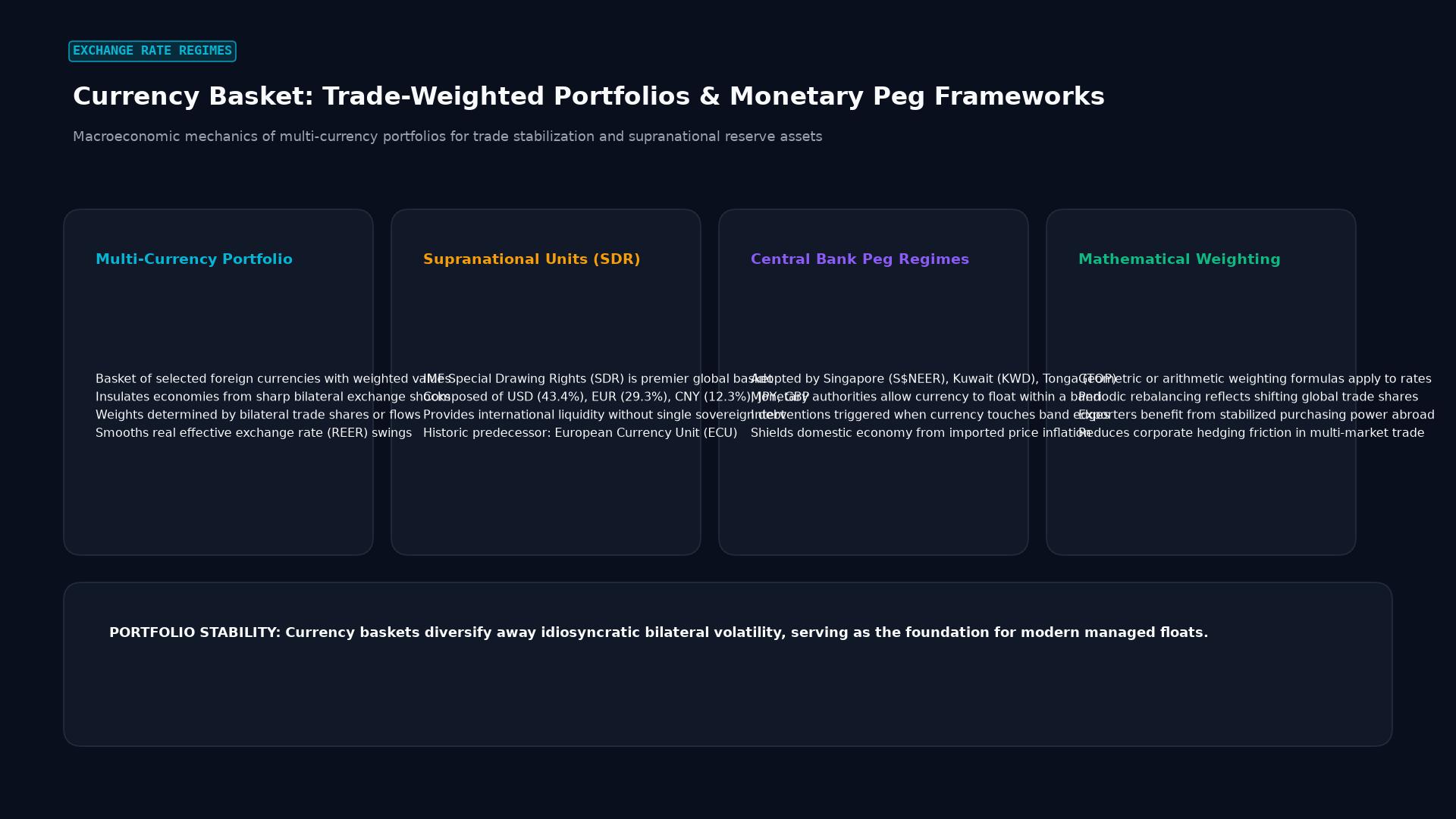 Figure: Macroeconomic mechanics of multi-currency portfolios for trade stabilization and supranational reserve assets
Key Takeaways
- Bilateral Volatility Dampening: Pegging to a multi-currency basket prevents domestic exporters from suffering sudden competitiveness shocks caused by policy moves in a single foreign capital.
- Trade-Weighted Proportions: Sovereign basket weights are generally calculated in direct proportion to a nation’s bilateral trade volumes, import-export dependencies, and foreign-denominated debt structure.
- The IMF Special Drawing Right (SDR): The world’s most prominent official currency basket, composed of the US Dollar, Euro, Chinese Renminbi, Japanese Yen, and British Pound.
- Geometric vs. Arithmetic Averaging: Baskets are computed mathematically through either trade-weighted arithmetic sums or geometric weighted indexes to maintain mathematical transitivity over time.
Famous Benchmark Currency Baskets in Global Finance
Several composite currency baskets serve as the foundation of international trade, central bank reserves, and speculative trading:
| Currency Basket | Operating Institution | Constituent Currencies & Approximate Weights | Core Strategic Purpose |
|---|---|---|---|
| IMF SDR (Special Drawing Rights) | International Monetary Fund (IMF) | USD (43.38%), EUR (29.31%), CNY (12.28%), JPY (7.59%), GBP (7.44%) | Supranational reserve asset and unit of account for international bailouts |
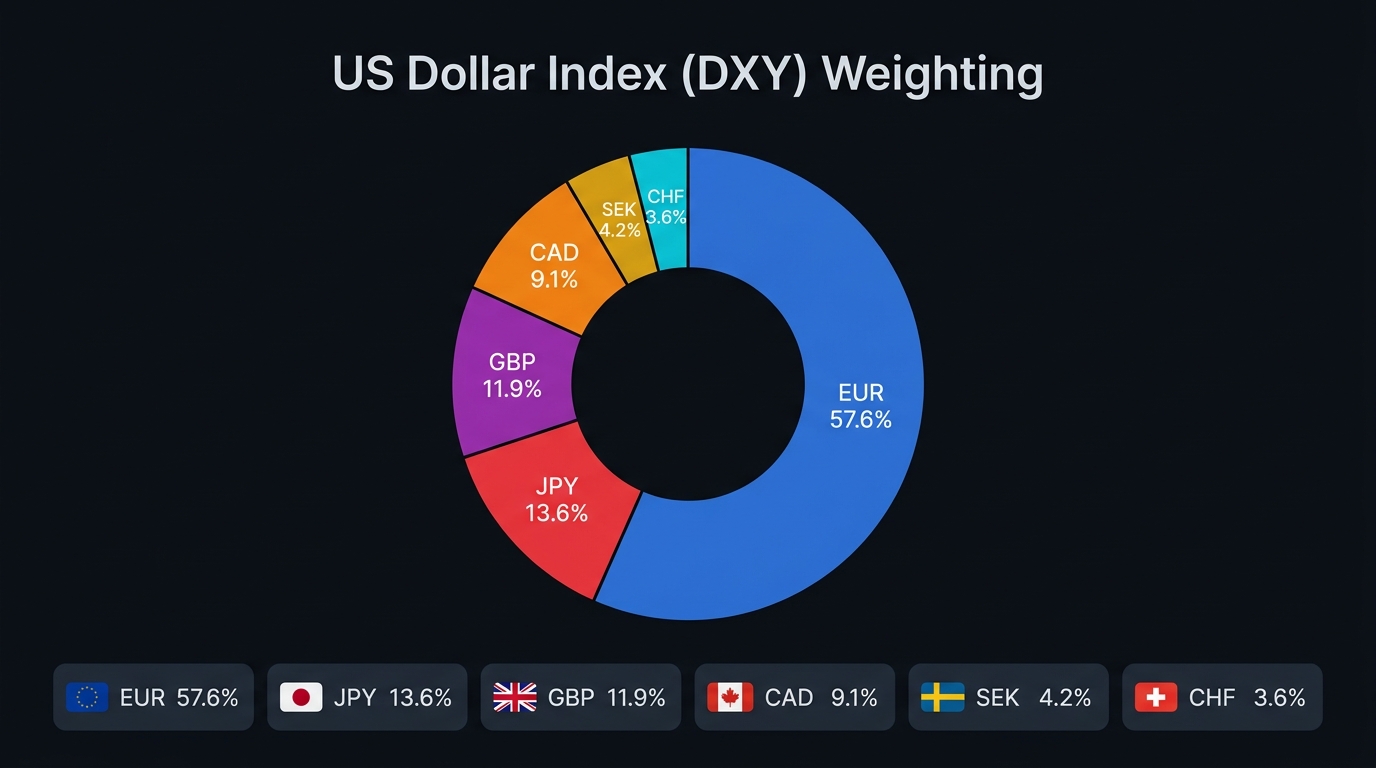
| U.S. Dollar Index (DXY) | Intercontinental Exchange (ICE) | EUR (57.6%), JPY (13.6%), GBP (11.9%), CAD (9.1%), SEK (4.2%), CHF (3.6%) | The global standard benchmark for measuring broad U.S. Dollar strength |
| CFETS RMB Index | People’s Bank of China (PBOC) | Basket of 24 currencies (USD ~19.8%, EUR ~18.2%, JPY ~9.2%, etc.) | Guides managed floating exchange rate regime for the Chinese Yuan |
| European Currency Unit (ECU) | European Economic Community (Historical) | Precursor to the Euro; weighted basket of 12 national European currencies | Formed the accounting foundation for the Maastricht Treaty and the Euro |
Mathematical Formulation: Computing Basket Valuation
To construct a currency basket index, financial institutions apply either an arithmetic weighted sum or a geometric weighted index:
1. The Geometric Trade-Weighted Index Formula
Used by the U.S. Dollar Index (DXY) and central bank effective exchange rate indices:
$$\text{Index Value} = k \times \prod_{i=1}^{n} S_i^{w_i}$$
Where:
- $k$ = Arbitrary scaling constant (e.g., $50.14348112$ for DXY)
- $S_i$ = Spot exchange rate of constituent currency $i$ against the domestic currency
- $w_i$ = Percentage weight assigned to currency $i$, such that $\sum w_i = 1.0$
2. The Arithmetic Currency Basket Unit
Used by the IMF SDR, where the basket represents an actual composite monetary value composed of fixed physical currency units ($q_i$):
$$\text{SDR Value (in USD)} = \sum_{i=1}^{n} \left( q_i \times \text{Spot Rate}_{i/\text{USD}} \right)$$
Every five years, the IMF Executive Board reviews global trade and reserve shares to adjust the exact physical quantities ($q_i$) in the basket.
Real-World Case Study: The Monetary Authority of Singapore (MAS) Basket Policy
Singapore operates one of the most successful and sophisticated currency basket frameworks in modern monetary history:
The Problem:
Singapore is an ultra-open city-state economy where gross import-export trade volume exceeds 300% of GDP. Traditional domestic interest rate targeting is ineffective because international capital flows effortlessly across its borders.
The Solution: The S$NEER Basket Framework:
- The Basket Target: The Monetary Authority of Singapore does not set benchmark policy interest rates. Instead, it manages the Singapore Dollar Nominal Effective Exchange Rate (S$NEER)—a confidential trade-weighted basket of its major trading partners’ currencies.
- The Band: The MAS permits the S$NEER basket to fluctuate inside a non-disclosed policy band.
- Monetary Levers:
- To fight domestic inflation: The MAS increases the slope of the band (allowing the Singapore Dollar to appreciate steadily against the basket, making imports cheaper).
- To stimulate the economy: It flattens the slope or centers the band lower.
- Result: By managing against a diversified basket rather than just the U.S. Dollar, Singapore has maintained one of the lowest inflation rates and strongest sovereign credit ratings (AAA) in Asia for over four decades.
Why Investors and Treasuries Utilize Currency Baskets
- Hedging Multinational Operations: A multinational corporation earning revenues in Japan, Germany, and the UK does not need to hedge each currency separately. Treasurers can construct a custom basket proxy, reducing hedging transaction fees by up to 40%.
- De-Dollarization Diversification: Sovereign wealth funds and central banks in emerging markets diversify their official foreign reserves away from 100% U.S. Treasury holdings into diversified multi-currency sovereign baskets to neutralize geopolitical sanctions and weaponized dollar risks.
Frequently Asked Questions
Why does the U.S. Dollar Index (DXY) have such a large Euro weighting?
The DXY was created in 1973 following the collapse of the Bretton Woods system. When the Euro was introduced in 1999, the legacy European currencies (Deutsche Mark, French Franc, Italian Lira, Dutch Guilder, and Belgian Franc) were consolidated into a single Euro component, resulting in its massive 57.6% weight. Because of this, the DXY functions largely as the mathematical inverse of EUR/USD.
What is the difference between a nominal basket and a real effective exchange rate (REER)?
A nominal basket measures purely the weighted spot currency exchange rates. A Real Effective Exchange Rate (REER) basket adjusts those nominal exchange rates for relative inflation differentials between the home country and each constituent trading partner, providing a true measure of underlying national economic competitiveness.
Does Kuwait peg its dinar to a currency basket?
Yes. On May 20, 2007, the Central Bank of Kuwait abandoned its rigid peg to the U.S. Dollar and reinstated an undisclosed, trade-weighted currency basket. This decision protected the Kuwaiti Dinar (KWD)—the world’s highest-valued currency unit—from imported inflation caused by U.S. Federal Reserve monetary easing.
Ready to trade forex?
Open a free demo account with a regulated broker. Practice with virtual funds before risking real money.