FKP
FKP is the ISO 4217 currency code for the Falkland Islands Pound, the official currency of the Falkland Islands, pegged at a strict 1:1 parity with the British Pound Sterling.
The Falkland Islands Pound (ISO code: FKP, symbol: £) is the official legal tender of the Falkland Islands, an internally self-governing British Overseas Territory located in the South Atlantic Ocean approximately 300 miles east of the Patagonian coast. Administered by the Commissioners of Currency under the statutory framework of the Falkland Islands Government (FIG), the currency operates under a strict currency board arrangement pegged at an exact, unalterable parity of 1:1 with the British Pound Sterling (GBP). Backed by full sterling reserve assets, the FKP provides monetary stability for an economy driven by commercial squid fishing licenses, agricultural wool exports, Antarctic expedition tourism, and offshore hydrocarbon exploration.
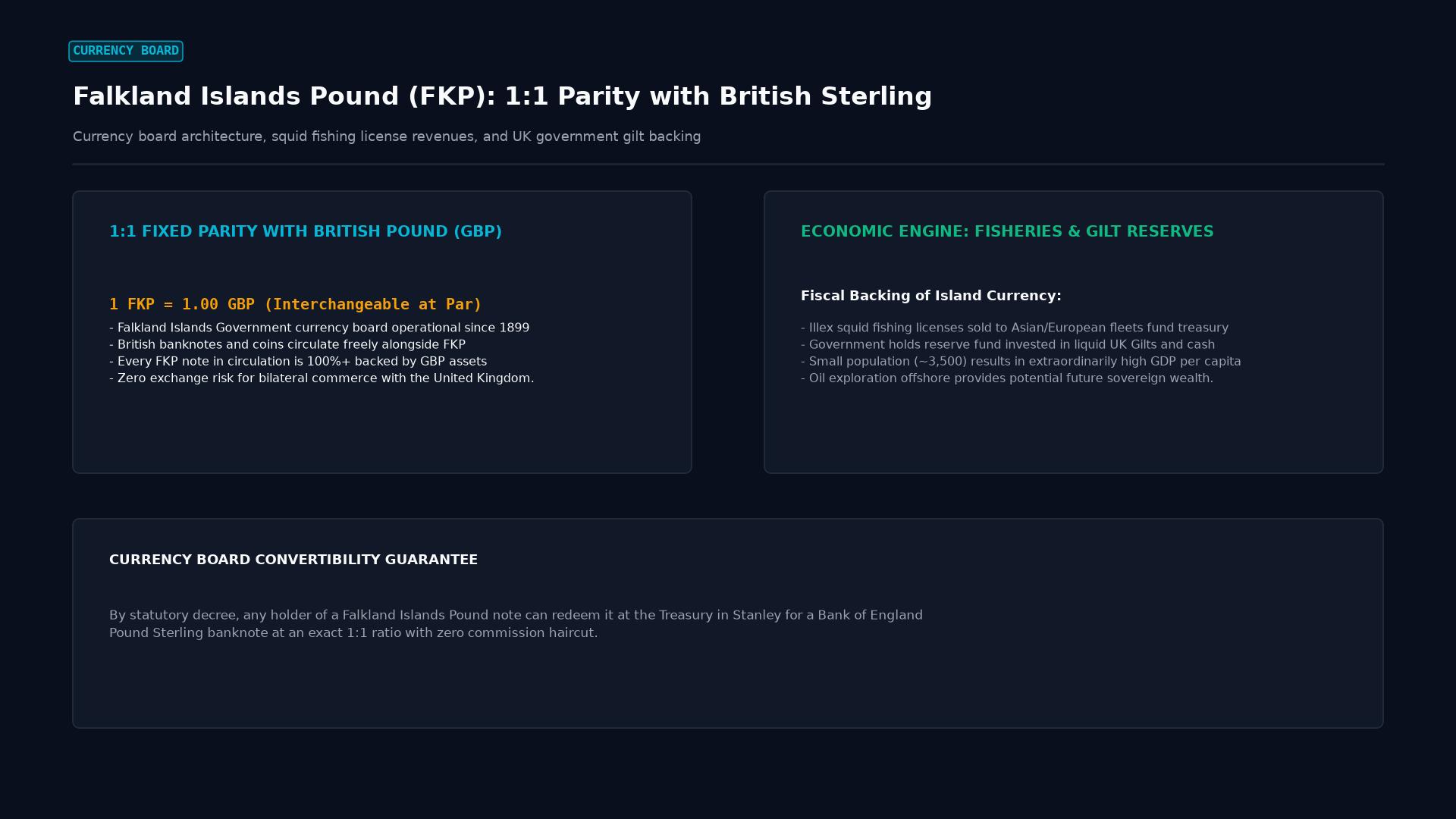 Figure: South Atlantic currency board: 1:1 parity with the British Pound backed by UK Gilt reserves and sovereign revenue from commercial Illex squid fishing licenses.
Historical Lineage and the 1899 Currency Notes Order
Prior to the formal issuance of sovereign paper currency, the Falkland Islands relied on British imperial coins, Spanish silver dollars from South American trade, and handwritten promissory scrip issued by the Falkland Islands Company (FIC), a royal chartered corporation established in 1851 that dominated retail commerce, shipping, and sheep ranching.
The formal monetary history of the territory began with the Imperial Currency Notes Order of 1899, which authorized the Governor and colonial authorities to issue official government notes backed by invested imperial funds. The first government-backed banknotes were printed in 1899 in denominations of 5 shillings, 10 shillings, £1, and £5.
Following the decimalization of the British Pound in February 1971, the Falkland Islands converted to decimal currency alongside London, dividing the pound into 100 new pence. The regulatory framework was modernized under the Currency Ordinance 1987, which codified the duties of the Commissioners of Currency and mandated that all local currency liabilities remain backed by British pound sterling assets.
The currency is subdivided into 100 pence. Banknotes currently circulate in denominations of £5, £10, £20, and £50. Coins circulate in denominations of 1p, 2p, 5p, 10p, 20p, 50p, £1, and £2, sharing identical dimensions, weight, and metallic composition with their British Royal Mint counterparts, but featuring reverse designs showcasing South Atlantic wildlife, including King penguins, Falkland steamer ducks, Commerson’s dolphins, and upland geese.
The Currency Board Mechanism and 1:1 Sterling Parity
The stability of the Falkland Islands Pound is guaranteed by the Currency Ordinance 1987, which operates on classic currency board rules:
- Statutory 1:1 Peg: By law, one Falkland Islands Pound is equal to one British Pound Sterling. The Commissioners of Currency are obligated to convert sterling into local notes and vice versa at par without charging commission.
- The Currency Note Fund: The government maintains a dedicated statutory reserve fund, known as the Currency Fund. By law, this fund must hold liquid assets, consisting of physical sterling bank deposits and UK sovereign debt securities (UK government gilts), with a market value equal to at least 100 percent of all FKP banknotes and coins in issue.
- No Discretionary Monetary Policy: The Commissioners of Currency do not function as an independent central bank. They cannot alter interest rates, adjust bank reserve requirements, or print money to finance public infrastructure projects. Local interest rates charged by the sole commercial bank in Stanley (Standard Chartered Bank) are tied directly to the Bank of England’s Official Bank Rate.
$$\text{Reserve Coverage Ratio} = \frac{\text{Currency Fund Sterling Assets (GBP)}}{\text{Total FKP Banknotes and Coins in Circulation}} \ge 1.00$$
Any investment income or coupon interest earned on the UK gilts held in the Currency Fund, after deducting printing and administrative costs, is transferred directly into the general revenues of the Falkland Islands Government.
Economic Pillars of the Falkland Islands Economy
Despite a small permanent population of approximately 3,600 residents, the Falkland Islands boasts one of the highest gross domestic product (GDP) per capita figures in the world, regularly exceeding 70,000 to 90,000 US dollars. The economy is characterized by high fiscal self-sufficiency, zero public debt, and substantial external financial reserves.
            FALKLAND ISLANDS GOVERNMENT (FIG) REVENUE MODEL
            ==============================================

   +-------------------------------------------------------------+
   |            MARITIME EXCLUSIVE ECONOMIC ZONE (EEZ)           |
   |              (Over 200 Nautical Miles of Ocean)             |
   +-------------------------------------------------------------+
                                 |
        +------------------------+------------------------+
        |                                                 |
        v                                                 v
+-------------------------------+             +-------------------------------+
|    COMMERCIAL SQUID LICENSES  |             |      OFFSHORE HYDROCARBONS    |
| * Loligo Squid (Falkland Cal.)|             | * Sea Lion Field Development  |
| * Illex Squid (Jigger Fleets) |             | * Environmental & Extraction  |
| * Generates 50-60% of State   |             |   Licensing Rights            |
|   Operational Budget Revenues |             | * Long-Term Sovereign Royalty |
+-------------------------------+             +-------------------------------+
The health of the local monetary system rests on four primary economic sectors:
1. Commercial Fisheries and Squid Licensing
The establishment of the Falklands Interim Conservation and Management Zone (FICZ) in 1986 transformed the islands from a sleepy agricultural outpost into a major maritime economy. The government sells seasonal fishing licenses to international fleets, primarily from Spain, Taiwan, and South Korea. The fishery targets two main species:
- Loligo Squid (Doryteuthis gahi): Harvested in two seasonal windows, Loligo squid is exported directly to Vigo, Spain, supplying a substantial portion of the European calamari market.
- Illex Squid (Illex argentinus): Highly migratory squid caught by specialized jigger vessels, subject to oceanographic temperature variations.
License fees, transshipment harbor dues, and joint-venture corporate taxes consistently generate between 50 percent and 60 percent of total annual government revenues.
2. Fine Wool Agriculture
Before the 1986 fisheries boom, sheep farming was the islands’ sole industry. Extensive rangeland grazing covers over 90 percent of the land area. More than 450,000 sheep, primarily Polwarth and Merino crosses, produce high-quality fine apparel wool (typically 18 to 22 microns). Raw greasy wool is baled and exported to the United Kingdom and global textile processing centers.
3. Antarctic Expedition and Nature Tourism
Stanley serves as a major gateway and port of call for international expedition cruise ships navigating between South America, South Georgia, and the Antarctic Peninsula. During the austral summer (November to March), tens of thousands of cruise passengers arrive to visit remote penguin colonies at Volunteer Point and tour historic battlefields from the 1982 conflict, injecting hard currency directly into local tour operators, hospitality businesses, and retail craft shops.
4. Offshore Hydrocarbon Exploration
Substantial oil discoveries in the North Falkland Basin, notably the Sea Lion oil discovery, offer significant long-term economic potential. Environmental impact assessments, development licensing, and logistics support provide steady commercial income, with future extraction royalties poised to create a sovereign wealth fund.
| Economic Sector | Primary Counterparties | Currency Mechanism |
|---|---|---|
| Squid Fishery Licenses | Spain, South Korea, Taiwan | Invoiced in GBP; licenses paid into FIG Treasury accounts |
| Apparel Wool Exports | United Kingdom, New Zealand | Priced against global Bradford/Australian wool auction benchmarks |
| Expedition Tourism | Global cruise lines (US, UK, EU) | Inbound retail expenditures settled in FKP, GBP, USD, or EUR |
| Hydrocarbon Logistics | International oil exploration cos | Direct corporate capital expenditure routed via Stanley |
Practical Realities of Currency Circulation and Banking
The Falkland Islands operates a unique dual-circulation cash system:
- Dual Legal Tender in Practice: British pound sterling (Bank of England, Scottish, and Northern Irish banknotes) and standard Royal Mint UK coins circulate freely alongside local FKP issues throughout the islands and are accepted at face value by all merchants.
- Non-Fungibility in the UK: Although FKP is backed 1:1 by sterling reserves, Falkland Islands banknotes and coins are not legal tender within the United Kingdom. While major commercial banks in London may accept them on a collection basis with a fee, they are generally refused by high-street merchants in Britain. Travelers can convert FKP into standard Bank of England banknotes before departure at the commercial bank in Stanley or at the Falkland Islands Government Office in London.
- Single Commercial Bank: Standard Chartered Bank operates the territory’s sole retail and commercial banking branch in Stanley. The bank handles corporate letters of credit, mortgage lending, international SWIFT wire transfers, and currency exchange.
For global forex traders, FKP does not trade as an independent floating instrument. Spot exchange rates for FKP/USD or FKP/EUR are identical to the market-clearing rates of GBP/USD and EUR/GBP.
Frequently Asked Questions
Can British citizens use Bank of England notes in the Falkland Islands?
Yes. Bank of England banknotes and standard UK coins are universally accepted at 1:1 face value across the Falkland Islands, alongside local Falkland Islands Pound notes and coins.
Why does the Falkland Islands issue its own currency instead of using standard British Pounds?
Issuing local currency reinforces the constitutional identity and internal self-governance of the Falkland Islands. Economically, operating a currency board allows the Falkland Islands Government to earn seigniorage: the interest income generated on the UK government bonds held in the Currency Fund to back the notes flows directly into the territory’s public revenues.
What is the relationship between the Falkland Islands Pound and the Argentine Peso?
There is no direct commercial or financial link between the Falkland Islands Pound and the Argentine Peso (ARS). Due to historical sovereignty disputes, commercial banking and trade links between the Falklands and mainland Argentina remain heavily restricted. All international trade and capital transactions in the territory settle in British Pound Sterling or major convertible currencies (USD, EUR).
Ready to trade forex?
Open a free demo account with a regulated broker. Practice with virtual funds before risking real money.