Fixed Exchange Rate
A fixed exchange rate, or currency peg, is a monetary regime where a national government or central bank binds its currency's exchange value to a foreign anchor currency, a basket of currencies, or a physical commodity such as gold.
What Is a Fixed Exchange Rate?
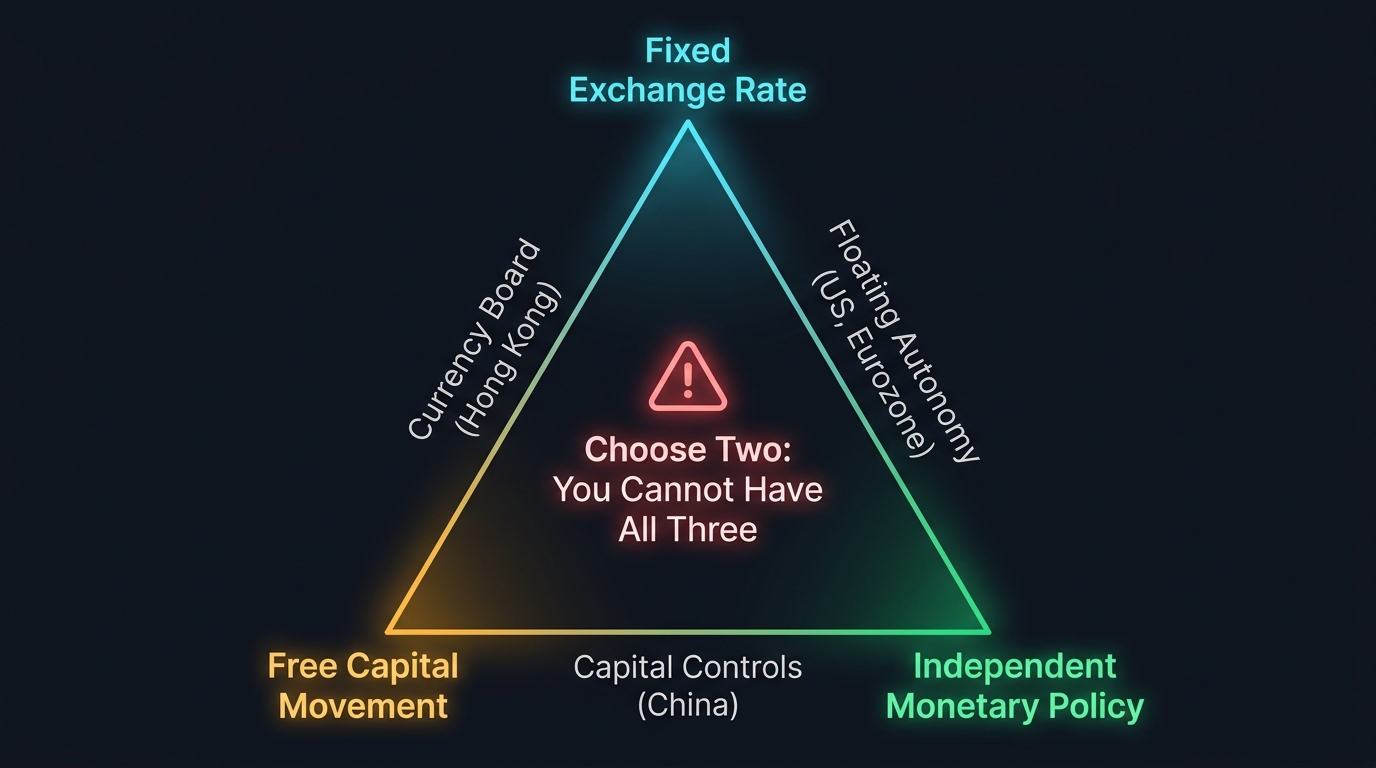
A fixed exchange rate—commonly referred to as a currency peg—is a formal monetary policy framework in which a country’s government or central bank sets a specific target price for its national currency relative to a foreign currency, a weighted basket of partner currencies, or a tangible asset like gold. The central bank commits to buying and selling its currency at this predetermined parity, strictly limiting or eliminating market price fluctuations.
Governments adopt fixed exchange rate regimes primarily to establish price stability, encourage foreign direct investment, and eradicate currency risk for international commerce. For developing economies or export-oriented nations, pegging to a major global reserve currency (most frequently the US Dollar or the Euro) provides instant monetary credibility, helping suppress chronic domestic inflation.
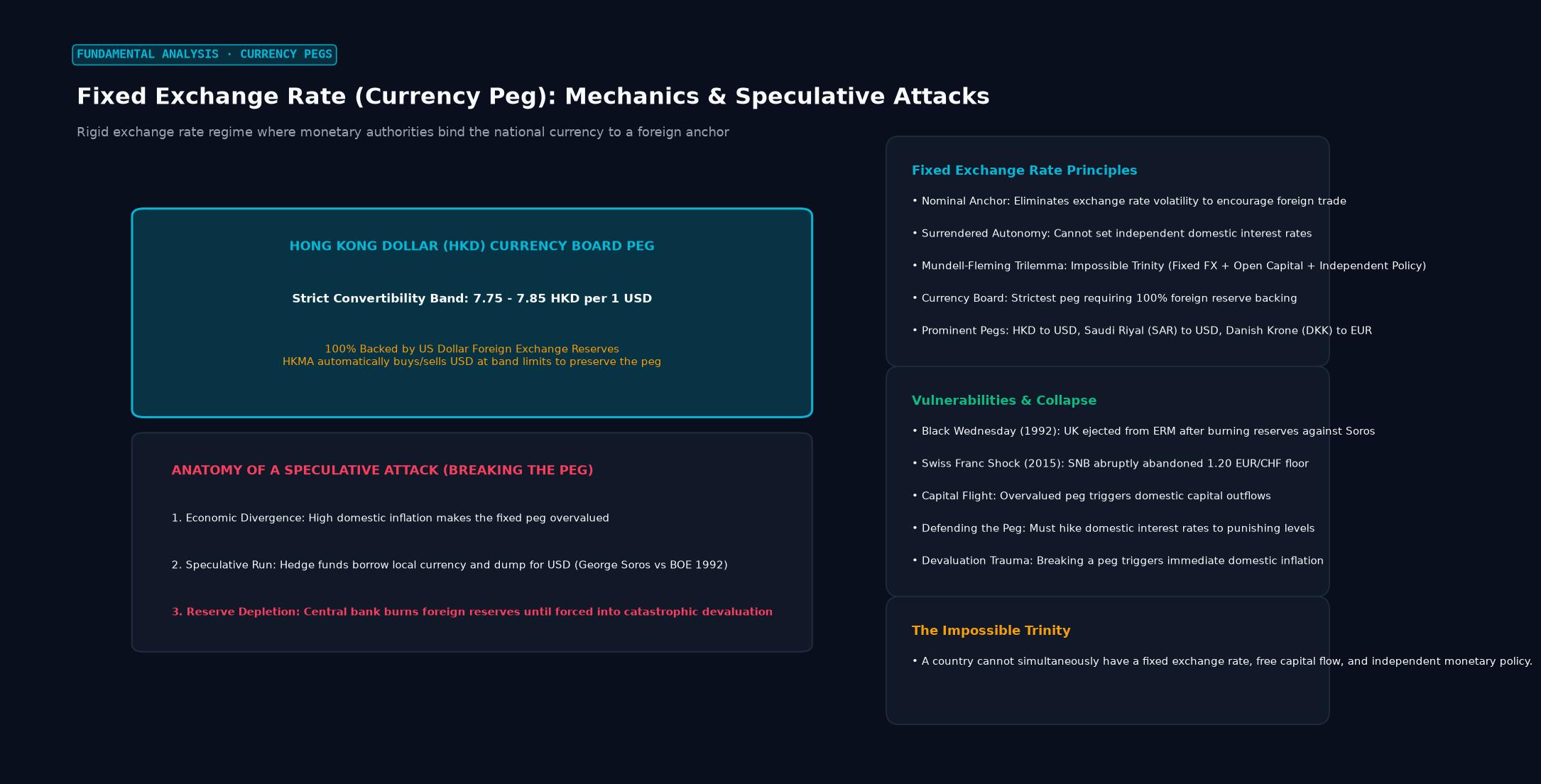 Figure: Rigid exchange rate regime where monetary authorities bind the national currency to a foreign anchor
Operational Mechanics: How Central Banks Defend a Peg
Unlike freely floating currencies where supply and demand continuously clear at market-determined prices, maintaining a fixed parity requires constant administrative intervention. Central banks rely on three primary instruments:
1. Open Market Foreign Exchange Operations
When market participants sell the pegged currency (creating downward pressure), the central bank must absorb the excess supply by purchasing its domestic currency using its foreign exchange reserves. Conversely, when foreign capital floods in and threatens to push the currency above its ceiling, the central bank prints domestic money to purchase incoming foreign currency, accumulating reserves.
2. Mirroring Foreign Monetary Policy
A country maintaining a currency peg surrenders independent monetary policy—a fundamental trade-off established by the Mundell-Fleming Impossible Trinity (a country cannot simultaneously maintain a fixed exchange rate, open capital accounts, and independent monetary policy). If the Federal Reserve raises interest rates in Washington, the Hong Kong Monetary Authority (HKMA) or the Saudi Central Bank must immediately match the rate hike, regardless of whether domestic economic conditions warrant tightening.
3. Capital Controls
Some nations enforce strict legal controls on cross-border capital flows to defend their pegs without draining reserves. By restricting the volume of money citizens and corporations can transfer abroad or convert into foreign currency, the state artificially suppresses speculative attacks.
Varieties of Fixed Exchange Rate Regimes
Fixed regimes exist on a spectrum of institutional rigidity:
| Regime Type | Description | Real-World Example |
|---|---|---|
| Currency Board | Extreme legislative commitment; 100% of domestic monetary base is backed by foreign reserve assets. | Hong Kong Dollar (HKD pegged to USD at 7.75–7.85) |
| Conventional Peg | Currency is tethered to an anchor within a narrow band (±1%) via active central bank intervention. | Saudi Riyal (SAR pegged to USD at 3.75) |
| Crawling Peg | The exchange rate target is periodically adjusted at a preannounced rate to reflect inflation differentials. | Nicaraguan Córdoba, Vietnamese Dong |
| Currency Basket Peg | The currency is linked to a weighted index of major trading partners’ currencies rather than a single currency. | Singapore Dollar (S$NEER band), Kuwaiti Dinar |
Fixed vs. Floating Exchange Rates
| Dimension | Fixed Exchange Rate | Floating Exchange Rate |
|---|---|---|
| Exchange Rate Volatility | Minimal to zero; predictable for exporters | High; continuously fluctuates |
| Monetary Autonomy | None (subordinated to anchor nation) | Complete freedom to set domestic rates |
| Foreign Reserve Demand | Massive (requires multi-billion-dollar backstops) | Minimal (no obligation to defend prices) |
| Vulnerability to Speculation | High (one-way speculative bets against the peg) | Low (speculators trade bid-ask spreads) |
| Economic Adjustment | Internal devaluation (wage cuts, recession) | External price adjustment (currency depreciates) |
Famous Broken Pegs and Speculative Attacks
History demonstrates that defending a currency peg against determined market forces is rarely sustainable when macroeconomic fundamentals diverge:
- Black Wednesday (1992): The United Kingdom attempted to fix the British Pound within the European Exchange Rate Mechanism (ERM). Recognizing that UK interest rates were unsustainably high for an economy in recession, hedge fund manager George Soros aggressively shorted sterling. The Bank of England spent billions in reserves before capitulating on September 16, 1992, withdrawing from the ERM and allowing the pound to crash.
- The Swiss Franc Shock (January 2015): The Swiss National Bank (SNB) maintained a minimum exchange rate floor of 1.20 CHF per EUR to prevent overvaluation. As the European Central Bank prepared to launch Quantitative Easing, the SNB realized that maintaining the floor would require printing hundreds of billions of francs indefinitely. On January 15, 2015, the SNB unexpectedly abandoned the peg, causing EUR/CHF to collapse by nearly 30% in minutes and bankrupting multiple retail brokerages.
Key Takeaways
- A fixed exchange rate links a national currency to an anchor currency, basket, or commodity at a specified price.
- Central banks defend pegs by buying and selling foreign currency reserves and matching the anchor central bank’s interest rates.
- Under the Impossible Trinity, adopting a fixed peg requires sacrificing either monetary policy autonomy or free capital mobility.
- Regimes range from strict Currency Boards (Hong Kong) to conventional pegs (Saudi Arabia) and crawling bands.
- Pegs create severe tail risk: when foreign reserves deplete during speculative runs, catastrophic devaluations occur overnight.
Frequently Asked Questions
Why do Gulf nations peg their currencies to the US Dollar?
Nations like Saudi Arabia, the UAE, and Qatar price their primary economic export—crude oil—exclusively in US Dollars. Pegging their currencies to the USD stabilizes national budget revenues, minimizes transaction friction, and eliminates foreign exchange volatility for their international energy contracts.
What is the difference between a currency peg and a currency board?
A conventional currency peg is maintained at the discretion of the central bank using general reserves. A currency board is an ironclad legal framework where the central bank is required by law to back 100% of all issued physical and digital domestic banknotes with foreign reserve assets.
How do forex traders approach pegged currency pairs?
Professional traders rarely trade pegged pairs for small daily moves due to lack of volatility. Instead, macro hedge funds monitor foreign exchange reserve levels, inflation disparities, and fiscal deficits to position for asymmetric “peg breaks” or band adjustments.
Ready to trade forex?
Open a free demo account with a regulated broker. Practice with virtual funds before risking real money.