HKD
HKD is the ISO 4217 currency code for the Hong Kong Dollar, the official currency of the Hong Kong Special Administrative Region, anchored to the US Dollar via the Linked Exchange Rate System.
The Hong Kong Dollar (ISO code: HKD, symbol: HK$) is the official legal tender of the Hong Kong Special Administrative Region (HKSAR) of the People’s Republic of China. Regulated by the Hong Kong Monetary Authority (HKMA), the territory’s de facto central bank, the currency functions under one of the most durable, heavily capitalized, and operationally rigorous currency board systems in modern financial history: the Linked Exchange Rate System (LERS). Established in October 1983, the LERS legally anchors the Hong Kong Dollar to the United States Dollar within a strict, transparent Convertibility Zone of 7.75 to 7.85 HKD per 1 USD, serving as the monetary foundation of Asia’s premier international financial center.
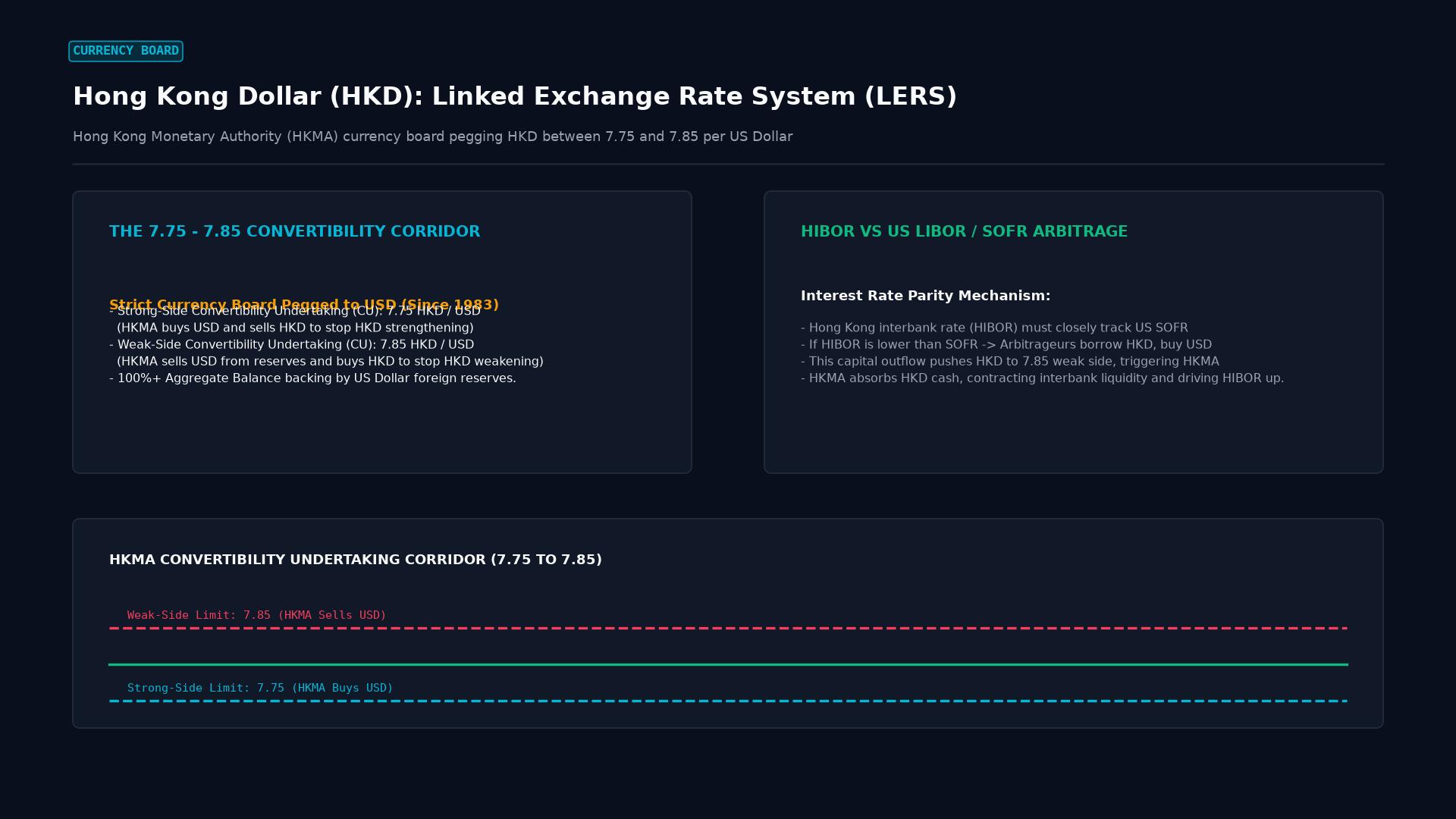 Figure: HKMA currency board corridor: defending the tight 7.75 to 7.85 HKD per USD convertibility band through automatic interest rate parity and dollar reserves.
Historical Lineage and the 1983 Currency Crisis
Following the British acquisition of Hong Kong in the 1840s, the territory functioned as an open free port utilizing a mixture of silver currencies, notably Spanish and Mexican silver dollars, British trade dollars, and silver coins from mainland China. In 1935, following China’s abandonment of the silver standard, Hong Kong established its own currency, the Hong Kong Dollar, initially pegged to the British Pound Sterling at a rate of 16 HKD to £1.
After the collapse of the Bretton Woods system and the floating of the British Pound in 1972, Hong Kong pegged to the US dollar before attempting a free-floating exchange rate experiment between November 1974 and October 1983.
The free-floating period ended in systemic crisis:
- In September 1982, British Prime Minister Margaret Thatcher met with Chinese leader Deng Xiaoping in Beijing to open diplomatic negotiations over the future sovereignty of Hong Kong after the expiration of the 1997 New Territories lease.
- Political uncertainty over the handover triggered panic selling across Hong Kong financial markets.
- Between 1981 and late 1983, the Hong Kong Dollar depreciated rapidly from approximately 5.00 HKD per USD to over 9.60 HKD per USD, causing retail bank runs and widespread hoarding of basic consumer goods.
To arrest the currency collapse, Financial Secretary Sir John Bremridge announced the implementation of the Linked Exchange Rate System on October 17, 1983, fixing the parity rate at exactly 7.80 HKD to 1 USD through a statutory currency board mechanism.
Mechanics of the Linked Exchange Rate System (LERS)
The LERS operates on transparent, automated currency board rules backed by the massive foreign currency assets of the Hong Kong Exchange Fund:
1. Note-Issuing Banks and Certificates of Indebtedness
A unique institutional characteristic of Hong Kong is that physical paper banknotes are not printed by the central bank. Instead, three authorized commercial banks are designated by statute as note-issuing institutions:
- The Hongkong and Shanghai Banking Corporation Limited (HSBC)
- Standard Chartered Bank (Hong Kong) Limited
- Bank of China (Hong Kong) Limited
Under the Exchange Fund Ordinance, before a note-issuing bank can print a single HKD banknote, it must surrender an equivalent value in physical US dollars to the HKMA’s Exchange Fund at the statutory rate of 7.80 HKD per 1 USD. In return, the HKMA issues non-interest-bearing Certificates of Indebtedness (CIs). The note-issuing bank holds these CIs as legal backing for the physical currency in public circulation. Conversely, when a bank retires banknotes from circulation, it redeems the CIs at the HKMA for US dollars at the exact 7.80 rate.
2. The 7.75 - 7.85 Convertibility Zone (Introduced in 2005)
Between 1983 and 2005, the LERS operated with a one-way convertibility undertaking at 7.80. In May 2005, following massive speculative capital inflows betting on a revaluation of the Chinese Renminbi, the HKMA introduced the two-way Convertibility Zone to refine interest rate arbitrage and dampen hot money volatility:
- Strong-Side Convertibility Undertaking (7.75 HKD/USD): If massive capital inflows cause the HKD to appreciate to 7.75, the HKMA is contractually bound to purchase US dollars and sell Hong Kong Dollars to commercial banks. This intervention injects local liquidity into the interbank banking system, expanding the “Aggregate Balance.”
- Weak-Side Convertibility Undertaking (7.85 HKD/USD): If capital flight or carry trade outflows push the HKD down to 7.85, the HKMA enters the market to sell US dollars and buy Hong Kong Dollars from commercial banks. This intervention absorbs domestic currency liquidity, shrinking the Aggregate Balance.
$$\text{Convertibility Zone Bounds} = [7.7500, ; 7.8500] \text{ HKD per USD}$$
The Automatic Interest Rate Adjustment Mechanism
The core stability of the Hong Kong Dollar is sustained by an automatic interest rate self-equilibrating mechanism that links domestic borrowing costs directly to the United States Federal Reserve.
When capital flows out of Hong Kong seeking higher yields in the United States, commercial banks sell HKD and buy USD, pushing the spot rate to the weak-side threshold of 7.85:
- The HKMA buys HKD at 7.85, paying out foreign reserves.
- The local currency purchased by the HKMA is permanently removed from the interbank clearing system, causing the Aggregate Balance of the banking sector to contract.
- As interbank cash liquidity becomes scarce, commercial banks must compete aggressively for short-term liquidity.
- The Hong Kong Interbank Offered Rate (HIBOR) spikes sharply upward, matching or exceeding the US Secured Overnight Financing Rate (SOFR) or Federal Funds Rate.
- Higher domestic interest rates eliminate the negative interest rate differential, rendering the USD/HKD carry trade unprofitable, drawing capital back into Hong Kong, and pulling the exchange rate away from 7.85 back into the interior of the band.
       THE HIBOR-SOFR EQUILIBRATING ARBITRAGE LOOP
       ===========================================

       Capital Flight to Higher USD Yields
                         |
                         v
       Spot Rate Hits Weak-Side Barrier (7.8500)
                         |
                         v
       HKMA Buys HKD -> Aggregate Balance Contracts
                         |
                         v
       Interbank Cash Dries Up -> HIBOR Spikes Upward
                         |
                         v
       Carry Trade Unwinds -> Capital Returns to HKD
The Exchange Fund: A Fortress Balance Sheet
The ultimate guarantor of the Hong Kong Dollar is the Exchange Fund. As of the mid-2020s, the Exchange Fund holds over 450 to 500 billion US dollars in high-grade international foreign assets, primarily US Treasury securities, G10 sovereign debt, and liquid global equities.
This reserve buffer represents one of the highest coverage ratios in the world:
- Total gross foreign reserves exceed the monetary base of Hong Kong by nearly two times.
- Foreign reserves represent more than 100 percent of the broad M3 money supply.
This overwhelming financial firepower was demonstrated during the 1997-1998 Asian Financial Crisis. Speculative hedge funds, led by Julian Robertson’s Tiger Management and George Soros’s Quantum Fund, launched a coordinated “double market play,” shorting both the Hong Kong Dollar and the Hang Seng Index simultaneously. In August 1998, the Hong Kong Government countered decisively, deploying 15 billion US dollars from the Exchange Fund to purchase blue-chip equities directly on the stock exchange while enforcing punitive overnight interest rates (interbank rates briefly touched 280 percent). The speculators were crushed, and the peg held without breach.
| Metric / Parameter | LERS Technical Specification | Role in Preserving Monetary Order |
|---|---|---|
| Convertibility Band | 7.7500 to 7.8500 HKD per USD | Provides a bounded target zone for commercial banks |
| Central Bank Interventions | Transparent, published in real-time | Guarantees absolute convertibility without delay |
| Reserve Backing Ratio | $\ge 110%$ of Monetary Base | Statutory rule enforced under the Exchange Fund Ordinance |
| Note-Issuing Banks | HSBC, Standard Chartered, BOC | Private banks assume operational distribution costs |
| Sovereign Debt | Negligible; government runs net fiscal surpluses | Prevents central bank monetization of state deficits |
Trading Realities for Global FX Participants
For global investment banks, hedge funds, and institutional treasurers, HKD exhibits distinct trading characteristics:
- Carry Trade Mechanics: When US interest rates exceed HIBOR by 100 to 150 basis points, traders borrow HKD at low rates, sell HKD to buy USD, and invest in higher-yielding US Treasury bills. This pushes USD/HKD toward 7.85 until the HKMA intervenes, shrinking the Aggregate Balance and closing the interest rate spread.
- Stock Connect and Mega-IPOs: Cross-border capital flows from mainland Chinese institutional investors buying Hong Kong-listed equities via Southbound Stock Connect, or massive global IPOs of Chinese technology enterprises, generate multi-billion-dollar surges in HKD demand, frequently pinning the currency to the 7.75 strong-side limit.
- Convertibility Risk Premium: Offshore forward curves for USD/HKD trade with minimal deviation from covered interest parity, reflecting global market confidence in the unshakeable credibility of the LERS.
Frequently Asked Questions
Why doesn’t Hong Kong peg the Hong Kong Dollar to the Chinese Renminbi (CNY)?
While Hong Kong is an integral part of China and conducts extensive economic integration with the mainland, the Chinese Renminbi is not yet a fully convertible currency on the capital account. Pegging to the Renminbi would require imposing capital controls on Hong Kong, destroying its status as an open global financial center. The US dollar remains the dominant global trading and reserve currency, perfectly matching Hong Kong’s role as a frictionless conduit for international capital.
Can the Hong Kong Monetary Authority run out of US dollars when defending the peg?
With gross foreign exchange reserves exceeding 450 billion US dollars, the HKMA holds sufficient US dollar assets to buy back the entire circulating supply of Hong Kong banknotes and coins twice over. In any speculative attack, the automatic contraction of the Aggregate Balance drives domestic interest rates to whatever level is necessary to crush speculative short sellers long before foreign exchange reserves could be depleted.
Why do Hong Kong interest rates move in lockstep with the US Federal Reserve?
Under the macroeconomic principle known as the “Impossible Trinity” (or trilemma), an economy cannot simultaneously maintain a fixed exchange rate, free capital mobility, and an independent monetary policy. Because Hong Kong permits completely unrestricted capital flows and fixes its currency to the US Dollar, it must surrender its domestic monetary independence. When the Federal Reserve raises or lowers the Federal Funds Rate, the HKMA’s Base Rate adjusts automatically to mirror Washington’s policy moves.
Ready to trade forex?
Open a free demo account with a regulated broker. Practice with virtual funds before risking real money.