HNL
HNL is the ISO 4217 currency code for the Honduran Lempira, the official currency of the Republic of Honduras, regulated under a crawling peg framework by the Banco Central de Honduras.
The Honduran Lempira (ISO code: HNL, symbol: L) is the official monetary unit of the Republic of Honduras, a Central American nation bordered by Guatemala, El Salvador, Nicaragua, and the Caribbean Sea. Regulated by the Banco Central de Honduras (BCH), the currency operates under a crawling peg exchange rate system anchored primarily to the United States Dollar. Named after the sixteenth-century indigenous Lenca war chieftain who led armed resistance against Spanish conquistadors, the lempira’s external valuation is driven by massive family remittance inflows from the United States, light industrial export manufacturing (maquila), and agricultural commodity exports.
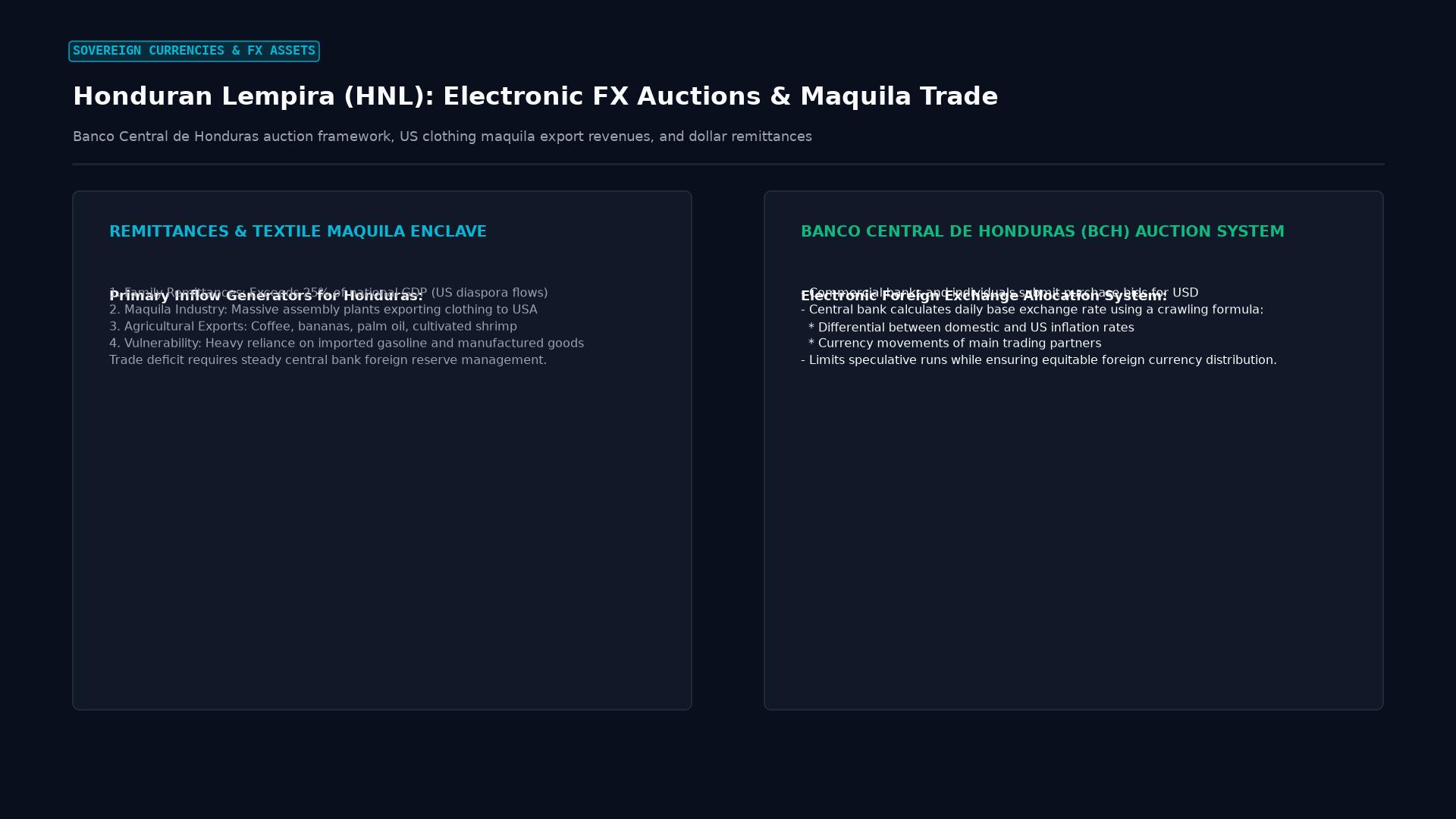 Figure: Central American trade flows: US apparel maquila factory revenues and diaspora remittances clearing through Banco Central de Honduras electronic auctions.
Historical Lineage and the Era of the 2:1 Peg
During the Spanish colonial period, the region utilized Spanish colonial silver coinage minted in Mexico and Guatemala. Following the dissolution of the Federal Republic of Central America in 1838, Honduras issued the Honduran Real, which was replaced in 1871 by the silver Honduran Peso.
On April 3, 1926, the National Congress passed Decree No. 102, creating the modern national currency: the Lempira. The new monetary unit was officially launched in 1931, replacing the silver peso at par. To establish monetary stability and foster commercial agricultural investment by American fruit conglomerates (such as the United Fruit Company and Standard Fruit), the government established a statutory fixed peg to the United States Dollar:
$$\text{Historical Parity} = 2.00 \text{ HNL per } 1.00 \text{ USD}$$
This artificial 2:1 parity endured for nearly six decades, backed by the Banco Central de Honduras following the bank’s founding in July 1950.
By the late 1980s, mounting fiscal deficits, trade imbalances, and regional geopolitical tensions in Central America made the fixed 2:1 rate untenable. Black markets flourished, trading at steep premiums over the official rate. In 1990, under an economic structural adjustment program supported by the International Monetary Fund and the World Bank, President Rafael Leonardo Callejas enacted sweeping reforms that dismantled the historical peg, allowing the currency to devalue and initiating the transition to market-based crawling mechanisms.
The currency is subdivided into 100 centavos. Banknotes currently circulate in denominations of 1, 2, 5, 10, 20, 50, 100, 200, and 500 lempiras. The 200-lempira banknote, introduced in 2021 to commemorate the bicentennial of national independence, incorporates modern security features and celebrates the scarlet macaw, Honduras’s national bird.
The Crawling Peg Mechanism and BCH Operational Policy
The Banco Central de Honduras manages the exchange rate through an operational crawling peg mechanism implemented via the Electronic Foreign Currency Trading System (Sistema de Negociación Electrónica de Divisas, or SENEDI).
Under this framework, the central bank establishes an official reference exchange rate for the US dollar that is adjusted gradually over time. The rate of crawl is determined by a multi-variable formula incorporating:
- The Inflation Differential: The difference between domestic Honduran consumer price inflation and the weighted average inflation of its major trading partners (dominated by the US).
- Trading Partner Currency Movements: Bilateral exchange rate variations between the US dollar and other trading currencies.
- Foreign Exchange Reserve Adequacy: The level of gross international reserves held by the BCH, targeted to maintain at least 4 to 5 months of merchandise imports.
$$\text{Crawl Adjustment Rate} \approx (\pi_{\text{Honduras}} - \pi_{\text{Trading Partners}}) + \text{Competitiveness Offset}$$
To prevent destabilizing speculative currency runs, the BCH enforces mandatory surrender requirements: licensed commercial banks and registered foreign exchange houses are required to sell a specified percentage of the foreign exchange they purchase from the public directly to the central bank. The central bank then redistributes this foreign exchange back into the economy through daily electronic auctions, allocating dollars to authorized importers based on verified commercial invoices.
Structural Macroeconomic Inflow Pillars
The external equilibrium of the Honduran Lempira is supported by three primary economic pillars:
1. Family Remittances (Remesas Familiares)
Family remittances transmitted by the Honduran diaspora living in the United States represent the undisputed lifeblood of the domestic economy:
- Annual remittance inflows exceed 8.5 billion to 9.5 billion US dollars, accounting for an extraordinary 25 percent to 28 percent of national gross domestic product.
- Transmitted primarily through money transfer operators from cities such as Houston, Miami, Los Angeles, and Charlotte, these funds provide direct income support to more than one-third of Honduran households.
- Remittance dollars flow into domestic commercial banks, providing the banking system with consistent hard currency liquidity to pay for imported fuel, food, and medicine.
2. The Maquila Manufacturing Sector
Concentrated in the Sula Valley and San Pedro Sula (the country’s industrial capital), the maquiladora light manufacturing sector operates within specialized free-trade zones. Capitalizing on the Dominican Republic-Central America Free Trade Agreement (CAFTA-DR) with the United States, these factories produce:
- Cotton apparel, activewear, and athletic garments exported to major US retail brands.
- Complex electrical wiring harnesses for the North American automotive assembly sector.
3. Agricultural Commodity Exports
Honduras is the premier producer and exporter of Arabica coffee in Central America, ranking among the top seven coffee exporters globally. Specialty beans from regions such as Marcala and Copán generate over 1 billion dollars in seasonal export receipts. Bananas, palm oil, cultivated shrimp, and tilapia provide additional diversification.
| Economic Engine | Magnitude (USD) | Primary Mechanism Supporting the HNL |
|---|---|---|
| Family Remittances | $8.5B - $9.5B | Massive structural cash supply; offsets persistent merchandise trade deficits |
| Maquila Free Zones | $4.5B - $5.5B | Generates industrial employment and foreign currency export earnings |
| Arabica Coffee Exports | $1.0B - $1.4B | Concentrated seasonal dollar inflows during the Q1-Q2 harvest cycle |
| Bananas & Palm Oil | $800M+ | Steady, recurring agricultural trade flows |
Structural Vulnerabilities and Volatility Risks
Despite substantial remittance flows, the Lempira faces ongoing macroeconomic vulnerabilities:
- Severe Weather and Climate Sensitivity: Honduras is highly susceptible to Atlantic tropical storms and hurricanes (such as Hurricane Mitch in 1998 and Hurricanes Eta and Iota in 2020), which can devastate agricultural plantations and transport infrastructure, triggering sudden drops in export revenues.
- Petroleum Price Shocks: Honduras produces no commercial crude oil and relies entirely on imported refined fuels. A spike in global oil prices inflates the national import bill, depleting central bank reserves and putting downward pressure on the crawling peg.
- US Monetary Tightening: Elevated interest rates in the United States widen the yield differential between dollar-denominated assets and domestic lempira deposits, encouraging capital flight and forcing the BCH to raise its benchmark monetary policy rate (Tasa de Política Monetaria).
Frequently Asked Questions
Can travelers use US Dollars inside Honduras?
In major tourist hubs, such as the Bay Islands (Roatán and Utila), Copán Ruinas, and upscale international hotels in San Pedro Sula and Tegucigalpa, US dollars are widely accepted. However, for mainland everyday commerce, including grocery stores, gas stations, street markets, and domestic transportation, payment is required in Honduran Lempiras (HNL).
Why does the Honduran Lempira gradually depreciate against the US Dollar?
The BCH operates a crawling peg that intentionally permits gradual, managed depreciation of the lempira against the US dollar. Because historical inflation in Honduras is typically several percentage points higher than in the United States, gradual currency depreciation is necessary to prevent the lempira from becoming overvalued in real terms, thereby preserving the price competitiveness of Honduran coffee, textiles, and agricultural exports.
What is the role of the BCH foreign currency auction system?
The BCH operates an electronic auction system (SENEDI) to allocate scarce foreign exchange equitably. Commercial banks must surrender incoming foreign currency to the central bank, which then auctions dollars daily to verified businesses based on priority guidelines (such as essential fuel and medical imports) to prevent hoarding and speculative runs.
Ready to trade forex?
Open a free demo account with a regulated broker. Practice with virtual funds before risking real money.