Crawling Peg
A crawling peg is an exchange rate regime where a sovereign nation pegs its currency to an anchor currency or basket, adjusting the central parity rate periodically in small, scheduled increments to offset inflation differentials.
What Is a Crawling Peg?
A crawling peg is an intermediate exchange rate regime in which a sovereign nation’s central bank pegs its national currency to an external anchor currency (most commonly the U.S. Dollar or Euro) or a multi-currency basket, while permitting the central parity exchange rate to adjust (“crawl”) periodically in small, controlled, and predictable increments.
Rather than maintaining a rigid, immutable fixed peg—which often becomes economically unsustainable during high domestic inflation—or allowing the currency to fluctuate freely in an open floating market, a crawling peg provides a hybrid solution. The exchange rate is adjusted continuously (daily, weekly, or monthly) according to a predefined mathematical formula, an economic indicator (such as the domestic-versus-foreign inflation differential), or a publicly announced central bank schedule.
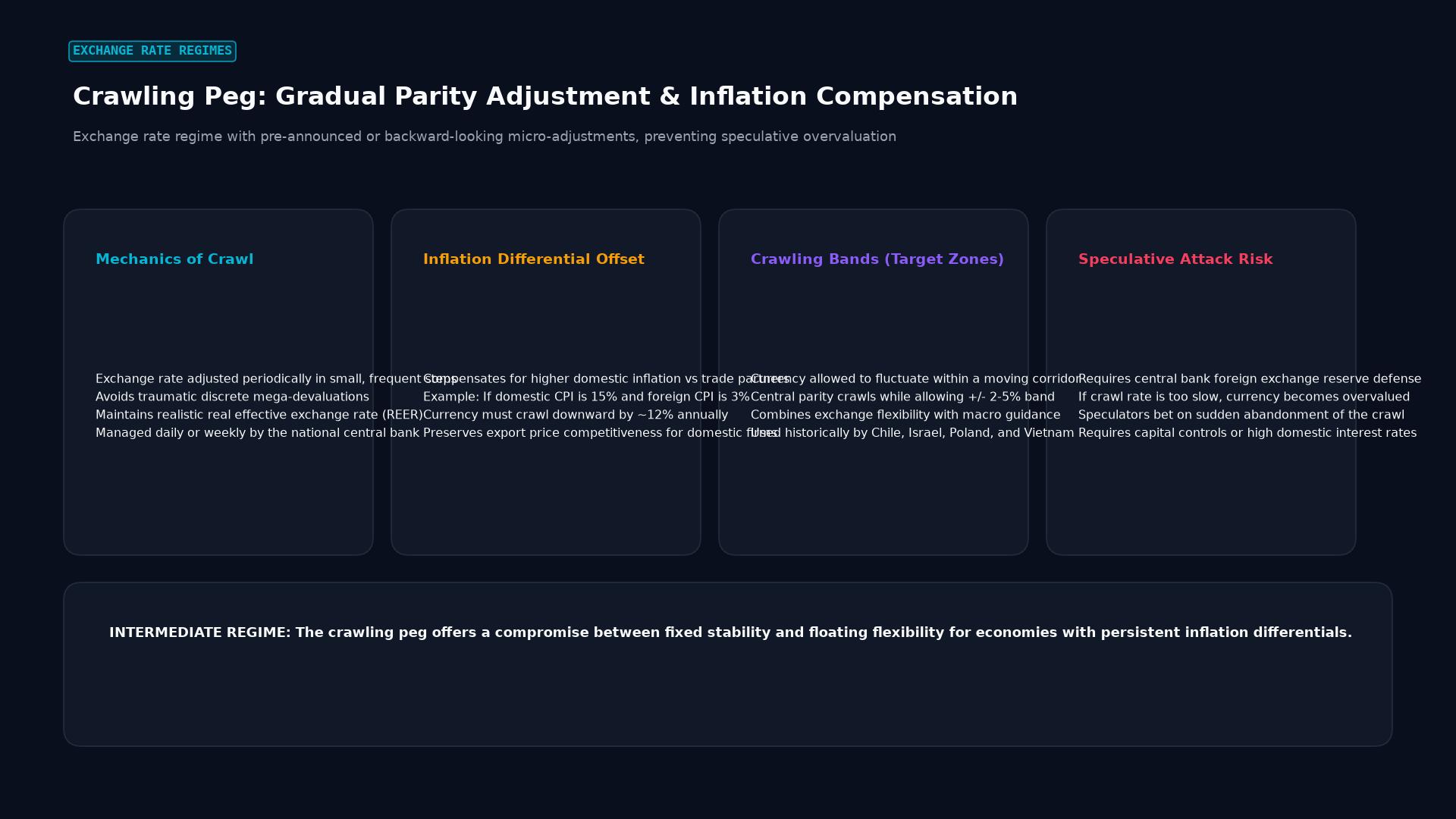 Figure: Exchange rate regime with pre-announced or backward-looking micro-adjustments, preventing speculative overvaluation
Key Takeaways
- Inflation Offset Mechanism: The primary economic objective of a crawling peg is to systematically neutralize high domestic inflation, preventing the Real Effective Exchange Rate (REER) from becoming overvalued and destroying export competitiveness.
- Avoiding Devaluation Shocks: By depreciating the currency incrementally over time (e.g., 0.5% per month), the central bank avoids the violent financial market panics and corporate bankruptcies caused by sudden, one-off devaluations.
- Active vs. Passive Crawling: A passive (backward-looking) crawl adjusts parity based on past realized inflation; an active (forward-looking) crawl pre-announces future lower crawl rates to anchor public inflation expectations (la tablita).
- Crawling Bands: Many central banks incorporate a crawling band, establishing a symmetric fluctuation corridor (e.g., $\pm 2.0%$) around the crawling central parity line.
The Economics Behind the Crawl: Preserving Real Exchange Rate Parity
If Country A experiences an annual inflation rate of 15%, while its primary trading partner (the United States) experiences inflation of only 2%, maintaining a rigid nominal peg guarantees economic distortion:
$$\text{Real Exchange Rate (RER)} = \text{Nominal Rate} \times \frac{P_{\text{foreign}}}{P_{\text{domestic}}}$$
- If the nominal peg remains frozen, domestic goods become 13% more expensive each year in foreign purchasing power terms.
- The nation’s exporters lose global market share, imports surge, the national trade deficit widens, and foreign exchange reserves are rapidly drained.
- Under a crawling peg, the central bank systematically depreciates the nominal exchange rate by approximately 13% per year ($15% - 2%$), ensuring that the Real Exchange Rate remains completely stable.
Visualizing a Crawling Peg Over Time:
Exchange Rate (Units per USD)
  ▲
  │                                     Upper Band Boundary (+2%)
  │                                   . ── ── ── ── ── ── ── ──
  │                               . '       /\    /\
  │                           . '          /  \  /  \
  │                       . '      /\     /    \/    \  Central Crawling Parity
  │                   . '         /  \___/
  │               . '  ── ── ── ── ── ── ── ── ── ── ── Lower Band Boundary (-2%)
  │           . '
  └────────────────────────────────────────────────────────► Time
Comparative Matrix: Exchange Rate Regimes
| Feature | Rigid Fixed Peg | Crawling Peg | Managed Float (Dirty Float) | Free Float (Clean Float) |
|---|---|---|---|---|
| Exchange Rate Target | Exact fixed rate (e.g., HKD 7.80) | Dynamic, moving central parity | No published target | Zero target |
| Adjustment Frequency | Only during rare sovereign devaluations | Daily, weekly, or monthly schedule | Continuous, discretionary | Continuous, pure market |
| Central Bank Interventions | Unlimited foreign reserve commitment | Continuous intervention inside band | Tactical, unannounced interventions | Never intervenes |
| Monetary Autonomy | Zero independent policy | Highly constrained autonomy | Moderate policy autonomy | 100% full monetary policy independence |
Real-World Case Study: Vietnam’s Crawling Peg Framework
The State Bank of Vietnam (SBV) utilizes an active crawling peg regime to manage the Vietnamese Dong (VND) against the U.S. Dollar:
The Operational Architecture:
- Every morning, the SBV sets and publishes an official Central Reference Exchange Rate (e.g.,
24,250 VND/USD). - Commercial banks in Hanoi and Ho Chi Minh City are legally permitted to trade USD/VND within a symmetrical daily crawling band of $\pm 5.0%$ around that reference rate.
- Throughout the year, as global interest rates fluctuate, the SBV gradually adjusts the daily central reference rate upward by a few dong per day.
Macroeconomic Benefits:
- Export Engine Stability: Multinational electronics manufacturers (such as Samsung and Intel) establish manufacturing supply chains in Vietnam with total confidence that the VND will not appreciate rapidly or suffer sudden erratic swings.
- Controlled Depreciation: When the U.S. Dollar surges globally due to Federal Reserve rate hikes, the SBV widens the crawl rate, absorbing macro pressure without exhausting national FX reserves.
Structural Vulnerabilities and Risks of Crawling Pegs
While crawling pegs offer predictability, they harbor systemic macroeconomic vulnerabilities:
1. Speculative Attacks and Reserve Depletion
If international macro hedge funds determine that the central bank’s pre-announced rate of crawl is too slow to compensate for real fiscal deficits, they will short the currency aggressively. The central bank must burn foreign exchange reserves to defend the lower band. Once reserves run dangerously low, the peg collapses into a disorderly floating devaluation.
2. Built-in Inflation Inertia
A backward-looking crawling peg institutionalizes inflation expectations. Because business contracts, wage negotiations, and import prices automatically factor in the scheduled future depreciation, domestic inflation becomes structurally embedded, making it difficult for monetary authorities to bring inflation down to standard 2% targets.
Frequently Asked Questions
What is the difference between a crawling peg and a crawling band?
A crawling peg establishes a single moving central exchange rate that adjusts along a linear trajectory. A crawling band (or target zone) establishes an upper and lower percentage boundary (e.g., $\pm 3%$) around that moving central rate, permitting modest market-driven price discovery within the corridor.
Can forex retail traders trade currencies with crawling pegs?
Yes, but with caveats. Pairs involving crawling peg currencies (such as USD/VND, USD/MAD, or USD/NGN) are often categorized as exotics by retail brokers. They carry wider bid-ask spreads, higher rollover swap charges, and occasional trading restrictions due to local capital controls.
Why did Argentina’s famous “Tablita” crawling peg fail in the late 1970s?
In 1978, Argentine Economy Minister José Alfredo Martínez de Hoz introduced la tablita, a forward-looking crawling peg that published a schedule of declining monthly devaluations to cure inflation. However, because the fiscal deficit was not eliminated, domestic inflation remained far higher than the published crawl rate. The peso became massively overvalued, causing balance-of-payments collapse, a massive banking panic, and a catastrophic currency devaluation.
Ready to trade forex?
Open a free demo account with a regulated broker. Practice with virtual funds before risking real money.