HTG
HTG is the ISO 4217 currency code for the Haitian Gourde, the official legal tender of the Republic of Haiti, regulated under a floating exchange rate regime by the Banque de la République d'Haïti.
The Haitian Gourde (ISO code: HTG, symbol: G) is the official currency of the Republic of Haiti, a Caribbean nation sharing the island of Hispaniola with the Dominican Republic. Regulated and issued by the nation’s central bank, the Banque de la République d’Haïti (BRH), the gourde operates under a managed floating exchange rate regime. The valuation and purchasing power of the gourde reflect deep structural macroeconomic challenges, including high reliance on imported food and fuel, extensive informal dollarization, political and security disruptions, and the vital role of diaspora family remittances from North America.
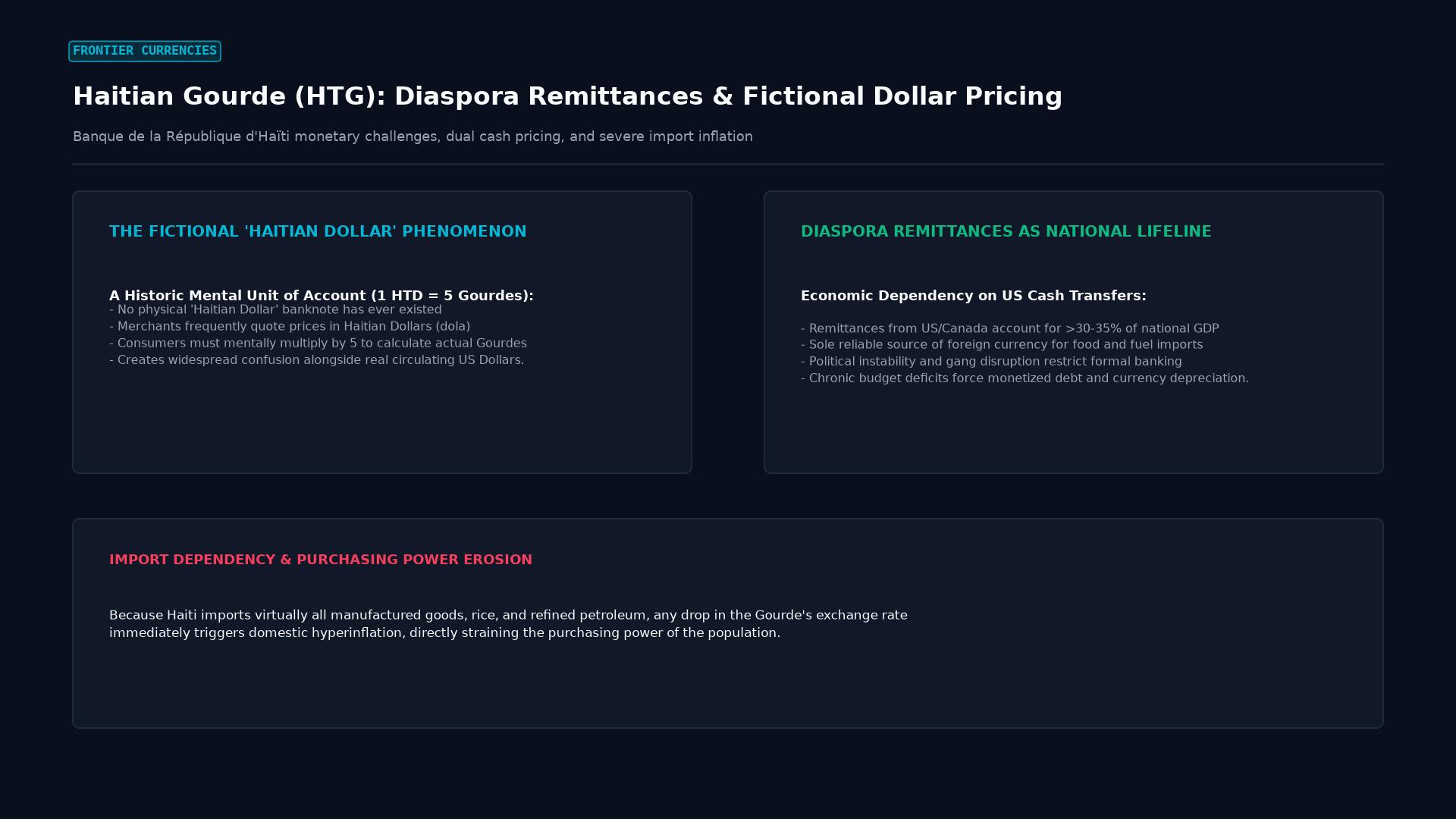 Figure: Banque de la République d’Haïti monetary challenges, dual cash pricing, and severe import inflation
Historical Lineage and the “Haitian Dollar” Phenomenon
The Haitian Gourde was introduced in 1813 by President Alexandre Pétion to replace the colonial French colonial livre at a rate of 1 gourde to 8 livres and 5 sous. The name gourde derived from the historical Spanish term gordo, referring to large Spanish silver pieces of eight (pesos gordos) that circulated throughout the Caribbean.
In 1919, during the United States military occupation of Haiti (1915-1934), American authorities overhauled the Haitian monetary system. The Banque Nationale de la République d’Haïti established a formal statutory peg to the United States Dollar:
$$\text{Historic Parity (1919-1989)} = 5.00 \text{ HTG per } 1.00 \text{ USD}$$
This 5:1 fixed parity endured for seven decades. Because five gourdes bought exactly one US dollar, commercial merchants and the public began utilizing an informal mental unit of account known as the “Haitian Dollar” (dola ayisyen).
- One “Haitian Dollar” was not a physical paper currency; it was an imaginary convention equal to 5 physical Gourdes.
- To this day, vendors in informal open-air markets and street stalls across Haiti quote prices in “Haitian Dollars.” A customer purchasing an item priced at “10 dollars” is required to pay 50 physical gourdes.
In the late 1980s, escalating fiscal deficits, political instability following the fall of the Duvalier regime, and dwindling foreign exchange reserves forced the government to abandon the 5:1 peg in 1989. The gourde was transitioned to a market-determined floating regime, initiating a multi-decade trend of nominal depreciation against the US dollar.
The currency is subdivided into 100 centimes. Circulating banknotes are issued in denominations of 10, 20, 25, 50, 100, 250, 500, and 1,000 gourdes, honoring historical leaders of the Haitian Revolution, including Toussaint Louverture, Jean-Jacques Dessalines, and Henri Christophe.
The Dominance of Remittances and Financial Dollarization
Haiti’s external financial accounts are characterized by a profound dependence on family remittances sent by the extensive Haitian diaspora living in the United States (primarily South Florida, New York, and Boston), Canada (Montreal), France, and the Dominican Republic:
- Remittance flows consistently exceed 3.5 billion to 4.2 billion US dollars annually, accounting for between 30 percent and 38 percent of national gross domestic product.
- Remittances represent the primary lifeline supporting household consumption, private school tuition fees, and emergency medical care across the population.
- Because domestic production of food staples (rice, poultry, cooking oil) and consumer goods is severely limited, these remittance dollars are spent almost entirely on imported goods.
This dynamic has created deep “financial dollarization” across the commercial economy. Over 65 percent of commercial bank deposits in Port-au-Prince are denominated in US dollars. Real estate leases, vehicle purchases, import wholesale contracts, and university tuition fees are frequently billed and settled directly in US dollars.
      REMITTANCE TRANSMISSION TO THE DOMESTIC CURRENCY
      ================================================

   [ DIASPORA WORKER IN US ]
                 |
                 v (Transfers $200 via Western Union / MoneyGram / CamTransfer)
   [ COMMERCIAL PAYOUT WINDOW IN PORT-AU-PRINCE ]
                 |
                 +------> PAID IN HTG (Converted at Official BRH Reference Rate)
                 |        * Injects local buying power into retail economy
                 v
   [ ACCUMULATION OF HARD DOLLARS IN DOMESTIC BANKING SYSTEM ]
                 |
                 v
   [ COMMERCIAL IMPORTERS PURCHASE DOLLARS TO BUY RICE, GRAIN & FUEL ]
Central Bank Operational Tools and Monetary Policy
The Banque de la République d’Haïti manages monetary policy in an extraordinarily challenging macroeconomic environment characterized by supply shocks, high fiscal deficits, and physical security disruptions:
1. Foreign Exchange Market Interventions
When excessive demand for hard currency threatens to trigger rapid depreciation of the gourde (such as during periods when the exchange rate depreciated from 100 to over 150 HTG per USD), the BRH conducts discretionary foreign exchange injection auctions. The central bank sells tens of millions of US dollars from its international reserves directly to commercial banks, specifying that the funds must be allocated exclusively to certified commercial importers of essential commodities (refined fuel, wheat flour, and medical supplies).
2. High Reserve Requirements
To limit the creation of domestic currency credit and dampen speculative dollar purchases, the BRH maintains exceptionally high mandatory reserve requirements (coefficients de réserves obligatoires):
- Commercial banks are required to park upwards of 40 to 50 percent of their local-currency gourde deposit liabilities, and up to 50 percent of their foreign-currency deposit liabilities, in non-interest-bearing reserve accounts at the BRH.
- While this policy restricts money supply growth, it substantially increases commercial lending interest rates across the formal banking sector.
3. Regulatory Directives on Remittance Payouts
Through regulatory directives such as Circular 114-2, the BRH has intervened in the mechanics of remittance distribution, requiring licensed money transfer operators to pay out remittances to recipients in gourdes rather than physical US dollars, unless the sender explicitly contractually mandates a dollar payout or transfers funds directly into a foreign-currency bank account. This measure aims to route incoming hard currency through formal commercial bank reserve pools.
| Economic Dimension | Operational Reality in Haiti | Impact on HTG Exchange Rate |
|---|---|---|
| Diaspora Remittances | Over 30% of GDP ($3.5B - $4B) | Primary structural buffer of external liquidity |
| Merchandise Trade Deficit | Severe; imports exceed exports 4-to-1 | Chronic downward pressure on the gourde |
| Fuel & Food Import Share | Exceeds 80% of basic consumption | Drives immediate pass-through inflation |
| BRH Interventions | Targeted dollar sales to importers | Smooths short-term volatility and panic spikes |
Trading Realities for International Forex Participants
For institutional currency desks and corporate treasurers, HTG is an illiquid, restricted exotic currency:
- No Active Offshore Deliverable Market: International interbank platforms do not quote deliverable spot transactions in HTG outside the jurisdiction of Haiti.
- Offshore Forward Illiquidity: Non-Deliverable Forwards (NDFs) for USD/HTG are rarely traded by major global investment banks due to high sovereign and operational risk.
- Port and Supply Chain Frictions: Physical disruptions to port infrastructure in Port-au-Prince periodically halt fuel distribution and commercial container unloading, creating temporary local cash crunches where physical gourde banknotes trade at a premium or discount relative to electronic bank balances.
Frequently Asked Questions
What does a merchant mean when quoting a price in “Haitian Dollars”?
When a vendor in Haiti quotes a price in “Haitian Dollars,” the customer must multiply that number by 5 to determine the price in physical Haitian Gourdes (HTG). For example, an item priced at 20 Haitian Dollars costs 100 physical Gourdes. The “Haitian Dollar” is not a physical banknote; it is a legacy accounting concept stemming from the historic 5:1 peg to the US dollar that lasted from 1919 to 1989.
Why is domestic inflation in Haiti so closely correlated with the USD/HTG exchange rate?
Haiti imports more than 80 percent of its food staples (such as rice, wheat, and cooking oil) and 100 percent of its refined petroleum products. Because international suppliers invoice exclusively in US dollars, any depreciation of the gourde against the dollar instantly inflates the wholesale import price of food and fuel, transmitting directly into domestic consumer price inflation within days.
Can travelers use US Dollars directly in Haiti?
Yes. Major hotels, supermarkets, private medical clinics, and car rental agencies in Port-au-Prince and Cap-Haïtien widely accept US dollars and international credit cards. However, for domestic transport (tap-taps), rural markets, and small retail shops, physical Haitian Gourdes are required. Due to security considerations, carrying large quantities of physical cash is discouraged.
Ready to trade forex?
Open a free demo account with a regulated broker. Practice with virtual funds before risking real money.