IDC deposits
IDC deposits refer to specialized insured cash sweep and reciprocal deposit placement mechanisms pioneered by Institutional Deposits Corp to allocate multi-million-dollar deposits across a network of banks to ensure complete FDIC insurance coverage.
IDC deposits refer to institutional deposit allocation mechanisms and reciprocal multi-bank networks, pioneered in the early 2000s by entities such as Institutional Deposits Corp. (IDC) and subsequent industry networks like IntraFi (CDARS and Insured Cash Sweep). Designed to solve the fundamental constraint of statutory deposit insurance, these systems enable corporations, municipalities, endowments, and high-net-worth investors to place multi-million-dollar cash deposits through a single relationship bank while securing complete Federal Deposit Insurance Corporation (FDIC) coverage across the entire principal. In modern bank liquidity management, reciprocal and sweep deposits function as a vital tool for community and regional banks to retain large corporate relationships without incurring the regulatory penalties historically associated with traditional brokered deposits.
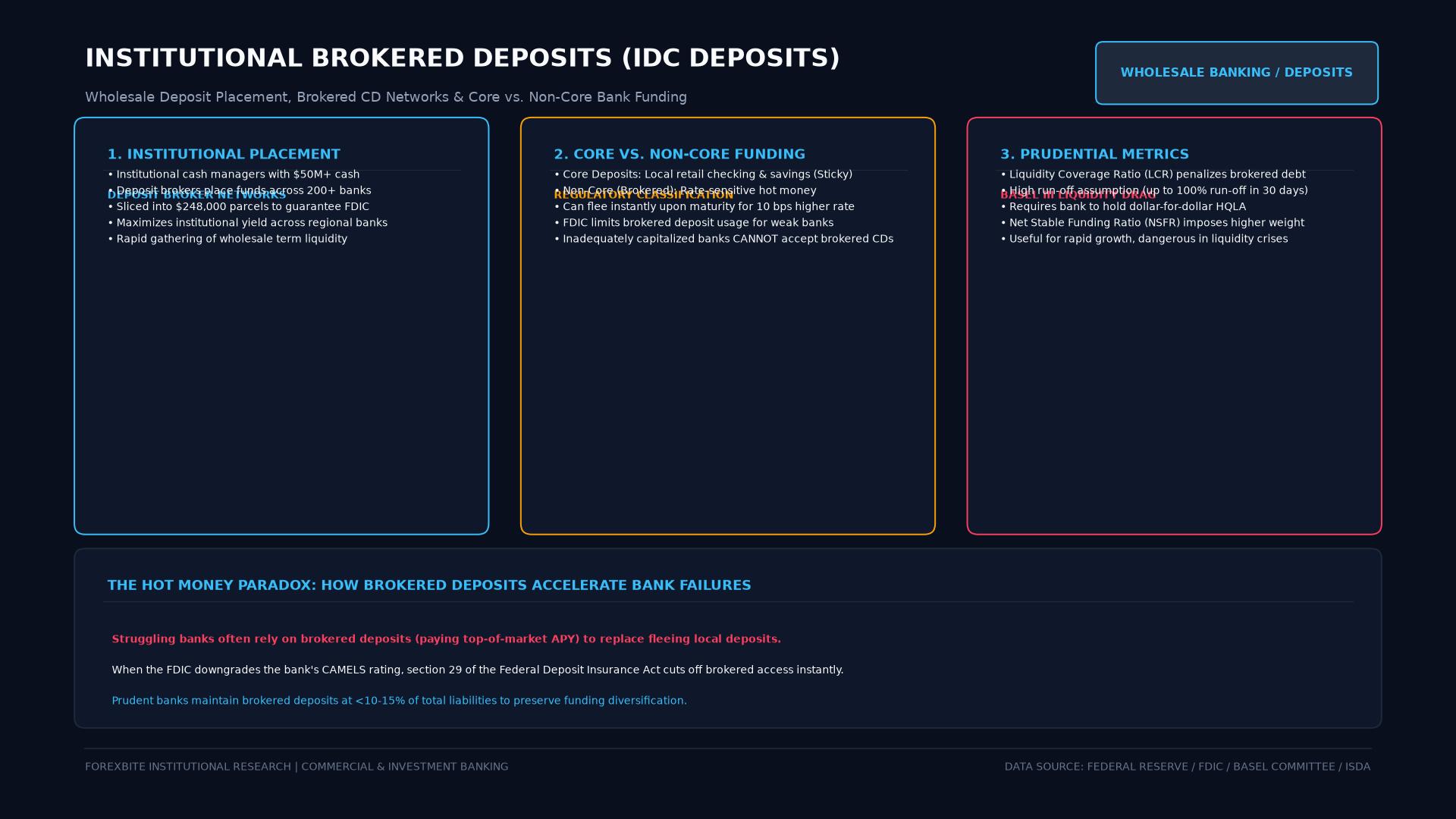 Figure: Large institutional cash allocation network: breaking multi-million dollar corporate deposits into $250k parcels across participating banks to maximize FDIC insurance.
The Statutory Insurance Dilemma: The $250,000 Limit
Under the Federal Deposit Insurance Act, the FDIC provides insurance coverage up to the Standard Maximum Deposit Insurance Amount (SMDIA) of $250,000 per depositor, per insured depository institution, for each account ownership category.
While this threshold provides complete protection for the vast majority of retail consumer banking customers, it presents an existential risk for institutional entities:
- Corporate Treasuries: Tech startups, manufacturing enterprises, and real estate management firms frequently hold $5 million to $50 million in operational cash to cover bi-weekly payroll and vendor invoices.
- Municipal Governments and Public Funds: School districts, county treasuries, and municipal utility districts hold tens of millions in tax receipts.
- Non-Profit Foundations and Endowments: Universities and hospital systems maintain substantial liquid liquidity reserves.
Prior to specialized placement systems, if a corporate treasurer deposited $10 million into a single commercial bank, $9,750,000 of that balance was completely uninsured. In the event of a bank failure (as demonstrated by the abrupt collapses of Silicon Valley Bank and Signature Bank in March 2023, where over 90 percent of deposits were uninsured), uninsured depositors face potential haircut losses and frozen working capital.
Historically, corporate treasurers attempted to mitigate this risk through burdensome manual processes: opening dozens of accounts at separate banks, negotiating complex tri-party repurchase agreements (repos), or requiring banks to pledge physical sovereign collateral (such as US Treasuries or municipal bonds) to back municipal deposits.
Mechanics of Insured Multi-Bank Allocation
Pioneered in 2000 by Institutional Deposits Corp. and expanded across the banking sector, automated deposit placement platforms revolutionized institutional liquidity management:
1. Account Consolidation and Automated Distribution
A corporate customer maintains a single banking relationship with their local community or regional bank. When the customer deposits a large sum, such as $10 million:
- The primary bank routes the funds through an automated electronic network.
- Proprietary algorithms divide the master deposit into discrete allocations, each calculated just below the statutory limit (typically $245,000 to ensure that future accrued interest does not breach the $250,000 ceiling).
- The allocations are distributed among 41 separate FDIC-insured financial institutions within the network.
- Because each individual balance is held at a separate, legally distinct insured depository institution, every dollar enjoys full statutory FDIC backing.
2. The Reciprocal Matching Principle
The true economic breakthrough of these systems is the “reciprocal” mechanism:
- If a customer’s $10 million is simply sent to 41 other banks, the primary relationship bank loses $10 million in liquid balance sheet funding.
- To prevent this liquidity drain, the clearing network matches the outflow on a dollar-for-dollar basis. The platform routes identical sub-$250,000 deposits originating from other network member banks back to the primary bank.
- As a result, the primary bank’s total deposit base remains unchanged at $10 million, allowing it to use those funds to support local commercial lending, while the customer achieves complete insurance coverage.
3. Unified Reporting and Operational Simplicity
The institutional depositor does not sign agreements with 41 separate institutions, nor do they log into multiple banking portals. They receive:
- A single consolidated monthly bank statement listing every participating bank holding their sub-deposits.
- A single unified interest rate negotiated with their primary relationship bank.
- A single tax reporting document (Form 1099-INT) at year-end.
The Regulatory Turning Point: EGRRCPA Section 202
For years, the widespread adoption of reciprocal deposit networks was hindered by an obsolete regulatory classification: the Federal Deposit Insurance Act’s definition of “brokered deposits.”
Under Section 29 of the FDI Act, brokered deposits were subjected to strict regulatory restrictions, higher FDIC insurance assessment premiums, and liquidity penalties under Basel III Liquidity Coverage Ratio (LCR) rules, because regulators viewed third-party deposit brokers as providers of volatile “hot money.”
In May 2018, the United States Congress passed the landmark Economic Growth, Regulatory Relief, and Consumer Protection Act (EGRRCPA / Public Law 115-174). Section 202 amended 12 U.S.C. § 1821(g) to establish an explicit statutory exemption:
- Reciprocal deposits placed through networks like IDC or IntraFi are legally classified as standard core relationship deposits rather than brokered deposits, provided the bank is well-capitalized.
- A financial institution can exclude reciprocal deposits from brokered deposit calculations up to the lesser of $5 billion or 20 percent of its total liabilities.
$$\text{EGRRCPA Statutory Safe Harbor} = \min($5,000,000,000, ; 0.20 \times \text{Total Liabilities})$$
This reform removed regulatory penalties, enabling regional and community banks to compete directly with Wall Street money-center giants (JPMorgan Chase, Bank of America, Citigroup) for large corporate, university, and municipal deposits.
| Deposit Feature | Uninsured Commercial Deposit | Reciprocal Network Deposit (IDC / IntraFi) | Collateralized Public Deposit |
|---|---|---|---|
| FDIC Coverage | Capped strictly at $250,000 | Multi-million-dollar 100% coverage | Covered via pledged securities |
| Credit Risk | Subject to bank failure haircuts | Zero credit risk (backed by US Government) | Low (pledged collateral holds lien) |
| Bank Balance Sheet Impact | Standard direct liability | Zero net liquidity loss via reciprocal inflow | Requires bank to lock up Treasuries |
| Administrative Burden | Minimal (single account) | Minimal (single statement, single bank) | High (custody tracking of bonds) |
| Regulatory Treatment | Core deposit (uninsured) | Core reciprocal deposit (EGRRCPA Section 202) | Core deposit with encumbered assets |
Impact on Bank Run Dynamics and Post-2023 Banking Stability
The strategic importance of multi-bank deposit allocation systems was elevated following the 2023 US regional banking crisis. When depositors observed the speed with which digital bank runs unfolded via mobile banking apps, corporate boards instituted formal treasury policies mandating that no operating cash balances remain uninsured.
Depository institutions experienced a structural migration of funds:
- Mid-sized and community banks marketed reciprocal sweep platforms to halt deposit flight toward systemically important “too-big-to-fail” institutions.
- Corporate treasurers transitioned liquid balances from unsecured checking accounts into Insured Cash Sweep (ICS) demand accounts (which permit daily withdrawals while maintaining multi-bank FDIC insurance) and Certificate of Deposit Account Registry Service (CDARS) term deposits for excess cash reserves.
Frequently Asked Questions
Is an IDC or reciprocal deposit as safe as investing directly in US Treasury bills?
Yes. Because every underlying deposit allocation is held at a federally insured bank below the $250,000 statutory limit, the entire principal and accrued interest carry the full faith and credit guarantee of the United States Government, identical to the sovereign backing of US Treasury bills.
How does liquidity work if an investor needs to withdraw funds from a reciprocal sweep account?
For demand sweep accounts (such as Insured Cash Sweep or IDC demand products), the funds operate identically to a standard commercial checking account. The depositor initiates a wire transfer or check withdrawal through their primary bank, and the automated network coordinates the intra-day clearing and rebalancing among network banks seamlessly.
Do participating network banks have access to the depositor’s private information?
No. The primary relationship bank maintains complete customer confidentiality. The automated network platform anonymizes transaction routing, meaning participating member banks receiving sub-$250,000 allocations only see an omnibus custodial ledger entry. They do not have access to the underlying corporation’s or individual’s identity, tax identification number, or proprietary banking records.
Ready to trade forex?
Open a free demo account with a regulated broker. Practice with virtual funds before risking real money.