Identity score
An identity score is a quantitative risk assessment metric utilized by financial institutions and fintech platforms to determine the authenticity of an applicant's personal data and mitigate fraud.
An identity score is a real-time, algorithmic risk metric generated during customer onboarding and payment processing to quantify the probability that an individual’s submitted personal information belongs to a legitimate human being rather than a fraudster, compromised profile, or synthetic identity. Deployed extensively by commercial banks, digital forex brokers, cryptocurrency exchanges, and fintech lenders, identity scores evaluate hundreds of dynamic data signals spanning device telemetry, phone carrier records, behavioral biometrics, and public database registries. In compliance with Anti-Money Laundering (AML) and Customer Identification Program (CIP) regulations, the identity score acts as an automated triage mechanism, determining whether an applicant is approved frictionlessly, flagged for manual compliance review, or outright rejected.
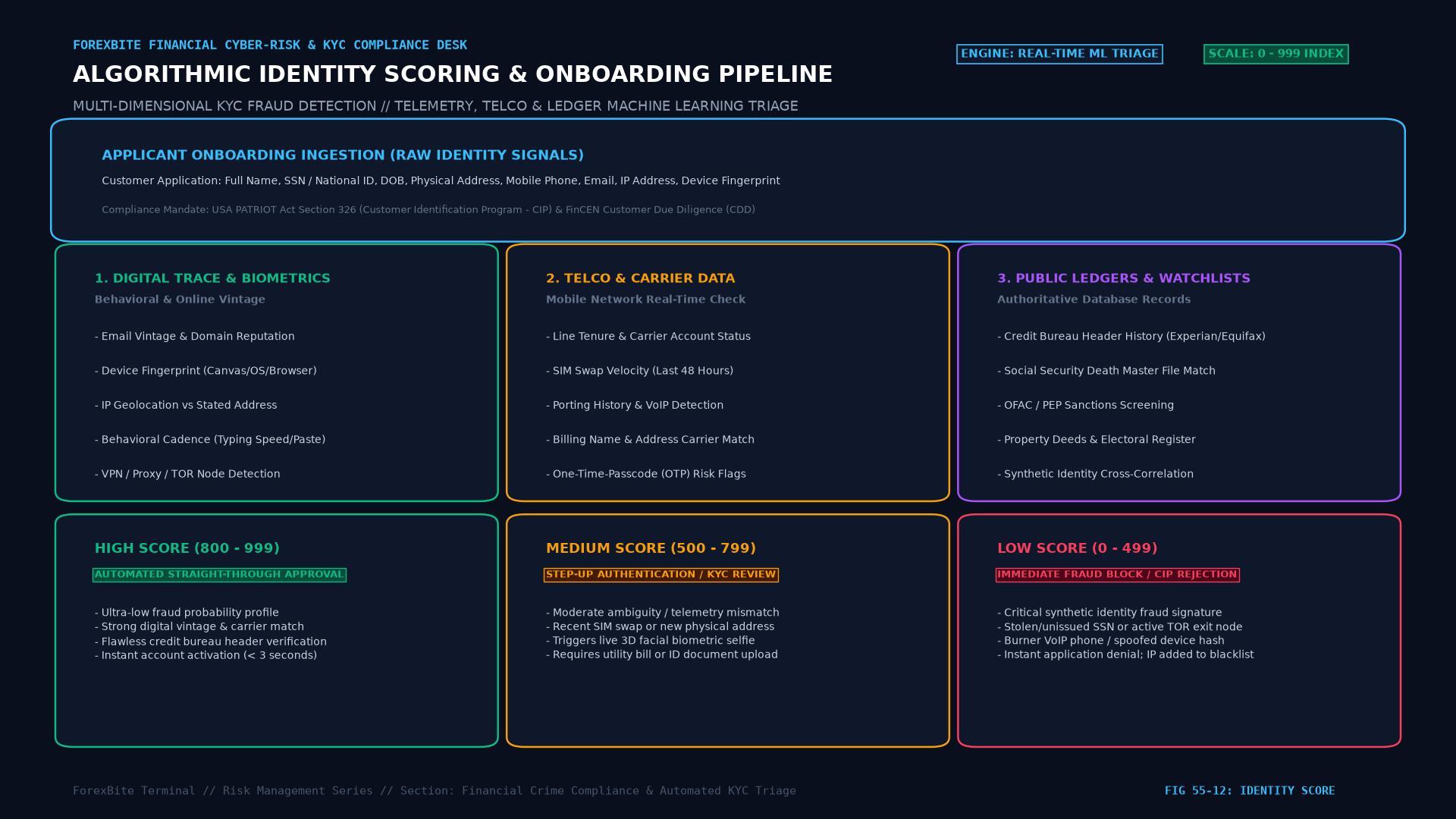 Figure: The multi-dimensional identity verification and algorithmic scoring pipeline triaging customer onboarding applications from 0 to 999.
The Regulatory Imperative: CIP, CDD, and the USA PATRIOT Act
The development of modern algorithmic identity scoring is rooted in statutory federal compliance mandates designed to prevent financial crimes:
1. Section 326 of the USA PATRIOT Act
Codified under 31 U.S.C. § 5318(l), Section 326 mandates that every federally insured financial institution implement a written Customer Identification Program (CIP). A compliant CIP requires institutions to collect and verify four foundational data elements before opening any financial account: legal name, date of birth, physical residential address, and government identification number (such as a Social Security Number or foreign passport number).
2. The FinCEN Customer Due Diligence (CDD) Rule
Enforced by the Financial Crimes Enforcement Network, the CDD Rule requires financial entities to identify and verify the ultimate beneficial owners (holding 25 percent or more equity) of legal entity accounts and establish ongoing customer risk profiles.
In high-speed digital trading environments, where retail traders demand instant account activation to capitalize on market moves, manual inspection of physical paper documents is unfeasible. Identity scoring algorithms cross-reference submitted customer credentials against authorized electronic databases within milliseconds to satisfy CIP requirements.
Multi-Layered Data Inputs of Modern Identity Scores
Legacy identity verification checked static records, comparing a name and Social Security Number against traditional credit bureau headers (Equifax, Experian, TransUnion). Sophisticated identity scoring platforms (such as LexisNexis ThreatMetrix, Socure, and Trulioo) evaluate a multi-layered matrix of dynamic and behavioral indicators:
1. Digital Footprint and Contact Age
- Email Velocity and History: Newly generated email addresses (registered within days of the account application) or disposable temporary email services generate severe negative risk scores. Legitimate applicants typically possess email addresses with multi-year transactional footprints across digital commerce platforms.
- Telecommunications Carrier Data: Algorithms query telecommunication application programming interfaces (APIs) to determine if a mobile phone number is registered to the applicant, how long the line has been active, and whether a recent unauthorized SIM swap or port-out occurred.
2. Device Fingerprinting and Network Telemetry
- Device Hardware Hashes: Evaluating canvas fingerprinting, operating system versions, browser language headers, and screen resolution to determine if the device has been linked to previous chargeback fraud or multiple concurrent account applications.
- IP Geolocation Velocity: Detecting discrepancies between the applicant’s declared home address and the connecting IP address. The use of commercial proxies, Virtual Private Networks (VPNs), TOR exit nodes, or data center hosting IP addresses lowers the identity score immediately.
3. Behavioral Biometrics
Advanced fraud prevention engines monitor micro-interactions during the digital form-fill process:
- The cadence and typing rhythm of keystrokes.
- Paste-event frequency (copying and pasting credentials from stolen text files rather than typing them organically).
- Mouse movements, gyroscope tilt, and touchscreen swipe dynamics on mobile devices.
$$\text{Identity Score} = f(\text{Bureau Ledger Match}, ; \text{Device Hash Integrity}, ; \text{Telco Line Tenure}, ; \text{Digital Footprint Age})$$
| Data Layer | Primary Indicators Assessed | High-Risk Indicator (Lowers Score) | Low-Risk Indicator (Raises Score) |
|---|---|---|---|
| Contact Data | Email age, domain type, phone line | Disposable domain, VoIP burner line | 5+ year email tenure, postpaid carrier |
| Device Integrity | Operating system, browser, hardware | Spoofed user-agent, rooted device | Consistent retail mobile hardware |
| Network Data | IP location, proxy routing, ASN type | Hosting data center, TOR exit node | Residential ISP matching home state |
| Public Ledgers | SSN issuance, address history, tax | Deceased file match, synthetic gap | Established mortgage and utility history |
| Behavioral | Typing speed, clipboard usage | Instant robotic autofill / paste | Natural human keystroke variations |
Combating Synthetic Identity Fraud
The most critical operational function of modern identity scores is detecting Synthetic Identity Fraud (SIF). Unlike traditional identity theft, where a criminal steals a real person’s entire profile, synthetic identity fraud involves constructing a fictitious persona:
- Combining a legitimate child’s or deceased person’s Social Security Number with an invented name, fake date of birth, and fabricated physical address.
- Applying for small credit lines and retail store cards, patiently paying bills for years to build an artificial credit profile (“piggybacking” as authorized users on established accounts).
- Eventually executing a “bust-out,” borrowing maximum capital across multiple lenders and vanishing.
Because synthetic identities possess clean credit histories, standard credit scores fail to detect them. An identity score analyzes the relational depth between data points:
- Does the date of birth match the historical issuance period of the SSN?
- Does the applicant possess historical utility, property tax, and electoral records that corroborate twenty years of adult life?
- Are multiple unrelated applicants using the exact same mobile phone number or residential forwarding mailbox?
If the relational graph reveals gaps, the identity score drops, preventing the opening of an account.
Institutional Account Opening and Triage
In retail forex and securities brokerage architectures, identity scores dictate the onboarding workflow:
            ONBOARDING TRIAGE BASED ON IDENTITY SCORE
            =========================================

     [ SCORE: 800 - 999 ] --------> GREEN LIGHT: Straight-Through Processing
                                    Account opened instantly; instant deposit enabled.

     [ SCORE: 500 - 799 ] --------> YELLOW LIGHT: Step-Up Authentication Required
                                    Triggers document scan (Passport/Driver's License)
                                    and 3D Facial Liveness Biometric Selfie verification.

     [ SCORE: 0 - 499   ] --------> RED LIGHT: Automated Denial
                                    Application blocked; IP and device hash blacklisted.
By segmenting applicants through automated scoring, financial institutions maintain strict AML/KYC compliance while minimizing friction for genuine retail investors.
Frequently Asked Questions
Is an identity score the same as a credit score?
No. A credit score (such as a FICO or VantageScore) measures an individual’s creditworthiness and historical likelihood of repaying borrowed debt. An identity score measures whether the applicant is actually who they claim to be, assessing the risk of fraud, stolen credentials, and synthetic identities. An individual can possess an exceptional 800 credit score while generating a failing identity score if applying from an anonymized proxy using a compromised device.
Can an applicant’s identity score be damaged by moving to a new address?
A recent change of address can temporarily trigger step-up verification if the new residence has not yet been updated across postal, utility, and bank registries. However, identity scoring engines compensate by verifying secondary signals, such as consistent mobile phone carrier records and device continuity, preventing false declines.
Does a low identity score impact an individual’s credit report?
No. Identity scores are proprietary fraud prevention metrics generated for internal institutional risk management and are not reported to consumer credit reporting agencies. An identity verification inquiry does not appear as a hard credit inquiry on a consumer’s credit file.
Ready to trade forex?
Open a free demo account with a regulated broker. Practice with virtual funds before risking real money.