Identity theft
Identity theft is the unauthorized acquisition, misappropriation, and fraudulent use of an individual's personally identifiable information (PII) to obtain financial credit, execute unauthorized transactions, or commit financial crimes.
Identity theft is a criminal offense involving the unauthorized acquisition, transfer, and fraudulent exploitation of an individual’s personally identifiable information (PII), such as a Social Security Number, date of birth, passport identifier, banking credentials, or biometric data. In financial markets and retail banking, identity theft manifests in two primary vectors: the establishment of unauthorized new financial accounts (new account fraud) and the illicit penetration and draining of existing consumer and corporate accounts (account takeover, or ATO). Regulated heavily under the Fair and Accurate Credit Transactions Act (FACTA) and the federal Red Flags Rule, combating identity theft is a primary operational mandate for depository institutions, brokerages, and clearinghouses.
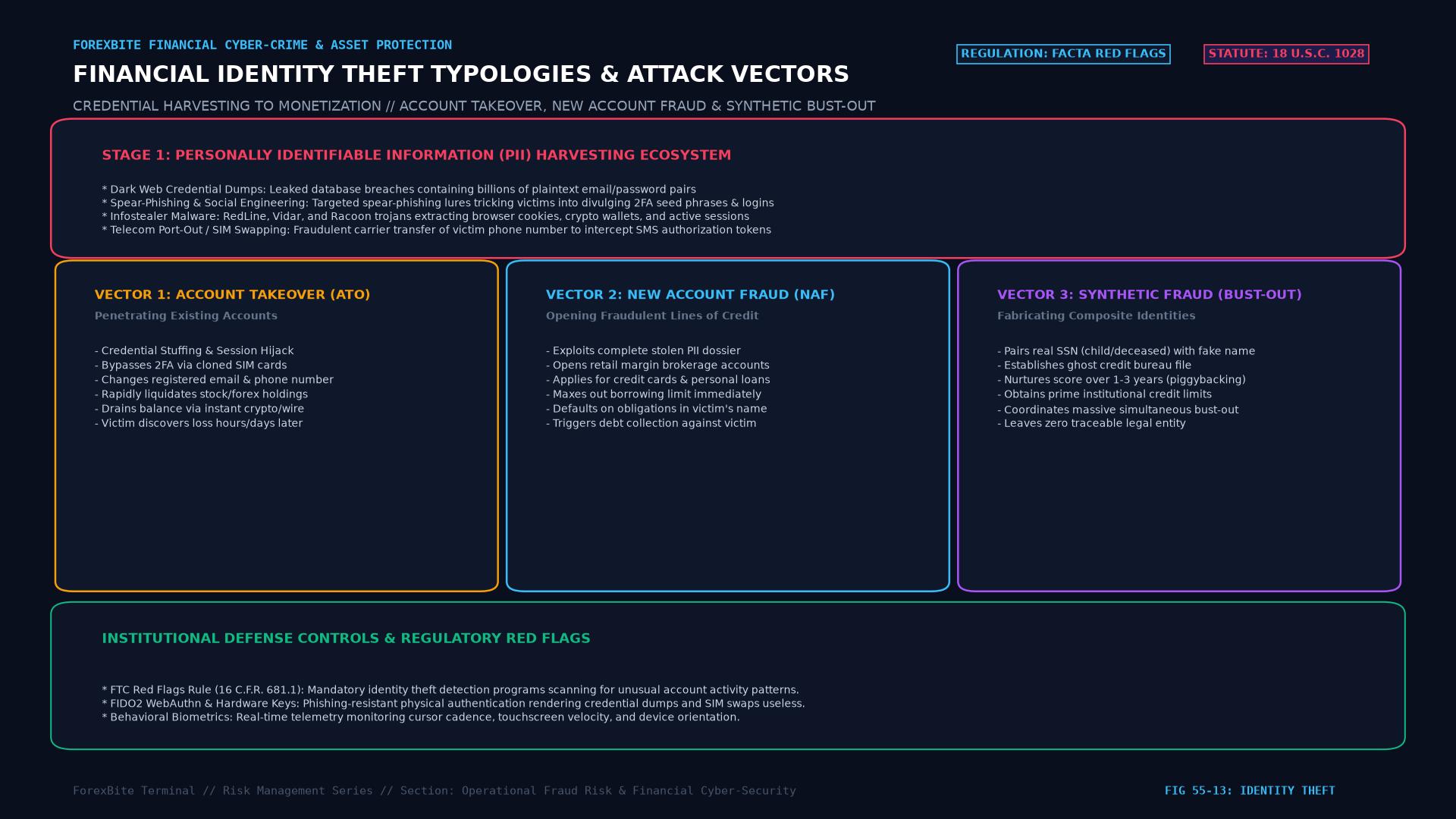 Figure: The primary financial identity theft typologies spanning Account Takeover (ATO), New Account Fraud (NAF), and Synthetic Identity Bust-Out.
The Legal and Regulatory Architecture
The institutional fight against identity theft in the United States is governed by several landmark federal statutes that define criminal liabilities and institutional compliance standards:
1. The Identity Theft and Assumption Deterrence Act of 1998
Codified under 18 U.S.C. § 1028, this landmark legislation established identity theft as an independent federal felony. Prior to 1998, federal law penalized solely the fraudulent misuse of physical government documents. The 1998 Act criminalized the unauthorized possession and transfer of the underlying means of identification itself, carrying penalties of up to 15 to 30 years’ imprisonment when committed in connection with financial fraud, terrorism, or transnational drug trafficking.
2. The Fair and Accurate Credit Transactions Act of 2003 (FACTA)
FACTA amended the Fair Credit Reporting Act (FCRA) to provide consumers and financial institutions with defensive mechanisms:
- Fraud Alerts: Established the right of consumers to place mandatory 90-day initial fraud alerts or seven-year extended fraud alerts on their nationwide credit bureau files.
- Redaction of Account Numbers: Mandated that retail point-of-sale receipt printers truncate credit card numbers, prohibiting the display of more than the last five digits or the expiration date.
- The Red Flags Rule (16 C.F.R. § 681.1): Enforced by the Federal Trade Commission (FTC), the Federal Reserve, the OCC, and the FDIC, the Red Flags Rule requires financial institutions and creditors to establish a formal, written Identity Theft Prevention Program capable of detecting, preventing, and mitigating warning signs (“red flags”) of identity theft across covered consumer accounts.
3. The 2018 EGRRCPA Free Credit Freeze Mandate
Section 301 of the Economic Growth, Regulatory Relief, and Consumer Protection Act of 2018 amended federal law to require Equifax, Experian, and TransUnion to provide free national credit freezes and unfreezes to all American consumers, eliminating state-level processing fees.
Operational Modalities: From Phishing to Account Takeover
Identity theft operations in global financial markets have evolved from physical mail theft and dumpster diving into automated, distributed cybercrime:
1. Account Takeover (ATO)
Account takeover represents the most immediate threat to retail brokerage and wealth management accounts:
- Credential Stuffing: Cybercriminals deploy automated botnets to test billions of stolen username-password pairs leaked from public corporate data breaches across banking and brokerage login portals.
- SIM Swapping: In a SIM swap attack, a fraudster impersonates a victim, contacting their mobile phone carrier to trick customer service representatives into porting the victim’s phone number to a criminal-controlled SIM card. Once successful, the attacker intercepts SMS-based two-factor authentication (2FA) one-time passcodes, resets the victim’s brokerage password, liquidates equity holdings, and wires funds offshore.
2. Synthetic Identity Theft
Considered by credit bureaus to be the fastest-growing form of identity theft, synthetic identity fraud does not target an adult victim’s full profile:
- Fraudsters harvest dormant Social Security Numbers belonging to children, prison inmates, or deceased individuals who do not actively use credit.
- The criminal pairs the real SSN with an invented name, artificial date of birth, and fabricated physical address, creating a hybrid “synthetic” entity.
- The criminal applies for retail store credit cards. Although initial applications are rejected, the inquiry creates a brand-new credit bureau file. Over months of responsible payments on small accounts, the synthetic profile builds an elite credit score, culminating in a coordinated multi-bank credit extraction (bust-out) before disappearing.
| Identity Theft Category | Primary Target Data | Direct Victim | Primary Financial Impact |
|---|---|---|---|
| New Account Fraud | Complete real PII profile | Individual consumer | Damaged credit rating; collections harassment |
| Account Takeover (ATO) | Banking/brokerage logins | Existing account holder | Immediate unauthorized balance liquidation |
| Synthetic Identity | Real SSN + Invented Name | Lending institutions | Credit default write-offs absorbed by banks |
| Tax Refund Fraud | SSN and wage W-2 data | IRS and taxpayer | Stolen federal and state tax refunds |
| Medical Identity Theft | Health insurance ID, SSN | Patient / Provider | Corrupted medical records; fraudulent claims |
Institutional Defenses and Risk Mitigation
To protect institutional capital and customer assets, modern financial platforms deploy defense-in-depth security architectures:
1. Elimination of SMS Two-Factor Authentication
Institutional brokerages have largely deprecated SMS text messages for high-value authorization. Platforms mandate time-based one-time password (TOTP) authenticator applications (such as Google Authenticator) or hardware security keys compliant with FIDO2 / WebAuthn protocols (such as YubiKeys), which are mathematically immune to phishing and SIM swapping.
2. Behavioral Analytics and Velocity Checks
Security operations centers deploy artificial intelligence to monitor user behavior after authentication:
- Sudden changes in keystroke dynamics or mouse velocity.
- Rapid alterations to payout banking account numbers immediately preceding large wire withdrawal requests.
- Requests originating from IP addresses associated with known VPNs or proxy networks that conflict with the customer’s typical physical trading location.
$$\text{Fraud Risk Score} = w_1(\Delta \text{IP Geolocation}) + w_2(\text{Device Unknown}) + w_3(\text{Immediate Withdrawal Request})$$
When risk thresholds are exceeded, the platform triggers an automated withdrawal hold, requiring biometric liveness facial scanning or out-of-band human compliance verification before releasing capital.
Frequently Asked Questions
What is the single most effective action a consumer can take to prevent new account identity theft?
Placing a security freeze on credit reports across all three nationwide credit reporting agencies (Equifax, Experian, and TransUnion) is the most powerful preventative step. A credit freeze locks access to the consumer’s credit file, preventing financial institutions from approving new credit cards, personal loans, or retail mortgages in the consumer’s name, even if a fraudster possesses the legitimate Social Security Number.
Are victims of identity theft legally liable for fraudulent debts run up in their name?
Under the Truth in Lending Act (Regulation Z) and the Electronic Fund Transfer Act (Regulation E), consumer liability for unauthorized credit card transactions is capped at a maximum of $50, and in practice, major card networks offer zero-liability protection. For unauthorized bank account withdrawals, consumers are protected if they notify the depository institution within 60 days of the statement showing the fraudulent transaction.
What is the FTC Red Flags Rule?
The FTC Red Flags Rule is a federal regulation requiring financial institutions, commercial banks, credit unions, and non-bank lenders to implement a formal, written program to detect the “red flags” of identity theft in their daily operations. Examples of red flags include alerts from credit bureaus, suspicious identification documents (altered photos or inconsistent physical traits), suspicious personal information (invalid address or phone number linked to known fraud), and unusual account activity (sudden changes in transaction volume).
Ready to trade forex?
Open a free demo account with a regulated broker. Practice with virtual funds before risking real money.