Idiosyncratic risk
Idiosyncratic risk is the asset-specific, unsystematic risk inherent to an individual company or asset that can be eliminated through portfolio diversification.
In modern financial economics and quantitative portfolio management, idiosyncratic risk (interchangeably termed unsystematic risk, specific risk, diversifiable risk, or residual risk) refers to the hazards unique to an individual company, issuer, or asset. Unlike systematic risk, which affects the entire macroeconomic environment (such as central bank interest rate hikes, wars, or global recessions), idiosyncratic risk stems entirely from microeconomic factors endogenous to a specific enterprise. Formally codified within Harry Markowitz’s Modern Portfolio Theory (MPT) and William Sharpe’s Capital Asset Pricing Model (CAPM), idiosyncratic risk possesses a defining mathematical property: it can be eliminated through portfolio diversification without sacrificing expected return.
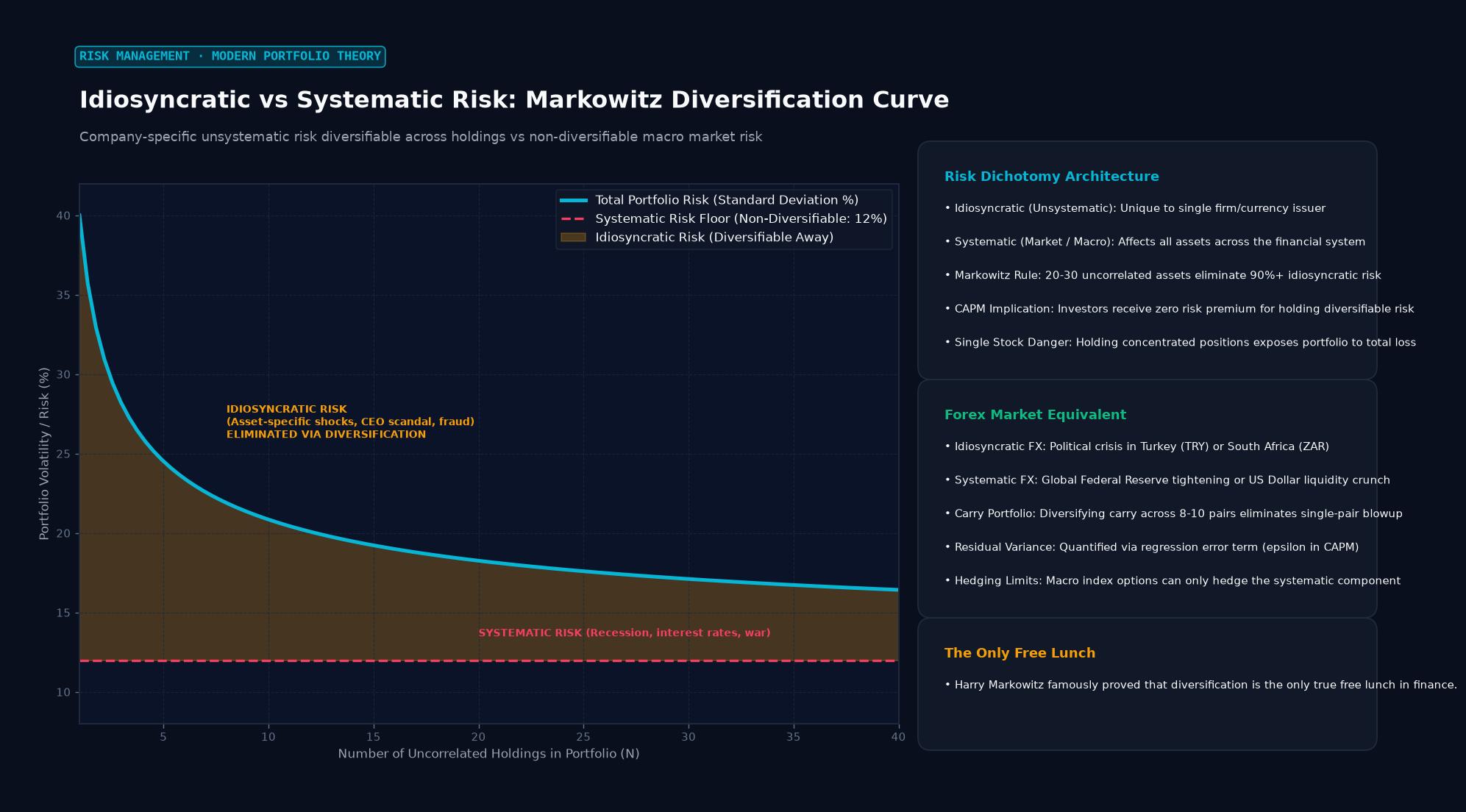 Figure: Company-specific unsystematic risk diversifiable across holdings vs non-diversifiable macro market risk
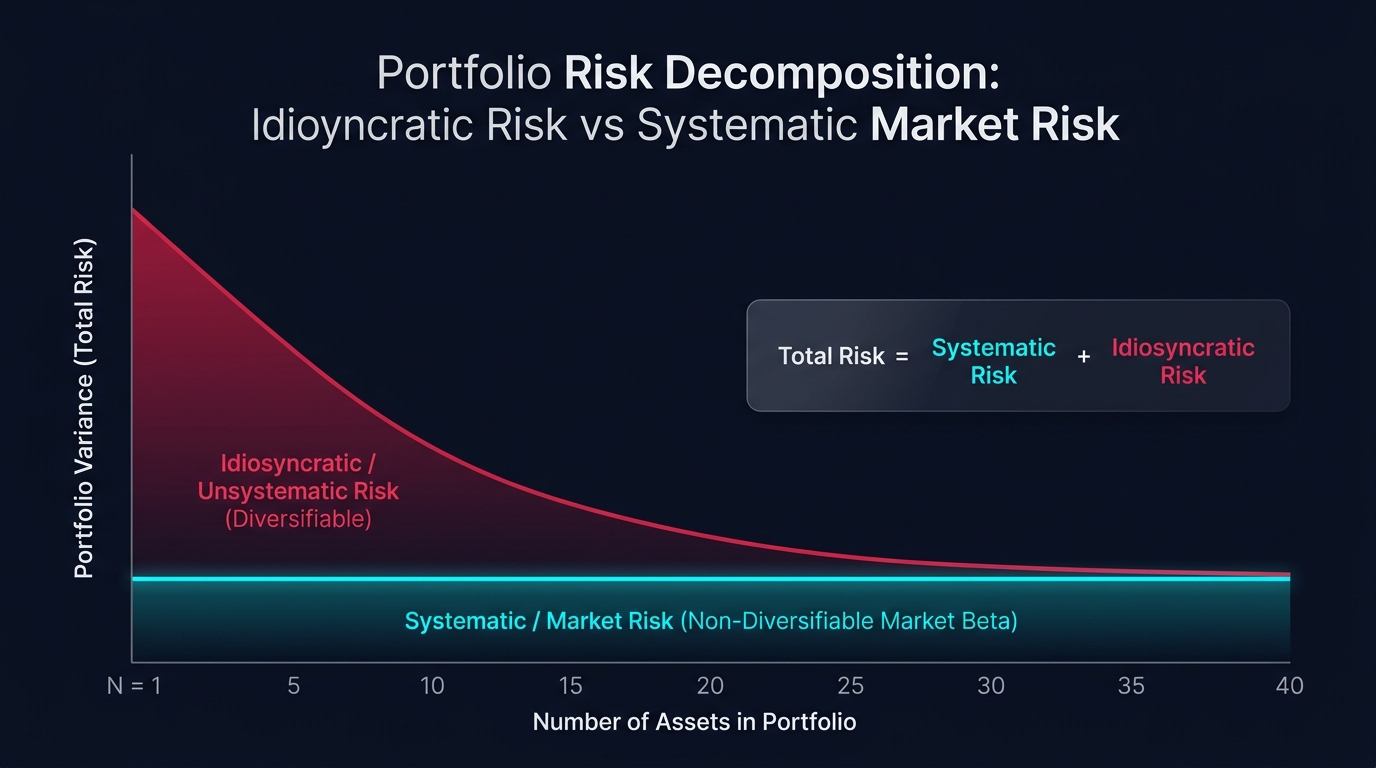
The Mathematical Framework: Total Variance Decomposition
Under the single-index Capital Asset Pricing Model, the realized return of any individual asset $i$ is modeled as a linear function of the broad market return plus an asset-specific residual:
$$R_i = \alpha_i + \beta_i R_M + \epsilon_i$$
Where:
- $\alpha_i$ represents the asset’s excess risk-adjusted return (Jensen’s Alpha).
- $\beta_i$ represents the asset’s systematic exposure to the market index ($R_M$).
- $\epsilon_i$ represents the random, zero-mean error term reflecting firm-specific events.
Assuming the idiosyncratic error term $\epsilon_i$ is completely uncorrelated with the market return ($\text{Cov}(\epsilon_i, R_M) = 0$), the total statistical variance ($\sigma_i^2$) of the asset decomposes into two distinct mathematical components:
$$\sigma_i^2 = \underbrace{\beta_i^2 \sigma_M^2}{\text{Systematic Risk}} + \underbrace{\sigma{\epsilon_i}^2}_{\text{Idiosyncratic Risk}}$$
In this equation:
- Systematic Risk Component ($\beta_i^2 \sigma_M^2$): The portion of volatility dictated by the asset’s covariance with the macro economy.
- Idiosyncratic Risk Component ($\sigma_{\epsilon_i}^2$): The residual variance generated purely by internal corporate developments.
The Mathematics of Diversification: Why Specific Risk Vanishes
The core insight of modern portfolio theory demonstrates that when multiple assets are combined into an equally weighted portfolio, idiosyncratic risk decays rapidly toward zero.
Consider a portfolio containing $N$ individual securities, each assigned an equal weight of $w_i = \frac{1}{N}$. The total variance of the portfolio ($\sigma_p^2$) is expressed as:
$$\sigma_p^2 = \frac{1}{N} \bar{\sigma}_i^2 + \left(1 - \frac{1}{N}\right) \overline{\text{Cov}}$$
Where:
- $\bar{\sigma}_i^2$ is the average variance of the individual stocks.
- $\overline{\text{Cov}}$ is the average pairwise covariance between all stocks in the portfolio.
As the number of uncorrelated assets ($N$) grows large, the mathematical limit reveals an extraordinary result:
$$\lim_{N \to \infty} \sigma_p^2 = \overline{\text{Cov}}$$
The first term, which contains the unique individual variances ($\bar{\sigma}_i^2$) containing idiosyncratic risk, is multiplied by $\frac{1}{N}$. As $N$ approaches infinity, this entire term vanishes. The portfolio’s remaining risk is determined purely by the average covariance between assets (the systematic market risk). Empirical financial research demonstrates that holding a portfolio of approximately 25 to 30 well-chosen, uncorrelated equities across diverse industry sectors eliminates more than 90 to 95 percent of an investor’s idiosyncratic risk.
Primary Sources of Idiosyncratic Risk
Idiosyncratic events are unpredictable, localized, and directly tied to an organization’s management, competitive positioning, and operational execution:
1. Management and Governance Failures
Corporate accounting scandals (such as Enron or Wirecard), sudden executive departures, catastrophic insider trading allegations, or destructive merger and acquisition decisions represent pure idiosyncratic risks. These events can cut a company’s market capitalization in half without impacting the broader S&P 500 index.
2. Regulatory and Clinical Disasters
In the biotechnology and pharmaceutical sectors, idiosyncratic risk reaches its most extreme manifestation. A clinical Phase III trial failure or an adverse Food and Drug Administration (FDA) rejection letter can trigger an immediate 70 to 80 percent single-day collapse in a small-cap biotech stock, even on a day when the broader market rallies.
3. Product Liability and Engineering Failures
Catastrophic manufacturing defects, such as fatal aerospace design flaws leading to global aircraft groundings, industrial chemical explosions, or massive automobile battery fire recalls, destroy firm value while leaving industry competitors largely unaffected (or even advantaged).
4. Labor Strikes and Localized Supply Chain Disruptions
A prolonged labor strike at a single mining concession or the destruction of a critical microchip fabrication foundry by an isolated fire constitutes firm-specific risk that does not impair unrelated market sectors.
| Feature / Dimension | Systematic Risk (Market Risk) | Idiosyncratic Risk (Specific Risk) |
|---|---|---|
| Origin / Source | Macroeconomic, geopolitical, monetary | Microeconomic, firm-specific, operational |
| Mathematical Symbol | Beta ($\beta$) and Market Variance ($\sigma_M^2$) | Residual Variance ($\sigma_{\epsilon}^2$) |
| Eliminated by Diversification? | No; persists across entire market | Yes; approaches zero in broad portfolio |
| Expected Market Compensation | Compensated via Equity Risk Premium | Zero excess return expected under CAPM |
| Primary Real-World Examples | Fed rate hikes, global wars, GDP recessions | CEO scandal, patent loss, factory fire |
Market Pricing and the Idiosyncratic Volatility Anomaly
A central tenet of modern asset pricing theory is that the market provides zero expected risk premium for bearing idiosyncratic risk.
Because an investor can eliminate idiosyncratic risk costlessly by simply holding a broad market index fund (such as an S&P 500 or MSCI World ETF), the market refuses to compensate investors for taking unnecessary, unforced risks. Investors are compensated solely for bearing systematic market risk ($\beta$), which cannot be diversified away. An investor who concentrates their life savings into a single single-stock bet takes massive idiosyncratic risk, but their expected return is governed purely by the stock’s market beta.
The Idiosyncratic Volatility (IVOL) Puzzle
In quantitative finance, the relationship between specific risk and realized returns presents a famous empirical anomaly documented by economists Andrew Ang, Robert Hodrick, Yuhang Xing, and Xiaoyan Zhang in 2006.
Standard finance theory suggests that if idiosyncratic risk matters at all, stocks with high idiosyncratic volatility should offer higher returns to compensate under-diversified investors. However, empirical market data across US and global equities revealed the opposite:
- Stocks with the highest idiosyncratic volatility historically delivered significantly lower subsequent risk-adjusted returns than stocks with low idiosyncratic volatility.
- Quantitative explanations for this “IVOL anomaly” include retail investor lottery-ticket preferences (overpaying for speculative, highly volatile stocks), limits to arbitrage, and corporate distress risk.
Frequently Asked Questions
Can an investor protect against idiosyncratic risk without buying dozens of stocks?
Yes. An investor can instantly eliminate idiosyncratic risk by purchasing broad-market exchange-traded funds (ETFs) or mutual funds that track diversified indices, such as the S&P 500, the Russell 2000, or the total stock market. Holding a fund containing hundreds or thousands of securities dilutes the impact of any single company failure to near zero.
Does idiosyncratic risk exist in foreign exchange (Forex) markets?
Yes. While global currency movements are heavily driven by systematic factors (such as global risk sentiment, US dollar dominance, and commodity super-cycles), individual currencies face idiosyncratic country-specific risks. Examples include sudden political coups, sovereign debt defaults, localized natural disasters, or unexpected central bank governor resignations that impact solely that nation’s currency.
How do hedge funds trade idiosyncratic risk?
Long-short equity hedge funds seek to profit exclusively from idiosyncratic risk while eliminating systematic market risk. By purchasing undervalued stocks (long) and shorting an equal dollar amount of overvalued stocks or index futures (short), the hedge fund achieves a net-zero market beta ($\beta = 0$). If their corporate fundamental analysis is correct, the fund generates pure alpha from company-specific performance, completely insulated from whether the broader market rises or falls.
Ready to trade forex?
Open a free demo account with a regulated broker. Practice with virtual funds before risking real money.