IDR
IDR is the ISO 4217 currency code for the Indonesian Rupiah, the official currency of the Republic of Indonesia, regulated by Bank Indonesia under a managed floating exchange rate regime.
The Indonesian Rupiah (ISO code: IDR, symbol: Rp) is the official currency of the Republic of Indonesia, the largest economy in Southeast Asia, an anchor member of ASEAN, and a prominent G20 sovereign. Regulated by Bank Indonesia (BI), the nation’s central bank headquartered in Jakarta, the rupiah operates under a market-determined floating exchange rate regime supported by active central bank intervention. Known historically for periodic vulnerability to global capital outflows during US Federal Reserve tightening cycles, the rupiah has undergone structural transformation driven by Indonesia’s downstream critical mineral industrialization (hilirisasi), substantial commodity export surpluses, and Bank Indonesia’s sophisticated multi-market intervention toolkit.
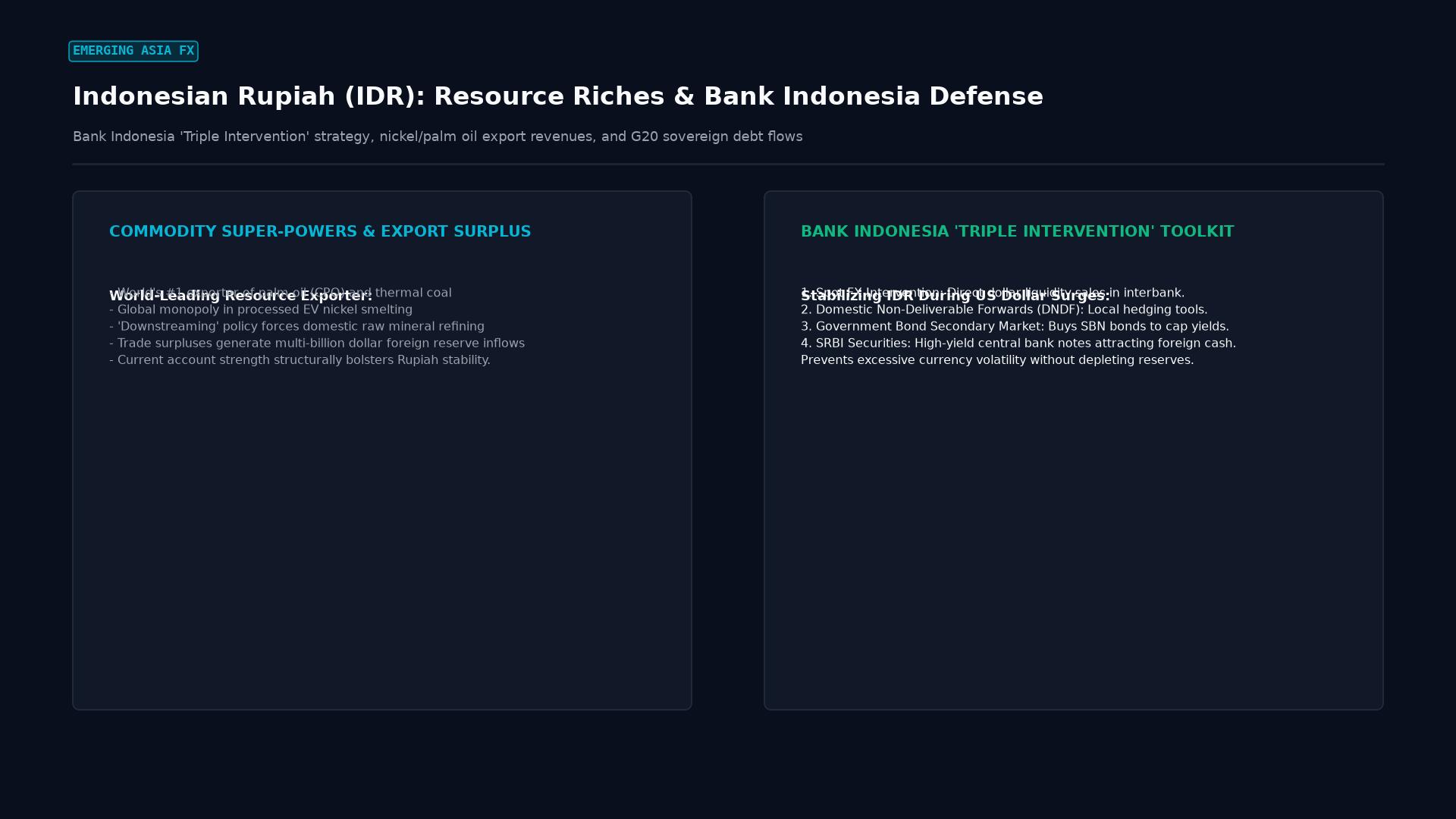 Figure: Bank Indonesia ‘Triple Intervention’ strategy, nickel/palm oil export revenues, and G20 sovereign debt flows
Historical Lineage and the 1997 Asian Financial Crisis
The term rupiah derives from the Sanskrit word rupyakam, meaning “wrought silver,” reflecting ancient Indian trade routes that connected Java and Sumatra with the Indian subcontinent. Following three centuries of Dutch colonial rule and the use of the Netherlands Indies Gulden, Indonesian nationalist leaders declared independence in 1945 and issued the first sovereign Indonesian currency, the Oeang Republik Indonesia (ORI).
On November 2, 1949, following international recognition of sovereignty, the modern Indonesian Rupiah was established as legal tender.
Modern Indonesian monetary history was permanently scarred by the 1997-1998 Asian Financial Crisis:
- Prior to the crisis, Bank Indonesia managed the rupiah through a crawling band regime against the US dollar.
- When speculative attacks forced the devaluation of the Thai Baht in July 1997, contagion spread immediately to Indonesia.
- Heavy unhedged foreign-currency corporate debt, severe banking insolvency, and political instability triggered catastrophic capital flight.
- On August 14, 1997, Bank Indonesia abandoned the crawling band, allowing the rupiah to float freely.
- The currency collapsed from approximately 2,400 IDR per USD in mid-1997 to an all-time low exceeding 16,800 IDR per USD in early 1998. The economic contraction exceeded 13 percent of GDP, leading to the collapse of the Suharto government, extensive banking nationalizations under the Indonesian Bank Restructuring Agency (IBRA), and sweeping central bank independence reforms codified in the Central Bank Act of 1999.
The currency is subdivided into 100 sen, although sen coins have long been retired from circulation due to cumulative depreciation. Banknotes circulate in large nominal denominations: 1,000, 2,000, 5,000, 10,000, 20,000, 50,000, and 100,000 rupiah. The 100,000-rupiah banknote depicts founding fathers Sukarno and Mohammad Hatta.
Bank Indonesia’s Operational Architecture: The Triple Intervention
Unlike advanced economy central banks that intervene solely through policy interest rates, Bank Indonesia operates an explicit, multi-market operational doctrine known as the Triple Intervention:
1. Spot Foreign Exchange Interventions
When corporate dollar demand outstrips supply, Bank Indonesia sells foreign currency from its international reserves directly into the onshore interbank spot market to satisfy commercial import requirements and prevent panic price gapping.
2. The Domestic Non-Deliverable Forward (DNDF) Market
Introduced by Bank Indonesia in November 2018, the DNDF market represents a major financial engineering innovation:
- In an offshore NDF (traded in Singapore or London), contracts settle in US dollars.
- A DNDF is an onshore forward contract traded between domestic banks and corporate clients, but settled exclusively in Indonesian Rupiah using Bank Indonesia’s official reference rate (JISDOR / Jakarta Interbank Spot Dollar Rate).
- By providing companies with an onshore hedging tool settled in local currency, Bank Indonesia anchors forward currency expectations without draining its physical US dollar foreign exchange reserves.
3. Sovereign Bond Market (SBN) Stabilization
Bank Indonesia actively intervenes in the secondary market for Indonesian government sovereign bonds (Surat Berharga Negara, or SBN). If foreign institutional investors stage sudden bond sales, the central bank buys sovereign debt to prevent bond yields from spiking, preserving financial stability.
$$\text{JISDOR Fixing} = \text{Volume-Weighted Average Rate of Interbank Spot Transactions (08:00 - 16:00 WIB)}$$
In 2023, Bank Indonesia augmented this toolkit by introducing Sekuritas Rupiah Bank Indonesia (SRBI) and Sekuritas Valas Bank Indonesia (SVBI). These pro-market monetary instruments offer attractive short-term yields to absorb foreign portfolio capital, replenishing national reserve buffers.
The Downstream Commodity Revolution (Hilirisasi)
A structural factor supporting the modern Indonesian Rupiah is the government’s aggressive industrial policy known as hilirisasi (downstream resource beneficiation).
Historically, Indonesia operated as a classic raw-material commodity exporter, shipping raw nickel ore, bauxite, and crude minerals to overseas smelters. This model generated low export margins and left the current account vulnerable to global commodity price drops:
- In 2020, President Joko Widodo enacted a total export ban on unprocessed raw nickel ore.
- The government mandated that foreign and domestic mining operators construct processing smelters within Indonesia.
- Global industrial conglomerates, led by Chinese stainless steel and EV battery manufacturers (such as Tsingshan Holding Group and CATL), invested over 30 billion dollars constructing advanced high-pressure acid leach (HPAL) smelters in industrial parks at Morowali (Central Sulawesi) and Weda Bay (North Maluku).
       INDONESIA'S CRITICAL MINERAL INDUSTRIAL TRANSFORMATION
       ======================================================

     PRE-2020: RAW ORE EXPORTS              POST-2020: DOWNSTREAM HILIRISASI
     +-----------------------------+        +-------------------------------+
     | Raw Nickel Ore Exported     |        | Raw Ore Export BANNED BY LAW  |
     | Low Value Added             |        | Foreign Billions Invested in  |
     | Annual Value: ~$1 Billion   |        | Onshore HPAL Smelters         |
     +-----------------------------+        +-------------------------------+
                   |                                        |
                   v                                        v
     +-----------------------------+        +-------------------------------+
     | CHRONIC TRADE DEFICITS      |        | HIGH-VALUE INDUSTRIAL EXPORTS |
     | Current account deficits    |        | EV Battery-Grade Nickel MHP,  |
     | left IDR vulnerable to      |        | Ferronickel, Stainless Steel  |
     | foreign capital flight      |        | Annual Value: >$30 Billion    |
     +-----------------------------+        +-------------------------------+
This structural shift transformed Indonesia into the world’s undisputed nickel capital (controlling over 50 percent of global supply). Together with major thermal coal exports to China and India, crude palm oil (CPO) shipments, and copper extraction from the giant Grasberg mine in Papua, Indonesia’s trade balance flipped from persistent deficits into multi-year monthly trade surpluses exceeding 3 billion to 5 billion dollars, creating a permanent structural supply of foreign currency to buffer the rupiah.
| Export Commodity | Global Market Position | Role in Stabilizing IDR |
|---|---|---|
| Nickel & Battery Metals | World’s #1 Producer (>50% global) | Generates tens of billions in high-margin industrial FX receipts |
| Thermal Coal | World’s #1 Seaborne Exporter | Heavy dollar inflows during global power generation crunches |
| Crude Palm Oil (CPO) | World’s #1 Producer & Exporter | Steady agricultural trade surplus; countercyclical food export |
| Copper & Gold (Grasberg) | World-class mega deposit | Processed at domestic smelters in Gresik; high corporate revenues |
Trading Dynamics and Foreign Institutional Participation
For international currency managers and fixed-income hedge funds, the Indonesian Rupiah offers distinct market dynamics:
- SBN Sovereign Bond Carry Trade: Foreign institutional investors hold a substantial share of local-currency Indonesian sovereign debt. When Bank Indonesia maintains an attractive yield spread over US Treasuries (typically 200 to 300 basis points) and inflation remains anchored below 3 percent, global investors allocate capital into SBN bonds, driving rupiah appreciation.
- Sensitivity to Chinese Economic Growth: Because China is Indonesia’s largest customer for coal, nickel, and industrial metals, the rupiah exhibits a high statistical beta to Chinese manufacturing PMIs and real estate construction activity.
- High Nominal Pricing: Due to historical inflation, USD/IDR trades at high nominal numbers (e.g., 15,000 to 16,500 IDR per USD). While redenominating the currency (cutting three zeros: 1,000 IDR to 1 new IDR) has been repeatedly planned by Bank Indonesia and the Ministry of Finance, implementation has been deferred to maintain macroeconomic focus during global financial transitions.
Frequently Asked Questions
Why does USD/IDR trade in such large numbers, such as 16,000 Rupiah per Dollar?
The high nominal exchange rate is a legacy of the 1997-1998 Asian Financial Crisis and historical periods of high inflation in the 1960s, during which the currency lost significant nominal value. However, high nominal exchange rates do not indicate modern economic weakness; Indonesia maintains an investment-grade sovereign credit rating, low public debt (under 40 percent of GDP), and strong foreign exchange reserves.
What is the difference between an offshore NDF and an onshore DNDF for the Rupiah?
An offshore Non-Deliverable Forward (NDF) is traded primarily in Singapore or London, regulated under ISDA rules, and settled in US dollars. An onshore Domestic Non-Deliverable Forward (DNDF) is traded within Indonesia under Bank Indonesia regulations, settled in Indonesian Rupiah using the official central bank JISDOR fixing rate. The DNDF allows domestic corporations to hedge currency exposure without consuming national foreign currency reserves.
How does Bank Indonesia use interest rates to defend the Rupiah?
When external capital outflows threaten to cause sharp rupiah depreciation, Bank Indonesia raises its benchmark policy rate (the BI-Rate). Higher domestic rates increase the yield on Indonesian government bonds and central bank bills (SRBI), widening the interest rate differential against the US Federal Reserve. This incentivizes foreign investors to retain capital within Indonesia, halting speculative currency sales.
Ready to trade forex?
Open a free demo account with a regulated broker. Practice with virtual funds before risking real money.