If-converted method
The if-converted method is an accounting convention used under ASC 260 and IAS 33 to compute diluted earnings per share by assuming convertible bonds or preferred stock were converted into common shares at the beginning of the period.
The if-converted method is a standardized financial accounting methodology mandated by the Financial Accounting Standards Board (FASB) under Accounting Standards Codification Topic 260 (ASC 260) and the International Accounting Standards Board (IASB) under International Accounting Standard 33 (IAS 33). Deployed in corporate financial reporting, the method calculates the dilutive impact of convertible securities (convertible bonds, convertible debentures, and convertible preferred stock) on a company’s Diluted Earnings Per Share (Diluted EPS). By simulating a scenario where all convertible security holders exercised their conversion rights into common stock at the beginning of the reporting period, the if-converted method provides investors with a conservative, worst-case assessment of potential equity dilution.
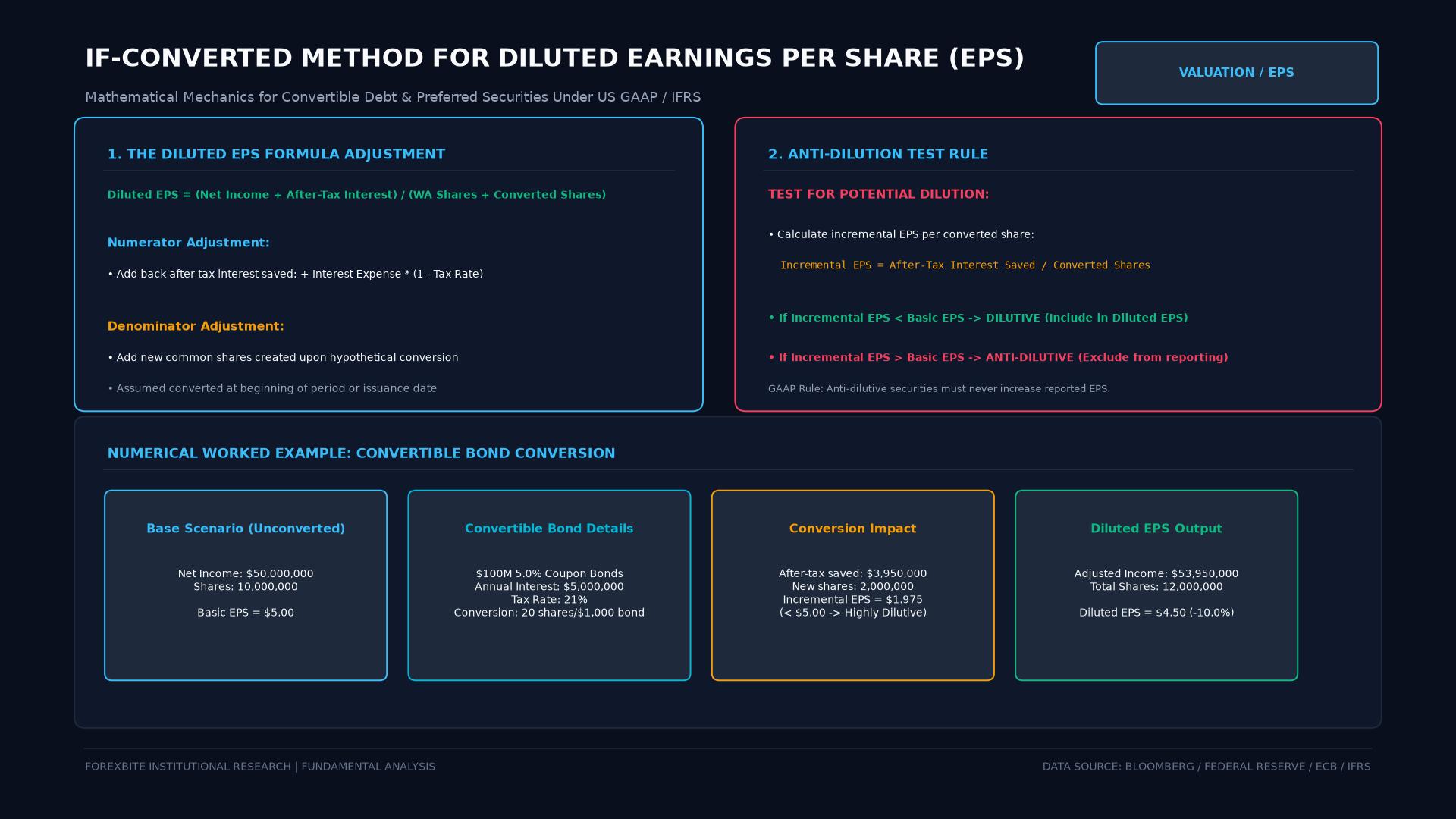 Figure: Mathematical mechanics of the If-Converted Method for convertible bonds and preferred shares, illustrating numerator after-tax interest adjustments, denominator share expansion, and anti-dilution test rules.
The Mathematical Framework: Numerator and Denominator Mechanics
Basic Earnings Per Share reflects historical accounting realities: dividing the net income available to common stockholders by the weighted-average number of common shares actually outstanding during the period:
$$\text{Basic EPS} = \frac{\text{Net Income} - \text{Preferred Stock Dividends}}{\text{Weighted-Average Common Shares Outstanding (WACSO)}}$$
When an enterprise issues convertible securities, the capital structure becomes complex. Convertible securities possess hybrid characteristics: they pay interest or preferred dividends, but can be exchanged at the holder’s option into common equity.
To compute Diluted EPS, the if-converted method assumes hypothetical conversion occurred on the first day of the fiscal year (or on the date of issuance during the year, if issued later). This hypothetical conversion requires two synchronized mathematical adjustments:
1. The Numerator Adjustment (Income Restoration)
-
Convertible Debt (Bonds and Notes): If debt holders had converted their bonds into common equity on day one, the corporation would not have paid any interest expense on those bonds. Consequently, net income would have been higher. However, because interest expense is tax-deductible, eliminating interest increases taxable corporate income. Therefore, the numerator is adjusted by adding back the after-tax interest expense:
$$\text{Numerator Adjustment}_{\text{Debt}} = \text{Pre-Tax Interest Expense} \times (1 - \text{Effective Marginal Tax Rate})$$
-
Convertible Preferred Stock: Preferred dividends are paid out of after-tax net income and are not tax-deductible. If preferred shareholders convert to common stock, the corporation saves the preferred dividend entirely. Therefore, the numerator is adjusted by adding back the gross preferred dividend:
$$\text{Numerator Adjustment}_{\text{Preferred}} = +\text{Preferred Dividends Declared}$$
2. The Denominator Adjustment (Share Dilution)
The denominator expands by adding the weighted-average number of additional common shares that would have been issued if the conversion privileges had been exercised:
$$\text{Incremental Shares} = \text{Total Convertible Par Value} \times \text{Conversion Ratio}$$
$$\text{Diluted EPS}_{\text{Convertible Debt}} = \frac{\text{Net Income Available} + [\text{Interest Expense} \times (1 - t)]}{\text{WACSO} + \text{Incremental Conversion Shares}}$$
Comprehensive Numerical Case Study
Consider Global Tech Corporation with the following audited capital structure:
- Net Income for the Fiscal Year: $10,000,000
- Effective Corporate Tax Rate: 25%
- Common Shares Outstanding: 2,000,000 shares
- Convertible Debt in Issue: $20,000,000 face value of 6% convertible bonds.
- Conversion Terms: Each $1,000 bond is convertible into 25 shares of common stock (totaling $20,000 \times 25 = 500,000$ potential common shares).
Step 1: Compute Basic Earnings Per Share
Basic EPS = $10,000,000 / 2,000,000 shares = $5.00 per share

Step 2: Calculate the Numerator Adjustment
Annual Pre-Tax Interest = $20,000,000 x 0.06 = $1,200,000
After-Tax Interest Saved = $1,200,000 x (1 - 0.25) = $900,000
Adjusted Numerator = $10,000,000 + $900,000 = $10,900,000

Step 3: Calculate the Denominator Adjustment
Incremental Conversion Shares = 500,000 shares
Adjusted Denominator = 2,000,000 + 500,000 = 2,500,000 shares

Step 4: Compute Diluted EPS
Diluted EPS = $10,900,000 / 2,500,000 shares = $4.36 per share
Because the resulting Diluted EPS ($4.36) is lower than Basic EPS ($5.00), the convertible debt is dilutive. The company is required by law to report a Diluted EPS of $4.36 on the face of its SEC Form 10-K income statement.
| Parameter | Basic EPS Calculation | If-Converted Diluted EPS (Debt) | If-Converted Diluted EPS (Preferred) |
|---|---|---|---|
| Numerator Base | Net Income minus Pref. Div | Add back After-Tax Interest | Add back Preferred Dividends |
| Tax Impact | Reflects actual tax expense | Taxes rise as interest drops | Zero tax impact (dividends after-tax) |
| Denominator Base | Actual common shares only | Add assumed common shares | Add assumed common shares |
| Hypothetical Date | Actual historical dates | First day of fiscal period | First day of fiscal period |
| Regulatory Scope | SEC / GAAP mandatory | SEC / GAAP mandatory | SEC / GAAP mandatory |
The Antidilution Integrity Test
A foundational principle of GAAP and IFRS financial reporting is that Diluted EPS is designed to measure downside risk. Financial accounting rules strictly prohibit reporting a Diluted EPS figure that is higher than Basic EPS (or reporting a diluted loss per share that is lower than basic loss per share).
If including a convertible security would increase EPS, the security is legally classified as antidilutive and must be excluded from the Diluted EPS calculation.
To determine whether a security is antidilutive, financial analysts calculate the security’s incremental EPS:
$$\text{Incremental EPS} = \frac{\text{After-Tax Interest Saved (or Preferred Dividend Saved)}}{\text{Incremental Common Shares Issued}}$$
If the Incremental EPS is greater than Basic EPS:
- The security is antidilutive.
- Converting the security would add more to the numerator (earnings) than it adds proportionally to the denominator (shares).
- The accountant must ignore the security, reporting Diluted EPS based solely on other genuinely dilutive instruments.
$$\text{Antidilution Decision Rule}: \quad \text{If } \text{Incremental EPS} > \text{Basic EPS} \implies \text{EXCLUDE FROM DILUTED EPS}$$
If-Converted Method vs Treasury Stock Method
Investors frequently confuse the two primary dilution methodologies mandated under ASC 260:
1. The If-Converted Method
- Applies Exclusively To: Convertible securities (convertible debentures, convertible notes, and convertible preferred stock).
- Core Mechanism: Assumes debt or preferred equity is permanently retired and replaced with newly issued common equity, adjusting both the earnings numerator and the share denominator.
2. The Treasury Stock Method
- Applies Exclusively To: Stock options, stock warrants, and unvested Restricted Stock Units (RSUs).
- Core Mechanism: Assumes that options and warrants are exercised at the strike price, and the hypothetical cash proceeds received by the company are immediately used to repurchase common shares on the open market at the average stock price during the period. Only the net incremental shares expand the denominator, with zero adjustment to the earnings numerator.
Frequently Asked Questions
What happens under the if-converted method if a company reports a net loss?
If a corporation reports a net loss from continuing operations, all convertible securities and options are automatically deemed antidilutive. Exercising or converting securities would expand the share count, which would mathematically decrease the net loss per share (making performance appear less severe). Therefore, in loss periods, Diluted EPS is legally required to be reported as identical to Basic EPS.
How are convertible securities issued mid-year treated under the if-converted method?
If convertible bonds or preferred shares were issued during the current fiscal year (e.g., on October 1 of a calendar fiscal year), the if-converted method does not assume conversion on January 1. Instead, conversion is assumed to have occurred on the actual date of issuance (October 1). The incremental shares and after-tax interest savings are weighted on a time-apportioned basis for the remaining three months of the fiscal year.
How does FASB ASU 2020-06 impact the if-converted method?
In August 2020, FASB issued Accounting Standards Update (ASU) 2020-06, simplifying the accounting for convertible debt instruments. The update eliminated several complex legacy separation models (such as cash conversion and beneficial conversion features) and mandated that virtually all convertible debt instruments must be evaluated using the if-converted method in Diluted EPS calculations, ending the use of the alternative treasury stock method for certain cash-settled convertible bonds.
Ready to trade forex?
Open a free demo account with a regulated broker. Practice with virtual funds before risking real money.