International Securities Dealers Association (ISDA)
The International Swaps and Derivatives Association (ISDA)—historically referred to in early OTC documents as the International Swap Dealers Association—is the leading global trade organization representing participants in the over-the-counter (OTC) derivatives and interbank financial markets.
What Is the International Swaps and Derivatives Association (ISDA)?
The International Swaps and Derivatives Association (ISDA)—often referenced in legacy financial literature as the International Swap Dealers Association or erroneously titled the International Securities Dealers Association—is the preeminent private global trade body governing over-the-counter (OTC) derivatives. Formed in 1985 in New York by eighteen swap-dealing financial institutions, ISDA represents commercial banks, investment banks, asset managers, energy and commodities firms, insurance companies, and sovereign wealth funds across more than 75 countries.
Rather than acting as a statutory government regulator like the U.S. Commodity Futures Trading Commission (CFTC) or the UK Financial Conduct Authority (FCA), ISDA operates as a market-driven self-regulatory architect. Its primary mission is standardizing legal contracts, reducing counterparty credit risk, and fostering legal certainty across privately negotiated derivative contracts—including foreign exchange forwards, cross-currency swaps, interest rate swaps (IRS), and credit default swaps (CDS).
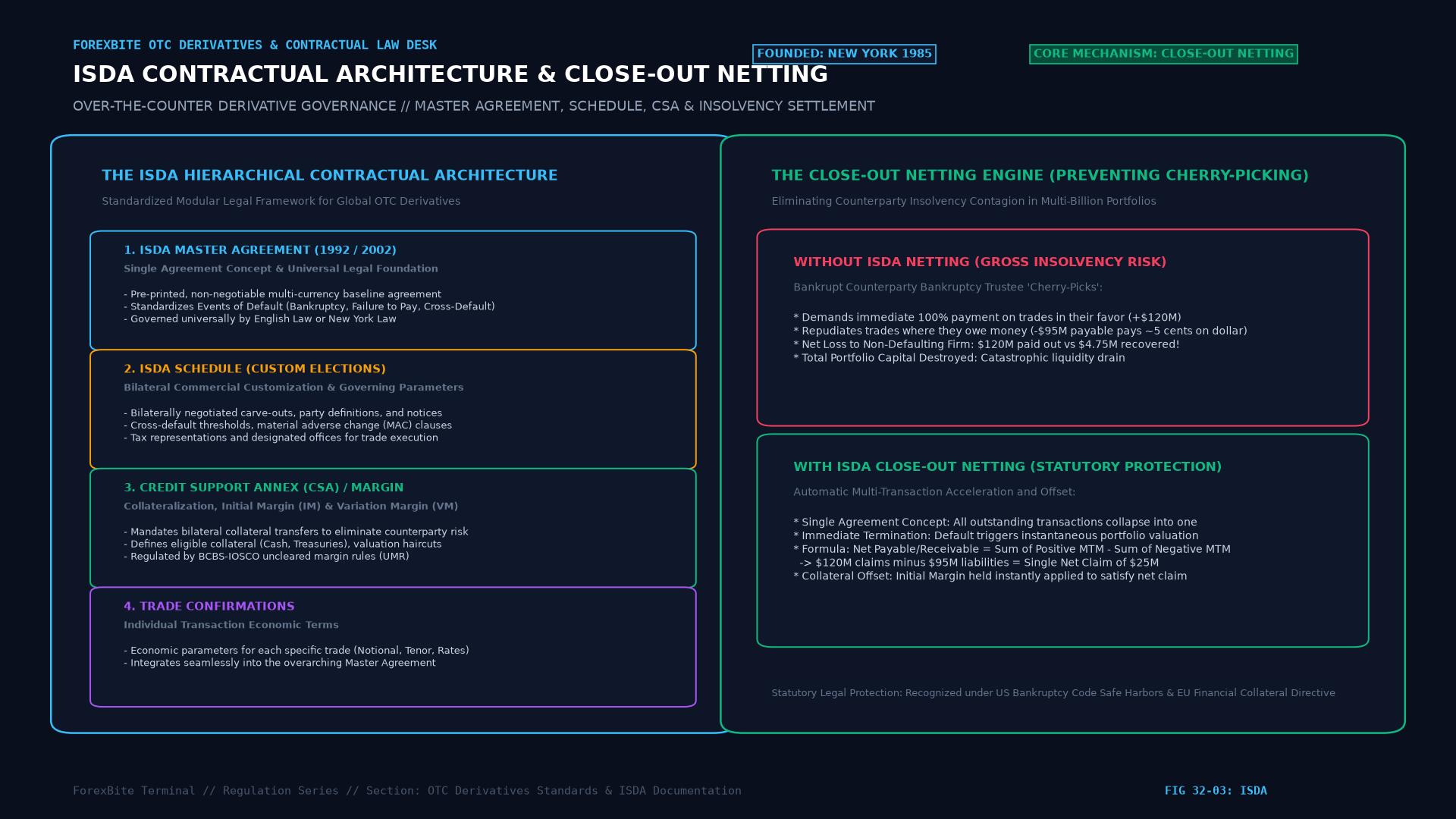 Figure: The ISDA documentation hierarchy (Master Agreement, Schedule, CSA, Confirmations) and the close-out netting engine protecting against counterparty cherry-picking.
Key Takeaways
- Industry Standard Framework: ISDA authored the ISDA Master Agreement (1992 and 2002 versions), establishing the universal baseline for bilaterally negotiated OTC derivatives.
- Close-Out Netting: The cornerstone of ISDA documentation is legally enforceable multi-transaction netting, allowing non-defaulting parties to aggregate all outstanding trades into a single net payable or receivable amount upon counterparty insolvency.
- Credit Support Annex (CSA): Establishes explicit rules for posting initial margin (IM) and variation margin (VM), eligible collateral types, and valuation dispute procedures.
- Global Documentation Standards: Publishes standard transaction definitions and protocols, including the 1998 FX and Currency Option Definitions and the 2006/2021 Interest Rate Definitions.
- Determinations Committees (DCs): Independent regional committees established by ISDA that adjudicate whether a “Credit Event” (such as bankruptcy, failure to pay, or restructuring) has occurred on a sovereign or corporate entity.
Core Pillars of ISDA Governance
1. The ISDA Master Agreement
The ISDA Master Agreement functions as a single umbrella contract under which all future derivative transactions between two counterparties take place. Every individual trade confirmation incorporates the Master Agreement by reference. Crucially, the agreement treats all individual trades not as separate contracts, but as a single overarching legal obligation.
This structural design prevents “cherry-picking” by bankruptcy trustees. If a bank defaults, a receiver cannot legally enforce winning contracts while rejecting losing ones; instead, the entire portfolio of trades is liquidated simultaneously.
2. Close-Out Netting Mechanics
In the absence of ISDA netting, a financial institution with 100 open currency swaps against a failing counterparty would face extreme credit exposure:
$$\text{Gross Credit Exposure} = \sum_{i=1}^{n} \max(V_i, 0)$$
Under an active ISDA Master Agreement with valid bilateral close-out netting recognized across local bankruptcy jurisdictions:
$$\text{Net Credit Exposure} = \max\left( \sum_{i=1}^{n} V_i, 0 \right)$$
Where $V_i$ represents the mark-to-market replacement value of transaction $i$. Close-out netting routinely reduces interbank credit and capital requirements by 80% to 95%.
3. The Credit Support Annex (CSA)
The CSA is a legal document that regulates collateral posting between counterparties. Following the 2008 global financial crisis and the subsequent Basel III / BCBS-IOSCO non-cleared derivatives margin requirements, uncleared bilateral FX forwards and swaps require daily exchange of Variation Margin (VM) and, for large counterparties, regulatory Initial Margin (IM) held in segregated third-party custodian accounts.
ISDA Master Agreement: 1992 vs. 2002 Comparison
| Dimension | 1992 Master Agreement (Multi-Currency) | 2002 Master Agreement |
|---|---|---|
| Market Standard | Widely used legacy framework; still governs older trades | Modern institutional standard for bilateral OTC derivatives |
| Close-Out Valuation | “Market Quotation” or “Loss” methods | Single “Close-out Amount” standard based on commercially reasonable valuation |
| Grace Periods | Longer grace periods (e.g., 30 days for breach of agreement, 3 days for failure to pay) | Sharply reduced grace periods (1 business day for failure to pay) |
| Force Majeure | Relied on “Impossibility” termination provisions | Dedicated Force Majeure Event with a 30-day waiting period |
| Set-Off Rights | Optional bilateral addition via schedule | Express contractual set-off clause built into Section 6(f) |
| Interest on Default | Default rate based on prime/lending reference rates | Detailed interest calculation hierarchy based on cost of funds |
Real-World Case Study: The 2008 Lehman Brothers Default
When Lehman Brothers Holdings Inc. filed for Chapter 11 bankruptcy on September 15, 2008, it held millions of open OTC derivative contracts across thousands of global counterparties, representing hundreds of billions in gross notional exposure.
Because almost all major investment banks and dealers transacted with Lehman under ISDA Master Agreements:
- Counterparties immediately exercised their contractual rights under Section 5(a)(vii) (Bankruptcy Default Event).
- All outstanding FX swaps, interest rate hedges, and credit derivatives were designated for Early Termination.
- Counterparties calculated the aggregate replacement cost (Close-out Amount) of all open contracts, applied the cash and Treasury collateral held under CSAs, and collapsed their gross claims into a single net receivable or payable balance.
- While the failure caused systemic liquidity stress, the legal enforceability of ISDA close-out netting prevented the entire interbank derivatives settlement system from collapsing into perpetual litigation.
Risk Considerations and Pitfalls
- Enforceability Across Jurisdictions: Close-out netting relies on local insolvency legislation recognizing insolvency carve-outs. ISDA annually obtains formal legal opinions across more than 80 sovereign jurisdictions to verify whether local courts will enforce netting against bankrupt entities.
- Cross-Default Triggers: ISDA schedules often include “Cross-Default” clauses, meaning a default on commercial paper or bank loans exceeding a negotiated threshold automatically triggers an early termination event on all derivatives.
- Operational Margin Calls: Failure to meet a CSA margin call within tight operational windows (often by 1:00 PM local time on T+1) can constitute an event of default, potentially triggering sudden unwinding of firm-wide currency hedges.
Frequently Asked Questions (FAQ)
Is ISDA a government regulator?
No. ISDA is a private, non-profit trade association. It does not possess statutory enforcement or investigative powers. However, international financial regulators—such as the Basel Committee, CFTC, SEC, and ESMA—routinely consult ISDA when drafting derivatives legislation, and market participants treat ISDA standardized contracts as binding civil agreements.
What is an ISDA Confirmation?
An ISDA Confirmation is a legal document exchanged between two trading counterparties following the verbal or electronic execution of a trade. It details the precise economic terms: notional amount, trade date, settlement dates, exchange rate or fixed/floating interest rate, payment accounts, and specific market disruption fallback rules.
How does ISDA affect retail forex traders?
Retail forex traders rarely execute an ISDA Master Agreement directly because retail traders execute off-exchange spot forex contracts governed by retail broker customer agreements. However, retail brokers maintain institutional prime brokerage and liquidity provider accounts with Tier-1 banks governed entirely by ISDA Master Agreements and CSAs.
Ready to trade forex?
Open a free demo account with a regulated broker. Practice with virtual funds before risking real money.