Settlement Risk
The danger that one counterparty in a financial transaction will fulfill its contractual commitment by delivering funds or assets, but the other counterparty will fail or default before delivering its reciprocal obligation; historically known as Herstatt Risk.
What Is Settlement Risk?
Settlement risk—often referred to interchangeably as principal risk or Herstatt risk—is the probability that a financial institution will complete its leg of a transaction by transferring currency, securities, or commodities to a counterparty, but the counterparty defaults, becomes insolvent, or experiences operational failure before fulfilling its reciprocal payment obligation.
Unlike ordinary market risk (which involves price fluctuations) or general credit risk (which involves an obligor failing to repay a loan), settlement risk involves the complete loss of the principal notional amount exchanged. In the multitrillion-dollar over-the-counter (OTC) foreign exchange market, where trades regularly exceed hundreds of millions of dollars and involve currencies settling across different global time zones, settlement risk represents the single greatest threat to systemic financial stability.
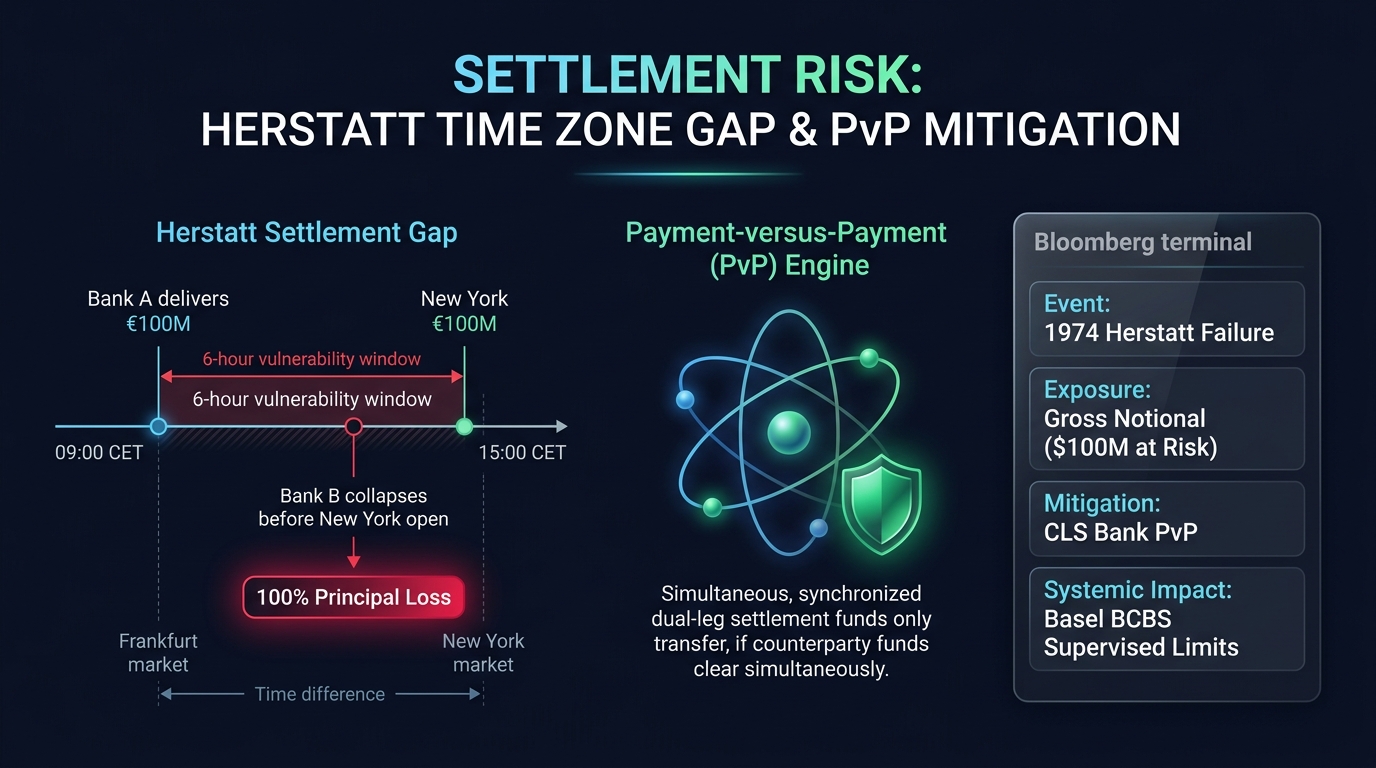
                      THE ANATOMY OF CROSS-BORDER SETTLEMENT RISK

  TIME: 09:00 Central European Time (Frankfurt)
  Bank A executes EUR/USD trade with Bank B.
  Bank A irrevocably transfers €100,000,000 to Bank B via TARGET2.
                     │
                     ▼
  TIME GAP: 6-Hour Time Zone Asymmetry & Settlement Window
  Bank A has surrendered legal ownership of €100,000,000.
  Bank B's correspondent bank in New York has NOT yet opened.
                     │
                     ▼
  TIME: 13:00 Eastern Standard Time (New York)
  Bank B collapses into bankruptcy or regulators freeze assets.
  Bank B's receiver halts all outgoing payments.
                     │
                     ▼
  [ RESULT: BANK A SUFFERS COMPLETE PRINCIPAL LOSS OF €100,000,000 ]
The Four Dimensions of Settlement Risk
The Basel Committee on Banking Supervision (BCBS) categorizes settlement risk into four interrelated components:
- Principal Risk: The risk that an institution pays away the full principal value of a sold currency but receives nothing in return. This is the most destructive form of financial risk, capable of causing instantaneous insolvency.
- Replacement Cost Risk (Pre-Settlement Risk): The risk that a counterparty defaults prior to the settlement date. While no principal has been lost, the surviving institution must replace the transaction in the open market at prevailing rates, potentially absorbing large adverse price swings.
- Liquidity Risk: The risk that a counterparty fails to settle on time, forcing the non-defaulting party to scramble for emergency intraday central bank liquidity or commercial loans to fund its own downstream payment commitments.
- Operational Risk: Disruptions in payment messaging networks (such as SWIFT telecommunications failures or national RTGS outages) that delay the execution of settlement instructions.
Mathematical Formulation: Principal Risk vs. Replacement Cost
Institutional risk engines quantify settlement exposure across two distinct mathematical models:
1. Principal Settlement Exposure (Gross Notional At Risk)
During the irrevocable settlement window (between payment release and confirmed receipt), the maximum potential loss equals the entire gross notional value:
$$\text{Principal Exposure} = \text{Notional Value of Delivered Currency}$$
If an institution transfers $500,000,000 worth of Japanese Yen, its principal risk exposure is exactly $500,000,000 until the counterparty’s U.S. Dollars settle irrevocably.
2. Replacement Cost Exposure (Pre-Settlement Value)
Prior to the actual settlement date, risk is modeled as the positive mark-to-market (MTM) replacement value:
$$\text{Replacement Exposure} = \max\left(0, V_{\text{current}} - V_{\text{contract}}\right)$$
If an institution holds an FX forward contract showing an unrealized gain of $12,000,000 and the counterparty defaults three weeks before maturity, the replacement loss is limited to the $12,000,000 mark-to-market gain.
Settlement Risk vs. Counterparty Risk vs. Market Risk
| Risk Category | What Is at Stake? | Primary Cause | Typical Mitigation Mechanism |
|---|---|---|---|
| Settlement Risk | 100% of Principal Notional Value | Insolvency during the cross-time-zone delivery window | Payment-versus-Payment (PvP) via CLS Bank; DvP clearing |
| Counterparty Credit Risk | Positive mark-to-market value & unpaid margins | Default or bankruptcy prior to trade settlement date | Variation margin collateral, ISDA Master Agreement netting |
| Market Risk | Adverse changes in asset prices, interest rates, or FX | Economic reports, central bank policy, geopolitical events | Stop-loss orders, options hedges, portfolio diversification |
Real-World Institutional Case Study: Lehman Brothers Bankruptcy (September 2008)
The ultimate real-world test of global foreign exchange settlement infrastructure occurred on September 15, 2008, when Lehman Brothers Holdings Inc. filed for Chapter 11 bankruptcy—the largest corporate failure in history.
       LEHMAN BROTHERS COLLAPSE & THE CLS STABILIZATION

 The Crisis:
 - Lehman Brothers was an active counterparty in thousands of pending FX trades
   totaling tens of billions of dollars across every major currency.
 - Global banks faced the terrifying prospect of sending funds to Lehman's accounts
   and receiving nothing in return (Herstatt catastrophe on a systemic scale).

 The Resolution via CLS Bank:
 1. CLS Bank's Payment-versus-Payment (PvP) rules meant no currency was released
    to Lehman unless Lehman's correspondent bank funded the reciprocal leg.
 2. On the day Lehman collapsed, CLS settled $1.55 TRILLION in total transactions
    across 430,000 separate trade instructions.
 3. ZERO PRINCIPAL LOSSES occurred across any CLS-settled FX transactions.
By halting trades where Lehman could not fund its obligations and returning funds safely to solvent banks, CLS Bank prevented a domino cascade of interbank insolvencies that could have paralyzed the international banking system.
Modern Institutional Architecture for Eliminating Settlement Risk
Financial institutions and regulators utilize four cornerstone mechanisms to neutralize settlement vulnerabilities:
                  THE SETTLEMENT RISK DEFENSE HIERARCHY

           [ Continuous Linked Settlement (CLS Bank - PvP) ]
           - Real-time simultaneous multi-currency settlement
           - Eliminates principal risk across 18 major currencies
                                    │
                                    ▼
           [ Central Counterparty Clearinghouses (CCPs) ]
           - LCH ForexClear, CME Clearing
           - CCP interposes itself as buyer to every seller
                                    │
                                    ▼
           [ Legal Netting: ISDA Master Agreement ]
           - Bilateral close-out netting collapses gross obligations
           - Reduces gross settlement liquidity needs by 85% to 95%
                                    │
                                    ▼
           [ Basel III Intraday Monitoring (BCBS 248) ]
- Mandates banks track real-time intraday liquidity buffers- Continuous Linked Settlement (CLS Bank): Settles both sides of an FX trade simultaneously using a Payment-versus-Payment (PvP) architecture connected to central bank payment engines.
- Central Counterparty Clearing (CCPs): Clears standardized OTC FX forwards and non-deliverable forwards (NDFs), mutualizing default risk and guaranteeing performance through a dedicated default waterfall.
- ISDA Master Agreement & Bilateral Netting: Compresses gross delivery obligations between two institutions into a single net payment, minimizing the absolute dollar amount moving across international payment rails.
Frequently Asked Questions
What was the original “Herstatt Risk” that defined settlement risk?
In June 1974, German regulators forced the liquidation of Bankhaus Herstatt at 4:30 PM Frankfurt time after European banks had already transferred millions of Deutsche Marks to it. Because New York banks were just opening and had not yet received their reciprocal US Dollars, Herstatt’s New York accounts were frozen, inflicting massive principal losses on counterparties. This cross-currency time-lag risk was forever named “Herstatt Risk.”
Do retail forex traders face settlement risk?
Retail traders do not face direct interbank settlement risk because retail brokers operate on a cash-settled margin basis without physical currency delivery. However, retail traders face counterparty broker risk: if the brokerage firm becomes insolvent or mismanages segregated client funds, the trader may lose their deposited account equity.
Why hasn’t settlement risk been eliminated in emerging market currencies?
CLS Bank only supports 18 major convertible currencies (such as USD, EUR, GBP, JPY, AUD, CAD, and CHF). Emerging market currencies (such as the Indian Rupee, Chinese Yuan, Brazilian Real, and Nigerian Naira) are subject to sovereign capital controls and cross-border currency restrictions, preventing them from joining CLS and leaving trades in these currencies exposed to bilateral settlement risk.
Ready to trade forex?
Open a free demo account with a regulated broker. Practice with virtual funds before risking real money.