Joint Account
A joint account is a bank, brokerage, or financial trading account shared by two or more individuals or legal entities, granting each co-owner specified rights to deposit, trade, withdraw, and manage assets according to contractual ownership structures.
What Is a Joint Account?
A joint account is a custodial, banking, or brokerage account opened and maintained simultaneously by two or more individuals or legal entities. While commonly utilized by married couples or domestic partners for everyday household banking, joint accounts are also widely established in foreign exchange (Forex), commodities, and securities trading by business partners, investment syndicates, and family offices looking to pool liquid capital into a unified trading vehicle.
Under standard financial law, co-owners of a joint account share legal ownership of all deposited capital, open positions, and accrued interest or trading profits. However, the exact rights of each holder—including whether one party can trade independently, withdraw funds, or inherit assets upon the other’s death—depend strictly on the legal structure designated at the time the account is opened.
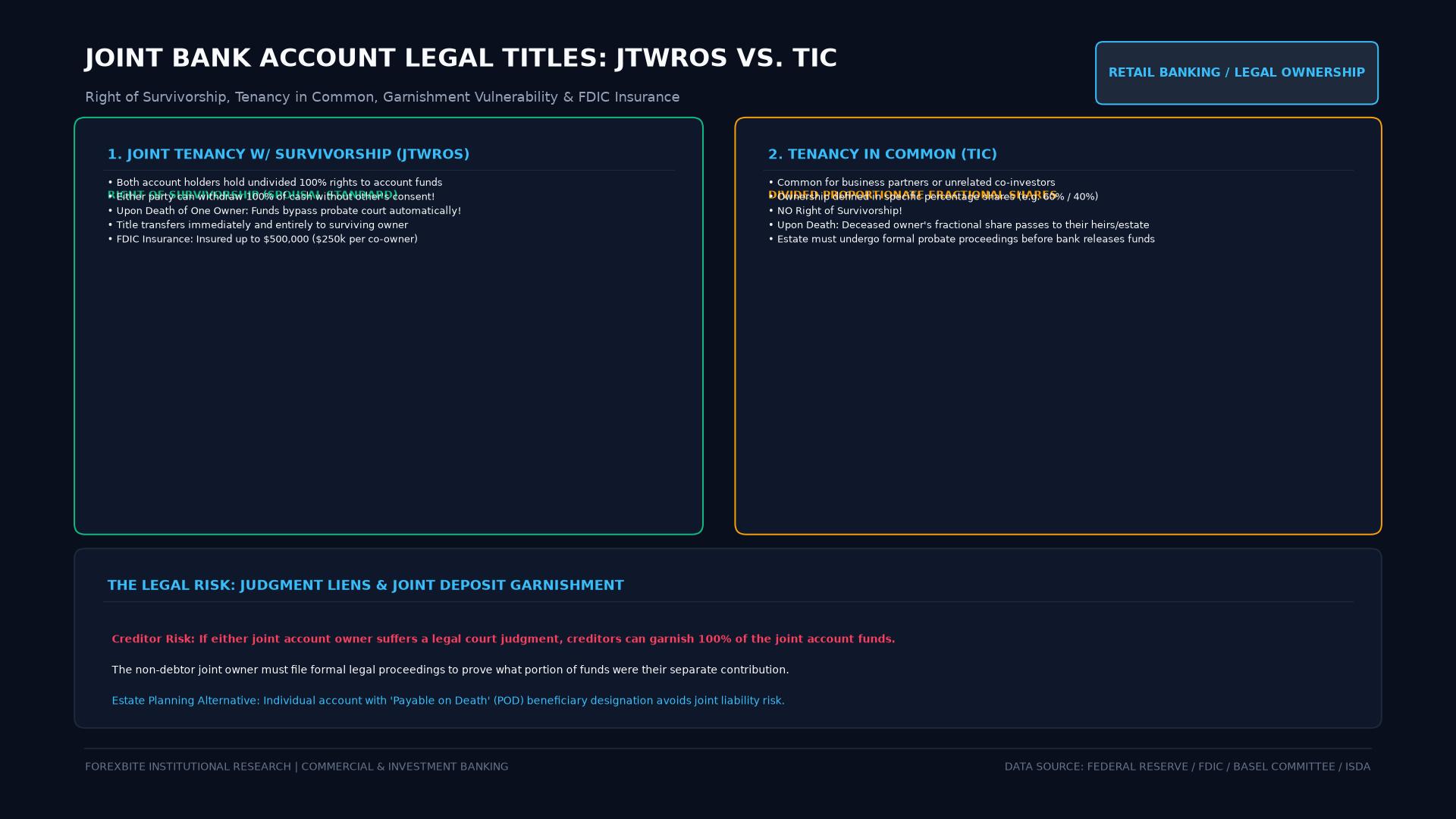 Figure: Legal ownership distinctions in joint depository accounts: Joint Tenants with Right of Survivorship (JTWROS) versus Tenants in Common (TIC) probate rules.
Key Takeaways
- Ownership Frameworks: The two primary structures in trading brokerages are Joint Tenants with Rights of Survivorship (JTWROS) and Tenants in Common (TIC).
- Pooled Purchasing Power: Combining capital enables retail and institutional traders to satisfy higher account minimums, access institutional ECN raw spreads, and secure better volume tier commissions.
- Joint and Several Liability: In leveraged forex trading, all account holders are typically jointly and individually liable for any negative account balances, margin deficits, or regulatory obligations incurred by either party.
- Trading Authorization: Most retail brokerages default to “either-or” trading authorization, allowing either account holder to execute trades, initiate leverage changes, or close positions without prior consent from the other.
- Stringent KYC / AML Compliance: Opening a joint trading account requires full Know Your Customer (KYC) identity verification, proof of address, and economic source-of-funds validation for all participating holders.
Legal Structures: JTWROS vs. Tenants in Common (TIC)
Selecting the proper legal form when opening a joint brokerage account carries profound consequences for ownership splits, operational rights, and estate distribution.
| Legal Dimension | Joint Tenants with Rights of Survivorship (JTWROS) | Tenants in Common (TIC) | Tenancy by the Entirety (TBE) |
|---|---|---|---|
| Typical Relationship | Spouses, domestic partners | Business partners, unrelated co-investors | Married couples (specific jurisdictions) |
| Ownership Share | Strictly equal (e.g., 50/50 for two holders) | Flexible defined percentages (e.g., 60/40, 80/20) | Indivisible unified ownership (100% by both) |
| Death of a Co-Owner | Assets pass automatically to survivor outside probate | Deceased holder’s share transfers to their legal estate/heirs | Automatically passes to surviving spouse outside probate |
| Creditor Claims | Creditor of one owner may attach whole account | Creditors can only target debtor’s designated share | Protected from individual debts of only one spouse |
| Trading Authority | Either party can execute orders independently | Usually requires written power of attorney or either-to-trade clause | Both or either party depending on jurisdiction |
| Account Applicability | Standard across retail FX and stock brokerages | Common in commercial partnerships and syndicate funds | Restricted to real estate and select banking products |
Mechanics in Leveraged Forex Trading
When operating a joint margin account in foreign exchange markets, margin calculations, equity tracking, and liability are shared across the legal entity:
$$\text{Usable Margin} = (\text{Balance}{\text{Holder A}} + \text{Balance}{\text{Holder B}} + \text{Floating P&L}) - \text{Used Margin}$$
1. Unified Risk Exposure
If Trader A executes a long position of 20 lots on GBP/USD and experiences severe slippage during an unexpected macroeconomic shock (such as a flash crash), the resulting loss depletes the entire equity of the account. Trader B’s deposited capital is fully exposed to Trader A’s trade execution.
2. Joint and Several Liability
Should an unexpected market gap trigger a catastrophic negative balance:
$$\text{Account Equity} < 0$$
Under the broker’s terms of service, the broker possesses the legal right to pursue collection of the entire deficit balance against Trader A, against Trader B, or against both simultaneously. Trader B cannot legally claim exemption on the grounds that they did not click the buy button.
Case Study: Algorithmic Partnership via a Joint Brokerage Account
Two proprietary quantitative traders—Partner A (a machine-learning software engineer) and Partner B (a macro strategist)—decided to deploy an automated trading algorithm on spot FX without incorporating a formal hedge fund or LLC.
- Setup: They opened a Tenants in Common (TIC) joint account with an ECN forex broker, depositing $100,000 total capital ($70,000 from Partner A, $30,000 from Partner B), establishing an explicit 70/30 TIC equity split.
- Operational Access: Both partners signed a cross-trading authorization granting API execution credentials to their trading server while requiring dual authorization for outward bank wire withdrawals.
- Results: Over twelve months, the automated trading system generated a 25% net return ($25,000 net profit after commissions and overnight swaps).
- Distribution: Because the account was governed by a formal TIC agreement, the broker issued annual consolidated tax reporting (such as IRS 1099 or international equivalents) showing $17,500 attributable to Partner A and $7,500 attributable to Partner B, preventing tax reporting disputes with revenue authorities.
Strategic Risks and Operational Pitfalls
- Unilateral Withdrawal Vulnerability: Unless “both-to-sign” withdrawal controls are explicitly mandated in writing with the broker, either party in an “either-to-sign” joint account may legally wire the entire cash balance to their individual bank account without the other’s foreknowledge.
- Relationship and Partner Disputes: In the event of a commercial fallout or marital dissolution, brokerages typically freeze trading and withdrawal functions immediately upon receiving notification of an active dispute, locking up open positions during market volatility.
- Tax Complexities: When co-owners fall into different national tax jurisdictions or tax brackets, determining the allocation of capital gains and foreign withholding taxes can generate severe regulatory complications.
Frequently Asked Questions (FAQ)
Can both parties trade simultaneously on a joint forex account?
Yes. In modern online brokerages, both account holders are typically issued individual user credentials or share API access keys. Both can log into web or mobile terminals simultaneously, execute trades, and manage open positions.
What happens if one holder dies?
In a JTWROS account, ownership of the entire account automatically transfers to the surviving holder upon submission of a certified death certificate, bypassing probate. In a Tenants in Common (TIC) account, the deceased party’s fractional share is frozen and transferred according to their will or local intestacy laws, while the surviving partner retains their designated percentage.
Can a joint account holder withdraw all funds without the other’s signature?
In standard “either-or” joint accounts, yes. Either account holder has the legal authority to request a full withdrawal of funds, provided the payout destination matches the bank account rules of the brokerage. To prevent this, parties must request a dual-authorization (“both-to-sign”) operational structure.
Ready to trade forex?
Open a free demo account with a regulated broker. Practice with virtual funds before risking real money.