Margin Account
A margin account is a specialized brokerage account that allows traders and investors to borrow funds or use leverage against deposited collateral, enabling them to control position sizes significantly larger than their actual cash balance.
What Is a Margin Account?
A margin account is a financial brokerage account that extends a line of credit from the broker to the client, allowing the account holder to trade securities, futures, or foreign exchange contracts on leverage. Unlike a standard cash account—where an investor can only purchase assets up to the exact amount of settled cash on deposit—a margin account requires only a fractional deposit, known as margin, to open and maintain market positions.
In the retail and institutional foreign exchange (Forex) markets, virtually all trading accounts are structured as margin accounts. Because currency exchange rates typically fluctuate by less than 1% on an average trading day, margin accounts allow participants to borrow the underlying base or quote currencies from the broker’s liquidity network, amplifying both the capital efficiency of trading campaigns and the potential for both substantial profits and catastrophic losses.
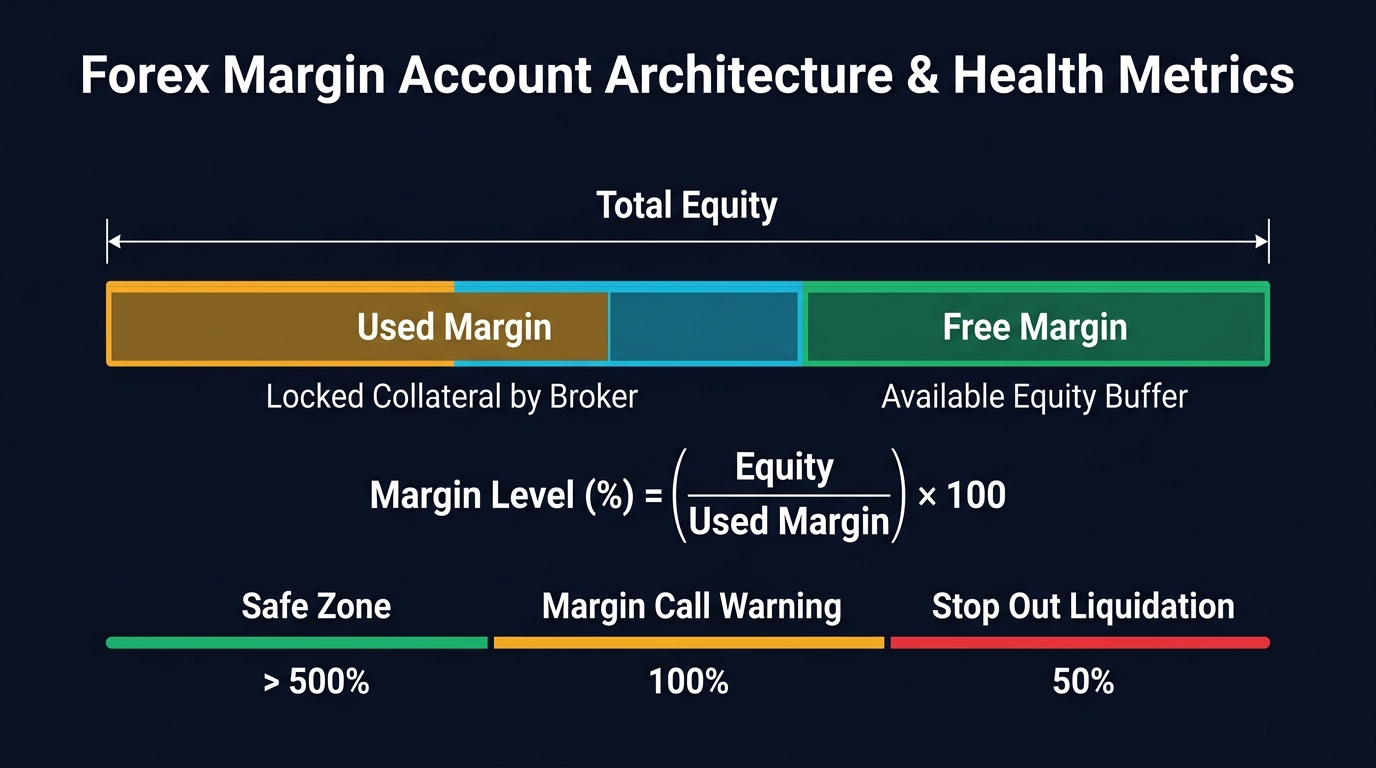
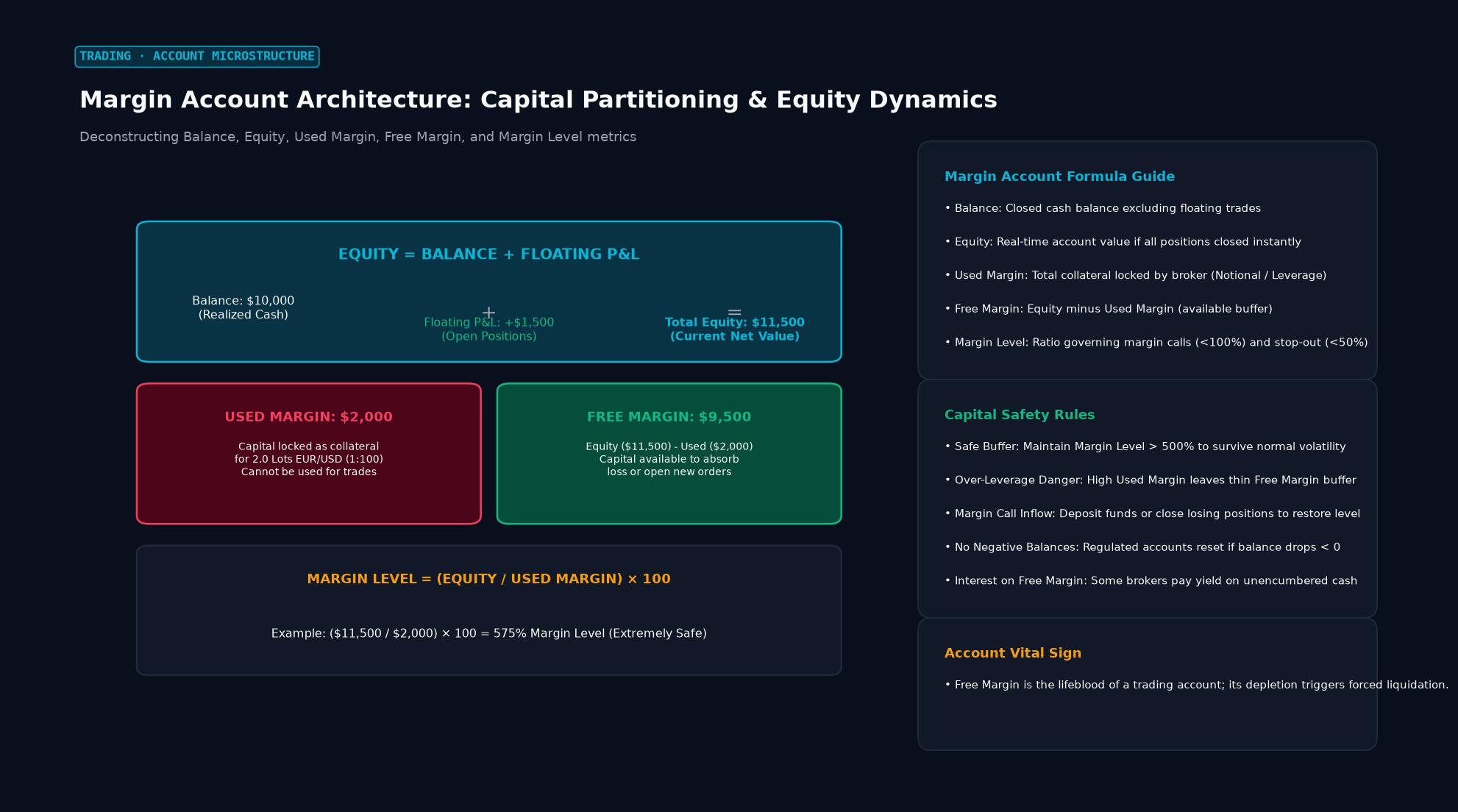 Figure: Deconstructing Balance, Equity, Used Margin, Free Margin, and Margin Level metrics
Key Takeaways
- Amplified Purchasing Power: A margin account enables traders to control large notional contracts with a fraction of the capital (e.g., $1,000 margin controls $100,000 with 1:100 leverage).
- Collateral-Backed Credit: The cash, open profits, and eligible securities deposited in the account serve as collateral for the broker’s credit line.
- The Margin Call and Stop-Out Threshold: If market movements erode account equity below mandatory maintenance requirements, the broker initiates a Margin Call or triggers automated Stop-Out Liquidation.
- Borrowing / Financing Fees: In equities, margin accounts incur interest charges on borrowed cash (margin interest). In spot forex, overnight positions incur or earn Rollover Swaps reflecting central bank interest rate differentials.
- Regulatory Leverage Caps: Regulators enforce strict maximum leverage limits on retail margin accounts: 1:30 in the European Union (ESMA) and UK (FCA), 1:50 in the United States (CFTC), and up to 1:500 in offshore jurisdictions.
Comparative Taxonomy: Margin Account vs. Cash Account vs. Portfolio Margin
| Account Feature | Standard Cash Account | Standard Forex Margin Account | Portfolio Margin Account |
|---|---|---|---|
| Borrowing Allowed? | No (100% cash funded) | Yes (Collateralized leverage) | Yes (Risk-based net model) |
| Typical Leverage | 1:1 (Zero leverage) | 1:30 to 1:500 | 1:10 to 1:15 (Equities/Options) |
| Short Selling? | Strictly prohibited | Inherent to two-way FX pairs | Permitted across equities & options |
| Settlement Horizon | $T+1$ or $T+2$ settlement wait | Instant margin turnover | Real-time multi-asset netting |
| Margin Call Risk | Impossible (Cannot lose > cash) | High (Forced stop-out on drops) | Moderate (Based on net portfolio VaR) |
| Target User | Long-term buy-and-hold investors | Retail FX traders, prop firms | Institutional funds, HNWI traders |
Mathematical Mechanics: Margin Metrics in Spot FX
A margin account continuously updates three interrelated mathematical metrics on the trading terminal:
$$\text{Used Margin} = \frac{\text{Notional Trade Volume}}{\text{Leverage Ratio}}$$
$$\text{Free Margin} = \text{Account Equity} - \text{Used Margin}$$
$$\text{Margin Level (%)} = \left( \frac{\text{Account Equity}}{\text{Used Margin}} \right) \times 100$$
Practical Calculation Example:
A trader deposits $10,000 into a margin account with 1:100 leverage and opens 2 standard lots ($200,000 notional) of GBP/USD at 1.2500:
- Used Margin: $\frac{$200,000}{100} = $2,000$.
- Free Margin: $$10,000 - $2,000 = $8,000$.
- Starting Margin Level: $\left(\frac{$10,000}{$2,000}\right) \times 100 = 500%$.
If GBP/USD drops by 300 pips ($-$6,000$ floating loss):
- New Equity: $$10,000 - $6,000 = $4,000$.
- New Free Margin: $$4,000 - $2,000 = $2,000$.
- New Margin Level: $\left(\frac{$4,000}{$2,000}\right) \times 100 = 200%$.
The account remains safely above the broker’s 30% stop-out threshold, but free margin is constrained, preventing the trader from opening additional positions.
Real-World Case Study: The Danger of Maximum Margin Utilization
In 2020, during the initial global outbreak of the COVID-19 pandemic, an inexperienced retail trader deposited $5,000 into an offshore margin account offering 1:500 leverage.
- Over-Allocation: Seeking rapid wealth creation, the trader opened a 20-lot Long EUR/USD position ($2,000,000 notional) at 1.1000.
- Margin Utilization: With 1:500 leverage, the required margin was $\frac{$2,000,000}{500} = $4,000$.
- The Buffer: Free margin was only $$1,000$ ($$5,000 - $4,000$). Across 20 lots, each pip movement was worth $200.
- The Stop-Out: Minutes after entry, an unexpected headline triggered an ordinary 15-pip retracement down to 1.0985. The floating loss surged to $-$3,000$. Account equity collapsed to $$2,000$, breaching the broker’s 50% stop-out level.
- Outcome: The broker’s automated risk engine liquidated the entire position. The trader lost over 60% of their life savings in less than ten minutes on an insignificant 0.13% market fluctuation.
Operational Traps and Risk Controls
- Treating Margin as “Free Money”: Margin is borrowed purchasing power backed by your deposited collateral. Losses are deducted 100% from your actual cash balance, not the borrowed portion.
- Weekend Gap Vulnerability: Leaving high-margin positions open over the weekend exposes the account to opening price gaps that bypass stop-losses, potentially triggering negative balances.
- Variable Spread Expansion: During illiquid rollovers (5:00 PM EST), broker spreads can widen from 0.2 to 5.0 pips, causing a momentary dip in floating equity that can accidentally trigger a false margin stop-out on tightly margined accounts.
Frequently Asked Questions (FAQ)
Can I withdraw money while having open positions in a margin account?
Yes, but you can only withdraw from your Free Margin. Any capital locked as Used Margin collateral cannot be transferred out of the account until the corresponding trades are closed.
What is the difference between a margin call and a stop-out?
A Margin Call is an advisory warning (traditionally at 100% margin level) alerting the trader that equity equals used margin and that deposits or position reductions are recommended. A Stop-Out is the mandatory, automated liquidation of trades by the broker’s server when equity falls to the contractually defined liquidation threshold (e.g., 20% to 50%).
Do I pay interest on used margin in forex?
In forex trading, you do not pay separate daily margin interest like stock investors do. Instead, the cost or credit of borrowing the base and quote currencies is reflected directly in the daily Rollover Swap Rate applied to positions held open across the 5:00 PM EST market cutoff.
Ready to trade forex?
Open a free demo account with a regulated broker. Practice with virtual funds before risking real money.