Key Currency
A key currency is an internationally recognized, highly liquid currency that serves as the primary global standard for cross-border trade invoicing, official central bank reserves, international debt issuance, and as the reference anchor against which other sovereign currencies are pegged.
What Is a Key Currency?
A key currency is a sovereign currency that plays a dominant, foundational role within the international monetary and financial system. Beyond functioning within its country of origin, a key currency is universally accepted across international borders as a store of value, medium of exchange, and unit of account.
Key currencies act as the primary currency in which global commodities (such as crude oil, copper, and agricultural products) are priced, cross-border commercial transactions are invoiced, and multinational sovereign bonds are issued. Furthermore, foreign central banks hold substantial portions of their foreign exchange reserves in key currencies and frequently manage or formally peg their own domestic currencies to them.
Throughout modern financial history, the role of primary global key currency has transitioned from the British Pound Sterling (GBP) during the 19th-century gold standard to the United States Dollar (USD) following the 1944 Bretton Woods Agreement.
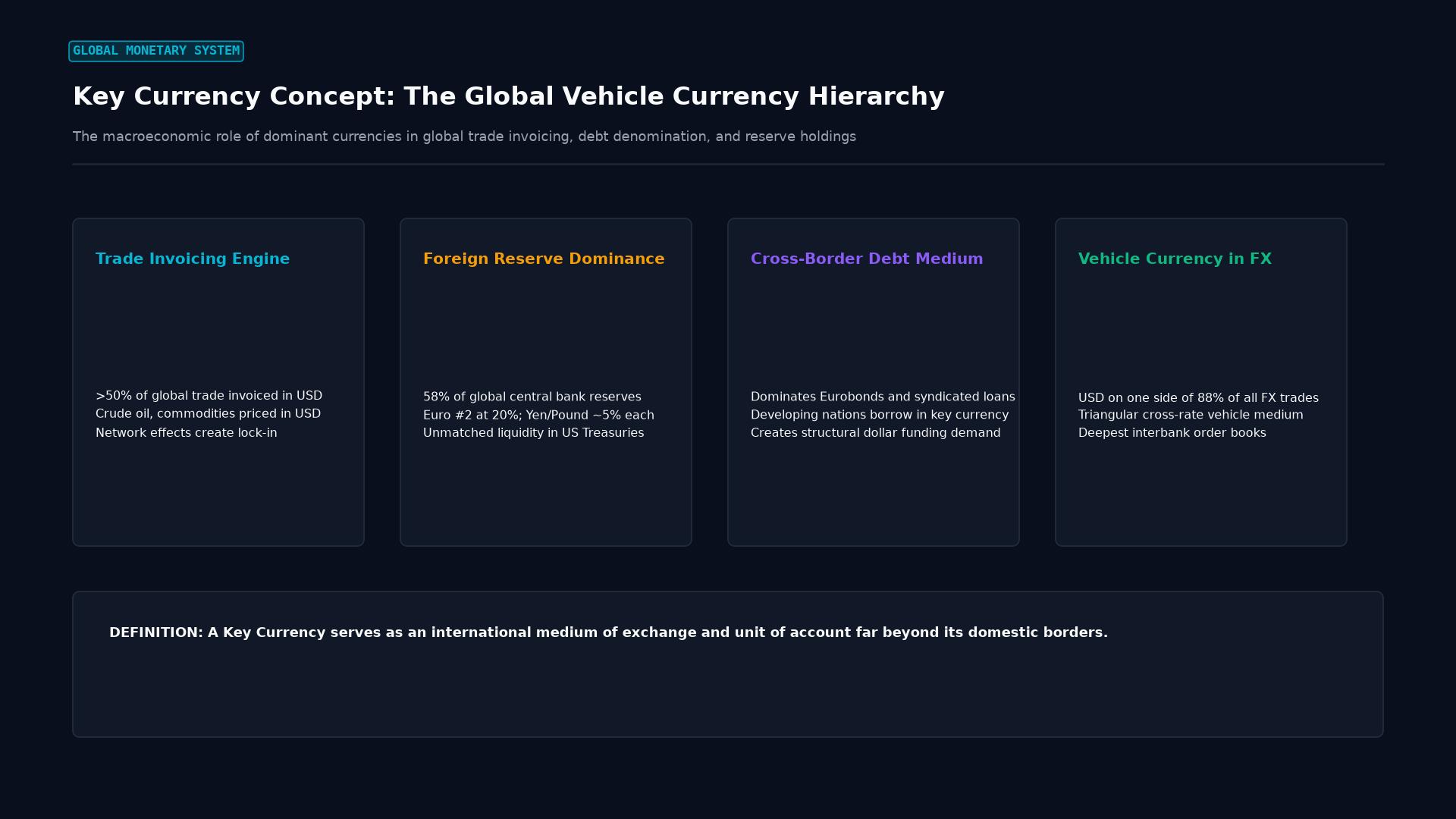 Figure: The macroeconomic role of dominant currencies in global trade invoicing, debt denomination, and reserve holdings
Key Takeaways
- Vehicle Currency Function: In the $7.5+ trillion-per-day foreign exchange market, the U.S. dollar participates in roughly 88% of all trades (according to the Bank for International Settlements), acting as the intermediate “vehicle” for non-dollar currency conversions.
- Official Reserve Currency: Key currencies represent the majority of central bank reserves held in the IMF’s Currency Composition of Official Foreign Exchange Reserves (COFER).
- Triffin Dilemma: The issuing country of a global key currency faces an inherent economic paradox: it must run persistent current account deficits to supply global trade with sufficient currency liquidity, which over time can erode confidence in the currency’s long-term backing.
- Commodity Pricing Anchor: Major global physical commodities, notably oil (“Petrodollars”) and precious metals, are internationally priced in the primary key currency, generating non-discretionary global demand for that currency.
- Secondary Key Currencies: While the USD remains the world’s primary key currency, the Euro (EUR), Japanese Yen (JPY), British Pound (GBP), and increasingly the Chinese Renminbi (RMB / CNY) serve as secondary or regional key currencies.
The Hierarchical Roles of Major Key Currencies
The international financial system functions through a distinct hierarchy of key currencies, categorized by liquidity, reserve share, and convertibility.
| Currency | Global FX Share (BIS) | Official Reserves Share (IMF COFER) | Primary Global / Regional Function |
|---|---|---|---|
| United States Dollar (USD) | ~88% (one leg of trade) | ~58% | Primary global vehicle currency, oil/commodity benchmark, anchor for dollar pegs |
| Euro (EUR) | ~31% | ~20% | Regional dominant key currency in Europe and Francophone Africa; European trade invoicing |
| Japanese Yen (JPY) | ~17% | ~5.5% | Premier global funding currency for carry trades; safe-haven reserve asset |
| British Pound (GBP) | ~13% | ~4.8% | Historical key currency; international legal contracts and London interbank finance |
| Chinese Renminbi (RMB) | ~7% | ~2.3% | Rising bilateral trade settlement currency in Asia and BRICS; managed capital controls |
Mechanics: The Key Currency as an FX “Vehicle”
In global foreign exchange, two currencies with small international trading volumes rarely trade against each other directly. For instance, if an institution seeks to exchange Chilean Pesos (CLP) for Turkish Lira (TRY), an interbank dealer does not maintain a direct CLP/TRY market order book.
Instead, the transaction is routed through the key currency vehicle in two synchronized steps:
$$\text{CLP} \xrightarrow{\text{Trade 1}} \text{USD} \xrightarrow{\text{Trade 2}} \text{TRY}$$
$$\text{Exchange Rate}_{\text{CLP/TRY}} = \frac{\text{USD/TRY}}{\text{USD/CLP}}$$
Because the U.S. Dollar possesses supreme liquidity, the bid-ask transaction costs of executing two distinct USD transactions are substantially narrower than the massive spread that would be demanded to clear a direct, illiquid CLP/TRY transaction.
Case Study: The Petrodollar System and the Bretton Woods Collapse
Following the unilateral cancellation of direct U.S. dollar-to-gold convertibility by President Richard Nixon in August 1971 (“The Nixon Shock”), the USD lost its formal precious-metal backing. To maintain the dollar’s status as the indispensable key currency:
- In 1974, the United States and Saudi Arabia concluded historic diplomatic and financial accords.
- In exchange for military protection and security guarantees, Saudi Arabia agreed to price all of its global crude oil exports exclusively in U.S. dollars and invest surplus oil revenues (“petrodollars”) into U.S. Treasury securities.
- Because every industrialized economy required oil to function, every sovereign nation had to continuously accumulate and hold U.S. dollars in reserves.
- This petrodollar architecture cemented the USD as the indisputable global key currency for over half a century, insulating the United States from standard balance-of-payments crises experienced by other debt-issuing nations.
Systemic Risks and the De-Dollarization Debate
- Sanctions and Weaponization Risk: Following the 2022 freezing of Russian central bank foreign exchange reserves by Western nations, non-aligned sovereigns increased efforts to diversify reserve holdings into gold and settle bilateral trade in non-key currencies.
- The Triffin Paradox: As global economic volume expands faster than the U.S. domestic economy, supplying adequate dollar liquidity abroad requires perpetual U.S. fiscal and trade deficits, which creates recurring long-term debt-ceiling and inflation challenges.
- Imported Inflation for Pegged Economies: Emerging nations that peg their domestic currencies to a key currency lose monetary policy sovereignty. If the Federal Reserve raises rates while an emerging economy is in recession, the pegged nation is forced to hike interest rates, exacerbating domestic economic pain to defend the peg.
Frequently Asked Questions (FAQ)
What is the difference between a key currency and a reserve currency?
While often used interchangeably, a “reserve currency” refers specifically to currency assets held by foreign central banks and monetary authorities to defend their exchange rates and back liabilities. A “key currency” is a broader concept that also encompasses vehicle currency status in commercial trade, commodity pricing, and financial contract invoicing.
Can a country have more than one key currency?
A nation’s financial system may utilize multiple key currencies depending on trade geography. For example, Central and Eastern European countries frequently reference both the Euro (for regional trade and migration remittances) and the U.S. Dollar (for oil imports and international capital markets debt).
Why hasn’t the Chinese Yuan completely replaced the US Dollar as a key currency?
Despite China being the world’s largest exporter of physical goods, the Renminbi’s emergence as the primary global key currency is constrained by China’s capital controls, restrictions on outbound capital flight, and the absence of a deeply liquid, transparent, and judicially independent bond market comparable to the U.S. Treasury market.
Ready to trade forex?
Open a free demo account with a regulated broker. Practice with virtual funds before risking real money.