Reserve Currency
A reserve currency is a foreign currency held in substantial quantities by central banks, sovereign wealth funds, and international monetary authorities as a core component of their foreign exchange reserves, widely utilized for global trade settlement, commodity pricing, and financial debt issuance.
What Is a Reserve Currency?
A reserve currency (often referred to as an anchor currency or world currency) is a sovereign currency that is held in significant volume by national central banks, sovereign wealth entities, and international financial institutions as a pillar of their official foreign exchange reserves.
Beyond central bank vaults, a true reserve currency serves as the primary global vehicle for pricing internationally traded commodities (such as crude oil, gold, copper, and agricultural goods), invoicing cross-border trade transactions, and denominating offshore debt securities.
Since the 1944 Bretton Woods Conference, the US Dollar (USD) has maintained undisputed hegemony as the world’s primary global reserve currency, accounting for roughly 58% of allocated global reserves, followed by the Euro (EUR) at approximately 20%, with the Japanese Yen (JPY) and British Pound (GBP) comprising approximately 5% each.
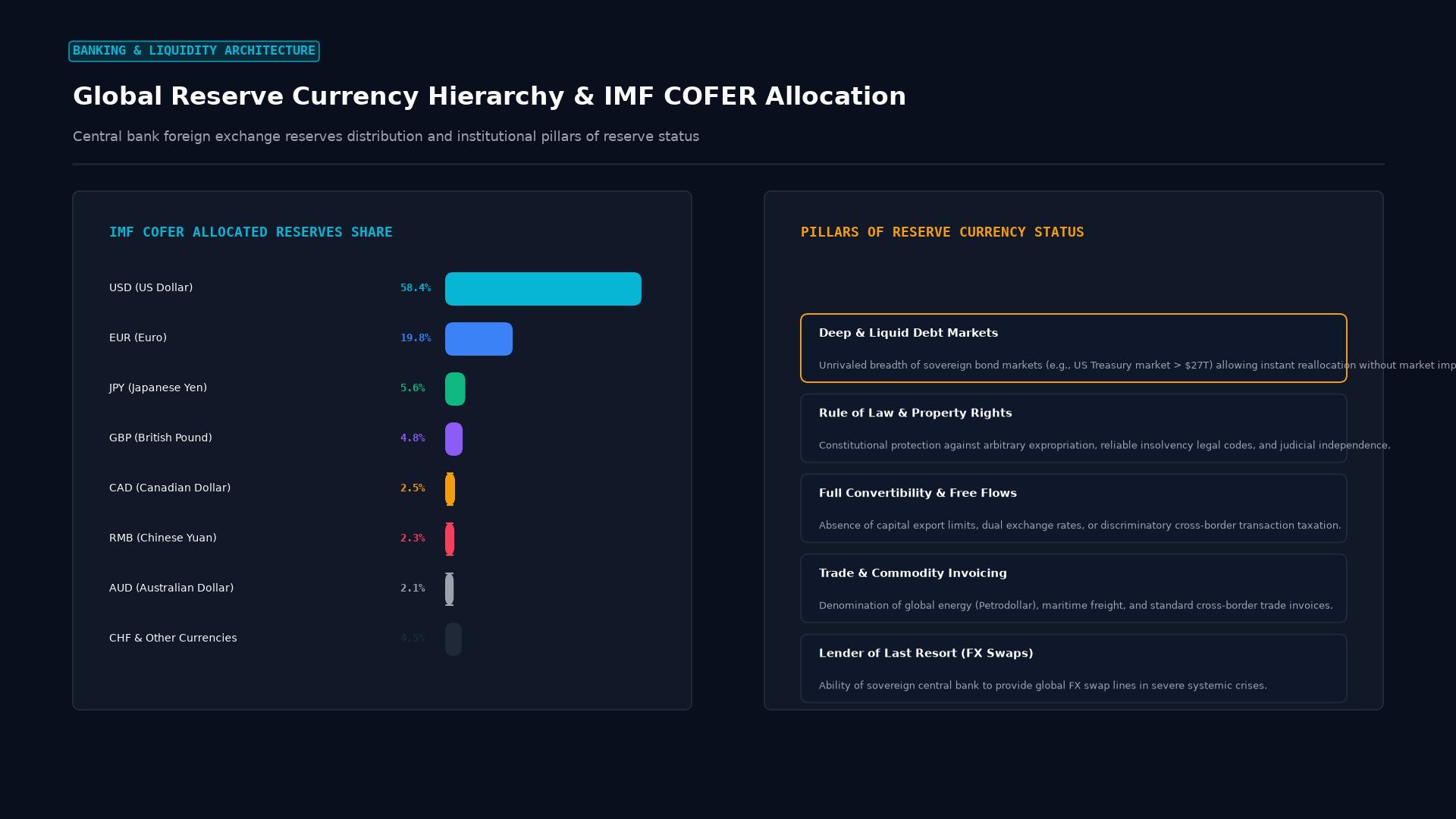 Figure: IMF COFER central bank foreign exchange reserve distribution and the fundamental macroeconomic pillars required to maintain reserve currency status.
Mandatory Structural Criteria for Reserve Currency Status
A nation cannot simply declare its currency a global reserve asset; it must satisfy four stringent macroeconomic and institutional prerequisites:
1. Unrestricted Capital Account Convertibility
The issuing nation must maintain completely free capital mobility without foreign exchange restrictions, repatriation caps, or government rationing. Central banks must be confident they can convert billions of dollars in reserves into liquid cash at any moment without regulatory friction.
2. Deep, Liquid Sovereign Debt Markets
Reserve holders do not store physical paper cash; they invest their reserves in safe, yield-bearing sovereign government debt. The US Treasury market—with over $26 trillion in marketable debt—offers unparalleled market depth, allowing foreign central banks to buy or sell multi-billion-dollar clips without moving market prices.
3. Rule of Law and Institutional Solvency
The issuing jurisdiction must possess an independent central bank, transparent legal protections for foreign property rights, political stability, and a deep-seated commitment to contract enforcement.
4. Open-Ended Trade Deficits (The Triffin Dilemma)
Identified by Belgian-American economist Robert Triffin in 1960, the Triffin Dilemma reveals a paradox at the heart of reserve currency status: $$\text{Global Demand for Reserves} \implies \text{Reserve Nation Must Run Persistent Current Account Deficits}$$ To supply the global economy with enough liquidity to finance international trade, the reserve currency nation must continuously export its currency by running persistent trade deficits, which over decades erodes its net international investment position (NIIP).
The “Exorbitant Privilege” and Petrodollar Hegemony
The dominance of the US Dollar grants the United States what French Finance Minister Valéry Giscard d’Estaing termed an “exorbitant privilege”:
- Borrowing at Discounted Rates: Because global central banks continuously purchase US Treasuries to maintain reserve buffers, the US government enjoys lower borrowing costs and long-term interest rates than its fiscal debt levels would otherwise dictate.
- Seigniorage Revenue: The US Federal Reserve prints physical banknotes and electronic credits at near-zero cost, exchanging them for real foreign goods and services worldwide.
- The Petrodollar System: Established in the 1970s between the Nixon administration and Saudi Arabia, global oil trade was standardized exclusively in US Dollars. Nations worldwide were forced to accumulate and hold USD reserves simply to purchase imported energy.
De-Dollarization: Structural Trends vs. Market Reality
In recent years, geopolitical friction, financial sanctions (such as the freezing of Russian central bank reserves in 2022), and ballooning US sovereign debt have accelerated discussions surrounding de-dollarization:
| Emerging Trend | Structural Reality & Constraints | Long-Term Impact on USD Dominance |
|---|---|---|
| Bilateral Local Currency Trade | China, Russia, India, and Brazil settle bilateral trade in RMB, Rubles, or Rupees. | Effective for bilateral trade, but counterparties often dump soft currencies immediately back into USD or gold. |
| Chinese Renminbi (RMB) Expansion | China promotes the CIPS payment system and inclusion in the IMF SDR basket. | Severely constrained by China’s strict domestic capital controls and closed capital account. |
| Central Bank Gold Accumulation | Sovereign central banks have bought record quantities of physical gold bullion since 2022. | Replaces sovereign paper debt with sanction-immune physical bullion; reduces marginal USD reserve growth. |
| Digital Currency Alternatives (CBDCs) | Multi-CBDC bridges (e.g., Project mBridge) for cross-border wholesale settlement. | Improves settlement efficiency, but underlying reserve backing remains tethered to major stable currencies. |
Real-World Case Study: The Freezing of Central Bank Reserves (2022)
In February 2022, following the escalation of the conflict in Ukraine, the United States, European Union, United Kingdom, and Japan took the unprecedented step of freezing approximately $300 billion of the Central Bank of Russia’s foreign exchange reserves held in Western custodial depositories (such as Euroclear):
- The Weaponization of Reserves: Historically, sovereign foreign exchange reserves held at foreign central banks or commercial custodian banks were assumed to be untouchable under customary international sovereign immunity.
- The Shockwave: By cutting Russia’s access to its US Dollar, Euro, and British Pound assets, Western allies demonstrated that paper reserve assets hold counterparty sovereign risk.
- The Structural Shift: Non-aligned central banks (including China, India, Saudi Arabia, and Turkey) responded by accelerating the diversification of their official reserves. Between 2022 and 2024, global central bank gold purchases surged to all-time historic records (> 1,000 metric tons per year), shifting reserve allocation toward tangible physical assets.
Frequently Asked Questions
What are the IMF Special Drawing Rights (SDR)?
Created by the International Monetary Fund in 1969, the Special Drawing Right (SDR) is an international supplementary reserve asset. Its value is determined by a weighted currency basket consisting of the five primary reserve currencies: the US Dollar (43.38%), Euro (29.31%), Chinese Renminbi (12.28%), Japanese Yen (7.59%), and British Pound (7.44%).
Can the Euro or Renminbi replace the US Dollar as the primary reserve currency?
Not in the near term. While the Euro is a formidable secondary reserve currency, the Eurozone lacks a unified, centralized sovereign bond market (Eurobonds remain fragmented across German Bunds, French OATs, and Italian BTPs). Meanwhile, the Chinese Renminbi cannot challenge the dollar until China completely lifts capital controls and permits unrestricted global outflows.
How does reserve currency status affect a nation’s export competitiveness?
Reserve currency status tends to keep the issuing nation’s currency structurally overvalued because international demand for reserve assets artificially props up the exchange rate. This phenomenon makes domestic manufacturing exports more expensive globally, contributing to the deindustrialization of the reserve-issuing nation over multi-decade cycles.
Ready to trade forex?
Open a free demo account with a regulated broker. Practice with virtual funds before risking real money.