Ladder Option
A ladder option is an exotic, path-dependent derivative contract that locks in predetermined minimum payout levels ('rungs') as the underlying asset price reaches specified threshold barriers during the life of the option, preserving partial gains regardless of subsequent price reversals.
What Is a Ladder Option?
A ladder option is an exotic, path-dependent financial option contract designed to solve one of the classic dilemmas of derivative trading: preserving paper gains when an underlying asset stages a massive intraday or intra-tenor rally but subsequently collapses before the expiration date.
Unlike a standard European vanilla option—where the entire payout is determined solely by the underlying asset’s spot price at the exact moment of expiration—a ladder option features predetermined price milestones known as “rungs.” Each time the underlying spot rate touches or breaches a rung during the contract’s lifespan, a corresponding minimum payout is permanently locked in. Even if the market subsequently reverses and finishes out-of-the-money (OTM) at maturity, the option holder is guaranteed the locked-in payout from the highest rung attained.
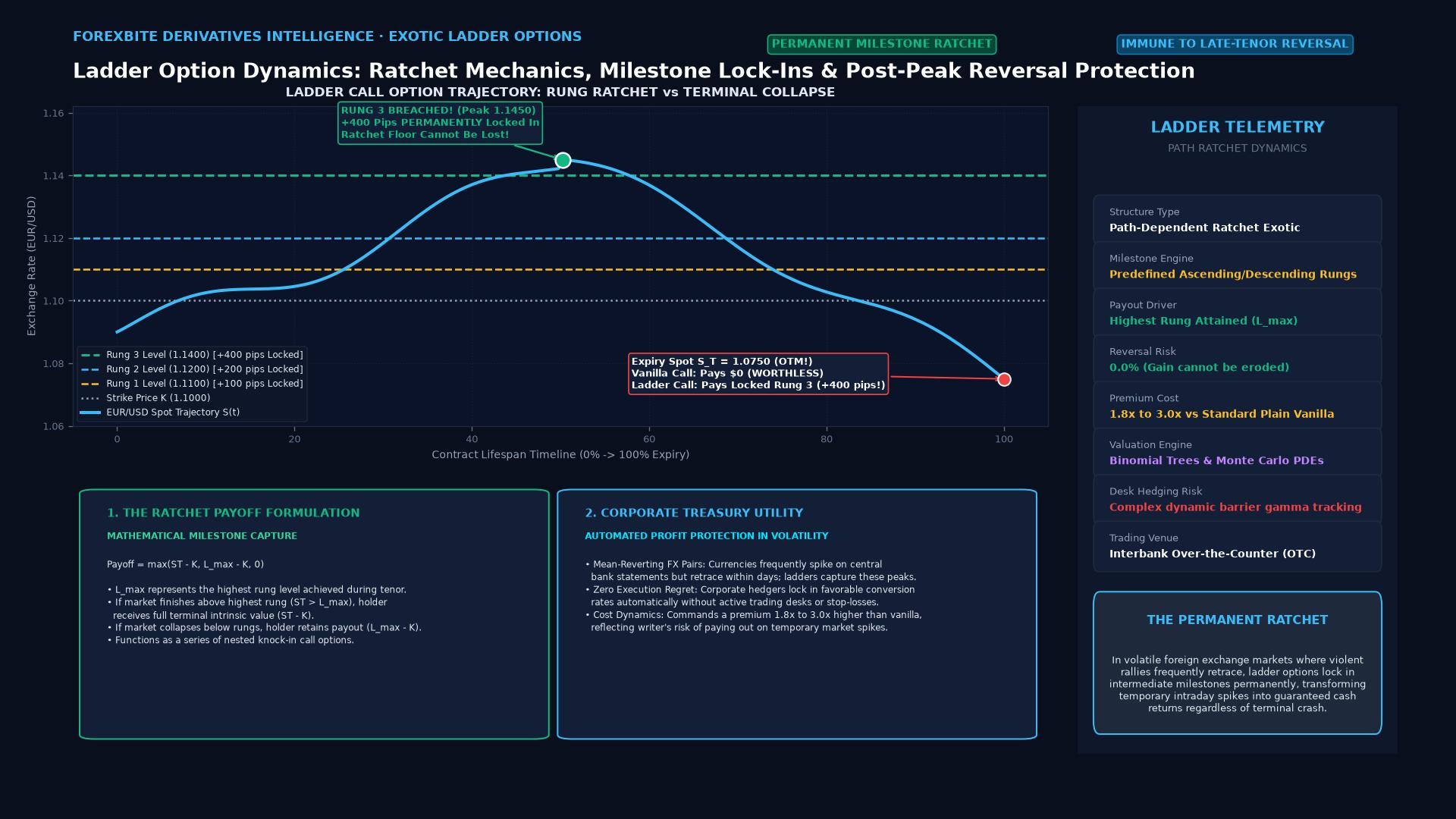 Figure: Ladder option ratchet payout dynamics showing locked price milestone rungs and protection against post-peak terminal market collapse.
Key Takeaways
- Path-Dependent Payoff: The ultimate value of a ladder option depends not only on the terminal price at expiration, but on the trajectory the asset took to get there.
- Rung Ratchet Mechanism: Once a price rung is triggered, the payout floor is established; the locked gain cannot be eroded by future adverse market movements.
- Superior to Vanilla Options in Volatility: Ladder options protect traders and corporate treasuries in volatile, mean-reverting currency markets where rapid price spikes are common but temporary.
- Higher Premium Overhead: Because the seller (writer) assumes greater risk of paying out on temporary price spikes, ladder options carry significantly higher option premiums than equivalent vanilla options.
- Tailored Corporate Risk Management: Widely traded in over-the-counter (OTC) interbank foreign exchange markets by multinational corporations seeking to hedge currency revenue without having to manually monitor and execute dynamic delta-hedging.
Mathematical Payoff Formulation
Consider a Ladder Call Option with strike price $K$, expiration $T$, and $m$ discrete predefined ascending price rungs $L_1, L_2, \dots, L_m$ such that $K < L_1 < L_2 < \dots < L_m$.
Let $L_{\text{max}}$ denote the highest rung achieved by the underlying spot price $S_t$ at any time during the option life ($0 \le t \le T$).
The payout of the ladder call option at maturity $T$ is given by:
$$\text{Payoff}{\text{Ladder Call}} = \max\left( S_T - K, ; L{\text{max}} - K, ; 0 \right)$$
If the market rallied and touched Rung 2 ($L_2$), but crashed below the strike price by expiration ($S_T < K$), the holder still receives:
$$\text{Payoff} = L_2 - K$$
Conversely, if the market experiences a parabolic trend and finishes above the highest rung ($S_T > L_m$), the option holder participates fully in the upside:
$$\text{Payoff} = S_T - K$$
Comparative Analysis: Ladder vs. Other Option Structures
| Option Type | Path Dependency | Payout Determinant | Protection Against Reversal | Relative Premium Cost |
|---|---|---|---|---|
| Ladder Option | Path-dependent | Highest rung reached OR terminal spot price | Absolute: Locks in gains at discrete rung levels | High (reflects multi-barrier ratchet guarantee) |
| Vanilla European | Path-independent | Terminal spot price at expiration only | Zero: Complete forfeiture if price reverses below strike | Baseline standard |
| Barrier Option (Knock-Out) | Path-dependent | Extinguishes entirely if boundary is touched | Negative: Option dies if boundary breached | Low (discounted due to cancellation risk) |
| Asian Option | Path-dependent | Average spot price over contract duration | Partial: Averages smooth out sharp reversals | Moderate (lower volatility than vanilla) |
| Lookback Option | Path-dependent | Absolute highest/lowest price attained across tenor | Total: Captures exact extreme price point | Very High (highest premium among standard exotics) |
Practical Application: Hedging Export Revenues
Consider a European aerospace exporter expecting a milestone payment of $50,000,000 USD in six months. The current spot exchange rate is EUR/USD = 1.0800.
- Objective: The exporter wants to convert USD into EUR. A falling EUR/USD (strengthening dollar) is beneficial, but a surging EUR/USD reduces their Euro proceeds.
- Strategy: The company purchases an OTC EUR/USD Ladder Call Option with a strike price of $K = 1.1000$ and tenors of six months, with rungs set at $L_1 = 1.1200$, $L_2 = 1.1400$, and $L_3 = 1.1600$.
- Market Movement:
- Two months into the contract, geopolitical instability in the Middle East weakens the USD, and EUR/USD spikes to 1.1420, triggering Rung 2 ($1.1400$).
- Over the remaining four months, U.S. interest rates rise aggressively, and EUR/USD reverses sharply, finishing at 1.0700 at maturity.
- Outcome:
- A standard vanilla call option at 1.1000 would have expired completely worthless.
- However, the ladder option locks in the Rung 2 level: the exporter receives a cash settlement of $1.1400 - 1.1000 = 400 \text{ pips}$ ($0.0400 per EUR) on the notional contract, generating €1,754,000 in cash compensation that offsets the unfavorable conversion timing.
Risk Considerations and Pitfalls
- High Upfront Premium Drag: If market volatility remains low and the spot price never reaches the first ladder rung, the option holder loses a substantial upfront premium that is far costlier than a standard vanilla option.
- Pricing and Valuation Opacity: Because ladder options are non-standardized exotic OTC instruments priced via complex Monte Carlo simulations or multi-dimensional trinomial trees, interbank dealers embed wider profit margins, and secondary market liquidity is virtually non-existent.
- Discontinuous Delta Risk for Writers: Option sellers face severe gamma risk near ladder rungs. As spot approaches a rung, the option’s delta jumps abruptly, forcing the market maker to aggressively execute spot transactions to maintain delta neutrality.
Frequently Asked Questions (FAQ)
Can a ladder option have both call and put features?
Yes. Ladder put options function symmetrically for downward price movements, locking in minimum payouts as the underlying asset breaches progressively lower descending price rungs.
How are ladder option rungs determined?
Rungs are customized bilaterally between the corporate client and the investment bank dealer during trade inception. A typical structure might feature three equally spaced rungs placed at intervals of 1.5% to 3.0% out-of-the-money.
Why not just buy a lookback option instead of a ladder option?
While a lookback option captures the absolute mathematical peak price reached during the entire contract, its premium is extraordinarily expensive. A ladder option provides a cost-effective alternative by offering 80% to 90% of the benefit of a lookback option at a significantly reduced premium.
Ready to trade forex?
Open a free demo account with a regulated broker. Practice with virtual funds before risking real money.