Barrier Option
A barrier option is an exotic, path-dependent derivative contract whose payoff and validity depend on whether the price of the underlying currency pair crosses a specified price threshold (the barrier) prior to expiration. They are classified into knock-out and knock-in variants.
What Is a Barrier Option?
A barrier option is an exotic derivative whose life cycle and eventual payout depend not merely on where the underlying asset’s price finishes at expiration, but on the exact path the price travels while the contract is active.
In a standard “vanilla” option, the trader cares only about the relationship between the market price and the strike price at maturity (or during exercise). In contrast, a barrier option incorporates a specific, predefined price trigger—the barrier level. If the market price of the underlying currency pair touches or breaches this barrier level during the option’s tenure, one of two events occurs:
- The option is instantly cancelled and extinguished (Knock-Out).
- The option is instantly activated and brought into legal existence (Knock-In).
Over-the-counter (OTC) foreign exchange is by far the largest and most liquid market in the world for barrier options. Multinational corporate treasuries and global macro hedge funds trade trillions of dollars in barrier structures because they provide tailored hedging and directional leverage at a substantially lower premium cost than plain vanilla options.
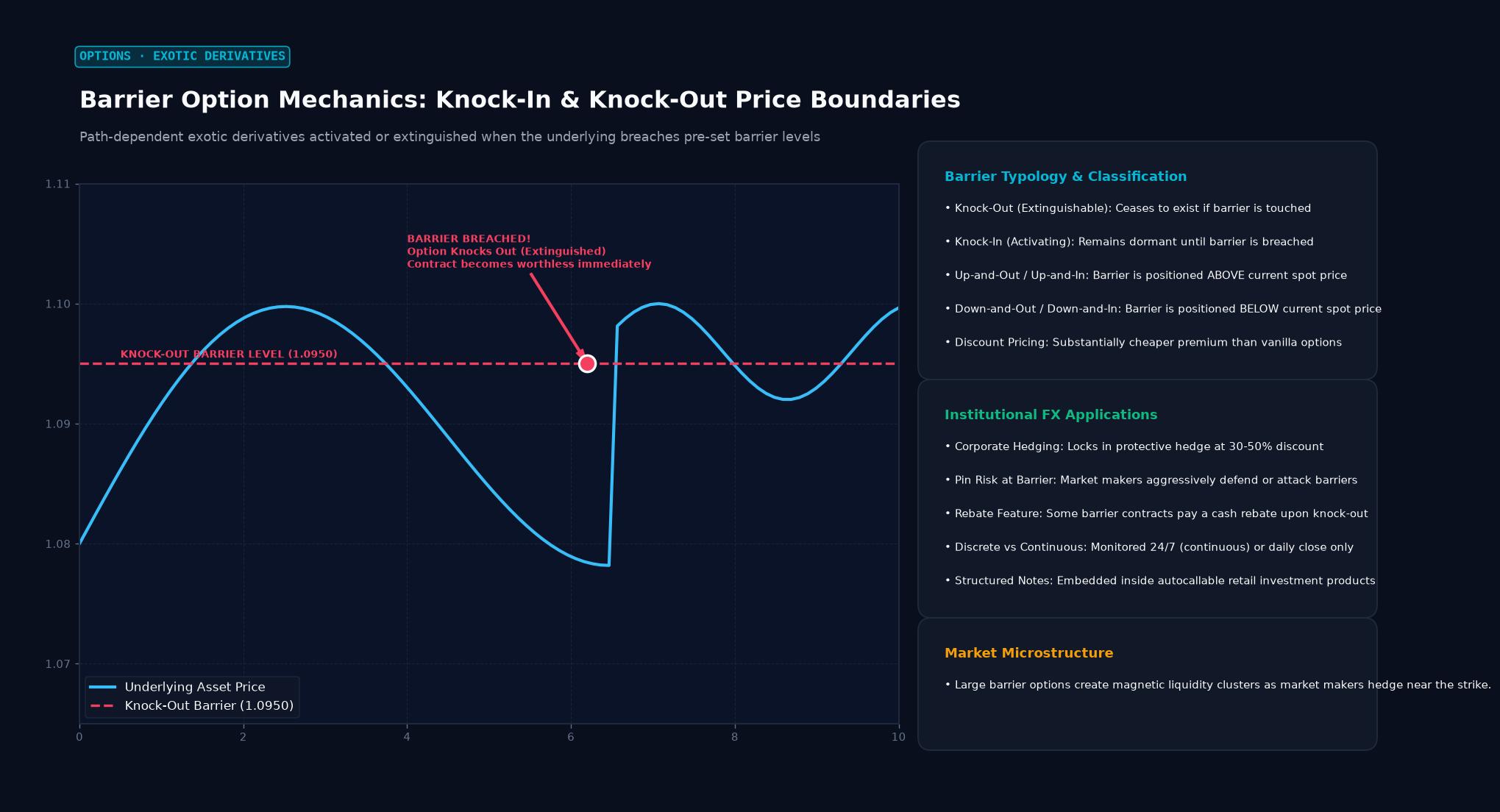 Figure: Path-dependent exotic derivatives activated or extinguished when the underlying breaches pre-set barrier levels
The Four Primary Types of Barrier Options
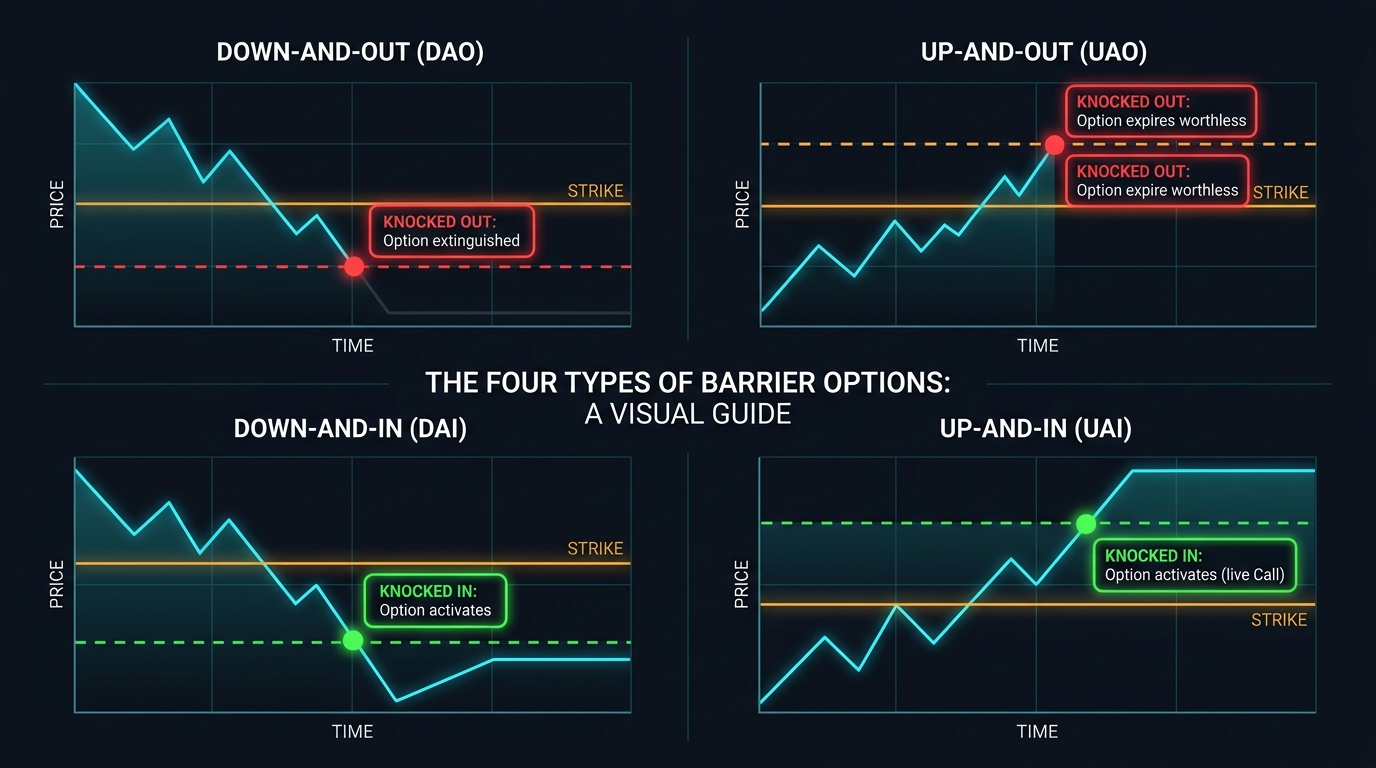
Barrier options are organized into four fundamental classifications based on the direction of price movement and whether the contract is activated or extinguished:
1. Down-and-Out (DAO)
- Mechanics: The option begins its life active. A lower barrier is established below the current market price. If the exchange rate falls and touches the barrier at any point, the option immediately dies and ceases to exist.
- Common Use: A bullish trader buys a Down-and-Out Call on EUR/USD. Because they believe EUR/USD will rally, they accept a lower barrier at 1.0650 to discount the premium. As long as EUR/USD never dips to 1.0650, the call behaves identically to a standard vanilla call at expiration.
2. Up-and-Out (UAO)
- Mechanics: The option is active initially. An upper barrier is placed above the current market price. If the exchange rate surges and touches the barrier, the contract is cancelled.
- Common Use: A corporate importer hedges against a modest rise in foreign currency, but does not want to pay for extreme, low-probability tail-risk moves.
3. Down-and-In (DAI)
- Mechanics: The option is completely dormant and cannot be exercised at inception. It springs into existence as a live vanilla option only if the underlying price declines and strikes the lower barrier.
- Common Use: A speculative fund buys a Down-and-In Put to profit from a potential market collapse, ensuring they pay nothing unless a technical breakdown actually occurs.
4. Up-and-In (UAI)
- Mechanics: The option is dormant at inception and activates only if the exchange rate rallies to touch the upper barrier level.
- Common Use: Momentum breakout trading. If a major multi-month resistance barrier is penetrated, the trader’s call option activates automatically.
Why Institutions Choose Barrier Options
The primary incentive for utilizing barrier options is premium efficiency:
- Substantial Cost Discount: Adding a knock-out barrier significantly reduces the mathematical probability of the option finishing in-the-money. Depending on how close the barrier sits relative to the spot price and the strike, a barrier option can cost 30% to 70% less than an equivalent vanilla contract.
- Elimination of Unnecessary Coverage: A corporate hedger who expects a currency to fluctuate within a predictable corridor does not need expensive protection for price zones they consider impossible.
- Rebate Provisions: Many barrier contracts include a cash “rebate.” If the barrier is breached and the contract is knocked out, the issuer pays the buyer a predetermined cash sum to partially offset the loss of option coverage.
Barrier Styles: American vs. European Observation
How the barrier is monitored exerts a major influence on option pricing:
- American-Style Barrier (Continuous Monitoring): The barrier is active 24 hours a day throughout the life of the contract. The instant a single transacted interbank tick touches the barrier, the knock-in or knock-out trigger fires. This is the dominant standard in interbank foreign exchange.
- European-Style Barrier (Discrete / At-Expiry Monitoring): The barrier is monitored only at the exact expiration timestamp (e.g., 10:00 AM New York Cut on the expiration date). What happens to the price during the preceding weeks is completely irrelevant.
The Interbank Battleground: “Defending the Barrier”
In the spot foreign exchange market, large-scale barrier options create visible, intense price dynamics. Institutional option books at major investment banks frequently aggregate multi-hundred-million-dollar barrier exposures at major psychological levels (such as 1.1000 on EUR/USD or 160.00 on USD/JPY).
When spot prices approach a massive knock-out barrier:
- The Option Buyer’s Incentive: If the barrier is touched, the buyer loses their entire investment. To prevent this, the buyer deploys aggressive spot buying orders in front of the barrier to “defend” the level and force the market higher.
- The Option Writer’s (Bank’s) Incentive: If the barrier is breached, the option seller is completely relieved of their liabilities. The option desk will often sell heavily in the spot market as the price nears the barrier, attempting to trigger a knock-out and eliminate their financial exposure.
This fierce institutional clash often causes price action to stall repeatedly just ahead of a major barrier level, or alternatively, trigger explosive cascading momentum once the barrier finally snaps.
Practical Trading Example: The Down-and-Out Call
Suppose EUR/USD is trading at 1.0850. A macro fund anticipates that an upcoming European Central Bank press conference will spark a rally toward 1.1100 over the next month.
The fund evaluates two choices:
- Choice A (Standard Vanilla Call): 1-month 1.0900 strike Call costs 120 pips ($12,000 per million EUR).
- Choice B (Down-and-Out Call): 1-month 1.0900 strike Call with a knock-out barrier at 1.0750. The cost drops to 50 pips ($5,000 per million EUR)—a 58% discount.
The fund chooses the Down-and-Out Call:
- Scenario 1 (Successful Trade): EUR/USD pulls back slightly to 1.0780 (never touching 1.0750), then surges to 1.1120 at expiration. The option is alive and 220 pips in-the-money. Net profit: $220 - 50 = 170\text{ pips}$ ($17,000 per million).
- Scenario 2 (Knock-Out Disaster): On day five, an unexpected US data release causes EUR/USD to spike down to 1.0749 for five seconds before skyrocketing to 1.1120. Because the 1.0750 barrier was touched, the option was extinguished instantly. At expiration, the fund receives zero payout, illustrating the path-dependent risk of barrier contracts.
Key Takeaways
- A barrier option is a path-dependent derivative that is activated (knock-in) or cancelled (knock-out) if a specific price level is touched.
- Adding a barrier reduces the option’s premium significantly compared to a plain vanilla option.
- The four core types are Down-and-Out, Up-and-Out, Down-and-In, and Up-and-In.
- In forex, continuous (American-style) barrier monitoring is standard, making every market tick consequential.
- Large barrier options attract aggressive institutional order flow as buyers “defend” the level and sellers attempt to trigger knock-outs.
FAQ
What is the difference between a knock-in and a knock-out option? A knock-in option begins dormant and only becomes a valid, tradeable option if the barrier is struck. A knock-out option begins as an active contract, but is immediately terminated and made worthless if the barrier is touched.
What is a double barrier option? A double barrier option has two separate price triggers—an upper barrier and a lower barrier. In a Double Knock-Out option, the contract remains valid only as long as the underlying currency pair fluctuates within the corridor between the two boundaries; touching either barrier terminates the contract.
Why do retail forex brokers rarely offer direct barrier options? Barrier options are complex OTC contracts customized between institutional counterparties and investment bank dealing desks. Pricing and hedging barrier options requires advanced mathematical models (such as local volatility and stochastic volatility simulations) and dynamic delta-gamma hedging that exceeds standard retail platform architecture.
Ready to trade forex?
Open a free demo account with a regulated broker. Practice with virtual funds before risking real money.