Exotic Option
An exotic option is a non-standard derivative contract featuring customized structures, complex path-dependent payoff mechanisms, multi-asset underlying baskets, or barrier triggers that distinguish it from standard plain-vanilla calls and puts.
What Is an Exotic Option?
An exotic option is a category of financial derivatives that deviates from standard “plain-vanilla” options in its payment structure, expiration date, underlying asset mechanics, or strike price determination. Unlike vanilla European or American options, which feature straightforward payoff curves based purely on the asset’s price at or before expiration, exotic options introduce tailored conditions designed to meet bespoke corporate risk-hedging requirements or speculative investment strategies.
In institutional foreign exchange (FX) trading and multinational corporate treasury management, exotic options are widely traded Over-the-Counter (OTC) with major dealer banks. Corporations use exotics to hedge currency exposures at a significantly lower upfront premium cost than vanilla options by forfeiting payoff rights under market conditions they deem improbable.
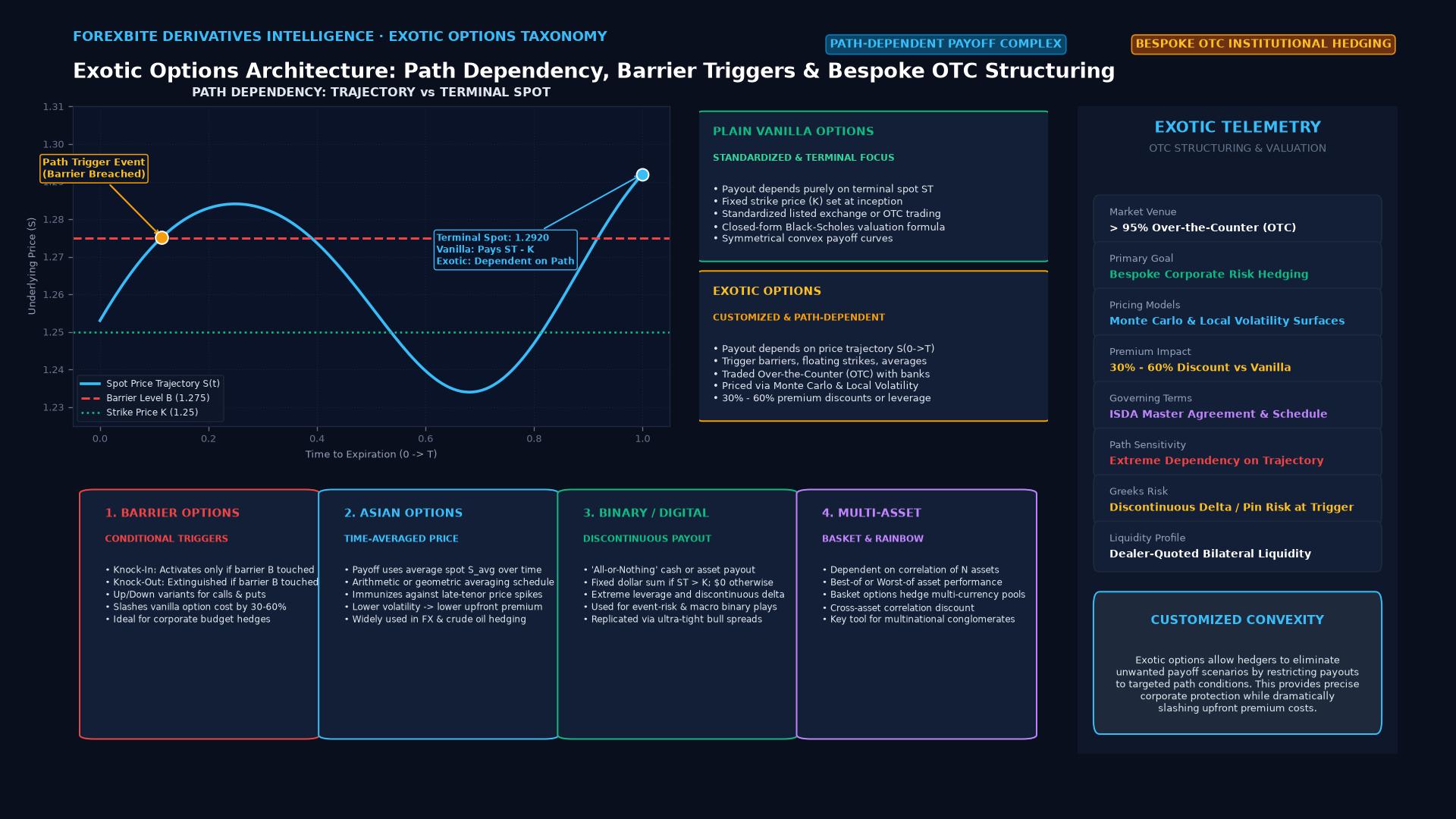 Figure: Exotic options structural taxonomy, path-dependent payoff simulation, and institutional OTC risk architecture.
Key Takeaways
- Bespoke Over-the-Counter Contracts: Exotic options trade predominantly in the OTC market between multinational corporations, hedge funds, and investment bank derivatives desks.
- Cost Reduction Advantage: Barrier options (such as knock-outs) provide targeted downside protection for corporate treasuries at a fraction of the premium cost of vanilla options.
- Path Dependency: Many exotic options depend not only on where the currency ends up at expiration, but on the exact price trajectory taken throughout the option’s lifespan.
- Complex Valuation: Exotic options cannot be priced using standard closed-form Black-Scholes formulas; dealers utilize Monte Carlo simulations, local volatility surfaces, and finite difference numerical methods.
Primary Types of Exotic Options in Foreign Exchange
1. Barrier Options (Path-Dependent)
A barrier option is activated (Knock-In) or extinguished (Knock-Out) if the spot currency exchange rate breaches a predetermined price threshold:
- Up-and-Out Call: A regular call option that becomes completely void and worthless if the exchange rate rallies and touches an upper barrier level prior to expiration.
- Down-and-In Put: A put option that does not exist initially, but activates into a standard put option if the exchange rate falls and touches a lower barrier.
2. Asian Options (Average-Rate Options)
Rather than comparing the strike price to the final spot rate on expiration day, the payoff of an Asian option is determined by the arithmetic average of the exchange rate sampled over periodic intervals (e.g., daily or weekly fixes across three months): $$\text{Payoff}{\text{Asian Call}} = \max\left(0, S{\text{Average}} - K\right)$$ Multinational corporations with continuous foreign currency cash flows (such as regular monthly payroll or supplier invoices) prefer Asian options because they smooth out exchange rate volatility and eliminate manipulation risk at expiration.
3. Digital (Binary) Options
Digital options provide an all-or-nothing payout. If the spot rate finishes in-the-money by as little as 0.1 pip, the option pays a fixed, predetermined cash sum. If out-of-the-money, the option pays zero.
4. Basket & Rainbow Options
Options written on a basket of multiple underlying currencies (e.g., an option tied to the performance of a basket consisting of EUR, GBP, and JPY against USD). Rainbow options pay out based on the best- or worst-performing asset in the group.
Comparative Matrix: Vanilla vs. Exotic Options
| Feature | Plain Vanilla Option | Barrier Option (Exotic) | Asian Option (Exotic) |
|---|---|---|---|
| Trading Venue | Public exchanges (CME) & OTC | Strictly OTC dealer market | Primarily OTC interbank |
| Premium Cost | 100% baseline cost | 30% to 70% cheaper than vanilla | 15% to 30% cheaper than vanilla |
| Path Dependency | None (terminal price only) | Full path dependency (barrier breach) | Averaging path dependency |
| Greeks Stability | Smooth Delta and Gamma | Discontinuous Delta near barrier; extreme Gamma | Dampened Gamma; lower volatility sensitivity |
| Hedging Purpose | Broad speculative or balance sheet hedge | Cost-effective conditional corporate hedging | Continuous revenue/expense FX budget hedging |
Pricing Challenges and the “Greek Cliff” Risk
For derivatives dealers and market makers, managing the risk (delta-hedging) of exotic barrier options is notoriously hazardous near the barrier level:
The Barrier Option "Greek Cliff":
Spot Rate ($)
    ▲
    │                     BARRIER LEVEL ($1.1000)
────┼─────────────────────────────────────────────────────────── Knock-Out Barrier
    │           ▲
    │          ╱ ╲       Delta drops instantaneously from +0.90 to 0.00
    │         ╱   ╲      Gamma spikes to infinity at the barrier touch
    │        ╱     ▼
────┴───────┴───────────────────────────────────────────────────► Time
As the spot exchange rate approaches a knock-out barrier, the option’s Delta can drop instantly from near 1.0 (acting like a full spot position) to zero if the barrier is touched. Dealers hedging these contracts must rapidly buy or sell immense volumes of spot currency to adjust hedges, often causing localized liquidity vacuums or pinning behavior around popular barrier strikes.
Frequently Asked Questions
Why are exotic options cheaper than vanilla options?
Exotic options like barrier knock-outs are cheaper because the buyer accepts conditions that could extinguish the option before expiration or reduce its final payoff (such as averaging in Asian options). Because the mathematical probability of a positive payout is lower than that of an unconditional vanilla option, dealers charge lower premiums.
What is a “Cliquet” option?
A Cliquet option (or ratchet option) is an exotic contract with periodic reset dates. At each reset interval, accumulated gains are locked in, and the strike price is automatically updated to the current market spot rate for the next period, protecting against subsequent market downturns.
Are exotic options available to retail forex traders?
Standard retail brokerages generally do not offer true OTC exotic options (like double-barrier knock-outs or lookback options) due to pricing complexity and lack of secondary liquidity. However, simplified retail derivatives—such as fixed-payout binary options and barrier CFDs—are available on select European and offshore retail platforms.
Ready to trade forex?
Open a free demo account with a regulated broker. Practice with virtual funds before risking real money.