Lesser Developed Country (LDC)
A Lesser Developed Country (LDC)—formally categorized by the United Nations as a Least Developed Country—is a sovereign nation exhibiting the lowest indicators of socioeconomic development, per capita income, and financial market infrastructure across the global economy.
What Is a Lesser Developed Country (LDC)?
A Lesser Developed Country (LDC)—officially designated by the United Nations Committee for Development Policy (CDP) as a Least Developed Country—is a sovereign nation characterized by severe structural impediments to sustainable development. These economies exhibit low gross national income (GNI) per capita, acute vulnerability to external economic and environmental shocks, and underdeveloped institutional infrastructure.
In global foreign exchange and macro investing, currencies of LDCs fall within the exotic currency or frontier market asset classes. Unlike freely floating, highly liquid G10 major currencies, LDC currencies—such as the Ethiopian Birr (ETB), Bangladeshi Taka (BDT), or Angolan Kwanza (AOA)—are generally non-convertible or subject to stringent central bank capital controls, persistent double-digit inflation, recurring sovereign debt crises, and pervasive parallel (black market) exchange rates.
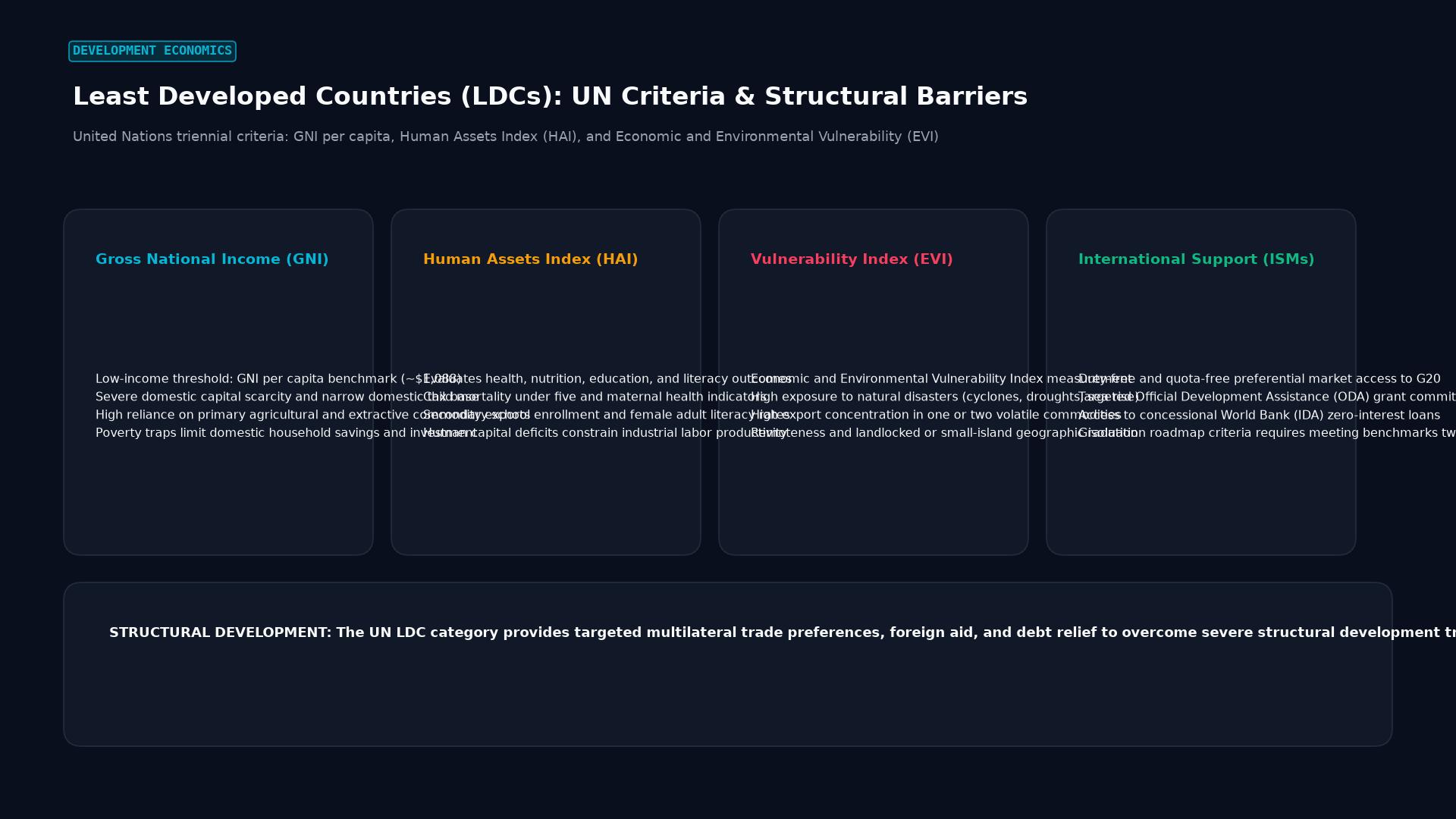 Figure: United Nations triennial criteria: GNI per capita, Human Assets Index (HAI), and Economic and Environmental Vulnerability (EVI)
Key Takeaways
- Tripartite UN Classification: A country is designated an LDC based on three criteria: low per capita income (GNI below specified World Bank thresholds), weak human assets (education and health indices), and high structural economic vulnerability.
- Exotic Currency Realities: LDC currencies rarely trade in standard spot interbank markets. International corporate treasuries and institutional funds manage currency risk using Non-Deliverable Forwards (NDFs) settled offshore in U.S. Dollars.
- Dual Exchange Rate Systems: Severe foreign exchange shortages frequently force central banks in LDCs to impose artificial official peg rates, causing active informal or “parallel” black markets to flourish at substantial discounts.
- High Sovereign Debt Spreads: LDC sovereign debt trades with steep yield premiums over U.S. Treasuries, reflecting elevated credit default risks, balance-of-payments fragilities, and frequent restructuring under IMF Extended Credit Facility (ECF) programs.
- Trade and Tariff Preferences: Under World Trade Organization (WTO) rules and initiatives like the EU’s “Everything But Arms” (EBA), LDCs receive duty-free and quota-free market access to encourage export-led industrialization.
Macroeconomic Comparison: DM vs. EM vs. LDC / Frontier Markets
Understanding where LDCs sit along the global developmental and financial spectrum is essential for cross-border capital allocation.
| Dimension | Developed Markets (DM) | Emerging Markets (EM) | Lesser Developed Countries (LDC) |
|---|---|---|---|
| Example Economies | US, Germany, Japan, UK | Brazil, India, Mexico, Poland | Bangladesh, Ethiopia, Laos, Zambia |
| GNI Per Capita | > $13,845 (High income) | $4,466 – $13,845 (Upper middle) | < $1,088 (Low income) |
| Currency Regime | Free float, zero capital controls | Managed float, partial controls | Fixed peg, crawling band, strict controls |
| FX Market Structure | Continuous spot, tight spreads | Liquid spot & onshore deliverable | Illiquid, offshore NDF, parallel rate |
| Inflation Profile | 1% – 3% target anchor | 3% – 8% cyclical variability | 15% – 50%+ structural chronic inflation |
| FX Reserve Adequacy | Deep reserves, swap lines with Fed | 6 to 12 months import cover | Often < 2 to 3 months import cover |
| Capital Market Depth | Deep corporate & sovereign debt | Developing local currency bonds | Almost exclusively multilateral / bilateral |
The FX Mechanism: Parallel Currency Markets and NDFs
When an LDC experiences a severe balance-of-payments crisis (often driven by falling commodity prices or surging debt service costs), foreign currency reserves dry up.
$$\text{Reserve Cover Ratio} = \frac{\text{Central Bank Gross FX Reserves}}{\text{Monthly National Imports}} < 3.0 \text{ months}$$
To prevent an immediate collapse of the domestic currency, the central bank implements strict rationing:
- Official Peg Defense: The monetary authority sets an artificial official rate (e.g., 50 units per USD) restricted exclusively to vital imports (medicine, wheat, fuel).
- Parallel Market Surge: Domestic businesses unable to acquire dollars through official banking channels turn to the informal street market, driving the parallel exchange rate to 80 or 100 units per USD.
- Offshore Hedging: Foreign institutional investors holding local assets cannot repatriate physical cash due to capital controls. They hedge currency devaluation risk using offshore USD-settled Non-Deliverable Forwards (NDFs) priced in hubs like London or Singapore.
Real-World Case Study: Currency Devaluation in Egypt and Nigeria (2023–2024)
Both Egypt and Nigeria—large economies with substantial low-income populations facing severe FX shortages—demonstrated the painful transition out of artificial exchange rate controls.
- The Problem: The Central Bank of Nigeria (CBN) maintained an official peg for the Nigerian Naira (NGN) around 460 per USD, while the parallel market rate traded near 750–800 NGN/USD. In Egypt, the official Egyptian Pound (EGP) was held at 30.9 per USD, while parallel trading exceeded 65 EGP/USD.
- The Reform: Under pressure from multi-billion-dollar IMF bailout programs, both nations dismantled artificial currency controls. Nigeria unified its exchange windows in mid-2023, causing the Naira to weaken past 1,500 NGN/USD. In March 2024, Egypt enacted an emergency 600-basis-point rate hike and let the EGP float to 49.5 per USD.
- Outcome: While the immediate currency devaluations drove domestic inflation above 30%, exchange rate unification cleared backlogged import payments, eliminated the parallel market spread, and revitalized foreign portfolio investment.
Investment Risks in Lesser Developed Markets
- Transfer and Inconvertibility Risk: Foreign investors may generate attractive nominal local-currency yields (e.g., 20% on treasury bills), but sovereign exchange controls can physically prohibit converting proceeds back into hard currency.
- Expropriation and Geopolitical Instability: LDCs frequently endure civil conflicts, coups d’état, and sudden legislative nationalization of foreign commercial assets or mines.
- Catastrophic Devaluation Gaps: Because peg adjustments in LDCs occur through sudden discretionary central bank decrees rather than continuous market discovery, a currency can devalue 40% to 70% overnight, completely wiping out foreign equity holdings.
Frequently Asked Questions (FAQ)
How many countries are officially classified as LDCs?
As designated by the United Nations, there are currently 45 sovereign nations categorized as Least Developed Countries, with the vast majority located across Sub-Saharan Africa, followed by parts of Southeast Asia and the Pacific Island states.
Can retail traders trade LDC currencies on MetaTrader?
Generally no. Retail forex brokers do not offer spot trading in true LDC currencies due to lack of interbank liquidity, extreme counterparty settlement risk, and local foreign exchange restrictions. Retail brokers typically limit exotic offerings to upper-tier emerging market currencies like the Mexican Peso (MXN), South African Rand (ZAR), or Turkish Lira (TRY).
What does it mean for a country to “graduate” from LDC status?
Graduation occurs when a country consistently exceeds established thresholds in GNI per capita, human assets, and economic vulnerability across two consecutive triennial UN reviews. Notable past graduates include Botswana (1994), Cabo Verde (2007), Maldives (2011), Samoa (2014), and Bhutan (2023).
Ready to trade forex?
Open a free demo account with a regulated broker. Practice with virtual funds before risking real money.