Sovereign Risk
The financial risk that a national government will default on its sovereign debt obligations, restructure existing liabilities, or enforce capital controls and foreign exchange restrictions that prevent cross-border debt servicing.
What Is Sovereign Risk?
Sovereign risk encompasses the probability that a national government will fail to honor its sovereign debt obligations, default on principal or coupon payments, or enact sweeping policy shifts—such as currency confiscation, moratoriums, or capital controls—that prevent domestic and foreign debtors within that jurisdiction from fulfilling cross-border financial commitments.
Sovereign risk is the apex credit risk in global finance. Because national governments hold sovereign immunity and cannot be forced into bankruptcy courts by commercial creditors in the same manner as corporations, resolving sovereign distress requires diplomatic negotiations, debt-restructuring agreements (often brokered by the International Monetary Fund), or severe hair-cuts on outstanding debt.
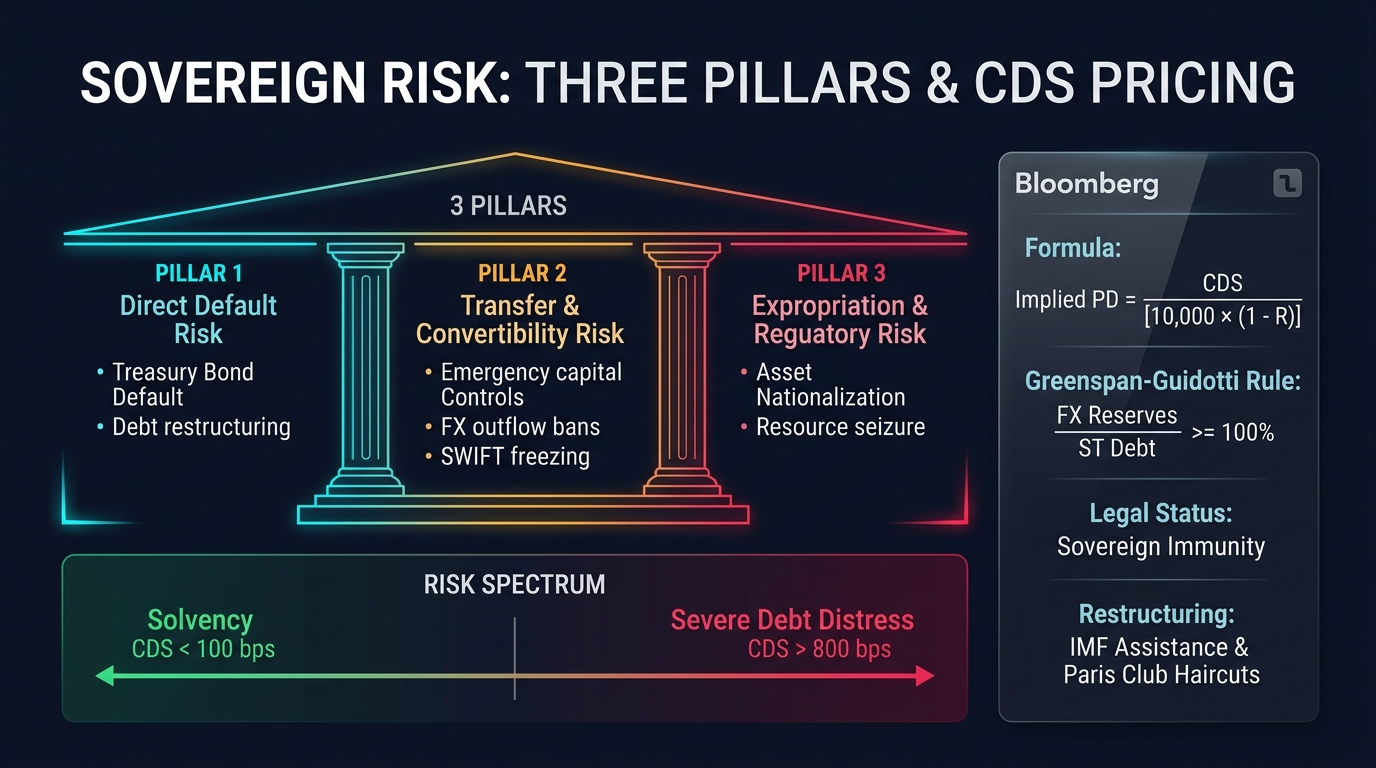
                      THE THREE PILLARS OF SOVEREIGN RISK

                               [ SOVEREIGN RISK ]
                                       │
        ┌──────────────────────────────┼──────────────────────────────┐
        ▼                              ▼                              ▼
  [ DIRECT DEFAULT RISK ]    [ TRANSFER & CONVERTIBILITY ]    [ REGULATORY & SEIZURE ]
  Government fails to pay    State bans foreign exchange      Expropriation of foreign
  interest or principal on   outflows; freezes bank accounts  assets, nationalization
  sovereign bonds / loans.   and nostro foreign balances.     of resources, tax shocks.
        │                              │                              │
        ▼                              ▼                              ▼
  Sovereign Bond Crash       Local Currency Collapses         Direct Capital Loss
The Components: Direct Default vs. Transfer and Convertibility Risk
Institutional credit analysts divide sovereign risk into two fundamental legal and operational categories:
- Direct Sovereign Default Risk: The government itself is the debtor (via sovereign treasury bonds, Eurobonds, or bilateral credits). The state runs out of foreign exchange reserves or fiscal revenues and announces an outright moratorium, suspension of payments, or debt restructuring.
- Transfer and Convertibility Risk: Even if a private domestic corporation or commercial bank is completely solvent and possesses ample domestic cash, the sovereign state enforces emergency capital controls. The government prohibits the conversion of local currency into foreign exchange (e.g., U.S. Dollars or Euros) or blocks cross-border SWIFT transfers, forcing private borrowers into technical default on their foreign debts.
Quantitative Indicators: How Sovereign Risk Is Measured
Global debt desks and macro hedge funds evaluate sovereign solvency through rigorous quantitative benchmarks:
1. Sovereign Credit Default Swap (CDS) Spreads
A sovereign CDS functions as an insurance policy against government default. The spread is quoted in basis points (bps) per year:
$$\text{Implied Default Probability (1-Year)} \approx \frac{\text{CDS Spread (in bps)}}{10,000 \times (1 - R)}$$
Where $R$ is the expected recovery rate (standardly assumed at 40% in sovereign restructurings). A sovereign CDS spread jumping from 80 bps to 800 bps indicates surging default expectations.
2. External Debt to FX Reserves (The Greenspan-Guidotti Rule)
A vital metric for emerging economies is the ratio of short-term external sovereign debt to official central bank foreign exchange reserves:
$$\text{Reserve Coverage Ratio} = \frac{\text{Official FX Reserves}}{\text{Short-Term External Debt Due Within 1 Year}}$$
Under the Greenspan-Guidotti Rule, this ratio must remain above 1.0 (100%). If a country’s short-term foreign debt obligations exceed its total central bank foreign reserves, the state is mathematically vulnerable to a sudden-stop currency crisis.
Sovereign Risk vs. Political Risk vs. Country Risk
| Risk Category | Scope of Exposure | Typical Catalyst | Primary Impacted Assets |
|---|---|---|---|
| Sovereign Risk | Direct actions of the sovereign state affecting its debt and currency convertibility | Fiscal insolvency, foreign reserve depletion, default | Sovereign government bonds, national currency exchange rates |
| Political Risk | Government instability, war, civil unrest, or policy changes | Coups, elections, regulatory overhauls, nationalization | Foreign direct investment (FDI), multinational corporate equities |
| Country Risk | Comprehensive umbrella covering all economic, financial, and political risks of a nation | Simultaneous banking collapse, recession, and debt crisis | All domestic financial assets, sovereign debt, and private enterprise |
Real-World Institutional Case Study: The 2010–2012 Eurozone Sovereign Debt Crisis
The most significant sovereign risk event in modern developed markets struck the peripheral economies of the Eurozone (Greece, Ireland, Portugal, Spain, and Italy):
       GREEK 10-YEAR SOVEREIGN BOND YIELD (2009–2012)

 35% ──┐                                         ┌─── Peak Yield: ~38% (2012)
       │                                         │
 25% ──┼                                        /│
       │                                       / │
 15% ──┼                                _..-''`  │
       │                         _.-''`          │
  5% ──┼─-.._             _.-''`                 │
       └─────`'--------'─────────────────────────┴─────────────────────
2009 2010 2011 2012- The Catalyst: In late 2009, newly elected Greek authorities revealed that prior governments had concealed massive fiscal deficits, with the true deficit exceeding 12.7% of GDP (more than four times the EU limit).
- The Contagion: Because Eurozone member states share a common currency and central bank (ECB), they cannot independently print money to inflate away domestic sovereign debt. Sovereign bond yields on peripheral European nations spiked violently.
- Market Fallout: Greek 10-year yields skyrocketed above 35%, and the Greek government enforced an unprecedented private sector debt restructuring (PSI), imposing a 53.5% nominal haircut (and over 70% real economic loss) on bondholders. EUR/USD plunged from 1.5100 to below 1.2100.
- The Resolution: The existential crisis was halted only in July 2012, when ECB President Mario Draghi delivered his historic declaration that the ECB was prepared to do “whatever it takes to preserve the euro.”
How Sovereign Risk Impacts the Foreign Exchange Market
When sovereign risk escalates within a nation, the domestic currency experiences violent structural depreciation through three transmission channels:
- Capital Flight: Domestic citizens and foreign institutions convert bank deposits into hard foreign currencies (USD, CHF, EUR), triggering rapid reserve depletion.
- Yield Curve Inversion & Widening Spreads: Sovereign bond spreads widen exponentially over risk-free benchmarks (e.g., German Bunds or U.S. Treasuries), raising borrowing costs across the entire domestic economy.
- Cross-Currency Basis Swap Dislocation: Domestic banks are locked out of international wholesale funding markets, causing dollar liquidity shortages and extreme negative dislocations in cross-currency basis swaps.
Frequently Asked Questions
Can a nation that prints its own currency default on its sovereign debt?
Technically, a nation that issues debt exclusively in its own sovereign, fiat currency (such as the United States, Japan, or the United Kingdom) cannot be forced into involuntary nominal default, as its central bank can print unlimited domestic currency to repay debt. However, doing so triggers runaway hyperinflation and severe currency collapse, resulting in a real economic default in purchasing power terms.
What is the difference between local-currency and foreign-currency sovereign debt?
- Local-Currency Debt: Denominated in the nation’s own currency; carries lower default risk because the central bank can act as lender of last resort.
- Foreign-Currency Debt (e.g., Dollar-denominated Eurobonds): Issued in foreign currencies; carries severe default risk because the sovereign cannot print foreign exchange and depends entirely on export receipts and central bank reserves.
How do multinational corporations protect themselves against sovereign risk?
Corporations utilize political and sovereign risk insurance (PRI) offered by institutions such as the World Bank’s Multilateral Investment Guarantee Agency (MIGA) or private Lloyd’s of London syndicates. Treasuries also execute cross-currency swaps, establish offshore holding companies, and repatriate daily cash balances into neutral jurisdictions.
Ready to trade forex?
Open a free demo account with a regulated broker. Practice with virtual funds before risking real money.