Liability
A liability is a legally enforceable financial obligation, debt, or claim against an economic entity's assets resulting from past transactions, requiring settlement through future economic sacrifices such as cash outflows, asset transfers, or service delivery.
What Is a Liability?
In corporate finance and accounting, a liability is a present legal obligation of an enterprise arising from past events, the settlement of which is expected to result in an outflow of resources embodying economic benefits. On a corporate balance sheet, liabilities represent the claims of external creditors and debt holders against the total assets of the firm, adhering to the foundational accounting equation:
$$\text{Assets} = \text{Liabilities} + \text{Equity}$$
In foreign exchange (Forex) and international treasury management, liabilities take on a crucial specialized dimension: foreign-currency-denominated liabilities. When a financial institution, corporation, or sovereign government incurs debts payable in a foreign currency (such as the U.S. Dollar or Euro), fluctuations in exchange rates directly alter the real domestic-currency cost of servicing that debt. An unexpected depreciation of the domestic currency inflates the debt burden, creating systemic insolvency risks known as currency mismatch.
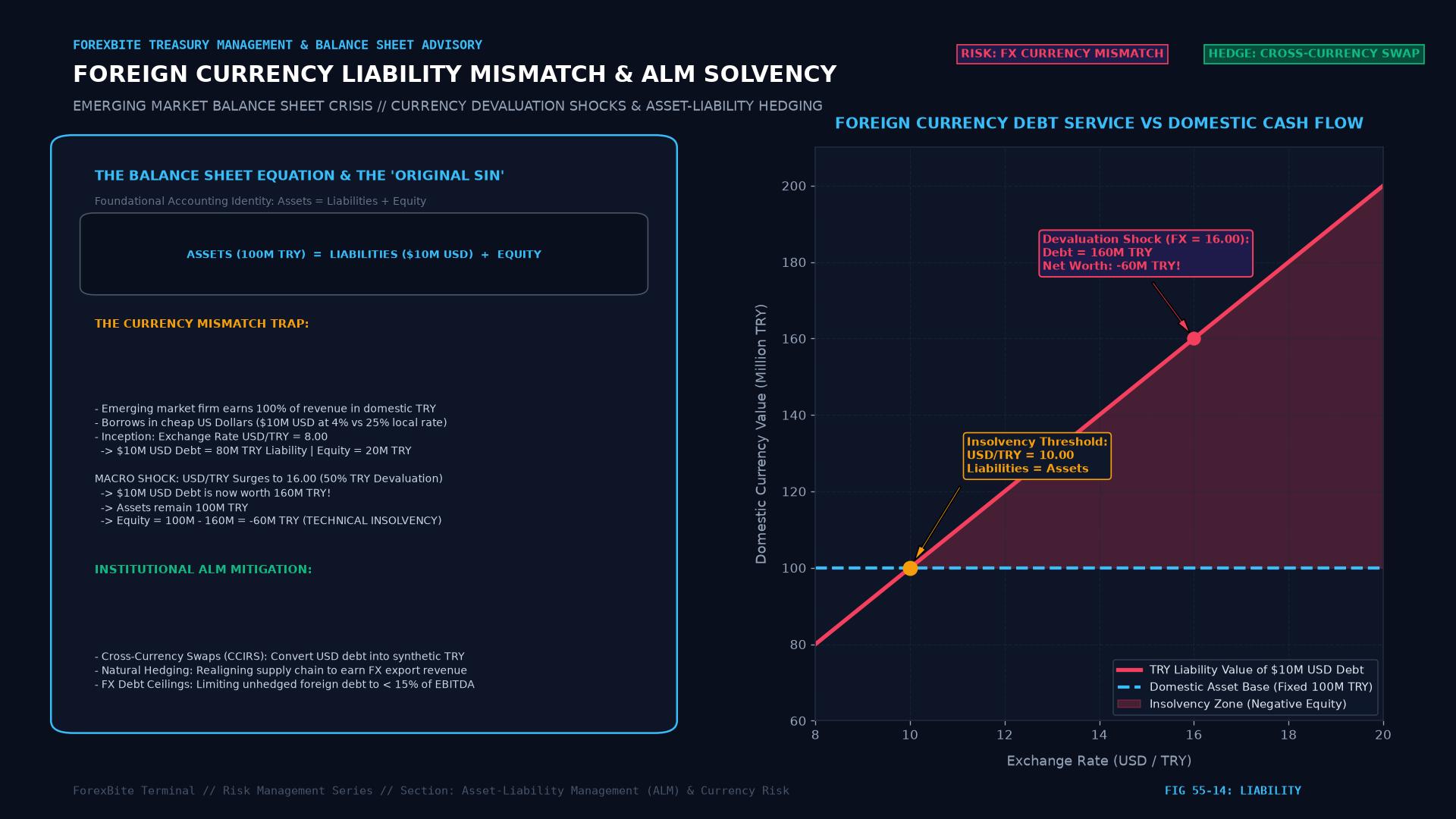 Figure: The foreign currency liability mismatch mechanism where domestic currency devaluation doubles unhedged foreign debt burdens, triggering balance sheet insolvency.
Key Takeaways
- Balance Sheet Classification: Liabilities are partitioned into Current Liabilities (due within 12 months, such as accounts payable, short-term debt, and derivative margin obligations) and Non-Current Liabilities (long-term bonds, syndicated bank loans, and deferred taxes).
- Currency Mismatch Risk: Borrowing in foreign currency while earning revenues in domestic currency creates severe unhedged balance-sheet fragility, historically recognized as the “Original Sin” of emerging market finance.
- Derivative Liabilities: In OTC derivatives and interbank trading, an open position with negative mark-to-market replacement value is classified as a derivative liability, requiring daily variation margin collateral under ISDA Credit Support Annexes.
- Asset-Liability Management (ALM): Financial institutions use ALM models to align the maturity profiles, interest rate sensitivities (duration), and currency compositions of their assets and liabilities.
- Contingent Liabilities: Potential future obligations that depend on the outcome of an uncertain future event (such as loan guarantees or legal disputes) that must be disclosed under IFRS and US GAAP standards.
Comparative Taxonomy: Types of Financial Liabilities
| Liability Category | Tenor / Horizon | Financial Characteristics | FX Market Relevance |
|---|---|---|---|
| Current Operating | Under 12 months | Accounts payable, trade credit, short-term supplier debt | Driving force behind corporate commercial FX conversion and leads/lags |
| Current Derivative | Daily mark-to-market | Floating losses on open FX forwards, swaps, options | Requires posting Variation Margin (VM) in cash or eligible bonds |
| Long-Term Funded | Over 12 months to 30 years | Eurobonds, syndicated debt, foreign-currency bank notes | High vulnerability to secular currency depreciation cycles |
| Contingent | Conditional / uncertain | Sovereign guarantees for state-owned enterprises (SOEs) | Sudden trigger can cause sovereign credit downgrades and currency dumps |
Mechanics: The Debt-to-Equity Currency Multiplier
To see how an unhedged foreign liability destroys corporate solvency during a currency crisis, consider a firm with the following balance sheet:
$$\text{Equity} = \text{Assets}{\text{Domestic}} - ( \text{Liabilities}{\text{Domestic}} + S \times \text{Liabilities}_{\text{USD}} )$$
Where $S$ is the spot exchange rate (domestic units per 1 USD).
-
Initial State:
- Domestic Assets = 1,000,000,000 local units.
- Domestic Liabilities = 200,000,000 local units.
- USD Liabilities = $100,000,000 USD.
- Initial Exchange Rate $S_0 = 5.00$ local units per USD.
- Initial USD Debt in local currency = $100,000,000 \times 5.00 = 500,000,000$ local units.
- Starting Equity = $1,000,000,000 - (200,000,000 + 500,000,000) = \mathbf{300,000,000}$ local units (Solvent).
-
After a 50% Currency Devaluation ($S_1 = 10.00$):
- The USD debt now equals $100,000,000 \times 10.00 = 1,000,000,000$ local units.
- Revised Equity = $1,000,000,000 - (200,000,000 + 1,000,000,000) = \mathbf{-200,000,000}$ local units.
- The firm is now technically bankrupt purely due to the exchange rate revaluation of its foreign currency liabilities.
Real-World Case Study: The 1997 Asian Financial Crisis
Prior to July 1997, corporate conglomerates in Thailand, Indonesia, and South Korea borrowed heavily in U.S. Dollars because dollar interest rates were substantially lower than local domestic rates, and national central banks maintained stable currency pegs to the USD.
- The Flaw: Corporations treated the currency peg as a permanent guarantee, failing to hedge their ballooning USD liabilities.
- The Run: Speculative pressures forced the Bank of Thailand to unpeg the Thai Baht on July 2, 1997. The Baht halved in value over subsequent months.
- The Cascade: As local currencies collapsed across Southeast Asia, domestic revenues converted into drastically fewer dollars. Giant industrial corporations could not service their dollar-denominated liabilities, triggering an unprecedented wave of corporate bankruptcies, IMF structural adjustment programs, and bank failures.
Liability Hedging Techniques
- Natural Hedging: Matching revenues and liabilities in the identical currency (e.g., an exporter using USD export revenues to directly service USD-denominated bank loans).
- Cross-Currency Swaps: Exchanging a stream of domestic-currency principal and interest payments for a stream of foreign-currency payments, effectively transforming a foreign liability into a synthetic domestic liability.
- Local Currency Debt Issuance: Refinancing foreign currency bank loans by issuing domestic-currency municipal or corporate bonds (“Panda bonds” in China, “Masala bonds” in India).
Frequently Asked Questions (FAQ)
What is a contingent liability in banking?
A contingent liability is a potential obligation that may become an actual liability depending on whether an uncertain future event occurs. Classic examples include standby letters of credit, performance bonds, and loan guarantees provided by commercial banks to corporate clients.
How are open forex trades treated as liabilities?
If you hold an open leveraged forex trade that has accumulated an unrealized loss, that loss constitutes a current derivative liability. The broker deducts this liability from your account equity, reducing your usable margin and bringing you closer to a margin call or stop-out.
Why do companies borrow in foreign currency if it is so risky?
Companies in developing nations often face shallow domestic capital markets with exorbitant local interest rates (e.g., 15%–25%) and short loan maturities (1–3 years). By tapping global debt markets in USD or EUR, they can secure significantly lower coupon rates (e.g., 5%–7%) and longer tenors (10–30 years), accepting exchange rate risk in exchange for immediate financing accessibility.
Ready to trade forex?
Open a free demo account with a regulated broker. Practice with virtual funds before risking real money.