London International Financial Futures Exchange (LIFFE)
The London International Financial Futures and Options Exchange (LIFFE) was Europe's premier derivatives exchange, renowned for establishing benchmark short-term interest rate futures, government bond contracts, and soft commodities before evolving into ICE Futures Europe.
What Was the London International Financial Futures Exchange (LIFFE)?
The London International Financial Futures and Options Exchange (LIFFE)—originally established in September 1982 as the London International Financial Futures Exchange—was the cornerstone of the European derivatives industry. Created in the wake of the United Kingdom’s 1979 abolition of foreign exchange controls, LIFFE was designed to provide European financial institutions, commercial banks, and multinational corporations with exchange-traded hedging instruments modeled after Chicago’s successful financial futures markets.
Operating initially from the historic Royal Exchange building in the City of London, LIFFE became the undisputed global hub for trading Short-Term Interest Rate (STIR) futures (such as the Three-Month Sterling / Euribor contracts), sovereign bond futures (UK Long Gilt, German Bund), equity index options (FTSE 100), and agricultural commodities. In 1996, LIFFE merged with the London Traded Options Market (LTOM), and in 2001 was acquired by Euronext, forming Euronext.liffe, which was subsequently absorbed into NYSE Euronext and ultimately acquired by the Intercontinental Exchange (ICE) in 2013.
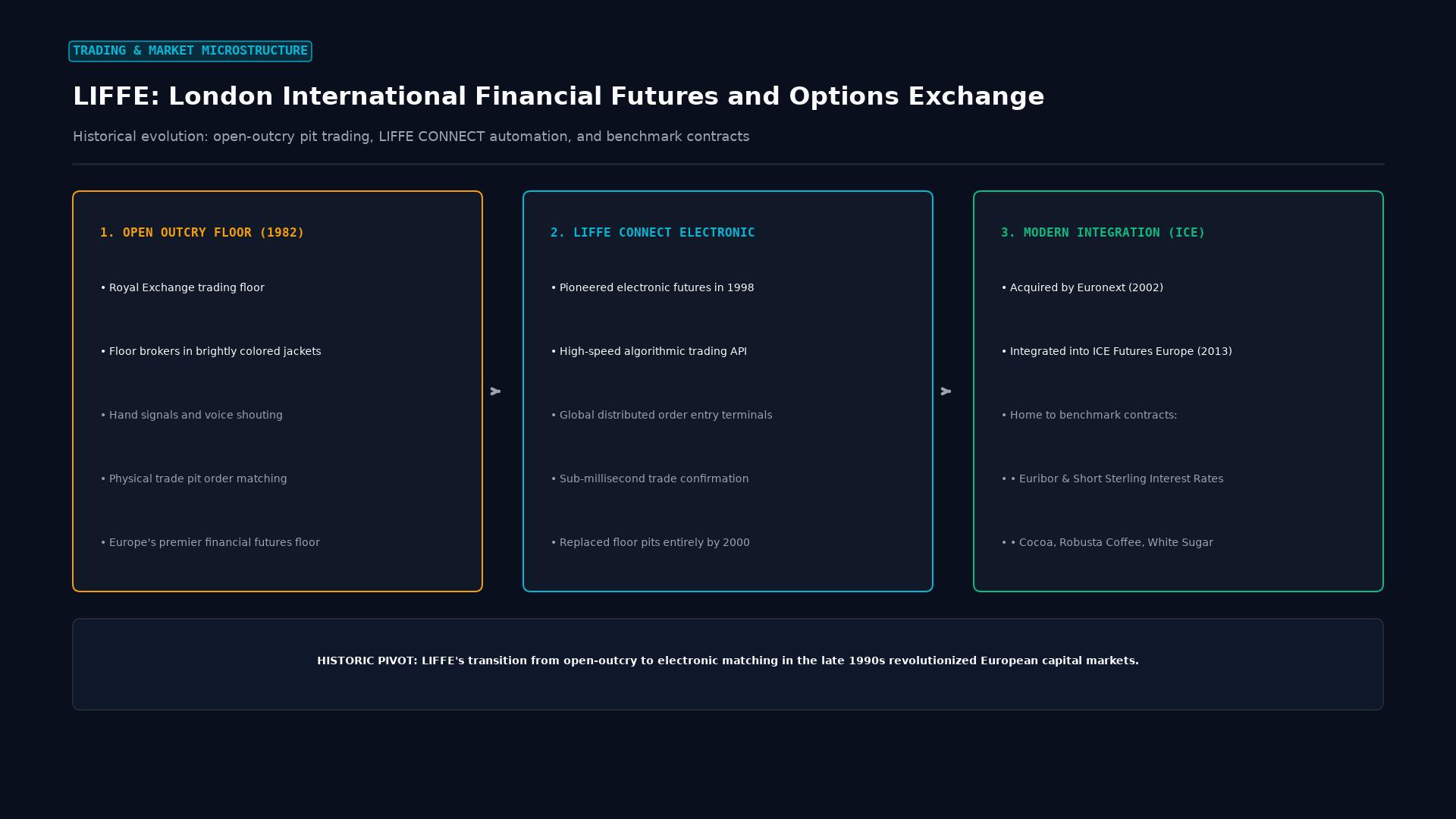 Figure: Evolution of LIFFE: from the Royal Exchange open-outcry pit trading to the automated Connect electronic matching platform and Euronext integration.
Key Takeaways
- Pioneering European Derivatives: LIFFE brought standardized, cleared financial futures and options to European hours, breaking the Chicago exchanges’ monopoly on financial derivatives.
- The Short-Term Interest Rate (STIR) Powerhouse: LIFFE was the epicenter of global European interest rate risk hedging, hosting the Three-Month Euribor, Short Sterling, and Euroswiss futures contracts.
- The Eurex Electronic Battle: In 1997–1998, LIFFE famously lost its dominant market share in German Government Bond (Bund) futures to the German-Swiss electronic exchange DTB (later Eurex) within months, accelerating the global extinction of pit trading.
- LIFFE CONNECT: Developed in response to the Bund crisis, LIFFE CONNECT became the benchmark electronic trading platform of the early 2000s, later licensed to major exchanges worldwide.
- Modern Identity: Today, the core financial futures originally traded on LIFFE reside within ICE Futures Europe, continuing to clear billions in European interest rate and soft commodity contracts daily.
Open-Outcry Pits vs. Electronic Trading: The LIFFE Paradigm Shift
LIFFE’s history is inextricably linked to the technological transformation of derivatives trading from physical floor trading to algorithmic screen execution.
| Dimension | LIFFE Open-Outcry Floor (1982–2000) | Modern Electronic Execution (ICE / Eurex) |
|---|---|---|
| Execution Venue | Trading floor pits at Cannon Bridge, London | Distributed server data centers (Equinix LD4, Slough) |
| Communication | Shouting, coded hand signals, physical badge badges | Sub-millisecond FIX protocol and direct market APIs |
| Trading Capacity | Restricted to registered floor brokers and “locals” | Global institutional, prop, and retail accessibility |
| Clearing Speed | End-of-day reconciliation by LCH (London Clearing House) | Real-time automated straight-through processing (STP) |
| Order Matching | Visual / verbal negotiation between pit traders | Algorithmic Central Limit Order Book (Price-Time FIFO) |
| Market Transparency | Limited to those physically standing on the floor | Full Depth-of-Market (DOM) visible worldwide |
Real-World Case Study: The “Battle for the Bund” (1997–1998)
The struggle between LIFFE and Germany’s Deutsche Terminbörse (DTB) represents the most famous market-share battle in financial market history.
- The Status Quo (Early 1997): LIFFE controlled over 70% of global trading volume in the 10-year German Government Bond (Bund) futures contract, traded via boisterous open-outcry pits in London. DTB operated a fully electronic screen-based exchange in Frankfurt, holding the remaining 30%.
- The Liquidity Flip: DTB installed trading terminals directly in the London offices of major international investment banks and waived terminal access fees. Traders realized they could execute Bund hedges electronically from their desks with lower clearing costs and zero pit broker commissions.
- The Collapse: In mid-1997, DTB’s market share began surging. Within an astounding 12-month period, LIFFE’s Bund volume plummeted from 70% to 0%. The open-outcry pit was completely drained of liquidity.
- The Response: In 1998, under CEO Brian Williamson, LIFFE made the radical decision to dismantle its open-outcry trading floors, invest heavily in digital infrastructure, and launch LIFFE CONNECT. By 2000, all floor trading ceased, transforming London into an electronic powerhouse.
Core Benchmark Contracts Pioneered by LIFFE
- Three-Month Short Sterling: The primary hedging instrument for UK interest rate expectations, tracking the Bank of England’s monetary policy curve.
- Three-Month Euribor: The flagship interest rate futures contract for the Eurozone, allowing global banks to hedge wholesale interbank funding costs.
- UK Long Gilt Futures: Standardized 10-year UK sovereign debt contract used by pension funds and gilt-edged market makers (GEMMs) for duration matching.
- Soft Commodities: World benchmark futures contracts for Robusta Coffee, Cocoa, White Sugar, and Feed Wheat.
Systemic Importance and Modern Legacy
LIFFE’s technological and structural innovations laid the blueprint for modern cleared derivatives:
- Central Counterparty Clearing: Through its historic clearing partnership with the London Clearing House (LCH), LIFFE perfected the practice of replacing bilateral counterparty risk with a mutualized clearing guarantee fund and daily mark-to-market variation margin.
- Electronic Price Ladders: The interface architecture developed for LIFFE CONNECT served as the foundation for modern Depth-of-Market (DOM) trading screens used by today’s prop traders and retail platforms.
Frequently Asked Questions (FAQ)
Does LIFFE still exist today?
Not as an independent exchange. Following its acquisition by Euronext in 2001 and subsequent corporate mergers, LIFFE was acquired by the Intercontinental Exchange (ICE) in 2013. Its contracts and trading operations were fully integrated into ICE Futures Europe.
Why were pit traders called “locals”?
On LIFFE’s physical trading floor, “locals” were independent, self-employed floor traders who traded strictly with their own personal capital. Acting as high-frequency liquidity providers of their era, they stood in the pits buying at the bid and selling at the offer, assuming short-term inventory risk to capture the spread.
What happened to the physical trading floor when LIFFE went electronic?
The cavernous trading floor at Cannon Bridge was closed in 2000. Floor brokers either transitioned into electronic screen trading desks at investment banks, established proprietary algorithmic trading firms, or retired from the industry.
Ready to trade forex?
Open a free demo account with a regulated broker. Practice with virtual funds before risking real money.