Interest Rate
An interest rate is the cost of borrowing money, expressed as a percentage of the principal over a specified period. In forex, central bank interest rates are the single most powerful driver of currency valuation — they determine investment yield differentials between countries and directly influence capital flows across borders.
Why Interest Rates Move Currencies
Money moves toward yield. That single principle explains most of what happens in forex markets at a macroeconomic level. When the US Federal Reserve raises its benchmark rate to 5.25%, US dollar-denominated assets suddenly pay significantly more than comparable assets in a country with rates at 0.5%. International investors — pension funds, sovereign wealth funds, institutional managers — rebalance portfolios toward the higher-yielding asset class.
To buy US dollar assets, they must first buy US dollars. That demand strengthens the dollar. This is why, historically, a central bank rate hike cycle is accompanied by currency appreciation, and a rate-cutting cycle tends to bring depreciation.
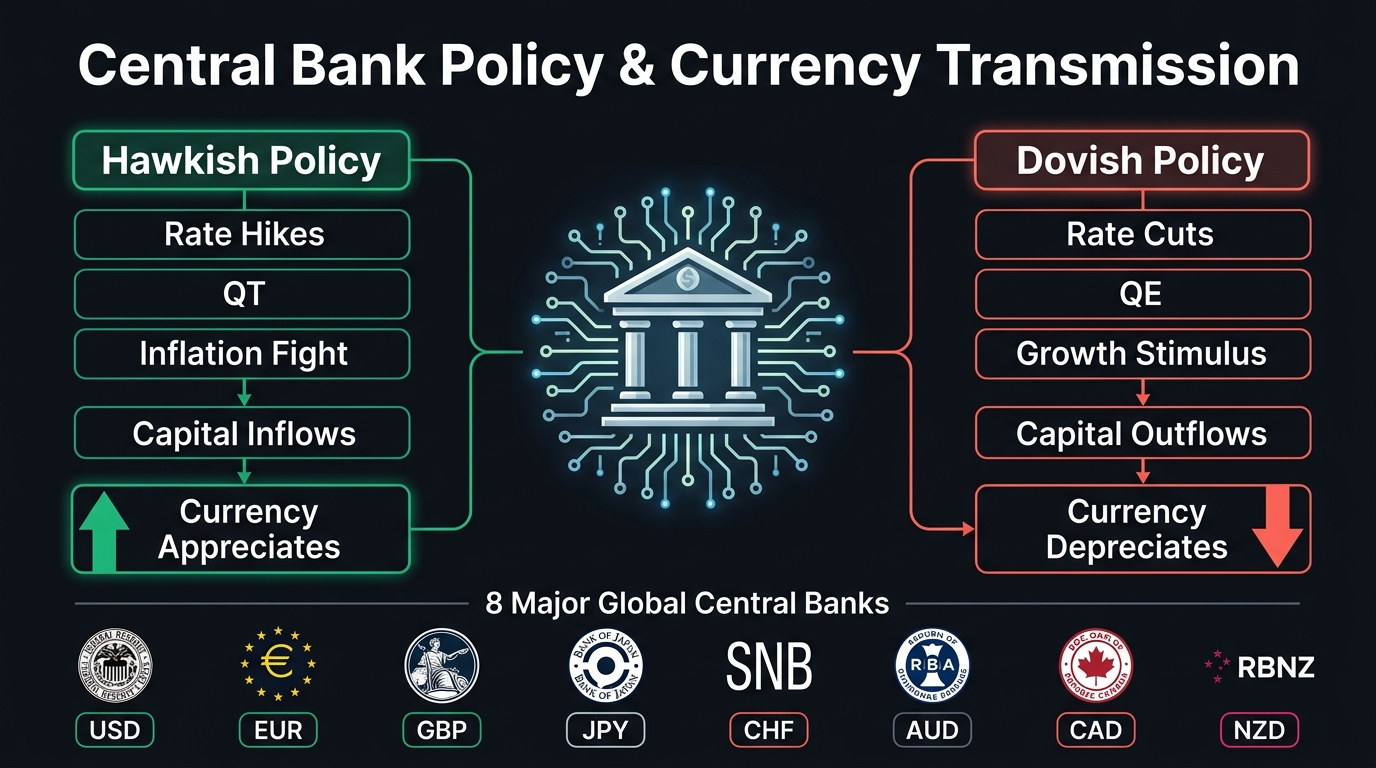
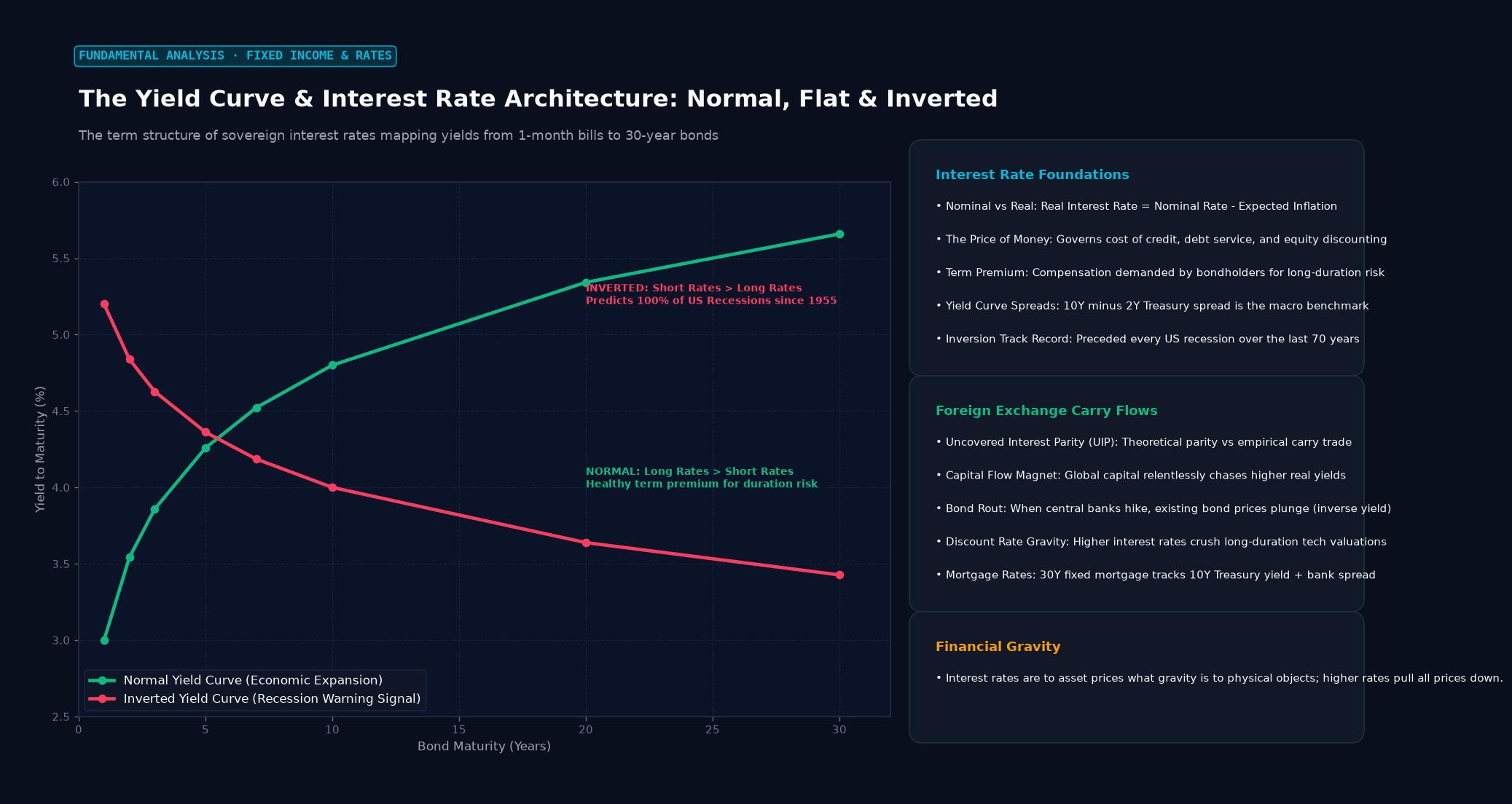 Figure: The term structure of sovereign interest rates mapping yields from 1-month bills to 30-year bonds
Types of Interest Rates That Matter in Forex
Central bank policy rate: The rate at which commercial banks borrow from the central bank overnight. This is the headline number that drives FX market reactions. The US Federal Funds Rate, the ECB’s Main Refinancing Rate, the Bank of England’s Bank Rate, and the Bank of Japan’s Policy Rate are the key benchmarks. Central bank meetings — 8 times per year for the Fed, quarterly for many others — are among the highest-impact events on the economic calendar.
Interbank rate (LIBOR/SOFR, EURIBOR): The rate at which large banks lend to each other. These market-determined rates reflect real-world credit conditions and serve as the reference point for countless financial instruments. LIBOR was the global standard until its replacement by SOFR (Secured Overnight Financing Rate) in 2023.
Real interest rate: The nominal rate minus inflation. A 5% policy rate with 7% inflation represents a real rate of -2% — meaning the currency is losing purchasing power in real terms. Currencies with positive real rates attract capital more persistently than those with high nominal but negative real rates.
Forward Guidance: Trading the Expectation, Not the Fact
By the time a central bank actually raises rates, the currency has often already moved significantly. Currency markets are forward-looking — participants position based on what they expect to happen, not what has already happened.
This creates the phenomenon where a rate hike can cause currency weakness rather than strength: if the market had fully priced in three more rate hikes and the central bank delivers only one while signaling caution, the “tightening” cycle reads as a dovish surprise. The dollar (or whatever currency) falls on a day when rates technically rose.
Understanding rate expectations — not just current rates — is what separates sophisticated fundamental traders from those who simply read headlines.
Interest Rate Differentials and Currency Pairs
Any currency pair is ultimately driven by the differential between the two countries’ interest rates. EUR/USD is strongly influenced by the spread between ECB and Federal Reserve policy rates. When the Fed was hiking aggressively in 2022–2023 while the ECB lagged behind, that widening differential drove EUR/USD from 1.1500 down to parity (1.0000) and briefly below it — a move of unprecedented speed.
Monitoring the evolution of rate expectations for both currencies in a pair is essential for fundamental EUR/USD, GBP/USD, or USD/JPY analysis.
The Yield Curve: Reading Rate Expectations from the Bond Market
The yield curve — plotting interest rates across different maturities of government bonds — is a forward-looking market signal. When short-term yields are higher than long-term yields (an inverted yield curve), the bond market is pricing in future rate cuts — typically because economic slowdown is expected. This is why yield curve inversions precede recessions with striking regularity.
For forex traders, the shape of the yield curve provides real-time intelligence about where the bond market expects policy to go. A country whose yield curve is aggressively steepening (long rates rising) signals growth expectations and potential future tightening — usually constructive for its currency.
How Rate Decisions Are Made
Central banks use several tools to set their benchmark rate:
Open Market Operations: Buying or selling government bonds to inject or drain liquidity from the banking system, which influences the overnight lending rate.
Reserve Requirements: Minimum reserves banks must hold; changing this affects how much banks can lend (and at what rate).
Forward Guidance: Communication about the future direction of policy. Markets treat forward guidance as a quasi-rate tool — a credible commitment to future hikes moves markets almost as effectively as the hike itself.
Key Takeaways
- Central bank interest rates are the most powerful fundamental driver of currency values
- Higher rates attract capital flows, increasing demand for a currency
- Real interest rate (nominal minus inflation) is more meaningful than nominal rate alone
- Markets price in expected future rates — surprises relative to expectations move currencies
- Rate differentials between countries drive currency pair trends
FAQ
How quickly does a rate change affect currency prices? The actual announcement can move prices within milliseconds. But the full effect on a currency over weeks and months depends on how the market recalibrates its expectations for the entire rate cycle going forward, not just the single decision.
What happens when central banks in both countries raise rates simultaneously? The currency pair remains relatively stable if rate differentials don’t change. EUR/USD direction depends on whether the ECB or the Fed is hiking faster and by more — both hiking together at the same pace has minimal currency impact.
Ready to trade forex?
Open a free demo account with a regulated broker. Practice with virtual funds before risking real money.