Futures Contract
A futures contract is a standardized, exchange-traded financial derivative obligating the buyer to purchase, and the seller to sell, a specific quantity of an underlying asset or currency at a predetermined price on a specified future date.
What Is a Futures Contract?
A futures contract is an exchange-traded, legally binding derivative agreement between two market participants to transact a specific quantity and quality of an underlying asset—such as foreign currencies, crude oil, stock indices, or government bonds—at an agreed price today, with settlement scheduled on a specified future delivery date.
Unlike over-the-counter (OTC) instruments like forward contracts, which are privately negotiated between two counterparties, futures trade exclusively on regulated public exchanges such as the Chicago Mercantile Exchange (CME Group), Intercontinental Exchange (ICE), and Eurex. The exchange determines every parameter of the contract—including contract size, expiration dates, minimum price increments (ticks), and delivery procedures. Market participants negotiate only one variable: the price.
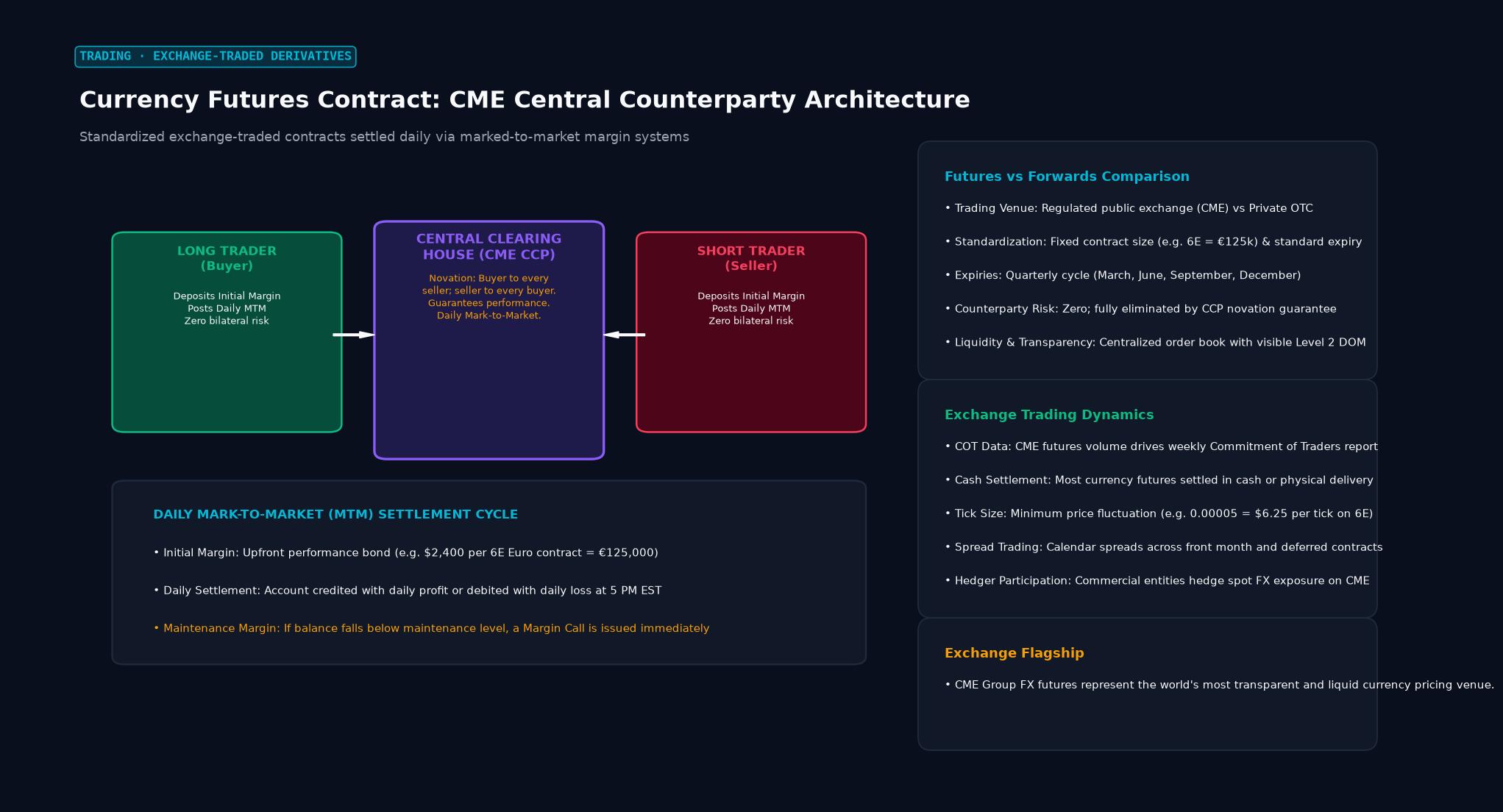 Figure: Standardized exchange-traded contracts settled daily via marked-to-market margin systems
Core Specifications of Currency Futures
In the foreign exchange market, currency futures provide an alternative to decentralized spot forex trading. The CME Group’s International Monetary Market (IMM) operates the world’s largest currency futures venue.
Every currency futures contract adheres to strict institutional specifications:
| Contract | Code | Standard Contract Size | Minimum Tick Size | Tick Dollar Value |
|---|---|---|---|---|
| Euro FX | 6E | €125,000 EUR | 0.00005 per EUR | $6.25 |
| Japanese Yen | 6J | ¥12,500,000 JPY | 0.0000005 per JPY | $6.25 |
| British Pound | 6B | £62,500 GBP | 0.0001 per GBP | $6.25 |
| Australian Dollar | 6A | A$100,000 AUD | 0.00005 per AUD | $5.00 |
| Canadian Dollar | 6C | C$100,000 CAD | 0.00005 per CAD | $5.00 |
| Micro Euro FX | M6E | €12,500 EUR | 0.0001 per EUR | $1.25 |
Futures contracts typically follow a quarterly expiration schedule falling on the third Wednesday of March, June, September, and December.
The Clearinghouse and Daily Mark-to-Market
The defining feature of a futures exchange is the Clearinghouse (such as CME Clearing). Through an institutional legal process called novation, the clearinghouse steps between the buyer and seller, becoming the counterparty to both sides of every executed transaction. This structure virtually eliminates individual counterparty default risk.
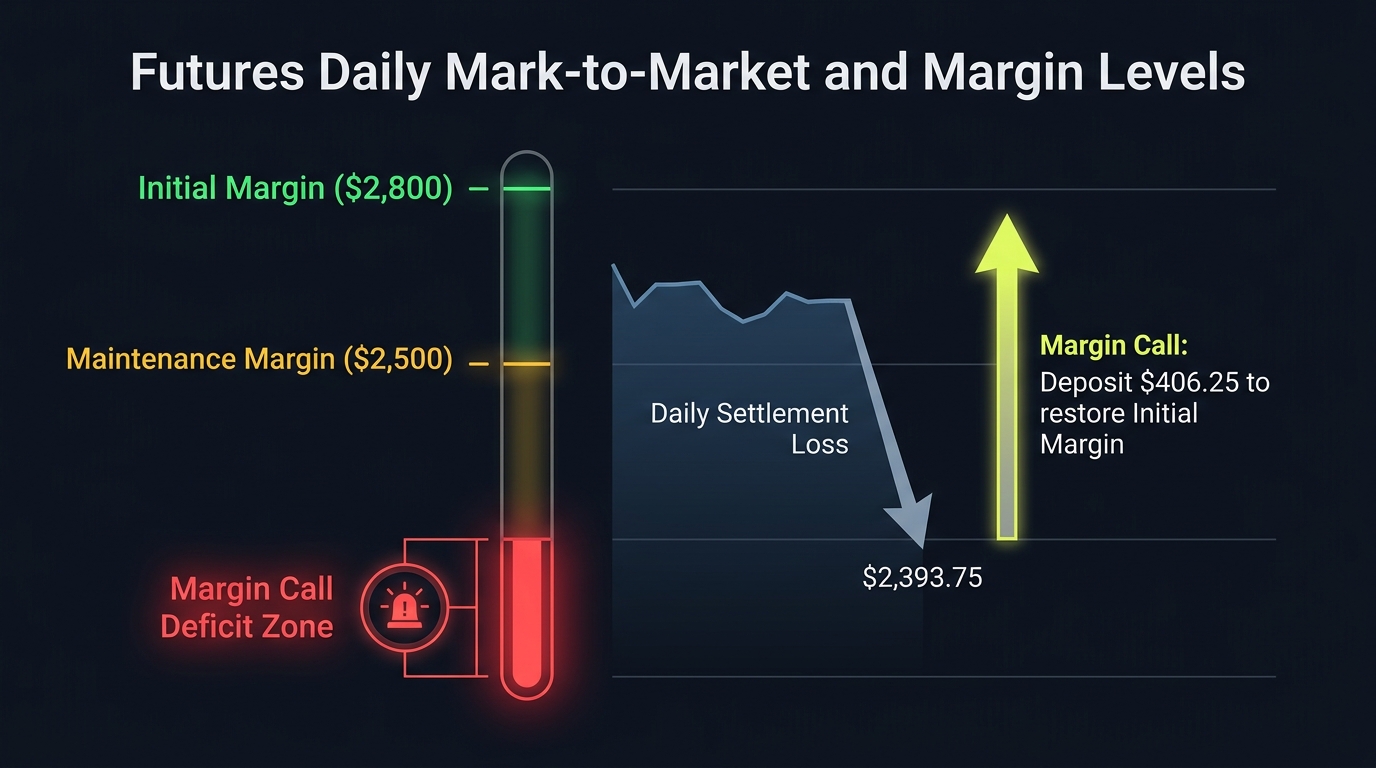
To guarantee financial integrity across the system, futures exchanges operate on a strict daily mark-to-market system using two margin levels:
1. Initial Margin
The minimum capital deposit required by the exchange to initiate a new futures position. Unlike a loan down payment, initial margin is a good-faith collateral performance bond, typically ranging from 2% to 8% of the contract’s total notional value.
2. Maintenance Margin
The minimum equity balance that must remain in the trader’s account at all times to sustain the position. If market movements push account equity below this threshold, the broker issues an immediate margin call. The trader must wire additional funds to restore the account to the initial margin level, or face automated liquidation.
Numerical Example: Trading 1 Contract of CME Euro FX (6E)
- Position: Long 1 contract of Euro FX (€125,000) purchased at 1.0850
- Notional Value: €125,000 × 1.0850 = $135,625 USD
- Exchange Initial Margin: $2,800 USD
- Exchange Maintenance Margin: $2,500 USD
Day 1 (Closing Settlement): The Euro FX futures price closes down 40 ticks at 1.0830. $$\text{Loss} = (1.0850 - 1.0830) \times €125,000 = -$250 \text{ USD}$$ The clearinghouse debits $250 from the trader’s account. Account equity drops to: $$$2,800 - $250 = \mathbf{$2,550 \text{ USD}}$$ Because $2,550 is still above the maintenance margin ($2,500), no margin call is triggered.
Day 2 (Closing Settlement): The contract closes down an additional 25 ticks to 1.08175. $$\text{Loss} = (1.0830 - 1.08175) \times €125,000 = -$156.25 \text{ USD}$$ Account equity falls to $2,393.75 USD, which is below the $2,500 maintenance margin.
A margin call is generated demanding $406.25 USD ($2,800 initial requirement - $2,393.75 current equity) before market open the next morning.
Futures Contracts vs. Spot Forex vs. Forward Contracts
| Feature | Currency Futures | Spot Forex | Forward Contracts |
|---|---|---|---|
| Trading Venue | Centralized Exchanges (CME) | Decentralized Interbank / OTC | OTC Private Negotiations |
| Order Book Transparency | 100% visible Volume & DOM | Fragmented broker quotes | Completely private |
| Contract Sizing | Standardized fixed lots | Flexible (micro, mini, standard) | Fully customizable |
| Counterparty Risk | Guaranteed by Clearinghouse | Dependent on broker solvency | Direct institutional credit risk |
| Regulation | Regulated by CFTC / NFA | Regulated by national broker rules | Governed by ISDA contracts |
| Cash Settlement | Daily variation margin cash-sweep | Overnight rollover / swap fees | Lump-sum settlement at maturity |
Key Takeaways
- A futures contract is an exchange-traded agreement to buy or sell an asset at a predetermined price on a future date.
- Contract sizes, expiration dates, and tick sizes are fully standardized by the exchange.
- The clearinghouse sits between buyer and seller, virtually eliminating counterparty credit risk.
- Positions are marked-to-market daily, requiring traders to maintain equity above the maintenance margin threshold.
- Currency futures provide transparent order flow, centralized volume data, and level-playing-field pricing unlike decentralized spot forex brokers.
Frequently Asked Questions
Do currency futures traders have to take physical delivery of foreign currency?
No. Over 98% of currency futures contracts are closed out before expiration through an offsetting trade (selling an existing long position or buying back a short position). For traders who hold through expiration, most contracts are settled through book-entry bank wire delivery or cash settlement.
How does volume on currency futures help spot forex traders?
Because spot forex is OTC and has no unified global volume feed, technical traders use the centralized volume and Commitments of Traders (COT) report data from CME currency futures to track institutional accumulation and distribution.
What is the difference between initial margin and maintenance margin in futures?
Initial margin is the upfront deposit required to open a position. Maintenance margin is the lower threshold of account equity required to keep the position open. Dropping below the maintenance margin triggers a margin call to restore the account to the initial margin level.
Ready to trade forex?
Open a free demo account with a regulated broker. Practice with virtual funds before risking real money.