Macedonia Denar
The Macedonian denar (MKD) is the official fiat currency of North Macedonia, managed by the National Bank of the Republic of North Macedonia under a de facto fixed peg to the euro.
The Macedonian denar (ISO code: MKD, numeric code: 807) serves as the official legal tender of the Republic of North Macedonia. Represented locally by the Cyrillic symbol “ден”, the currency is divided into 100 deni, though deni coins were decommissioned from active circulation in 2013 due to diminished purchasing power. Monetary policy and currency issuance fall under the statutory jurisdiction of the National Bank of the Republic of North Macedonia (NBRNM).
Since 1995, North Macedonia has maintained a continuous, de facto fixed exchange rate regime. The denar was initially pegged against the Deutsche Mark (DEM) and subsequently linked to the euro (EUR) upon its inception at a target parity of approximately 61.50 MKD per 1 EUR. This fixed peg forms the nominal anchor of North Macedonia’s macroeconomic framework, stabilizing domestic price expectations, dampening imported inflation, and facilitating trade integration with the European Union.
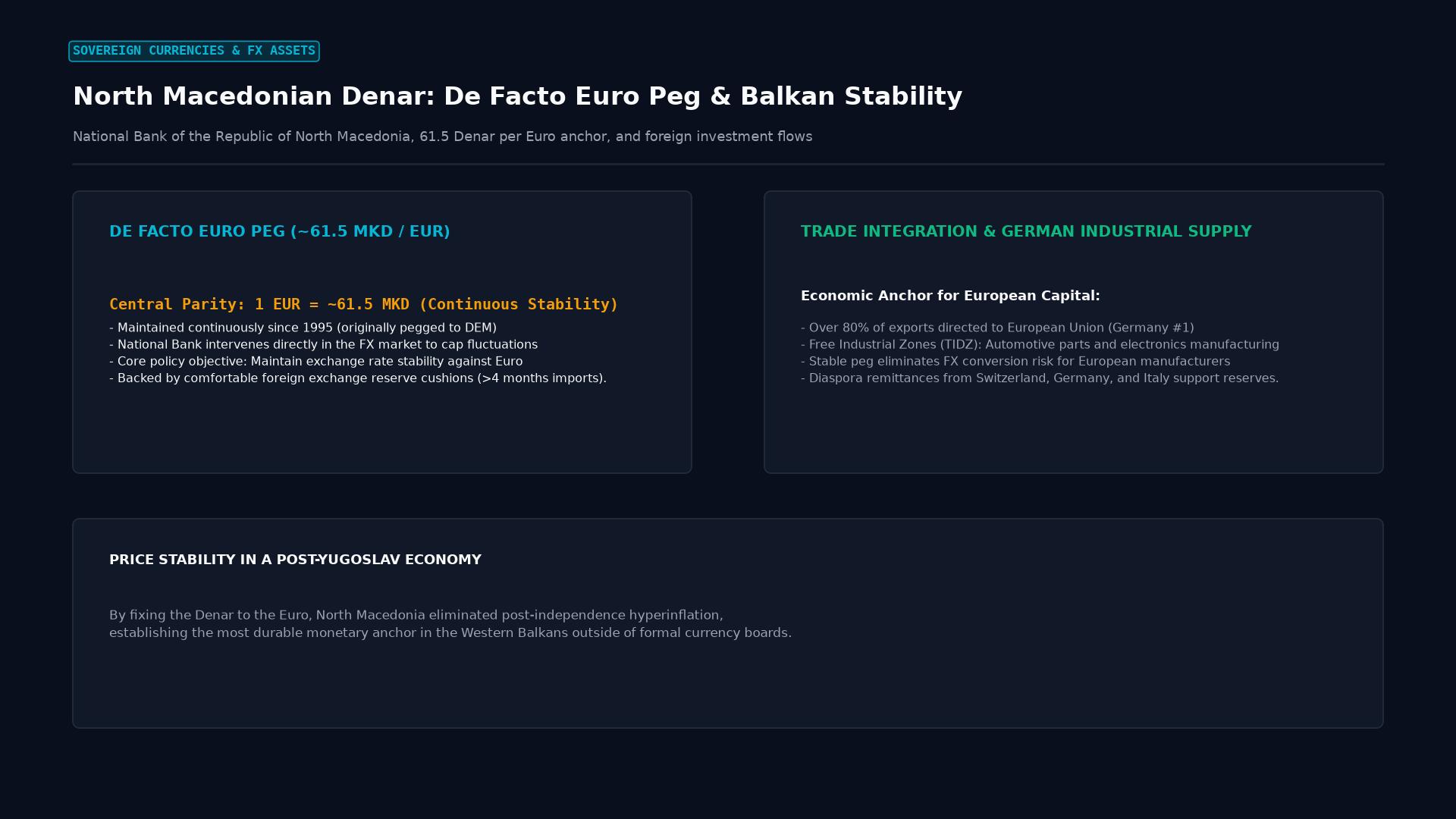 Figure: National Bank of the Republic of North Macedonia, 61.5 Denar per Euro anchor, and foreign investment flows
Historical Evolution and Currency Reforms
The modern denar traces its origin to the dissolution of the Socialist Federal Republic of Yugoslavia. North Macedonia declared independence in September 1991, inheriting an economy destabilized by hyperinflation and the collapse of the Yugoslav dinar monetary union.
The First Denar: Transitional Coupons (1992)
On April 26, 1992, the newly established central bank issued the first Macedonian denar as a provisional currency, exchanging it against the Yugoslav dinar at parity (1:1). These emergency paper coupons circulated without fractional coinage. Hyperinflation reached triple-digit rates throughout 1992 and 1993, driven by supply disruptions, regional embargoes, and fiscal deficits funded through direct central bank credit.
Monetary Stabilization and the Second Denar (1993)
In May 1993, the government implemented comprehensive macroeconomic reforms:
- Re-denomination: The second denar replaced the transitional coupons at a ratio of 1 new denar = 100 old denars.
- Fractional coins were minted in denominations of 50 deni, 1, 2, and 5 denars.
- Central bank financing of fiscal deficits was legally terminated.
- Nominal anchoring: In October 1995, the NBRNM shifted away from managed floating toward an explicit external anchor, pegging the denar to the Deutsche Mark at 31 MKD = 1 DEM.
When the euro replaced legacy European currencies in 1999, the peg transitioned automatically to 61.50 MKD per EUR. Except for a temporary, planned devaluation during the structural adjustment program in July 1997 (from 27 to 31 MKD per DEM), this parity has remained firm through domestic political crises, the 2001 security conflict, the 2008 global financial crisis, and the 2020 pandemic shock.
Macroeconomic Architecture and the Currency Peg
Maintaining a fixed peg without a formal currency board treaty requires the NBRNM to run conventional monetary policy constrained by the classical open economy trilemma. Because North Macedonia permits free cross-border capital flows and maintains an exchange rate target, its domestic interest rates must align closely with European Central Bank (ECB) policy rates while incorporating an endogenous sovereign risk premium.
$$\Delta i_{\text{MKD}} = \Delta i_{\text{ECB}} + \lambda (\pi_{\text{domestic}} - \pi_{\text{euro}}) + \phi_{\text{risk}} + \omega (\text{FX}{\text{target}} - \text{FX}{\text{market}})$$
Where:
- $i_{\text{MKD}}$ is the policy interest rate on NBRNM Central Bank (CB) bills.
- $i_{\text{ECB}}$ represents the ECB Main Refinancing Operations or Deposit Facility rate.
- $\pi_{\text{domestic}} - \pi_{\text{euro}}$ represents the inflation differential between North Macedonia and the Eurozone.
- $\phi_{\text{risk}}$ reflects the sovereign credit spread (observed in North Macedonia Eurobond yields).
- $\omega$ is the central bank intervention sensitivity to deviations from the 61.50 EUR/MKD parity.
The primary operational tool used by the NBRNM to control bank liquidity is the auction of 28-day CB bills. When market demand for euros exerts downward pressure on the denar, the central bank raises the CB bill rate, draining denar liquidity from commercial banks and elevating domestic yields. Simultaneously, the bank sells foreign exchange reserves in the interbank market.
Balance of Payments Dynamics Supporting the Peg
The sustainability of the 61.50 peg rests upon three vital capital inflow pillars that offset the structural trade balance deficit:
- Foreign Direct Investment in Free Economic Zones (TIRZ): Technological Industrial Development Zones have attracted multinational manufacturing investments (principally automotive parts suppliers such as Aptiv, Marquardt, and Gentherm). These export-oriented operations generate substantial gross foreign exchange earnings.
- Private Remittances: Emigrant transfers from the Macedonian diaspora residing in Germany, Switzerland, Italy, and Austria contribute between 12% and 16% of national GDP annually. Remittance inflows peak during summer months and winter holidays, supplying the domestic banking sector with cash euros that commercial banks sell to the central bank.
- Sovereign Eurobond Issues and Multilateral Financing: Regular issuance of sovereign paper on international markets (Luxembourg and Frankfurt exchanges), supplemented by IMF Precautionary and Liquidity Lines (PLL) and World Bank development loans, bolsters gross official reserves above the critical benchmark of four months of prospective imports.
       BALANCE OF PAYMENTS OFFSET STRUCTURE

+--------------------------------------------------------+
| Goods Trade Balance: Structural Deficit (-18% to -22% GDP)|
| Heavy imports of energy, raw materials, capital goods  |
+--------------------------------------------------------+
                           ^
                           | Net Offset via Capital Account
                           v
+--------------------------------------------------------+
| Surplus Items Providing Inflow Liquidity:              |
| 1. Private Cash Remittances & Diaspora Transfers       |
| 2. Automotive Components Export from TIRZ Zones        |
| 3. Foreign Direct Investment (FDI) Inflows             |
| 4. Sovereign Eurobond Issuance & IMF Credit Lines      |
+--------------------------------------------------------+
Foreign Exchange Market Structure and Banking Dynamics
North Macedonia’s foreign exchange market is divided into two primary tiers: the wholesale interbank market and the retail bureau de change market.
Interbank FX Market
Commercial banks trade euro-denar spot contracts directly with each other and with the NBRNM. Because the central bank stands ready to buy or sell unlimited quantities of euros at the tight corridor of 61.4932 to 61.5015 MKD per EUR, interbank market spreads remain exceptionally narrow. Liquidity in third-party currencies (USD/MKD, GBP/MKD, CHF/MKD) is derived synthetically through cross-currency triangular calculations:
$$\text{USD/MKD} = \frac{\text{EUR/MKD}}{\text{EUR/USD}}$$
Corporate hedging instruments, such as forward contracts and cross-currency interest rate swaps, are legally permitted under NBRNM foreign exchange regulations but exhibit low turnover. Most domestic corporations manage FX risk through natural hedges or balance-sheet denomination alignment.
Euroization of the Banking Sector
The high degree of historical currency substitution (financial euroization) represents a structural feature of the Macedonian financial system:
- Foreign Currency Deposits: Foreign currency accounts (predominantly in EUR) historically constitute between 40% and 50% of total commercial bank deposits.
- FX-Indexed Lending: A substantial volume of commercial and retail loans are denominated in denars with an explicit euro-index clause, transferring FX risk to borrowers.
To encourage dedollarization and protect systemic stability, the NBRNM applies differentiated reserve requirements:
- MKD deposits carry lower reserve requirement ratios (typically 5% to 8%).
- Foreign currency deposits face higher reserve requirements (typically 15% to 20%), with a portion mandated to be held in foreign currency with the central bank.
Real-World Case Study: Defending Parity During the 2022 Energy Shock
In late 2021 and throughout 2022, the European energy crisis hit North Macedonia with acute severity. As a net importer of electricity, natural gas, and refined petroleum, the country faced surging import bills denominated in foreign currencies.
+------------------------------------------------------------------------+
|           NBRNM POLICY RESPONSE TO 2022 IMPORT VALUE SHOCK             |
+------------------------------------------------------------------------+
| 1. Trade Deficit Widening: Energy import bill expanded by >120% YoY.  |
| 2. FX Depletion Pressure: Private demand for EUR outstripped inflows.  |
| 3. Reserve Interventions: NBRNM sold over 400 million EUR net in H1.  |
| 4. Policy Tightening: CB bill rate raised aggressively from 1.25% to  |
|    4.75% across 2022-2023.                                             |
| 5. Remittance Inflow Rebound: Summer diaspora inflows restored balance.|
| 6. Outcome: 61.50 EUR/MKD parity held intact; FX reserves closed 2023  |
|    at historic record highs (>4.1 billion EUR).                       |
+------------------------------------------------------------------------+
During the initial phase of the shock, panic buying of physical euro banknotes emerged among retail depositors. The spread between the official bank rate and licensed exchange bureau rates widened momentarily beyond the standard corridor.
The NBRNM executed a coordinated defense:
- It injected abundant euro liquidity directly into commercial banks, ensuring zero rationing of foreign currency for energy importers (ELEM/ESM).
- It sold approximately 430 million euros of official reserves between January and May 2022.
- It initiated consecutive rate hikes, lifting the policy rate from 1.25% in April 2022 to 6.30% by late 2023.
- In late 2022, the IMF approved a 24-month Precautionary and Liquidity Line (PLL) of 530 million euros, reinforcing market confidence.
As energy prices normalized and diaspora transfers surged during the summer season, the central bank reversed its stance, repurchasing euros in the second half of the year. By late 2023, gross foreign exchange reserves reached an all-time high exceeding 4.5 billion euros, proving the durability of the pegging mechanism.
Comparison: Denar vs Regional Balkan Currencies
| Feature | Macedonian Denar (MKD) | Serbian Dinar (RSD) | Albanian Lek (ALL) | Bulgarian Lev (BGN) |
|---|---|---|---|---|
| FX Regime | De facto fixed peg to EUR | Managed float (de facto stabilized) | Free floating | Currency Board to EUR |
| Anchor Rate | ~61.50 MKD / EUR | ~117.20 RSD / EUR | Market determined | 1.95583 BGN / EUR |
| Central Bank | NBRNM | National Bank of Serbia | Bank of Albania | Bulgarian National Bank |
| FX Restrictions | Moderate on capital account | Moderate on residents | Low restrictions | EU capital mobility rules |
| FX Reserves / Imports | >4.2 months | >5.5 months | >6.0 months | >7.5 months |
| Euro Adoption Target | Long-term (EU accession track) | Independent track | Independent track | Scheduled (ERM-II member) |
Frequently Asked Questions
Can foreign investors freely trade the Macedonian denar on international retail forex platforms?
The Macedonian denar is not a standard deliverable currency on international retail electronic communication networks (ECNs) or MT4/MT5 brokers. Cross-border settlement of denar balances is subject to foreign exchange regulations administered by the NBRNM. International exposure to the denar is conducted primarily through institutional non-deliverable forwards (NDFs), direct local bank accounts opened for authorized foreign investments, or by holding Macedonian sovereign Eurobonds.
Why does North Macedonia not adopt a formal currency board like Bulgaria or Bosnia?
A formal currency board requires 100% foreign reserve backing for all broad money (M1/M2) and legally strips the central bank of its lender-of-last-resort authority and discretionary interest rate policy. North Macedonia selected a de facto fixed peg instead. This structure permits the NBRNM to retain operational discretion, manage domestic banking liquidity via CB bill auctions, set differentiated reserve requirements, and act as a lender of last resort in financial emergencies while anchoring inflation through the exchange rate target.
What happens to the denar if North Macedonia joins the European Union?
Upon accession to the European Union, North Macedonia will commit to eventual adoption of the single currency. The formal sequence involves joining the European Exchange Rate Mechanism (ERM-II) for a mandatory minimum period of two years. During ERM-II participation, the denar must trade within a plus-or-minus 15% fluctuation band around the central rate (which is expected to match the historical 61.50 parity). Following satisfaction of the Maastricht convergence criteria on inflation, fiscal deficit, sovereign debt, and long-term interest rates, the denar will be retired and replaced by the euro.
Ready to trade forex?
Open a free demo account with a regulated broker. Practice with virtual funds before risking real money.