MAD
MAD is the ISO 4217 currency code for the Moroccan dirham, the official legal tender of the Kingdom of Morocco, managed by Bank Al-Maghrib under a currency basket peg anchored to the euro and US dollar.
The Moroccan dirham (ISO 4217 currency code: MAD, numeric code: 504) serves as the official legal tender of the Kingdom of Morocco and is widely utilized in the disputed territory of Western Sahara. Represented domestically by the Arabic abbreviation “د.م.” or Latin symbol “DH”, the dirham is divided into 100 centimes. Bank Al-Maghrib (BAM), the central bank of Morocco headquartered in Rabat, holds exclusive authority over banknote issuance and foreign exchange policy.
Unlike freely floating major currencies, the Moroccan dirham operates under a managed crawling peg anchored to a weighted currency basket consisting of 60% euro (EUR) and 40% US dollar (USD). Within this basket anchor, Bank Al-Maghrib enforces a fluctuation corridor of plus-or-minus 5.0%. The dirham is a partially convertible currency: foreign capital transactions by domestic residents are strictly regulated through the national Foreign Exchange Office (Office des Changes), while foreign direct investments and current account international trade transactions benefit from full convertibility.
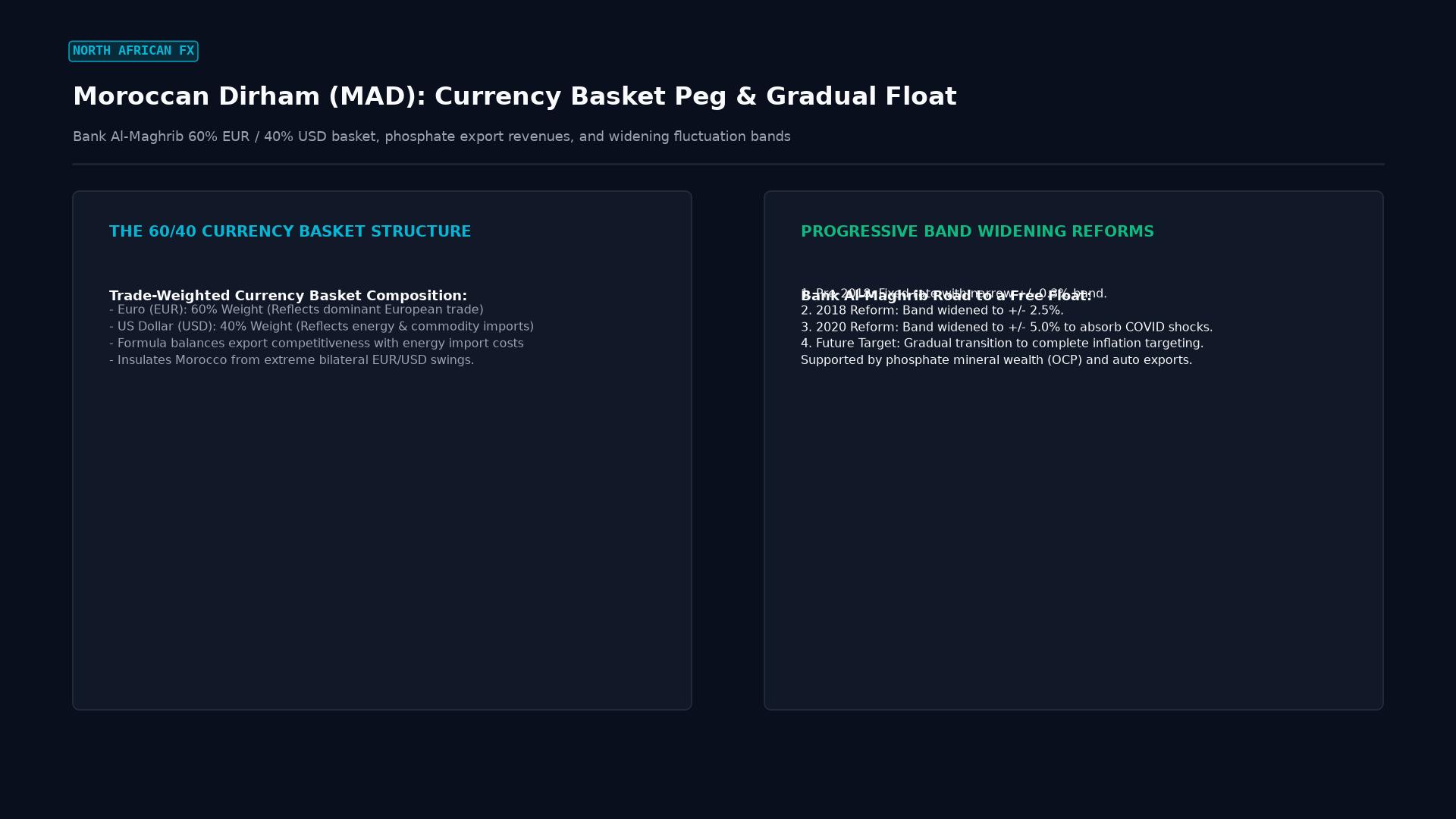 Figure: Bank Al-Maghrib 60% EUR / 40% USD basket, phosphate export revenues, and widening fluctuation bands
Historical Evolution and Currency Reforms
The monetary lineage of modern Morocco reflects its commercial history and post-colonial institutional development:
1. The Pre-Colonial and Protectorate Eras
Before the French and Spanish protectorates were established in 1912, the Kingdom of Morocco issued silver and bronze coins known as the rial or mouzouna. During the French protectorate (1921–1959), the Moroccan franc was introduced at par with the French franc (FRF), circulating under the supervision of the Banque d’État du Maroc.
2. Post-Independence Reintroduction of the Dirham (1959)
Following independence in 1956, King Mohammed V enacted comprehensive monetary reforms. On October 17, 1959, the Moroccan dirham was established as the primary unit of national currency, replacing the Moroccan franc at a conversion rate of 1 dirham = 100 old francs. Bank Al-Maghrib was chartered in the same year as the independent national central bank.
3. Transition to the Currency Basket (1973–2001)
In 1973, following the collapse of the Bretton Woods system of fixed dollar parities, Morocco abandoned its direct link to the French franc and adopted a trade-weighted basket of currencies representing its primary European trading partners (including the French franc, Deutsche Mark, and Spanish peseta). In April 2001, Bank Al-Maghrib simplified this basket, weighting the newly launched euro at 80% and the US dollar at 20% to reflect the predominance of Eurozone agricultural and industrial trade.
4. Realignment to 60/40 and Band Widening (2015–Present)
On April 13, 2015, Bank Al-Maghrib revised the currency basket weights to 60% EUR and 40% USD. This shift acknowledged the growing importance of dollar-denominated trade: Morocco’s substantial imports of crude energy, industrial capital goods, and dollar-priced cereal grains, alongside dollar-denominated foreign debt obligations.
Concurrently, under technical guidance from the International Monetary Fund (IMF), Moroccan authorities initiated a multi-year transition toward a fully flexible exchange rate regime and an explicit inflation-targeting monetary framework:
- January 15, 2018: The historical horizontal fluctuation band was widened from $\pm 0.3%$ to $\pm 2.5%$ around the central basket rate.
- March 9, 2020: In anticipation of global pandemic-related market volatility, Bank Al-Maghrib widened the band further to $\pm 5.0%$, creating a 10% total trading corridor.
Mathematical Architecture of the Basket Peg
Bank Al-Maghrib calculates the daily central reference rate for the dirham using a geometric weighted basket of the euro and US dollar. The spot exchange rate parity condition is formulated as:
$$\text{MAD}{\text{basket}} = \left( \frac{\text{EUR}}{\text{MAD}} \right)^{w{\text{EUR}}} \times \left( \frac{\text{USD}}{\text{MAD}} \right)^{w_{\text{USD}}}$$
Where:
- $w_{\text{EUR}} = 0.60$ (60% weight allocated to the euro).
- $w_{\text{USD}} = 0.40$ (40% weight allocated to the US dollar).
- $w_{\text{EUR}} + w_{\text{USD}} = 1.00$.
The operational exchange rate corridor is defined by explicit boundary interventions:
$$\text{Upper Limit (MAD Weakness)} = \text{Central Rate} \times (1 + 0.05)$$
$$\text{Lower Limit (MAD Strength)} = \text{Central Rate} \times (1 - 0.05)$$
       BAM DIRHAM EXCHANGE RATE CORRIDOR (+/- 5%)

Exchange Rate
(MAD per Basket)
   ^
   |  + 5.0% Upper Intervention Limit (Central Bank Sells USD/EUR)
   |  -------------------------------------------------------------
   |
   |              * Actual Interbank Quoted Rate *
   |             / \     /\      /
   |  ..........v...\.../..\..../... Central Reference Parity .....
   |                 \_/    \__/
   |
   |  - 5.0% Lower Intervention Limit (Central Bank Buys USD/EUR)
   |  -------------------------------------------------------------
   +--------------------------------------------------------------->
   Time (Trading Days)
Authorized domestic commercial banks (such as Attijariwafa Bank, Banque Centrale Populaire, and Bank of Africa) trade foreign currencies on the domestic interbank market within these published limits. If private supply-and-demand forces push market quotes to the edge of the corridor, Bank Al-Maghrib conducts direct liquidity auctions, buying or selling foreign exchange from its gross official reserves.
Macroeconomic Drivers and Balance of Payments Structure
The external value and reserve backing of the Moroccan dirham depend on four fundamental economic pillars:
1. Phosphate and Fertilizer Exports (OCP Group)
Morocco holds over 70% of the world’s proven phosphate reserves. State-owned OCP Group (Office Chérifien des Phosphates) is the world’s leading exporter of crude phosphate rock, phosphoric acid, and phosphate-based fertilizers. Global fertilizer price cycles heavily dictate Morocco’s merchandise export earnings and foreign exchange inflows.
2. Automotive and Industrial Manufacturing
Through the Tangier Med port complex and specialized automotive industrial zones (Kenitra and Casablanca), Morocco has emerged as Africa’s largest passenger vehicle manufacturing hub. Global automotive manufacturers, including Renault Group and Stellantis, produce hundreds of thousands of vehicles annually for export to the European Union, generating over 10 billion euros in annual export value.
3. Tourism Receipts
The hospitality and tourism sector represents a primary source of services exports, generating between 8% and 10% of national GDP. Tourism inflows peak during spring and autumn, bringing substantial physical euro banknotes into domestic banking channels.
4. Diaspora Remittances (MRE Inflows)
Transfers from Moroccans Residing Abroad (Marocains Résidant à l’Étranger, MRE) located across France, Spain, Italy, Belgium, and the Netherlands represent a critical financial lifeline. Annual MRE remittances consistently exceed 100 billion MAD (over $10 billion), providing a countercyclical buffer that stabilizes domestic bank deposits and offsets structural merchandise trade deficits.
       MOROCCAN EXTERNAL LIQUIDITY BALANCE

+----------------------------------------------------------------+
| Structural Current Account Deficit Driver:                     |
| - Energy Imports: 100% net importer of crude, oil products, gas|
| - Capital Goods: Industrial machinery for manufacturing plants |
| - Food Imports: Wheat and cereals during domestic droughts     |
+----------------------------------------------------------------+
                               ^
                               | Offsetting Capital Inflows
                               v
+----------------------------------------------------------------+
| Foreign Exchange Inflow Pillars:                               |
| 1. Phosphates & Phosphoric Acid (OCP Group Export Revenues)    |
| 2. Automotive Exports (Renault Tangier & Stellantis Kenitra)   |
| 3. Tourism Inflow Receipts (Marrakech, Agadir, Fes)            |
| 4. Diaspora Worker Remittances (MRE Bank Transfers)           |
| 5. Foreign Direct Investment (FDI) & Sovereign Eurobonds       |
+----------------------------------------------------------------+
Foreign Exchange Regulations and Capital Controls
The Moroccan dirham is governed by strict foreign exchange legislation enforced by the Office des Changes:
- Current Account Full Convertibility: Import and export transactions of physical goods and commercial services are fully convertible. Domestic companies can settle foreign invoices and repatriate export receipts via authorized intermediary banks without prior administrative approval.
- Capital Account Restrictions for Residents: Moroccan citizens and resident domestic corporations cannot freely transfer capital abroad to purchase foreign securities, acquire overseas real estate, or open foreign-currency bank accounts without explicit authorization. Strict annual foreign currency allowances apply to individual tourism travel.
- Full Foreign Investor Repatriation Guarantees: Foreign corporations and non-resident international investors who fund investments in Morocco using foreign currency convertibility accounts enjoy guaranteed rights to repatriate net capital gains, dividends, and initial invested capital in foreign currency without withholding or capital restrictions.
Real-World Case Study: Band Widening and the 2022 Energy Shock
In March 2020, as the global pandemic paralyzed international travel and severed tourism revenues, Bank Al-Maghrib broadened the dirham trading band from $\pm 2.5%$ to $\pm 5.0%$.
This structural widening proved crucial when global commodity prices surged in 2022 following the outbreak of the Russia-Ukraine war:
+--------------------------------------------------------------------+
|          2022 COMMODITY SHOCK AND THE DIRHAM CORRIDOR              |
+--------------------------------------------------------------------+
| 1. Import Price Shock: Energy and wheat import bills expanded by    |
|    over 60% YoY due to global commodity inflation.                 |
| 2. Drought Factor: Severe domestic agricultural drought cut wheat  |
|    harvest, forcing Morocco to import massive grain quantities.    |
| 3. Dollar Appreciation: US dollar surged to 20-year highs globally.|
| 4. Market Mechanism: USD/MAD rose from 9.20 to over 11.00 MAD.     |
| 5. Shock Absorption: The +/- 5.0% band allowed the exchange rate  |
|    to absorb external pressure without forcing Bank Al-Maghrib to  |
|    burn billions in reserves defending an artificial peg.          |
| 6. Offsetting Inflow: OCP fertilizer revenues doubled to record    |
|    highs, replenishing central bank foreign exchange reserves.     |
+--------------------------------------------------------------------+
Because the fluctuation band was wide enough ($\pm 5.0%$), the dirham adjusted downward against the US dollar naturally without breaching the corridor limits or forcing Bank Al-Maghrib into emergency currency market interventions. Gross official reserves remained resilient above 330 billion MAD (equivalent to over five and a half months of imports), allowing the central bank to avoid sharp emergency interest rate hikes that would have strangled domestic economic growth.
Comparison: Moroccan Dirham vs Regional Maghreb Currencies
| Metric | Moroccan Dirham (MAD) | Algerian Dinar (DZD) | Tunisian Dinar (TND) |
|---|---|---|---|
| FX Regime | Currency Basket Peg ($\pm 5.0%$) | Managed Crawling Peg | Managed Float |
| Anchor Assets | 60% EUR / 40% USD | Hydrocarbon trade weighted | EUR / USD trade weighted |
| Central Bank | Bank Al-Maghrib | Banque d’Algérie | Banque Centrale de Tunisie |
| Parallel Market | Negligible / None (Clean FX) | Massive (Square Port-Saïd) | Small Informal Market |
| Primary Export | Automotive, Phosphates, Ag | Crude Oil & Natural Gas | Textiles, Wire Harnesses, Olive Oil |
| FX Reserves (Imports) | >5.5 Months | >14 Months (Oil-backed) | ~3.5 Months |
| Capital Convertibility | Partial (Full for Foreign FDI) | Strict Non-Convertible | Strict Non-Convertible |
Frequently Asked Questions
Can international retail forex traders trade the MAD pair on spot brokers?
Due to capital account restrictions and the absence of continuous international interbank clearing in Moroccan dirhams, MAD spot pairs (such as USD/MAD and EUR/MAD) are rarely offered by retail forex brokers. When institutional foreign investors hedge dirham exposures, they utilize Non-Deliverable Forwards (NDFs) settled in US dollars or euros through global investment banks, or trade directly through licensed Moroccan custodian banks.
What is the rationale behind the 60% EUR and 40% USD basket weighting?
The 60/40 weighting reflects Morocco’s trade reality. Approximately 60% of Morocco’s physical exports and services (automotive vehicles, agriculture, tourism, and diaspora transfers) are settled with European Union member states in euros. However, roughly 40% of international obligations (including crude oil, refined fuel, coal, wheat imports, and international sovereign bond coupons) are priced in US dollars. The basket structure minimizes purchasing-power volatility across both primary currency spheres.
Is the Moroccan dirham planned to become a completely free-floating currency?
Bank Al-Maghrib and the Moroccan Ministry of Economy and Finance maintain an official long-term policy to transition toward a fully flexible exchange rate regime coupled with inflation targeting. Central bank leadership has stressed that this transition is conducted gradually. Full floating will only be implemented when structural prerequisites are satisfied: fiscal deficit consolidation, financial sector depth, adequate FX reserve buffers, and enhanced private corporate proficiency in commercial FX hedging instruments.
Ready to trade forex?
Open a free demo account with a regulated broker. Practice with virtual funds before risking real money.