Mainstream corporation tax
Mainstream Corporation Tax (MCT) was the residual net corporate tax liability payable by United Kingdom resident companies under the partial imputation system (1973–1999) after offsetting Advance Corporation Tax (ACT) paid on dividend distributions.
Mainstream Corporation Tax (MCT) was a fundamental statutory concept in United Kingdom corporate taxation between 1973 and 1999. Under the UK’s historical partial imputation tax system, introduced by the Finance Act 1972, corporate tax liabilities were bifurcated into two sequential payment mechanisms: Advance Corporation Tax (ACT) and Mainstream Corporation Tax (MCT).
When a UK company distributed dividends to shareholders, it was legally required to make an immediate payment of ACT to the Inland Revenue (now HM Revenue and Customs). Following the end of the accounting period, the company calculated its total corporation tax liability based on full annual taxable profits. The ACT previously remitted during that financial year was credited against this total tax charge. The remaining net tax balance due to the state was officially designated as Mainstream Corporation Tax.
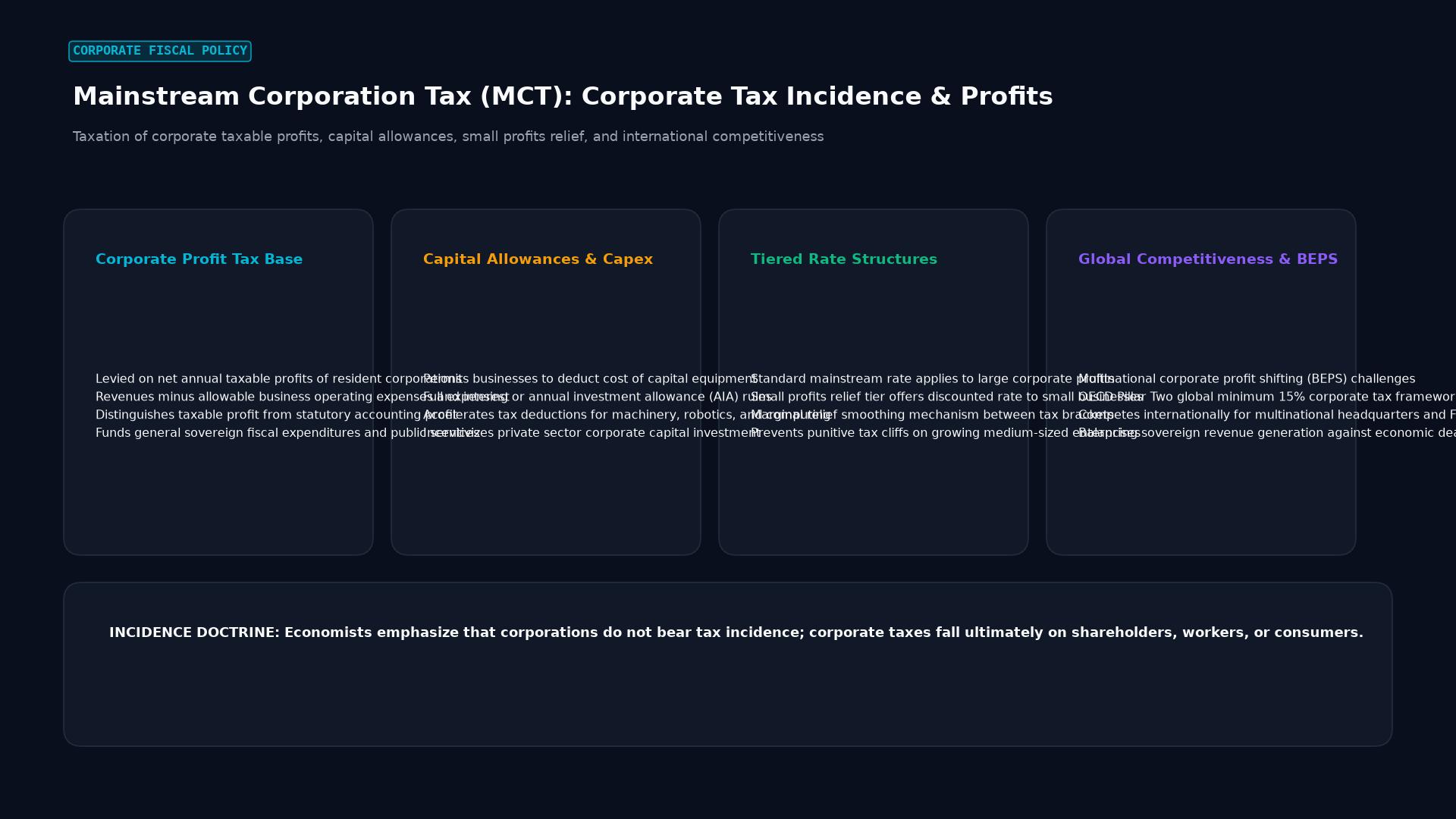 Figure: Taxation of corporate taxable profits, capital allowances, small profits relief, and international competitiveness
Historical and Statutory Background
The creation and eventual abolition of Mainstream Corporation Tax reflect the evolution of British fiscal policy regarding corporate distributions and investment incentives:
1. The Classical System vs Double Taxation (Pre-1973)
Prior to 1973, the UK operated a “classical” corporate tax system, similar to the modern US framework. Companies paid corporation tax on their total profits, and shareholders subsequently paid full income tax on received dividends. Critics argued this structure caused “economic double taxation,” incentivizing debt financing over equity issuance and penalizing profit distribution.
2. The Finance Act 1972 and the Imputation System
To resolve this distortion, Chancellor of the Exchequer Anthony Barber introduced the partial imputation system in the Finance Act 1972, taking effect in April 1973. The architecture functioned on an integrated credit model:
- The payment of ACT by the company satisfied two legal objectives simultaneously: it functioned as a prepayment of the company’s final corporate tax bill and served as an imputed basic-rate income tax credit for UK resident individual shareholders receiving the dividend.
- The company settled its remaining fiscal obligation via Mainstream Corporation Tax nine months and one day following the conclusion of its accounting period.
3. Structural Distortions and Surplus ACT
Over its 26-year tenure, the ACT/MCT framework created significant operational distortions:
- Surplus ACT Traps: Companies with low domestic UK taxable profits but substantial foreign dividend income (such as multinational groups like Shell, BP, and BAT) generated massive pools of “Surplus ACT” that could not be set off against MCT, resulting in unrecoverable tax drag.
- Foreign Income Dividend (FID) Scheme (1994): The UK introduced the FID mechanism in 1994 to allow multinationals to pay dividends out of foreign earnings without generating un-offsettable ACT, though the administrative complexity was substantial.
4. The 1997 Budget and Final Abolition in 1999
Following the 1997 general election, Chancellor Gordon Brown overhauled British corporate taxation. In his July 1997 budget, the government abolished the payable dividend tax credit for UK pension funds, removing a multi-billion-pound institutional tax refund.
Subsequently, the Finance Act 1998 formally abolished Advance Corporation Tax and Mainstream Corporation Tax with effect from April 6, 1999. The UK replaced the imputation structure with a simplified Corporation Tax Self-Assessment (CTSA) regime supported by Quarterly Installment Payments (QIPs) for large corporations, while enacting complex “Shadow ACT” regulations to allow companies to gradually run off historical surplus ACT reserves.
Mathematical Architecture and Offset Constraints
The determination of Mainstream Corporation Tax was governed by statutory formulas designed to prevent corporations from eliminating their tax liabilities entirely through artificial dividend distributions.
1. The ACT Calculation on Distributions
Whenever a qualifying distribution ($D$) was paid to shareholders, the company was mandated to remit ACT within 14 days following the end of the calendar quarter. The rate of ACT was linked directly to the basic rate of individual income tax ($I_{\text{rate}}$):
$$\text{ACT Rate} = \frac{I_{\text{rate}}}{100 - I_{\text{rate}}}$$
When the basic income tax rate was 20%:
$$\text{ACT Rate} = \frac{20}{100 - 20} = \frac{20}{80} = 25%$$
For a cash dividend distribution of £80,000:
$$\text{ACT Remitted} = 80,000 \times 25% = £20,000$$
The shareholder received £80,000 cash accompanied by a £20,000 imputed tax credit, representing gross income of £100,000 taxed at source at 20%.
2. The Maximum ACT Offset Limit
To ensure that companies with trading profits contributed cash tax revenue, Section 239 of the Income and Corporation Taxes Act 1988 (ICTA 1988) imposed a statutory ceiling on the volume of ACT offsettable against corporation tax in any given accounting period:
$$\text{Max Allowable ACT Offset} = \text{Taxable Profits} \times I_{\text{rate}}$$
Where $I_{\text{rate}}$ represents the basic income tax rate (e.g., 20%).
3. Calculating Mainstream Corporation Tax (MCT)
Total corporation tax liability ($T_{\text{gross}}$) was calculated by applying the headline corporation tax rate ($\tau_c$, historically ranging from 30% to 52%) to taxable profits ($P$):
$$T_{\text{gross}} = P \times \tau_c$$
The Mainstream Corporation Tax payable was defined as:
$$\text{MCT} = T_{\text{gross}} - \min\Big(\text{ACT Paid during Period} + \text{Brought-Forward ACT}, \text{Max Allowable ACT Offset}\Big)$$
If the ACT paid exceeded the maximum allowable offset:
- The excess was designated as Surplus ACT.
- Surplus ACT could be carried back up to six accounting years to offset prior MCT paid (generating a tax refund), or carried forward indefinitely to offset future MCT liabilities.
                  ACT OFFSET RESTRICTION MODEL

Gross Corporation Tax Liability (£P * 33%)
+-----------------------------------------------------------------+
| Non-Offsettable Core Revenue (£P * 13%)                         |
+-----------------------------------------------------------------+
| Maximum Permissible ACT Offset Cap (£P * 20%)                   |
| [ACT Credit Allowed Up to Basic Income Tax Rate Equivalent]     |
+-----------------------------------------------------------------+
                               |
         Comparison with Actual ACT Remitted on Dividends
                               |
      +------------------------+------------------------+
      |                                                 |
      v Actual ACT <= Cap                               v Actual ACT > Cap
+---------------------------+              +---------------------------+
| Full ACT Offset Claimed   |              | Maximum ACT Offset Claimed|
| MCT = Gross Tax - ACT     |              | MCT = Core Revenue Floor  |
| Surplus ACT = £0          |              | Balance = Surplus ACT     |
+---------------------------+              +---------------------------+
Real-World Case Study: British Industrial Group (1995 Fiscal Year)
To observe the operational mechanics of Mainstream Corporation Tax, consider a UK engineering enterprise, Midlands Precision Engineering Ltd, reporting for the 12-month accounting period ending December 31, 1995.
Corporate Parameters
- Taxable Trading Profits ($P$): £10,000,000
- Headline UK Corporation Tax Rate ($\tau_c$): 33.0%
- Basic Rate of Personal Income Tax ($I_{\text{rate}}$): 25.0%
- ACT Rate on Net Distributions: $\frac{25}{75} = 33.3333%$
- Net Cash Dividends Paid to Shareholders: £4,500,000
+--------------------------------------------------------------------+
|            MIDLANDS PRECISION ENGINEERING TAX COMPUTATION          |
+--------------------------------------------------------------------+
| 1. Advance Corporation Tax Paid on Distributions:                  |
|    Net Dividend Paid:                              £4,500,000      |
|    ACT Due (33.3333% of £4,500,000):                £1,500,000      |
|    (Remitted quarterly to Inland Revenue during 1995)              |
+--------------------------------------------------------------------+
| 2. Total Gross Corporation Tax Assessment:                         |
|    Taxable Profits (£10,000,000 * 33.0%):           £3,300,000      |
+--------------------------------------------------------------------+
| 3. Maximum Allowable ACT Offset Verification:                      |
|    Statutory Ceiling (£10,000,000 * 25.0%):         £2,500,000      |
|    Actual ACT Paid:                                £1,500,000      |
|    Allowable Offset:                               £1,500,000      |
|    (Since £1,500,000 <= £2,500,000 ceiling, full offset allowed)  |
+--------------------------------------------------------------------+
| 4. Mainstream Corporation Tax (MCT) Payable:                       |
|    Gross Tax Assessment:                           £3,300,000      |
|    Less: ACT Offset:                              -£1,500,000      |
|    Mainstream Corporation Tax (MCT) Due:            £1,800,000      |
|    Statutory Due Date: October 1, 1996 (9 mos & 1 day post-close)  |
+--------------------------------------------------------------------+
In this transaction, the company remitted £1,500,000 in early cash tax during 1995 via ACT. On October 1, 1996, it completed its statutory fiscal obligation by paying £1,800,000 in Mainstream Corporation Tax, delivering the total £3,300,000 corporate tax burden to the Exchequer.
Corporate Finance and Treasury Impacts
The structural split between ACT and MCT exerted substantial influence over corporate capital structure and treasury strategy:
- Dividend Smoothing vs Timing: Because ACT required immediate cash outflows to Inland Revenue within weeks of dividend distribution, companies timed dividend payments to coincide with seasonal cash surpluses.
- Preference for Debt Financing: Interest paid on corporate bank debt and debentures was fully deductible as a trading expense against gross profits before computing corporation tax, reducing both gross tax and MCT. Conversely, equity dividends triggered mandatory ACT payments. This asymmetry reinforced a systemic bias toward debt leverage across UK boardrooms.
- M&A Structuring and Group Relief: Groups of companies could utilize Group Income Elections under Section 247 of ICTA 1988, permitting subsidiaries to pay intra-group dividends to parent entities without paying ACT, preventing redundant administrative tax assessments.
The Modern Successor: Quarterly Installment Payments (QIPs)
When the UK eliminated the ACT and MCT dichotomy in April 1999, it abandoned the practice of allowing corporations to settle the balance of their taxes nine months after year-end. To replace the cash flow lost from ACT prepayments, the government introduced the Quarterly Installment Payments (QIPs) regime for large and very large companies.
Under modern UK tax rules:
- Large companies estimate their annual corporation tax liability and pay it in four equal quarterly installments starting in the sixth month of the financial year.
- “Very large” companies (profits exceeding £20 million) pay installments in months 3, 6, 9, and 12 of the accounting period.
- The concept of an “advance” tax on dividend distributions has been eliminated, aligning the UK with international territorial tax norms.
Frequently Asked Questions
Why was it called “Mainstream” Corporation Tax?
The term “Mainstream” was coined to distinguish the primary, final corporation tax settlement based on audited year-end commercial profits from the provisional “Advance” Corporation Tax (ACT) remitted during the financial year upon the payment of shareholder dividends. MCT represented the mainstream flow of corporate fiscal revenue.
What happened to historical Surplus ACT when MCT was abolished in 1999?
When ACT and MCT were eliminated on April 6, 1999, UK corporations held billions of pounds in un-offset surplus ACT on their balance sheets. The UK government instituted the “Shadow ACT” regime. Under these complex transitional rules, companies could not generate new ACT, but could continue offsetting historical surplus ACT against modern corporation tax liabilities, subject to an annual 20% profits cap and theoretical calculations of how much ACT would have been paid under legacy rules.
Did non-UK resident shareholders receive tax refunds under the ACT/MCT regime?
Under standard domestic rules, imputed ACT tax credits were primarily intended for UK resident taxpayers. However, under specific bilateral Double Taxation Treaties (such as the UK-US Double Taxation Convention), foreign individual investors and portfolio funds were permitted to claim partial cash tax refunds of the imputed ACT credit from the UK Inland Revenue, minus a treaty withholding deduction.
Ready to trade forex?
Open a free demo account with a regulated broker. Practice with virtual funds before risking real money.