Fiscal Policy
Fiscal policy refers to the use of government spending and taxation to influence macroeconomic conditions, stimulate employment, guide aggregate demand, and manage national budget deficits.
What Is Fiscal Policy?
Fiscal policy represents the economic strategy through which a sovereign government adjusts its tax rates and public spending levels to influence the broader domestic economy. Formulated by the legislative and executive branches of government (such as the US Congress and the White House, or the UK Parliament and HM Treasury), fiscal policy works alongside central bank monetary policy to stabilize business cycles, promote full employment, and sustain long-term economic growth.
Originating from the macroeconomic principles developed by British economist John Maynard Keynes during the Great Depression, fiscal theory asserts that governments can actively smooth volatile boom-and-bust cycles. By running budget deficits during recessions to stimulate aggregate demand and accumulating budget surpluses during economic expansions to prevent overheating, the state serves as an economic counterweight.
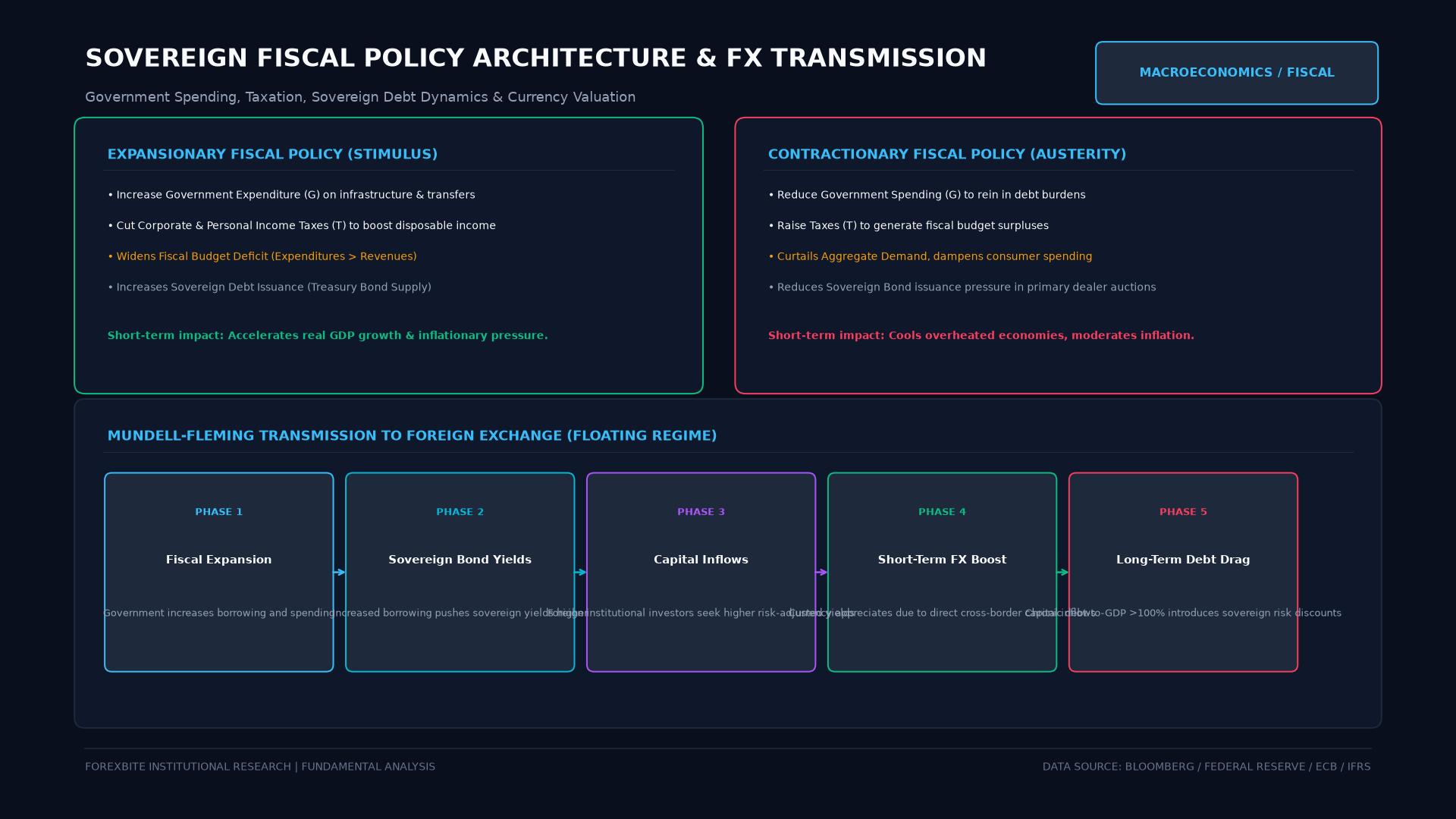 Figure: Sovereign fiscal policy mechanisms contrasting expansionary stimulus with contractionary austerity, sovereign bond issuance dynamics, and the Mundell-Fleming transmission channel to currency valuations.
The Primary Levers of Fiscal Policy
Governments execute fiscal policy through two overarching fiscal mechanisms:
1. Government Spending (Expenditure)
Direct public investment injects capital immediately into the circular flow of income:
- Infrastructure Projects: Building public transportation, bridges, telecommunications grids, and green energy facilities generates immediate employment and purchases industrial materials.
- Public Sector Employment: Salaries paid to civil servants, educators, military personnel, and healthcare workers support consumer spending.
- Transfer Payments: Direct welfare programs, unemployment insurance benefits, and social security payments act as automatic economic stabilizers, shielding low-income households during downturns.
2. Taxation (Revenue)
Taxes determine the disposable income of citizens and the retained capital of corporations:
- Direct Taxes: Personal income taxes and corporate profits taxes directly influence consumption and business capital expenditure.
- Indirect Taxes: Value-Added Taxes (VAT), sales taxes, and customs tariffs alter consumer price incentives and cross-border trade flows.
Expansionary vs. Contractionary Fiscal Policy
Depending on the stage of the macroeconomic cycle, governments deploy either expansionary or contractionary fiscal packages:
| Stance | Primary Objective | Policy Action | Economic Impact |
|---|---|---|---|
| Expansionary | Combat recessions and close output gaps | Increase government spending; cut taxes | Expands GDP; raises budget deficits; risks inflation |
| Contractionary | Cool an overheating economy and curb inflation | Reduce public spending; increase taxes | Dampens aggregate demand; narrows deficits; slows growth |
Fiscal Policy vs. Monetary Policy
While both disciplines seek economic stability, their governance structures, tools, and operational timelines differ substantially:
| Feature | Fiscal Policy | Monetary Policy |
|---|---|---|
| Executing Entity | Ministry of Finance, Parliament, Congress | Independent Central Bank (Fed, ECB, BOE) |
| Key Instruments | Tax brackets, infrastructure budgets, subsidies | Overnight policy rates, reserve requirements, QE/QT |
| Decision Lag | Long (requires political debates, votes, and legislation) | Short (monetary committees vote every 6 weeks) |
| Impact Focus | Target-specific industries, regions, and social strata | Broad economy-wide financial liquidity conditions |
| Political Influence | High (subject to electoral cycles and lobbying) | Low (statutorily shielded from political mandates) |
How Fiscal Policy Impacts Currency Valuations
In foreign exchange trading, fiscal announcements create significant volatility, impacting currency values through interest rate channels and sovereign debt sustainability metrics.
Short-Term Capital Inflows (The Mundell-Fleming Channel)
Under a flexible exchange rate regime, aggressive expansionary fiscal policy (such as a massive infrastructure spending bill) accelerates economic demand and boosts government bond issuance. To attract buyers for newly issued sovereign debt, domestic bond yields rise. International asset managers allocate foreign capital into these higher-yielding government bonds, creating immediate spot demand for the domestic currency.
Long-Term Debt Sustainability and Fiscal Crises
However, if fiscal stimulus is financed through unchecked borrowing that pushes sovereign debt-to-GDP ratios to precarious heights, the currency dynamic reverses violently:
- Investors begin pricing in sovereign credit rating downgrades and currency debasement risk.
- If central banks are forced to monetize the government’s debt (printing money to absorb unsold Treasury bonds), domestic inflation spikes and international capital flees.
Case Study: The 2022 UK “Mini-Budget” Crisis
The vulnerability of a national currency to irresponsible fiscal announcements was starkly demonstrated in September 2022 by the UK government under Prime Minister Liz Truss. The Chancellor of the Exchequer unveiled a “mini-budget” containing £45 billion in unfunded tax cuts alongside massive energy subsidies, with zero offsetting expenditure reductions or independent budget scrutiny.
GBP/USD Collapses on Unfunded Fiscal Package
1.1500 +-----------------------------------+ (Pre-Mini Budget)
       |                                   \
1.1000 +                                    \
       |                                     \  Historic Sterling Selloff
1.0500 +                                      \
       |                                       \
1.0350 +----------------------------------------+ (All-Time Low vs USD)
         Sep 22         Sep 24        Sep 26
Global bond markets staged an immediate revolt. Yields on UK government bonds (gilts) surged at an unprecedented rate, threatening domestic pension funds with insolvency. The British Pound cratered to an all-time record low of 1.0350 GBP/USD within three trading sessions, forcing emergency Bank of England bond purchases and the swift repeal of the fiscal package.
Key Takeaways
- Fiscal policy controls government spending and taxation to guide aggregate economic demand and employment.
- Expansionary fiscal policy stimulates growth during recessions through spending increases and tax relief; contractionary policy restrains overheating.
- Unlike monetary policy, fiscal policy suffers from substantial legislative delays due to political negotiation.
- Moderate, well-targeted fiscal expansion often strengthens a currency in the short term by driving sovereign bond yields higher.
- Unfunded fiscal deficits that jeopardize debt sustainability trigger capital flight, bond market selloffs, and severe currency depreciation.
Frequently Asked Questions
Which has a faster effect on forex markets: fiscal policy or monetary policy?
Monetary policy exerts a faster, more direct influence. Central bank rate changes and forward guidance immediately reprice money market curves, whereas fiscal bills take months or years to pass legislation and disperse capital into real economic channels.
What are “automatic stabilizers” in fiscal policy?
Automatic stabilizers are built-in government programs that automatically adjust spending and tax receipts without requiring new legislation. For example, progressive income taxes naturally collect less revenue during recessions, while unemployment insurance payouts automatically increase, cushioning household demand.
How does high government debt impact a nation’s currency?
When public debt grows excessively relative to GDP, international creditors demand higher risk premiums, or sell the country’s sovereign bonds entirely. Fears of debt monetization (inflationary printing) or sovereign default typically result in prolonged currency devaluation.
Ready to trade forex?
Open a free demo account with a regulated broker. Practice with virtual funds before risking real money.