Intervention
A foreign exchange intervention is a deliberate monetary operation conducted by a sovereign central bank or government treasury in the spot or derivatives currency market to influence the valuation of its national currency and combat excessive volatility.
What Is a Foreign Exchange Intervention?
A foreign exchange intervention (or currency intervention) occurs when a sovereign central bank or national finance ministry actively enters the open currency market to buy or sell its domestic currency against foreign currencies (such as the U.S. Dollar or Euro). The primary objective of an intervention is to stabilize an exchange rate, correct fundamental currency misalignments, curb disorderly speculative volatility, or defend a statutory currency peg or crawling band.
Interventions represent the most direct, aggressive assertion of state power in the foreign exchange market. While everyday monetary policy influences exchange rates indirectly through interest rate adjustments, an intervention deploys billions of dollars of national foreign exchange reserves directly into interbank matching engines to forcefully shift the market balance of supply and demand.
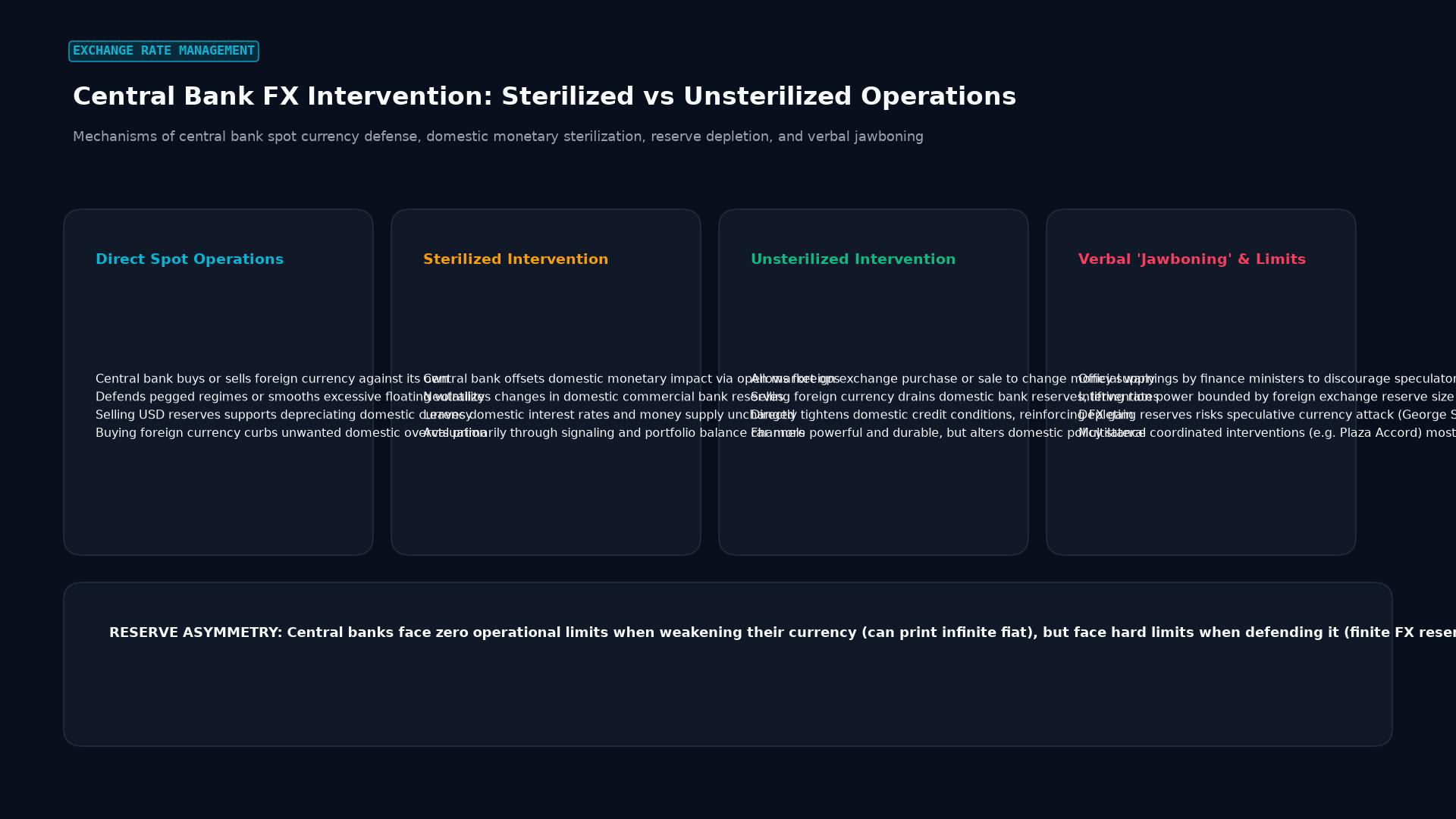 Figure: Mechanisms of central bank spot currency defense, domestic monetary sterilization, reserve depletion, and verbal jawboning
Key Takeaways
- Direct vs. Verbal Intervention: A direct intervention involves actual multi-billion-dollar market purchases or sales of currency; a verbal intervention (or “jawboning”) involves official warnings from finance officials aimed at spooking speculators without spending reserves.
- Sterilized vs. Unsterilized: In a sterilized intervention, the central bank conducts offsetting open-market bond operations to prevent the currency intervention from altering the domestic commercial money supply and inflation. In an unsterilized intervention, the money supply is allowed to expand or contract organically.
- Asymmetric Reserve Constraints: A central bank has unlimited capacity to intervene against an appreciating currency (it can electronically print infinite amounts of its own currency), but finite capacity to defend a depreciating currency (it will eventually exhaust its foreign exchange reserves).
- Unilateral vs. Coordinated: Unilateral interventions conducted by a single nation often fail over the long term; coordinated multilateral interventions (such as the 1985 Plaza Accord or the 2011 G7 Yen intervention) carry vast market-moving power.
Sterilized vs. Unsterilized Currency Interventions
The structural distinction between sterilized and unsterilized interventions dictates their long-term economic consequences:
| Dimension | Sterilized Intervention | Unsterilized Intervention |
|---|---|---|
| Operational Process | Central bank buys foreign currency, then sells domestic government bonds to absorb excess reserves. | Central bank buys foreign currency with newly created reserves, taking no offsetting bond action. |
| Domestic Money Supply | Completely unchanged (Zero impact on commercial banking liquidity) | Expands or contracts directly with the size of the intervention |
| Domestic Interest Rates | Policy interest rates remain insulated | Short-term interbank money market interest rates fluctuate |
| Domestic Inflation Risk | Low inflation risk | High inflation risk if expanding money supply to weaken currency |
| Market Durability | Often acts merely as a temporary speedbump against macro trends | Highly potent; alters both exchange rates and monetary fundamentals |
Historic Currency Intervention Case Studies
1. Bank of Japan (BOJ) Yen Interventions (2022 & 2024)
As the Federal Reserve aggressively hiked interest rates while the BOJ maintained negative interest rates, the Japanese Yen depreciated rapidly from 115 to over 160 USD/JPY. Acting on orders from the Ministry of Finance, the BOJ conducted massive unilateral stealth interventions, dumping over $60 billion in U.S. Treasuries to buy Yen in single trading sessions, triggering violent 500-pip intraday pullbacks.
2. The 2011 Coordinated G7 Intervention
Following the catastrophic Tōhoku earthquake, speculative repatriation flows drove the Yen to an all-time high of 76.25 against the dollar, threatening Japan’s post-disaster recovery. On March 18, 2011, the central banks of the G7 (the Fed, ECB, Bank of England, Bank of Canada, and BOJ) executed a rare joint coordinated intervention, selling Yen simultaneously across global trading sessions to stabilize the currency.
3. The Failure of the Bank of England (Black Wednesday 1992)
Attempting to keep the British Pound within the European Exchange Rate Mechanism (ERM), the Bank of England spent billions in foreign reserves buying Pounds from short-sellers led by George Soros. Running out of foreign reserves and unable to hike interest rates further without bankrupting domestic homeowners, the UK capitulated on September 16, 1992, withdrawing from the ERM and allowing the Pound to collapse.
Tactical Rules for Forex Traders During Interventions
- Never Stand in Front of the Central Bank: When a direct intervention begins, interbank liquidity evaporates, and price can move 300 to 500 pips in minutes. Trying to fight an intervention is financial suicide.
- Watch for Rate-Check Rumors: Prior to direct physical market intervention, central bank desks often call commercial dealer banks to ask for live price quotes (known as a “Rate Check”). When news of a rate check leaks, algorithms trigger rapid defensive positioning.
- Fade the Move Long-Term if Fundamentals Diverge: History proves that unilateral interventions without an accompanying shift in interest rate policy rarely alter the multi-month trend. Once the central bank’s initial intervention barrage subsides, the market frequently re-tests and breaks the intervention price level.
Frequently Asked Questions
Which government body decides to intervene—the Central Bank or the Treasury?
In most major nations, the legal authority to authorize an exchange rate intervention rests with the government treasury or ministry of finance (e.g., the U.S. Department of the Treasury or Japan’s Ministry of Finance). The central bank acts as the operational agent executing the physical trades in the market.
What is “Verbal Intervention”?
Verbal intervention (or “jawboning”) occurs when senior finance officials give speeches or press briefings warning that currency movements are “one-sided,” “excessive,” or that the government “reserves all options to respond.” This rhetoric is designed to introduce two-way risk to speculative traders without spending actual reserves.
Can a retail trader profit from an intervention?
Yes, but it carries extreme risk. Traders positioning for intervention typically place tight stop-loss trailing orders or buy out-of-the-money put options (which cap maximum loss while providing explosive payouts if a 500-pip intervention spike occurs).
Ready to trade forex?
Open a free demo account with a regulated broker. Practice with virtual funds before risking real money.