Managed forex account
A managed forex account is an individualized currency trading account where an investor retains beneficial capital ownership while granting discretionary trade execution authority to a professional money manager or CTA via a Limited Power of Attorney.
A managed forex account is a specialized financial arrangement wherein an investor deposits capital into a segregated foreign exchange trading account and delegates discretionary trading authority to a professional money manager, Commodity Trading Advisor (CTA), or algorithmic trading entity. The client executes a legal agreement known as a Limited Power of Attorney (LPOA), enabling the portfolio manager to execute spot, forward, and options trades on their behalf without permitting the manager to withdraw, deposit, or transfer capital from the account.
Managed forex accounts cater to high-net-worth individuals, family offices, and institutional investors seeking exposure to the foreign exchange asset class without requiring personal execution skills, continuous market monitoring, or algorithmic infrastructure development. Unlike pooled retail funds, managed forex accounts preserve individualized custodial ownership and provide transparent, real-time auditability of all open and closed market positions.
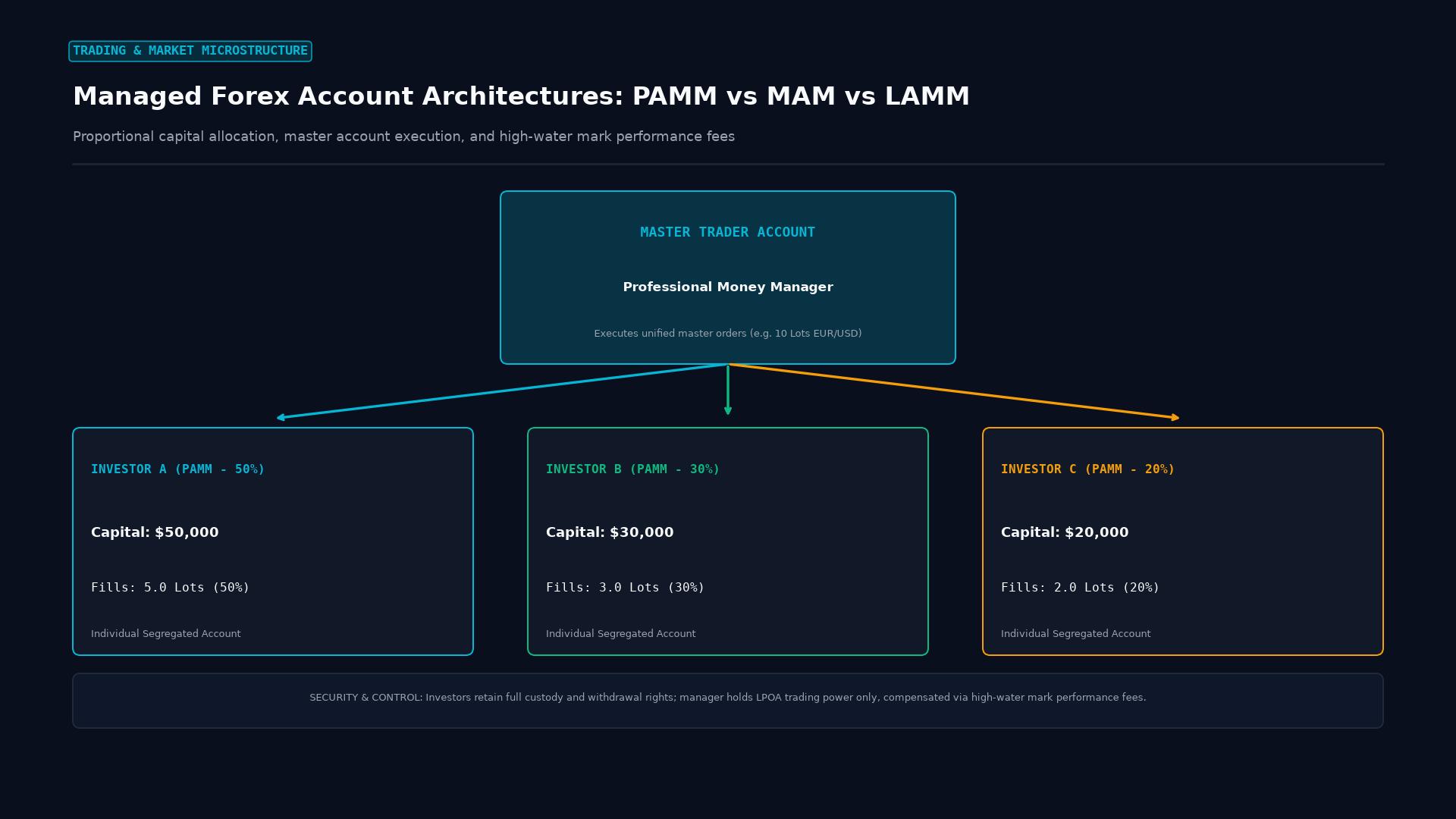 Figure: Professional money manager PAMM/MAM framework: master account order execution proportionally allocated across segregated investor sub-accounts.
Technical Execution Architectures: PAMM, MAM, and LAMM
Brokerages deploy specialized multi-account software modules to allow a single money manager to execute orders across dozens or hundreds of client sub-accounts simultaneously.
1. Percent Allocation Management Module (PAMM)
PAMM is the most common technical architecture in retail and institutional managed forex. In a PAMM system, all individual investor sub-accounts are pooled virtually into a single master account:
- The master manager executes a trade based on the aggregate balance of the entire pool.
- The PAMM server instantly divides the position across each sub-account based on that sub-account’s percentage share of total pooled equity.
- Floating profits, realized gains, and trading losses are distributed in real time with precision down to fractional micro-lots ($0.01$ lots).
2. Multi-Account Manager (MAM)
The MAM architecture offers greater flexibility than PAMM by allowing the portfolio manager to assign varied trade-allocation algorithms based on client risk mandates:
- Proportional by Equity: Functions identical to a standard PAMM.
- Proportional by Balance: Allocations are calculated based on realized balance rather than floating equity, dampening intra-day allocation swings.
- Fixed Lot Allocation: Each sub-account receives a predetermined fixed lot size on every trade.
- Lot Multiplier Allocation: The manager assigns custom leverage multipliers (e.g., conservative client receives $0.5\times$ base risk, while aggressive client receives $2.0\times$ base risk).
3. Lot Allocation Management Module (LAMM)
LAMM represents the earliest, simplest iteration of multi-account software. It allocates trades strictly based on predetermined lot sizes rather than equity percentages. Because LAMM ignores variations in client account equity, it poses substantial margin risks for smaller accounts and is rarely deployed by institutional currency managers.
       COMPARISON: PAMM VS MAM VS LAMM ARCHITECTURES

Feature         PAMM                     MAM                      LAMM
----------------------------------------------------------------------------------
Allocation Base Pro-rata floating equity Custom allocation rules   Fixed lot sizes
Risk Profiles   Uniform across pool      Segmented by client risk Uniform size
Sub-Lot Sizing  Down to 0.01 micro-lots  Down to 0.01 micro-lots  Whole / fixed lots
Target Client   Retail / High-Net-Worth  Institutional / Mixed    Legacy retail
Execution Venue Server-side virtual pool Sub-account execution    Client-side bridge
Mathematical Allocation and Performance Fee Mechanics
Managed forex accounts rely on quantitative trade allocation and performance fee accounting to ensure equitable treatment across participants.
1. The Pro-Rata Equity Allocation Formula
When the master manager executes an aggregate order of size $L_{\text{master}}$ on the trading terminal, the PAMM server calculates the specific lot size ($L_i$) allocated to each individual sub-account $i$:
$$L_i = L_{\text{master}} \times \left( \frac{E_i}{\sum_{j=1}^{N} E_j} \right)$$
Where:
- $E_i$ is the real-time equity of sub-account $i$.
- $\sum_{j=1}^{N} E_j$ is the total aggregate equity of all participating sub-accounts in the pool.
- $N$ is the total number of connected client accounts.
If a pool contains $1,000,000 total equity, and Client A holds $150,000 ($15%$ of the pool), a 20-lot trade entered on the master terminal automatically executes as a 3.0-lot trade in Client A’s account:
$$L_A = 20 \times \left( \frac{150,000}{1,000,000} \right) = 20 \times 0.15 = 3.0 \text{ lots}$$
2. Performance Fees and the High-Water Mark (HWM)
Professional currency managers are compensated primarily through a performance fee (typically 15% to 30% of net trading profits), calculated using a High-Water Mark (HWM) framework.
The High-Water Mark represents the highest historical equity level reached by the account, net of deposits and withdrawals. The manager is only entitled to collect performance fees on incremental new profits exceeding the previous peak:
$$\text{Net Profit Subject to Fee}t = \max\Big(0, E_t - \text{HWM}{t-1}\Big)$$
$$\text{Performance Fee Due} = \text{Net Profit Subject to Fee}t \times F{\text{rate}}$$
Where:
- $E_t$ is the account equity at the end of the calculation period (e.g., month-end).
- $\text{HWM}_{t-1}$ is the established historical high-water mark.
- $F_{\text{rate}}$ is the agreed contractual performance fee percentage.
If the account experiences a drawdown, the manager collects $0 performance fees until the entire drawdown is recovered and the account equity sets a new record high.
       HIGH-WATER MARK (HWM) FEE CALCULATION

Account
Equity ($)
   ^
   |                     * Peak 2 ($120k) -> Fee Charged on $10k New Gain
   |                    / \
   |    * Peak 1 ($110k)   \
   |   / \                  \
   |  /   \ Drawdown         \
   | /     \------------------\------------- HWM Threshold ($110,000)
   |/       ($95k)             \
   |        NO PERFORMANCE FEES \
   |        UNTIL HWM EXCEEDED   \
   +---------------------------------------->
   Month 1  Month 2  Month 3   Month 4  Month 5
Legal and Custodial Architecture: Limited Power of Attorney (LPOA)
The regulatory foundation of a legitimate managed forex account rests on the strict separation of capital custody and trading authority:
- Direct Account Segregation: The investor opens a retail or institutional brokerage account directly with an authorized, regulated financial institution (such as a CFTC/NFA-registered Futures Commission Merchant in the US, an FCA-authorized firm in the UK, or an ASIC-regulated broker in Australia). The account is registered under the investor’s tax identification number.
- Limited Power of Attorney (LPOA): The investor executes an LPOA agreement granting the manager specific, limited authorizations:
- Authority to execute spot, forward, and derivative currency transactions.
- Authority to instruct the broker to deduct contractual management and performance fees at month-end.
- Zero Withdrawal Authority: The manager is legally and technically barred from transferring capital to third-party accounts, requesting wire withdrawals, or altering account beneficiary designations. All capital distributions must return exclusively to the investor’s originating bank account.
Real-World Case Study: Algorithmic CTA Managing a USD/JPY Breakout
Consider a registered Commodity Trading Advisor (CTA), Apex Macro Capital, operating a quantitative trend-following strategy via a PAMM module on an institutional ECN broker.
+--------------------------------------------------------------------+
|               APEX MACRO CAPITAL PAMM POOL OPERATION               |
+--------------------------------------------------------------------+
| Master Pool Capital: $10,000,000 across 40 institutional clients.  |
| Strategy: Systematic multi-day momentum & yield-spread divergence. |
| Risk Budget: Maximum 1.5% portfolio risk per trade (VaR limit).   |
+--------------------------------------------------------------------+
| Execution Sequence:                                                |
| 1. Macro Signal: US Federal Reserve signals prolonged rate hikes; |
|    Bank of Japan maintains negative benchmark rates (-0.10%).     |
| 2. Technical Breakout: USD/JPY crosses resistance at 145.00.      |
| 3. Master Order Entry: Algorithmic engine buys 100 lots USD/JPY    |
|    at 145.05 with a hard protective stop at 143.50 (-155 pips).    |
| 4. Server Allocation: A client with $500,000 equity (5% of pool)   |
|    receives an automated sub-allocation of 5.0 lots USD/JPY.       |
| 5. Trend Maturation: Over 14 trading sessions, USD/JPY rallies to  |
|    150.05. The CTA trails stop-losses, exiting at 149.80.          |
| 6. Profit Realization: Trade captures +475 pips on 100 lots,       |
|    yielding a gross profit of $316,666 for the master pool.       |
| 7. Sub-Account Distribution: The $500,000 client captures $15,833  |
|    gross profit, lifting total equity to $515,833 (a new HWM).     |
| 8. Fee Settlement: At month-end, the broker debits a 20% HWM       |
|    performance fee ($3,166.60), crediting the manager, while      |
|    retaining $12,666.40 in net returns for the investor.          |
+--------------------------------------------------------------------+
The client maintained custody of their capital, observed every fill and exit in real time on their mobile terminal, and paid fees exclusively on verified net profits exceeding the previous high-water mark.
Due Diligence and Red Flags in Managed Forex
Due to the decentralized nature of retail foreign exchange, fraudulent schemes and unqualified operators frequently solicit retail investors. Rigorous institutional due diligence requires auditing specific factors:
- Third-Party Broker Regulation: The client’s funds must be held by an independent brokerage subject to tier-1 regulatory oversight (NFA/CFTC, FCA, ASIC, BaFin, FINMA). Offshore brokers operating in unregulated jurisdictions present severe counterparty and withdrawal risks.
- Audited Track Records: Investors must verify performance track records authenticated by independent accounting firms (such as GIPS-compliant composite performance reports) rather than unverified screenshots or self-reported track records.
- Strategy Risk Modeling: Investors must inspect whether the manager employs toxic money-management strategies such as Martingale (doubling lot sizes after consecutive losses) or unhedged grid trading. These strategies produce deceptively smooth upward equity curves for months before suffering complete, catastrophic account wipeouts during strong trending markets.
       DUE DILIGENCE CHECKLIST: MANAGED FOREX

+-----------------------------+---------------------------------------+
| Green Flag (Institutional)  | Red Flag (High Risk / Fraud)          |
+-----------------------------+---------------------------------------+
| Tier-1 Regulated Broker     | Unregulated Offshore Broker           |
| Segregated Account Custody  | Manager Demands Direct Cash Transfers |
| Strict High-Water Mark      | No High-Water Mark / Upfront Fee Only |
| GIPS / Audited Statements   | "Guaranteed" 10% Monthly Returns      |
| Hard Stop-Loss per Trade    | Martingale / No Stop-Loss Trading     |
+-----------------------------+---------------------------------------+
Frequently Asked Questions
Can an investor lose more than their initial deposit in a managed forex account?
In standard cash investment accounts, losses cannot exceed initial principal. However, in leveraged foreign exchange trading, sudden market gaps (such as the Swiss National Bank unpegging the EUR/CHF exchange rate in January 2015) can cause slippage beyond stop-loss orders. Under modern tier-1 regulatory protections (such as ESMA rules in Europe and FCA rules in the UK), retail accounts are legally guaranteed Negative Balance Protection, ensuring the broker absorbs losses beyond deposited equity. Institutional and professional clients, however, may remain liable for deficit balances.
How does a managed forex account differ from copy trading or social trading?
In copy trading, an investor utilizes software to copy the trades of an independent signal provider into their personal account. However, the client remains responsible for configuring trade sizing, leverage multipliers, and risk parameters. In a managed forex account, the manager operates under a formal Limited Power of Attorney (LPOA), assuming full professional fiduciary and operational responsibility for portfolio sizing, multi-asset allocation, and risk management.
Are managed forex account profits taxed as capital gains or ordinary income?
In the United States, foreign exchange trading profits are governed by default under IRC Section 988 as ordinary income or loss. However, currency traders can elect to be treated under IRC Section 1256, where regulated futures and qualifying currency contracts benefit from a 60/40 blended tax rate: 60% taxed at favorable long-term capital gains rates and 40% taxed at short-term ordinary income rates, regardless of holding period. Investors should consult a qualified tax professional to evaluate applicable elections.
Ready to trade forex?
Open a free demo account with a regulated broker. Practice with virtual funds before risking real money.