Managed account
A managed account is an individualized investment portfolio owned directly by an investor and overseen by a professional asset manager or fiduciary adviser who exercises discretionary trading authority.
A managed account is a personalized investment vehicle in which an individual investor, institutional endowment, or corporate treasury retains an authorized investment adviser, portfolio manager, or wealth management institution to make asset allocation and trading decisions on their behalf. The client grants the portfolio manager discretionary trading authority through a formal Limited Power of Attorney (LPOA).
The distinguishing feature of a managed account is direct beneficial ownership. Unlike pooled investment vehicles (such as mutual funds, unit trusts, or exchange-traded funds), where investors hold shares of an aggregate legal entity that owns an underlying basket of securities, a managed account client holds title to each individual stock, bond, and currency contract directly inside their personal account at a qualified custodian.
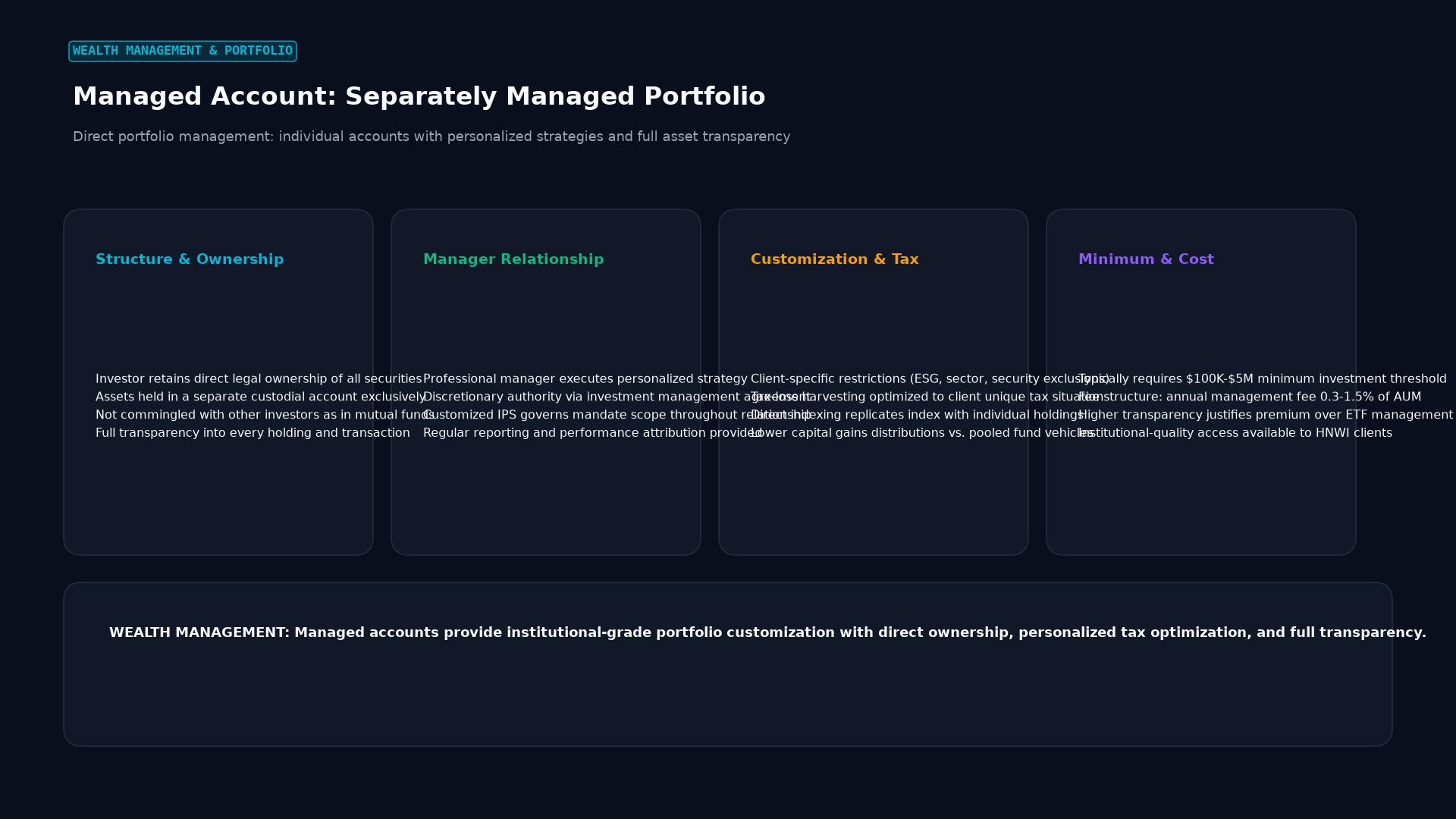 Figure: Direct portfolio management: individual accounts with personalized strategies and full asset transparency
Historical Evolution of Managed Accounts
The managed account industry has expanded through four structural phases:
1. Private Trust Banking and High-Net-Worth Brokerage
Historically, customized portfolio management was available exclusively to ultra-high-net-worth families and sovereign dynasties through private bank trust departments. Minimum entry thresholds exceeded several million dollars, as personal trust officers manually constructed bond and equity portfolios using physical paper certificates.
2. The Rise of Separately Managed Accounts (SMAs)
During the 1970s and 1980s, Wall Street investment banks institutionalized the Separately Managed Account (SMA). Brokerage firms partnered with independent institutional asset management boutiques, offering wealthy individuals access to institutional-caliber strategies. Clients paid an all-inclusive annual “wrap fee” covering portfolio management, custody, trade execution, and quarterly performance reporting.
3. Unified Managed Accounts (UMAs)
By the early 2000s, software automation enabled the creation of Unified Managed Accounts (UMAs). A UMA consolidates multiple disparate investment styles (such as large-cap growth equities, international value stocks, municipal bonds, and alternative exchange-traded funds) into a single master custodial account. A primary overlay portfolio manager (OPM) coordinates trades across sub-advisers, executing centralized asset allocation and rebalancing.
4. Direct Indexing and Algorithmic Tax Optimization
In recent years, the democratization of fractional share trading and commission-free electronic markets spurred the growth of Direct Indexing. Using platforms such as Parametric, Canvas, and modern robo-advisory engines, investors with account minimums as low as $50,000 can replicate benchmark indices (such as the S&P 500 or MSCI World) by purchasing the underlying equities directly, programmatically harvesting capital losses to maximize post-tax compound returns.
       CHRONOLOGICAL EXPANSION OF MANAGED ACCOUNTS

Period      Structure                    Key Innovation
----------------------------------------------------------------------------------
1950s-1970s Private Bank Trust Accounts  Bespoke human trust administration
1980s-1990s Separately Managed Accounts  Institutional equity/bond access via wrap fees
2000s-2010s Unified Managed Accounts     Multi-asset consolidation under single overlay
2020s-Pres. Direct Indexing / Robo-SMAs  Algorithmic tax-loss harvesting & custom ESG
Structural Classifications: SMA, UMA, and MFA
Wealth managers classify managed accounts into distinct operational frameworks:
1. Separately Managed Account (SMA)
A single-discipline portfolio dedicated to one asset class or investment style (for example, an intermediate municipal bond strategy or a large-cap dividend growth portfolio). The client contracts directly with a specialized institutional manager who exercises discretionary control over that specific asset silo.
2. Unified Managed Account (UMA)
A sophisticated multi-asset structure housing multiple underlying asset sleeves within one account. An overlay portfolio manager coordinates trades to avoid wash sales between sleeves, dynamically balancing equity and fixed-income weightings.
3. Managed Forex Account (MFA)
In currency markets, managed forex accounts allow professional foreign exchange traders (Commodity Trading Advisors or Money Managers) to execute currency trades simultaneously across multiple client sub-accounts using specialized aggregation technologies such as PAMM (Percent Allocation Management Module) or MAM (Multi-Account Manager).
                 UNIFIED MANAGED ACCOUNT (UMA) ENGINE

+--------------------------------------------------------------+
| Investor Custodial Account: Single Legal Taxpayer ID         |
+--------------------------------------------------------------+
                               |
                               v
+--------------------------------------------------------------+
| Overlay Portfolio Manager (OPM) / Rebalancing Algorithm      |
| - Controls strategic asset allocation targets                |
| - Coordinates cross-sleeve tax-loss harvesting               |
| - Prevents IRC Section 1091 Wash Sale violations             |
+--------------------------------------------------------------+
                               |
      +------------------------+------------------------+
      |                        |                        |
      v Sleeve A: 50%          v Sleeve B: 30%          v Sleeve C: 20%
+--------------------+   +--------------------+   +--------------------+
| Large-Cap Equity   |   | Fixed-Income Core  |   | Liquid Alternatives|
| Sub-Adviser Model  |   | Municipal Bond Desk|   | Commodity & Global |
| (Direct Stocks)    |   | (Direct Bonds)     |   | Macro Overlays     |
+--------------------+   +--------------------+   +--------------------+
Key Advantages: Tax Alpha and Customization
Managed accounts provide specific structural advantages over pooled mutual funds:
1. Generating Post-Tax “Tax Alpha”
In a mutual fund, when other investors redeem their shares, the fund manager may be forced to liquidate portfolio holdings, realizing taxable capital gains that are distributed to all remaining shareholders. An investor can buy into a mutual fund in November and receive a taxable capital gain distribution in December, despite having experienced zero actual economic gain.
In an SMA, the client is insulated from the transactions of other investors. Concurrently, the manager can harvest selective capital losses:
$$\text{Tax Alpha} = \sum_{i=1}^{N} \text{Realized Tax Loss}i \times \tau{\text{capital gains}} - \text{Tracking Error Drag}$$
Where:
- $\tau_{\text{capital gains}}$ is the client’s marginal capital gains tax rate.
- $\text{Tracking Error Drag}$ is the minor portfolio return deviation incurred by temporarily substituting a sold stock with a correlated proxy asset.
By systematically selling underwater positions while reinvesting in highly correlated alternative securities, the managed account accumulates tax deductions that offset realized capital gains across the client’s broader financial life.
2. Granular Values-Based and ESG Screening
Because the client owns the actual underlying securities, a managed account permits customized negative and positive screening. An executive at a major pharmaceutical company who holds extensive corporate stock options can mandate that their managed account exclude healthcare equities to avoid portfolio concentration. Similarly, clients can restrict companies based on environmental, social, or governance (ESG) criteria without sacrificing broad market exposure.
Real-World Case Study: Direct Indexing SMA Implementation
Consider an investor, Katherine Vance, who recently sold a private business, realizing a taxable capital gain of $2,000,000 subject to a 20% federal capital gains tax and a 3.8% Net Investment Income Tax (NIIT), for an aggregate tax burden of 23.8%.
+--------------------------------------------------------------------+
|               DIRECT INDEXING TAX-LOSS HARVESTING CASE             |
+--------------------------------------------------------------------+
| 1. Capital Allocation: Katherine allocates $3,000,000 liquid cash  |
|    into a Direct Indexing SMA replicating the Russell 1000 Index.  |
| 2. Direct Share Ownership: Custodian buys 450 individual equities. |
| 3. Market Volatility: Over the first 12 months, the Russell 1000   |
|    index finishes flat (+1.0%), but individual stock dispersion is  |
|    wide: 210 stocks gain +15%, while 240 stocks drop -12%.         |
| 4. Algorithmic Harvesting: The SMA software liquidates underwater  |
|    shares, replacing them with correlated sector peers to maintain |
|    index tracking while crystallizing capital losses.              |
| 5. Realized Losses: The manager harvests $280,000 in gross capital |
|    losses throughout the year.                                     |
+--------------------------------------------------------------------+
Tax Offset Financial Computation
- Gross Capital Losses Harvested: $280,000
- Tax Savings Rate: 23.8% ($20.0% + 3.8%$)
- Immediate Tax Savings: $$\text{Cash Tax Shield} = $280,000 \times 23.8% = $66,640$$
Katherine applies the $280,000 capital loss directly against the capital gains from her business sale on IRS Form 8949, saving $66,640 in cash taxes. Had she invested the $3,000,000 in a flat Russell 1000 ETF or index mutual fund, she would have generated $0 in realized capital losses to offset her external gains.
Regulatory and Fiduciary Standards
In the United States, professional managed accounts operate under strict legal frameworks:
- The Investment Advisers Act of 1940: Portfolio managers operating managed accounts as Registered Investment Advisers (RIAs) are bound by an affirmative fiduciary duty. Under SEC enforcement standards, fiduciaries must act with undivided loyalty and prudence, eliminate or fully disclose all conflicts of interest, and seek best execution on all trades.
- SEC Form ADV Part 2A (The Brochure): Advisers must provide prospective managed account clients with a detailed narrative brochure detailing their investment strategies, fee calculation schedules, disciplinary history, and potential conflicts of interest.
- The Wrap Fee Program Rule (SEC Rule 204-3(f)): When advisers bundle investment management, trade execution, and custodial services into a single wrap fee, they must provide clients with Schedule H of Form ADV, explicitly disclosing how execution fees are absorbed and explaining whether the client would pay lower fees under an unbundled commission structure.
Frequently Asked Questions
What is the typical fee structure of a managed account?
Managed accounts generally charge an annual asset-based fee calculated as a percentage of Assets Under Management (AUM), typically debited quarterly in advance or arrears. Advisory fees generally scale downward as account balances increase, ranging from 1.00% to 1.50% for portfolios under $500,000, down to 0.35% to 0.75% for multi-million-dollar accounts. Some institutional managers charge a lower base management fee combined with a performance fee above an agreed benchmark hurdle.
Can a client withdraw money from a managed account at any time?
Yes. Because the client retains beneficial ownership of the securities held at an independent custodian, they maintain the right to revoke the Limited Power of Attorney (LPOA), terminate the advisory agreement, withdraw cash, or transfer the physical securities in-kind to another brokerage firm without liquidating the positions.
What is the wash-sale rule and how does it affect managed accounts?
Under Section 1091 of the Internal Revenue Code, if an investor sells a security at a loss and repurchases the same or a “substantially identical” security within 30 days before or after the sale, the tax loss deduction is disallowed and added to the cost basis of the new position. High-quality managed account software prevents wash sales by automatically substituting a sold stock with a correlated proxy (such as selling Chevron at a loss and purchasing ExxonMobil) to capture the tax deduction while maintaining sector exposure.
Ready to trade forex?
Open a free demo account with a regulated broker. Practice with virtual funds before risking real money.