Manual Trading
Manual trading is an investment and execution approach where all trading decisions, market analysis, risk parameters, and order submissions are performed directly by human discretion and manual input rather than automated algorithms or robotic systems.
What Is Manual Trading?
Manual trading (often referred to as discretionary trading) is the traditional method of participating in financial markets wherein a human trader directly observes market data, formulates an analytical hypothesis, and physically enters orders through a trading terminal (such as MetaTrader, TradingView, or proprietary institutional execution management systems).
In contrast to algorithmic, quantitative, or automated trading—where pre-programmed code automatically identifies setups, calculates position sizes, and fires sub-millisecond execution commands via API—manual trading relies entirely on human cognitive assessment, pattern recognition, and real-time discretion. While automated systems dominate institutional market turnover, manual trading remains widely practiced by discretionary macro hedge fund managers, prop firm traders, and millions of retail forex operators worldwide.
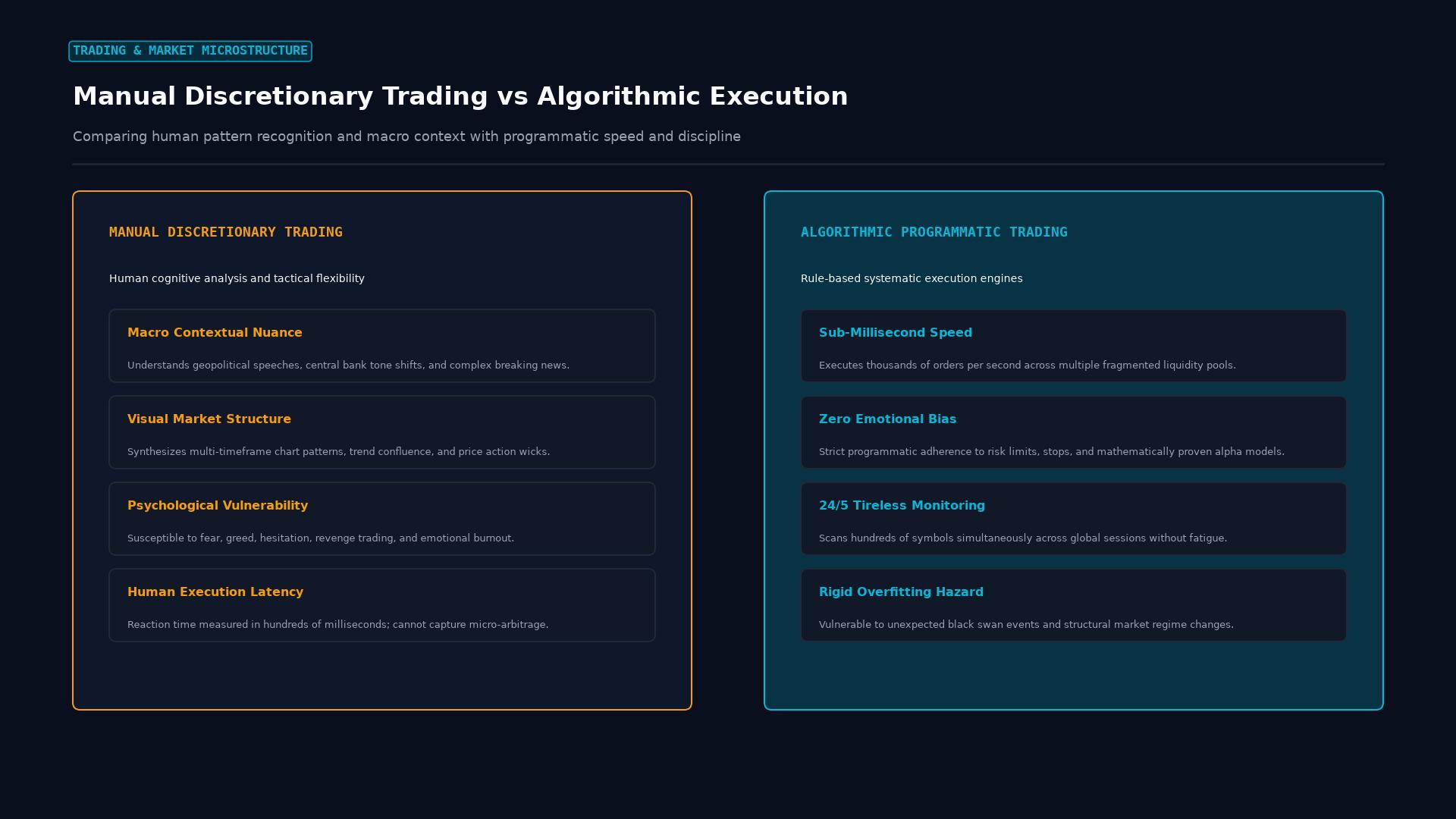 Figure: Discretionary trader cognitive workflow: macro chart analysis, mental risk assessment, and manual point-and-click order ticket entry.
Key Takeaways
- Qualitative Flexibility: Human traders excel at synthesizing qualitative information—such as unexpected central bank press conferences, geopolitical breaking news, and subtle shifts in market sentiment—that rule-based algorithms often misinterpret.
- Cognitive and Emotional Vulnerabilities: The primary downfall of manual trading is human psychology: fear, greed, revenge trading, overconfidence, and the disposition effect (holding losing trades too long while cutting winning trades prematurely).
- Physical Latency Drag: Human reaction time (typically 200–300 milliseconds) combined with manual button entry makes manual trading uncompetitive for high-frequency scalping, arbitrage, or latency-sensitive news straddles.
- Fatigue and Discipline Degradation: Unlike software that can operate 24 hours a day with uncompromising precision, human decision-making degrades rapidly over extended trading sessions due to cognitive fatigue.
- The Semi-Automated Hybrid: Many elite discretionary traders combine manual entries with automated risk management scripts that enforce hard stop-losses, breakeven trailing stops, and multi-tier take-profits automatically upon order fill.
Comparative Taxonomy: Manual vs. Automated Trading
| Operating Dimension | Manual (Discretionary) Trading | Algorithmic (Automated / EA) Trading |
|---|---|---|
| Decision Driver | Human intuition, chart analysis, qualitative news | Predefined mathematical rules, backtested code |
| Execution Speed | Slow (250ms – several seconds) | Ultra-fast (Microseconds via FIX API / VPS) |
| Emotional Interference | High (Susceptible to fear, tilt, greed) | Zero (Cold, uncompromising code execution) |
| Adaptability | Extreme (Can immediately pivot during crises) | Rigid (Prone to failure if market regime shifts) |
| Operating Capacity | Limited to human waking hours (4–8 hours/day) | Continuous 24/5 uninterrupted monitoring |
| Backtesting Rigor | Difficult and prone to cognitive hindsight bias | Statistically quantifiable over decades of tick data |
| Maintenance Burden | Physical presence and mental concentration | Software maintenance, VPS hosting, API monitoring |
The Psychological Pitfalls of Manual Trading
The overwhelming majority of unprofitable manual traders fail not due to flawed technical analysis, but due to psychological breakdowns:
1. The Disposition Effect
Empirical studies in behavioral finance reveal that manual traders have a pervasive cognitive bias to realize gains quickly while stubbornly refusing to realize losses:
$$\mathbb{E}[\text{Holding Time of Losers}] \gg \mathbb{E}[\text{Holding Time of Winners}]$$
A manual trader often moves their stop-loss further away as price approaches it, hoping for a bounce, transforming a modest 20-pip loss into a catastrophic margin call.
2. Revenge Trading
Following a frustrating loss or a series of stopped-out trades, manual traders frequently experience emotional “tilt.” Abandoning their trading plan, they instantly enter oversized, unplanned positions to win back lost capital, compounding losses exponentially.
Practical Application: The Breaking News Discretionary Advantage
While automated algorithms outperform humans in structured, quantitative environments, manual trading demonstrates superior resilience during unprecedented, black-swan events.
- Context: During an unscheduled press conference, a major central bank governor makes a surprise remark that directly contradicts their official written monetary policy statement.
- Algorithmic Failure: Natural Language Processing (NLP) news algorithms parse the written statement and aggressively buy the currency based on positive headline keywords.
- Manual Human Edge: An experienced manual macro trader watching the live video broadcast observes the governor’s hesitant body language, tone, and explicit verbal walk-back during the unscripted Q&A session.
- Execution: Recognizing that the written statement is obsolete, the manual trader immediately overrides standard technical indicators and shorts the currency into the algorithmic buying surge, capturing a multi-hundred-pip trend as the broader market realizes the true policy reality.
Best Practices for Professional Manual Traders
- Pre-Commitment Rules: Write out the exact entry price, invalidation stop-loss, and profit targets before clicking the order button. Never alter a stop-loss to allow more room for a losing trade.
- Hard Daily Loss Limits: Establish a rule that if account equity drops by more than 2% to 3% in a single trading day, all manual trading platforms are shut down until the next morning session.
- Maintain a Rigorous Trade Journal: Log every manual trade with screenshots, fundamental catalysts, emotional state at entry, and adherence to the trading plan to objectively track cognitive performance over time.
Frequently Asked Questions (FAQ)
Can manual traders beat automated trading algorithms?
Yes. Many discretionary macro and swing traders consistently outperform automated algorithms over long horizons. While algorithms excel at high-frequency execution and pattern exploitation during normal conditions, manual traders excel at adapting to regime shifts, unexpected geopolitical developments, and broad economic trends.
What is semi-automated trading?
Semi-automated trading is a hybrid methodology where the human trader manually identifies the market setup and triggers the initial entry, but an automated script or Expert Advisor (EA) takes over immediately upon execution, automatically placing the stop-loss, managing trailing stops, and scaling out partial profits at predetermined Fibonacci or R-multiple targets.
Which trading platform is best for manual forex trading?
MetaTrader 4 (MT4) and MetaTrader 5 (MT5) remain the global standards for retail manual trading due to their ubiquitous one-click trading panels and custom charting shortcuts. For institutional and advanced charting analysis, TradingView, cTrader, and multi-broker platforms like NinjaTrader are widely favored.
Ready to trade forex?
Open a free demo account with a regulated broker. Practice with virtual funds before risking real money.