Slippage
Slippage is the difference between the price at which a trader expects a trade to be executed and the price at which it actually fills. It occurs when market conditions move between the moment an order is submitted and the moment it's processed. Slippage can be positive (better-than-expected fill) or negative (worse-than-expected fill), though negative slippage is more commonly experienced in fast markets.
Why Slippage Happens
Forex trades don’t execute in a vacuum. When you click “buy market” on EUR/USD, your order travels from your trading platform to your broker’s servers, then to a liquidity provider, then back with a fill confirmation. This journey takes milliseconds — but in a fast-moving market, price can change substantially in that time.
If EUR/USD is quoted at 1.0850 when you click buy, but by the time the order reaches the liquidity provider it’s at 1.0853, you fill at 1.0853 — 3 pips worse than expected. That’s negative slippage. If price had moved to 1.0847 in your favor between click and fill, you’d receive positive slippage — 3 pips better than expected.
During normal market conditions on major pairs with a competitive broker, slippage is typically zero to 1 pip. During news events or in illiquid conditions, it can reach 5-30 pips or more.
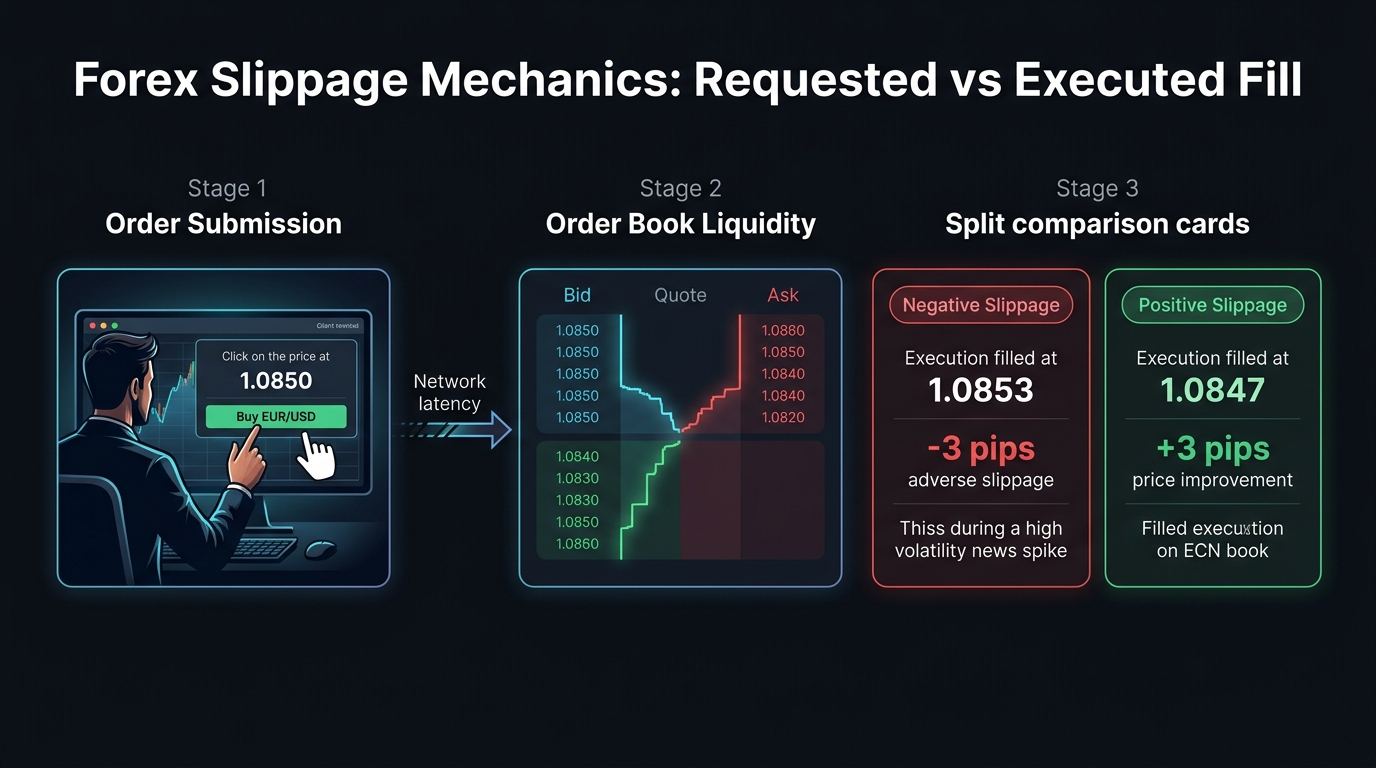
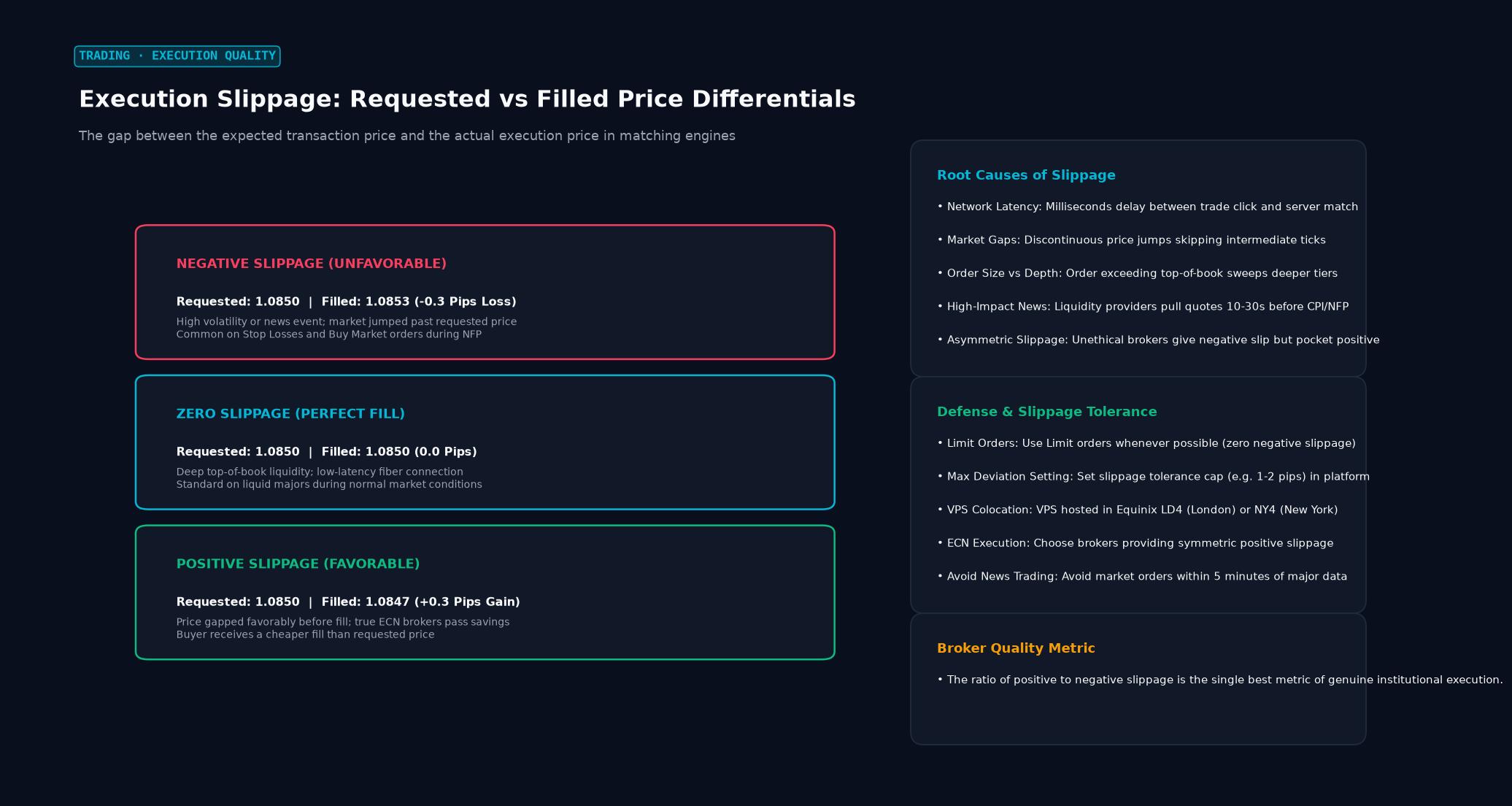 Figure: The gap between the expected transaction price and the actual execution price in matching engines
When Slippage Is Most Likely
High-impact news releases (NFP, CPI, FOMC decisions): The market moves faster than individual quotes can update. Liquidity providers widen spreads and delay fills during the initial reaction. A stop-loss set at a specific price may fill 10-20 pips below that level when the release hits.
Market opening (Sunday/Monday open): Currency markets close Friday at 22:00 GMT and reopen Sunday at 22:00 GMT. News events over the weekend can create a price gap — prices open at a completely different level than Friday’s close. A stop-loss at the Friday close may not fill until the new opening price, which can be significantly worse.
Low liquidity sessions (Asian session for European pairs): During hours when major market participants are not active, the bid-ask spread widens and market depth is shallow. Orders fill with less competition and more price impact.
Large position sizes: An order for 50 standard lots on EUR/USD may not fill entirely at the best available price — the first portion fills at the best price, subsequent portions fill at progressively worse prices as liquidity at each level is absorbed.
Fast markets: Any period of rapid, directional price movement — breakout from a tight range, sharp reversal, flash crash — creates conditions where prices move faster than order processing.
Types of Slippage by Order Type
Market orders: Always subject to slippage. Fill at best available price, which may differ from quoted price.
Stop-loss orders (stop-market): Convert to market orders when triggered. Subject to the same slippage as market orders — and the risk is typically at the worst possible moment (when price is moving rapidly against the position).
Limit orders: By definition, cannot experience negative slippage. A buy limit at 1.0830 fills at 1.0830 or better — never worse. They can experience positive slippage (filling at a better price if the market gaps through the level).
Stop-limit orders: Set a stop trigger and a limit price. If the market gaps past both trigger and limit, the order doesn’t fill at all — which protects from slippage but creates non-execution risk.
Measuring Your Broker’s Slippage
Before committing meaningful capital to a broker, run a test by examining their execution quality over 20-50 trades:
- Record the price at which you submitted each order
- Record the actual fill price
- Calculate the difference (slippage) on each trade
- Average positive and negative slippage separately
A quality ECN broker should show approximately symmetric slippage — positive and negative occurring with similar frequency, averaging close to zero during normal hours. A broker consistently showing negative slippage (fills always worse than expected) is extracting additional profit from your trades beyond the quoted spread — a red flag.
Regulated brokers in the EU/UK are required to provide “best execution” evidence. Many publish quarterly execution quality statistics. Reviewing these before choosing a broker is worthwhile.
Managing Slippage Risk
Accept slippage on stop-losses as a cost of doing business: Trying to eliminate stop-loss slippage by using stop-limit orders creates non-execution risk that’s usually worse than the slippage itself.
Avoid market orders around news events: If you must trade around scheduled data releases, widen your risk parameters to account for elevated slippage costs.
Use limit orders for planned entries: Limit orders provide price certainty on entry. The trade-off is that some setups won’t fill if the market never reaches your limit price — but the entries that do fill are at the price you chose.
Choose brokers with documented execution quality: During NFP, a reputable ECN broker might show 2-5 pips average slippage on stop-losses. A poor broker might show 15-20 pips. The difference compounds dramatically for active traders.
Key Takeaways
- Slippage is the difference between expected and actual fill price; positive slippage exists but negative is more common in practice
- Highest slippage risk: news events, weekend gaps, low-liquidity sessions, large orders
- Market and stop-market orders carry slippage risk; limit orders cannot receive negative slippage by definition
- Measure your broker’s slippage over a sample of trades before trusting them with significant capital
- Accept stop-loss slippage as a cost rather than fighting it with stop-limit orders that may not fill
FAQ
Is slippage the broker’s fault or just market conditions? Both can be true. Legitimate slippage reflects genuine market conditions where the price between order submission and execution changed. Artificial slippage — where the broker consistently fills worse than market prices warrant — is a broker quality issue. Comparing fills to an independent price feed helps distinguish the two.
Does slippage matter for swing traders? Less than for day traders and scalpers, but it still adds up. A swing trader entering and exiting 3-4 times per week with 2 pips average slippage per trade pays an additional 12-16 pips monthly in hidden costs beyond the stated spread. Over a year, this is a meaningful drag on returns.
Ready to trade forex?
Open a free demo account with a regulated broker. Practice with virtual funds before risking real money.