Day Trading
Day trading is a trading style where all positions are opened and closed within the same trading session — no trades are held overnight. Day traders capitalize on intraday price movements, typically targeting 15–80 pips on currency pairs, using 15-minute to 4-hour charts and closing all exposure before the daily rollover.
What Defines a Day Trader
The defining rule: no open positions when you close your screen for the night. Day traders enter and exit within a single session, deliberately avoiding the overnight risks of gap moves, weekend news events, and unexpected central bank comments during illiquid Asian hours.
This discipline eliminates certain risks — a Sunday-morning gap can wipe out a swing trade’s entire profit buffer before the trader even wakes up. Day traders never face that scenario. But the trade-off is significant: you need to be present, focused, and making high-quality decisions during a defined window each day.
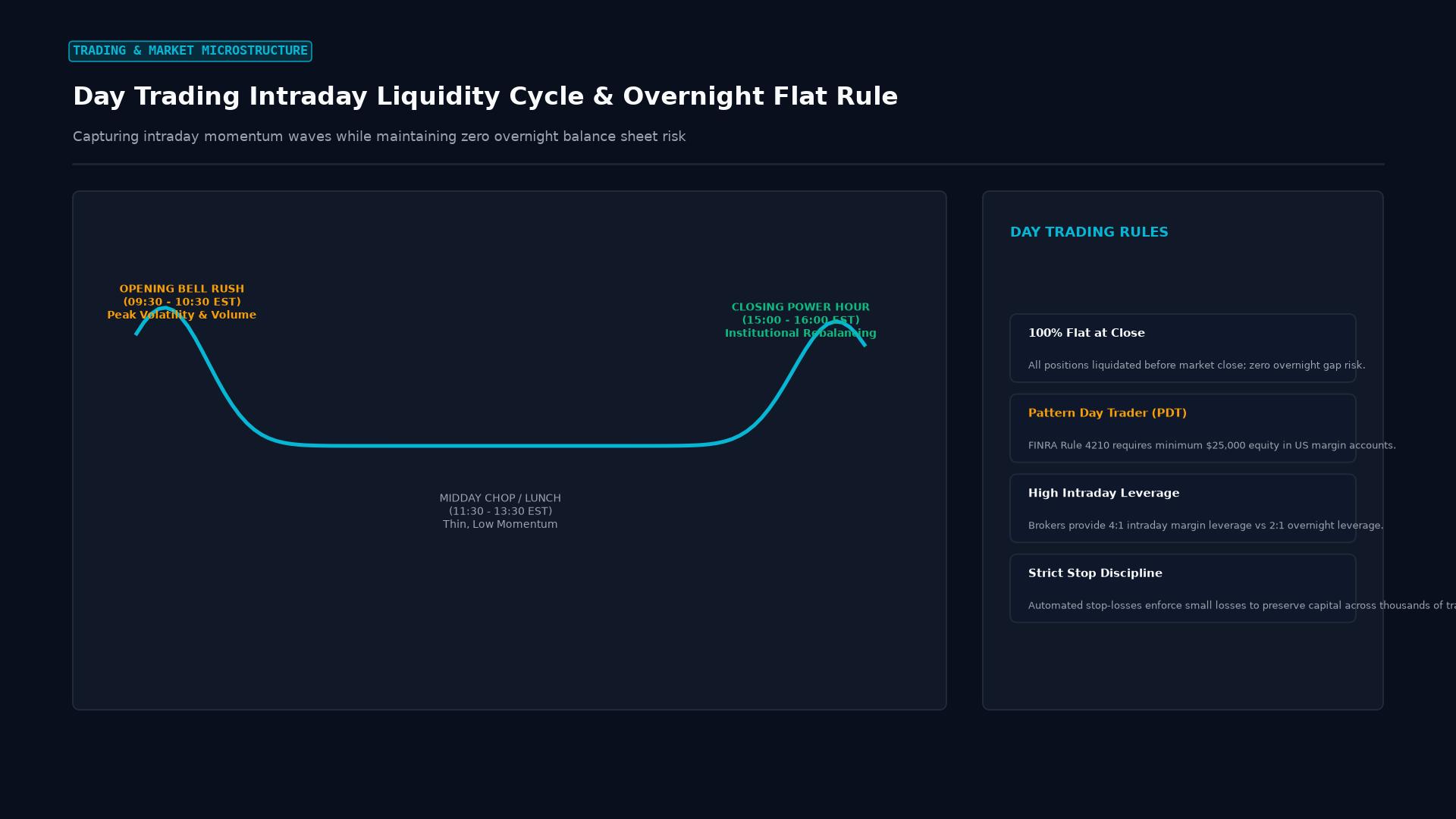 Figure: Intraday trading cycle: opening bell volatility rushes, midday volume compression, and mandatory 100% position liquidation before the closing bell to eliminate overnight gap risk.
The Most Important Sessions for Day Trading Forex
Not all hours are equally tradeable. Forex runs 24 hours on weekdays, but volatility and liquidity are not evenly distributed.
London session (08:00–17:00 GMT): The largest and most liquid forex session. European banks dominate transaction volumes. EUR/USD, GBP/USD, EUR/GBP, and EUR/JPY move most actively here.
New York session (13:00–22:00 GMT): The second-largest session. Most high-impact US data (NFP, CPI, FOMC) is released at 13:30 GMT during this session.
London-New York overlap (13:00–17:00 GMT): The most liquid 4-hour window in the entire week. Spreads are tightest; moves are most decisive. Most day traders focus their primary activity here.
Tokyo/Asian session (00:00–09:00 GMT): Lower volatility for EUR/USD and GBP/USD. Better for JPY crosses (USD/JPY, AUD/JPY) which see their primary institutional flow.
The practical implication: a day trader focusing on EUR/USD who only trades between 13:00-18:00 GMT operates in the optimal window for that pair — the tightest spreads, the most decisive moves, and the highest follow-through on technical setups.
Day Trading Strategies
Breakout trading: Trading the decisive break of a consolidation range or key level that forms during the earlier, lower-volume Asian session. London often breaks Asia’s range in the first hour of the session.
Trend continuation: Identifying the intraday trend early in the London session and trading pullbacks to key levels (20 EMA, prior session highs/lows) in the direction of that trend.
News trading: Trading the immediate market reaction to scheduled high-impact data. Requires understanding of market expectations, ability to act within seconds of a release, and a broker with fast execution and minimal requotes. High reward potential, very high risk — most day traders avoid it without specific expertise.
Session-open strategies: The first 15-30 minutes of the London open or New York open often produce sharp directional moves as institutional orders hit the market. Experienced day traders watch for range establishment in the first 15 minutes and then trade the break.
Transaction Costs: The Day Trader’s Primary Concern
Day traders pay the spread every time they enter and exit. A scalper making 15 trades per day on a standard lot pays:
- 1.5 pips spread × 15 trades × $10/pip = $225/day
- Over 20 trading days: $4,500/month in spread alone
This is why day traders are extremely sensitive to broker spreads and execution quality. The difference between a 0.8-pip spread and a 1.5-pip spread on EUR/USD represents thousands of dollars per month for an active day trader. ECN accounts with raw spreads plus commissions are almost always the right choice for day trading volume.
Day Trading vs. Swing Trading: The Honest Comparison
Day trading is not inherently better than swing trading. Each has genuine trade-offs:
| Aspect | Day Trading | Swing Trading |
|---|---|---|
| Overnight risk | None | Gaps can occur |
| Time required | High (several hours/day) | Low (15-30 min/day) |
| Transaction costs | Higher (many trades) | Lower (fewer trades) |
| Stress level | Higher | Lower |
| Compatible with employment | Difficult | Generally compatible |
Most retail traders who “try day trading” discover that the time commitment and discipline required are underestimated. Swing trading is more compatible with most people’s actual lives.
Key Takeaways
- Day trading means all positions closed within the same session — no overnight exposure
- The London-New York overlap (13:00-17:00 GMT) offers peak liquidity and the best day-trading conditions
- Transaction costs compound significantly with trading frequency — spreads are a day trader’s most important cost
- Major strategies: breakout, trend continuation, session-open, and news trading
- Swing trading is often more practical for traders who can’t commit several focused hours per day
FAQ
Do I need special software or a broker to day trade? A standard MetaTrader 4/5 account with a low-spread ECN broker is sufficient for most day traders. You need: reliable execution, low spreads, a stable internet connection, and ideally a broker with a track record of tight spreads during news events.
Is day trading forex profitable for retail traders? Statistically, most retail day traders lose money. The primary reasons are: paying the spread repeatedly, overtrading, insufficient capital, and taking too much risk per trade. Traders who survive and eventually thrive typically do so through rigid position sizing, narrow focus on 1-2 pairs, and extended practice before risking meaningful capital.
Ready to trade forex?
Open a free demo account with a regulated broker. Practice with virtual funds before risking real money.