Marked to Market
Marked to market (MTM)—or fair value accounting—is the daily practice of revaluing an asset, portfolio, or open derivative contract based on prevailing market prices, settling floating gains and losses in cash to prevent credit risk accumulation.
What Is Marked to Market (MTM)?
Marked to market (MTM)—also known as mark-to-market accounting or fair value accounting—is the foundational methodology in financial markets whereby the recorded value of an open trading position, investment portfolio, or balance sheet asset is continuously adjusted to reflect its current fair market price or liquidation replacement cost, rather than its original historical acquisition cost.
In foreign exchange (Forex) and derivatives markets, marked-to-market serves as the critical engine of systemic financial stability. Rather than permitting paper profits and losses to accumulate unmonitored over months until contract expiration, derivatives exchanges (such as the Chicago Mercantile Exchange, CME) and interbank prime brokers mark every single open contract to the official market settlement price at the end of each trading day. Floating losses are automatically debited as cash Variation Margin (VM), while floating profits are credited to the winning counterparties, resetting the contractual replacement value of all open positions to zero ($0.00) at the start of each new trading session.
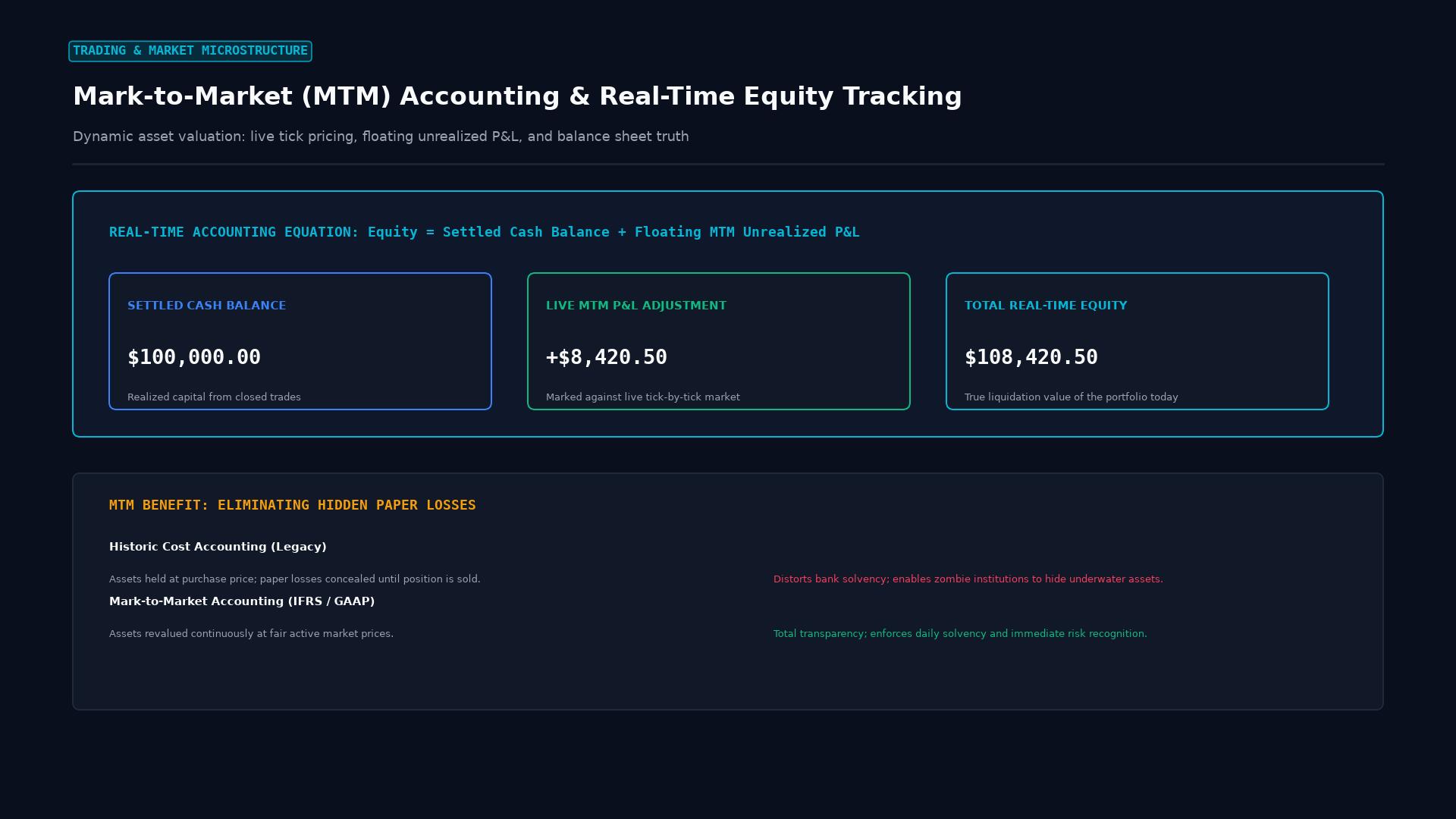 Figure: Mark-to-market daily revaluation cycle: tracking floating unrealized P&L against closing fixing prices and real-time margin adjustments.
Key Takeaways
- Elimination of Counterparty Default Risk: Daily cash settlement via MTM ensures that counterparty debts never accumulate beyond a single trading day’s price movement.
- Fair Value Hierarchy: Under US GAAP (ASC 820) and IFRS 13, marked-to-market accounting partitions assets into three levels: Level 1 (quoted active market prices), Level 2 (observable inputs/models), and Level 3 (unobservable proprietary estimates).
- Variation Margin Engine: MTM is the mathematical trigger for Variation Margin: counterparties with floating losses must post liquid cash collateral before the market opens the following morning.
- Unrealized vs. Realized Conversion: On futures exchanges, MTM converts unrealized paper gains into realized, cash-settled equity daily. In retail spot forex, MTM is tracked continuously in real time to calculate Free Margin and Margin Level.
- Procyclicality Concerns: During severe banking panics, strict mark-to-market rules can force institutions to record massive paper write-downs on temporarily depressed assets, triggering technical insolvency even if the underlying assets are fundamentally sound.
Comparative Taxonomy: Mark-to-Market vs. Historical Cost Accounting
| Accounting Dimension | Mark-to-Market (Fair Value) | Historical Cost / Amortized Cost |
|---|---|---|
| Valuation Baseline | Current prevailing market liquidation quote | Original purchase price minus amortization |
| Balance Sheet Accuracy | Dynamic, real-time reflection of current worth | Static, highly insulated from market volatility |
| Cash Settlement | Daily cash variation margin transfers | Settlement only occurs at asset maturity/sale |
| Vulnerability to Panics | High (Liquidity freezes cause artificial write-downs) | Low (Fluctuations ignored if held to maturity) |
| Transparency | High for liquid assets (Level 1) | Low (Obscures true economic erosion of value) |
| Primary Applicability | Trading books, FX spot, futures, swaps, equities | Commercial bank loans, Held-to-Maturity bonds |
The Mathematics of Daily MTM Cash Settlement
In an exchange-cleared derivatives contract (such as CME foreign exchange futures), the daily variation margin cash flow ($VM_t$) is governed by:
$$VM_t = N \cdot (P_t - P_{t-1})$$
Where:
- $N$ is the contract unit size multiplied by the number of open contracts.
- $P_t$ is the official daily settlement price on day $t$.
- $P_{t-1}$ is the settlement price on the prior day (or entry price if opened today).
Multi-Day Settlement Example:
A hedge fund shorts 20 British Pound futures contracts (£62,500 each, total notional £1,250,000) at an entry price of 1.2600:
- Day 1 Close ($P_1 = 1.2540$): $$VM_1 = -£1,250,000 \times (1.2540 - 1.2600) = +£7,500 ; (+$9,405 \text{ credited in cash})$$
- Day 2 Close ($P_2 = 1.2620$): $$VM_2 = -£1,250,000 \times (1.2620 - 1.2540) = -£10,000 ; (-$12,620 \text{ debited in cash})$$
- Net Position Baseline: At the start of Day 3, the fund’s contractual entry price is marked to 1.2620. The cumulative two-day net P&L ($-$3,215$) has already been completely settled in cash through the clearing house.
Real-World Case Study: SVB and the “Held-to-Maturity” MTM Controversy (2023)
The collapse of Silicon Valley Bank (SVB) in March 2023 showcased the high-stakes battle between mark-to-market accounting and historical cost accounting:
- The Asset Structure: SVB invested tens of billions of dollars of tech startup customer deposits into long-term, fixed-rate U.S. Treasury and mortgage-backed bonds paying ~1.5% yields.
- The Accounting Choice: SVB classified over $90 billion of these securities as Held-to-Maturity (HTM). Under U.S. accounting rules, HTM assets are exempt from mark-to-market accounting; banks do not have to report temporary unrealized paper losses on their balance sheets.
- The Rate Shock: When the Federal Reserve hiked interest rates to over 5%, the market price of SVB’s long-term bonds plunged, creating over $15 billion in hidden, unrecorded marked-to-market losses—an amount exceeding SVB’s entire regulatory equity capital.
- The Run: When depositors began withdrawing cash, SVB was forced to sell portions of its bond portfolio. Selling converted unrecorded paper losses into actual realized losses, revealing that the bank was fundamentally insolvent under true mark-to-market principles and triggering the fastest bank run in modern history.
Pitfalls and Distortion Risks of Mark-to-Market
- The “Fire-Sale” Feedback Loop: When market makers and funds are forced to mark to market during an illiquid crash, declining prices force margin calls, requiring them to dump assets into a bidless market, driving prices down further and forcing additional MTM write-downs across all competing firms.
- Model Risk (Mark-to-Model): For illiquid exotic derivatives (Level 3 assets) where no active market exists, institutions use internal mathematical models to simulate fair value. Unscrupulous institutions can manipulate model assumptions (such as default probabilities or correlation matrices) to conceal severe losses—a practice infamously dubbed “Mark-to-Make-Believe.”
Frequently Asked Questions (FAQ)
What is the difference between mark-to-market and mark-to-model?
Mark-to-market values an asset based on observed, transparent prices from active public exchanges or interbank dealer quotes (Level 1 and 2 assets). Mark-to-model values illiquid or customized assets (Level 3 assets) using theoretical mathematical pricing algorithms (such as Black-Scholes or discounted cash flow models) because no active trading market exists.
Does retail spot forex use marked to market?
Yes. Although retail spot forex does not physically debit or credit cash every afternoon like futures exchanges, the broker’s platform marks all open positions to market in real time, tick-by-tick. This continuously updates your account equity, free margin, and margin level, determining whether you face a margin call.
Can mark-to-market profits be withdrawn immediately?
On futures exchanges and professional prime brokerage accounts, yes. Daily MTM gains are settled as realized cash in your account ledger every evening, meaning they can be immediately withdrawn or deployed into new market opportunities without closing the underlying position.
Ready to trade forex?
Open a free demo account with a regulated broker. Practice with virtual funds before risking real money.