Variation Margin
Variation Margin (VM) is the collateral payment transferred daily or intraday between trading counterparties or through a central clearing counterparty (CCP) to settle unrealized mark-to-market profits and losses on active derivative positions.
What Is Variation Margin?
In derivatives trading and institutional clearing, Variation Margin (VM) represents the actual cash flow or high-grade liquid collateral transferred between trading counterparties to reflect mark-to-market (MTM) fluctuations in open contracts. While Initial Margin (IM) serves as upfront performance collateral pledged to absorb prospective future losses, Variation Margin reflects past, realized price changes that have already occurred.
Operated under the auspices of central clearing counterparties (CCPs like CME Clearing, LCH, and ICE Clear) or governed bilaterally under ISDA Credit Support Annexes (CSAs), Variation Margin is calculated at least once daily (and frequently intraday during periods of high volatility). By systematically sweeping cash from losing accounts and crediting winning accounts, Variation Margin prevents counterparty credit risk from accumulating, effectively resetting the net economic liability of every market participant to zero each morning.
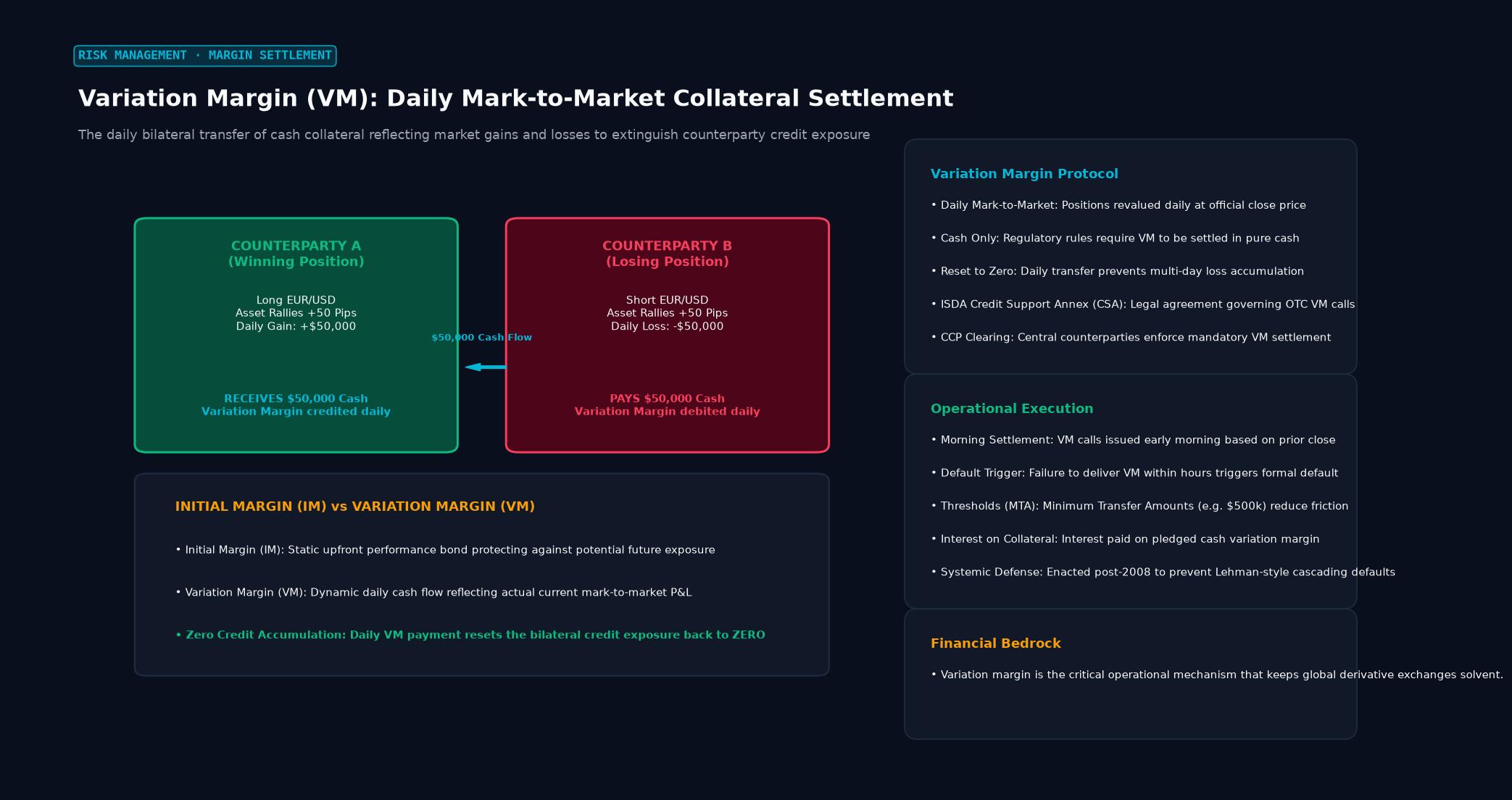 Figure: The daily bilateral transfer of cash collateral reflecting market gains and losses to extinguish counterparty credit exposure
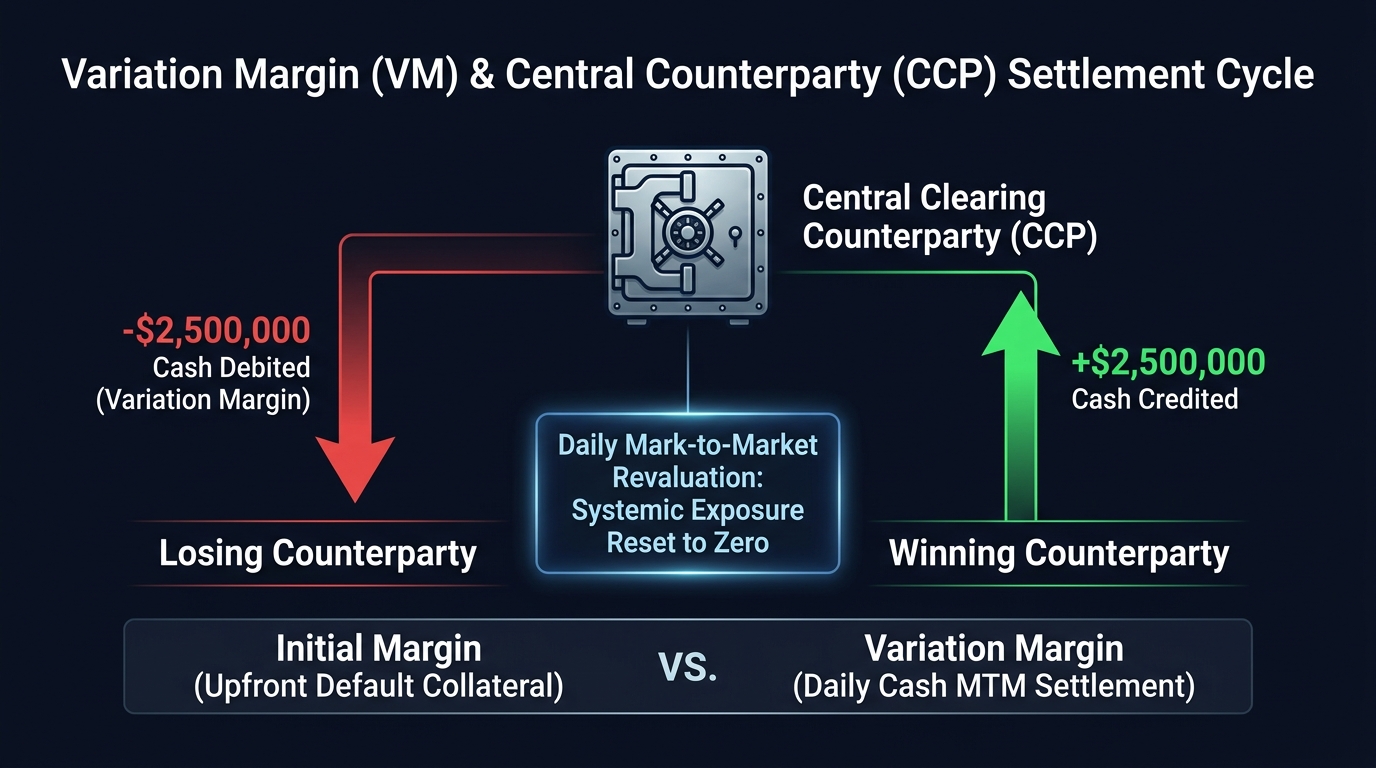
Mathematical Formulation: Mark-to-Market Settlement
The daily Variation Margin obligation ($\text{VM}t$) for a portfolio of $n$ derivative contracts is determined by comparing the current settlement price ($P_t$) to the preceding session’s settlement price ($P{t-1}$):
$$\text{VM}t = \sum{i=1}^{n} \left[ Q_i \times \left( P_{t, i} - P_{t-1, i} \right) \times M_i \right]$$
Where:
- $Q_i$: Position quantity (positive for long contracts, negative for short contracts).
- $P_{t, i}$: Official exchange settlement price on day $t$.
- $P_{t-1, i}$: Official exchange settlement price on day $t-1$ (or initial execution price if opened on day $t$).
- $M_i$: Contract point value multiplier (e.g., $$50$ for E-mini S&P 500 futures, $100,000$ for standard FX contracts).
Cash Call Threshold
If cumulative daily losses exhaust an account’s trading margin excess, the clearing member issues an immediate VM call:
$$\text{VM Call Amount} = \max\left(0, \text{Required Maintenance Collateral} - \text{Total Account Equity}\right)$$
Under exchange clearing rules, VM calls must be wired via central bank payment networks (e.g., Fedwire, CHAPS) in cash before the opening bell of the following trading session, typically by 07:30 to 08:30 AM local time.
Initial Margin vs. Variation Margin
Understanding the dual-margin architecture is vital for institutional liquidity planning:
| Margin Dimension | Initial Margin (IM) | Variation Margin (VM) |
|---|---|---|
| Core Purpose | Precautionary buffer against potential future price shocks. | Reconciles and settles actual past mark-to-market price shifts. |
| Payment Frequency | Pledged once upon position initiation; adjusted dynamically. | Settled daily (and intraday during extreme volatility). |
| Permissible Collateral | Cash, sovereign Treasuries, AAA government bonds, gold. | Strictly unencumbered cash in base contract currency. |
| Ownership / Segregation | Remains client asset; held in segregated custody account. | Irrevocably transferred from losing account to winning account. |
| Regulatory Framework | Basel-IOSCO Uncleared Margin Rules (UMR), CFTC / EMIR. | Mandatory daily zero-threshold exchange under 2017 UMR rules. |
The Liquidity Strain of Variation Margin
While Variation Margin eliminates counterparty default contagion, it creates severe liquidity risk. Because clearing houses mandate that Variation Margin be settled exclusively in cleared cash (rather than pledging Treasury bonds or corporate debt), market participants holding profitable long-term hedges can face sudden insolvency if they lack immediate cash to satisfy multi-million-dollar VM calls:
Hedging Corporation: Holds Physical Asset worth $500M + Short Futures Hedge worth $500M
Market Condition:    Asset price doubles -> Hedge accumulates $500M in floating loss
                     (Total enterprise value is 100% sound and delta-hedged)
                     |
                     v
THE VM LIQUIDITY TRAP:
Clearing House demands $500M in IMMEDIATE CASH Variation Margin
Company cannot pledge physical assets to CCP -> Suffers cash insolvency
Result: Forced to liquidate hedge at the absolute worst price
Real-World Institutional Case Study: The 2022 European Energy Crisis & The $1.5 Trillion Margin Shock
The systemic liquidity threat posed by Variation Margin was vividly illustrated during the European Energy Crisis of 2022.
European electric utility providers (such as Germany’s Uniper and Finland’s Fortum) operate by pre-selling electricity forward to lock in margins, simultaneously shorting benchmark Dutch Title Transfer Facility (TTF) natural gas futures contracts on the European Energy Exchange (EEX) as structural hedges.
Following geopolitical pipeline cutoffs in 2022, European natural gas prices surged parabolically from $€20/\text{MWh}$ to an unprecedented peak of over $€340/\text{MWh}$—a $1,600%$ increase.
[August 2022: The Natural Gas Margin Spiral]
Dutch TTF Gas Futures explode from €20 to €340/MWh
                     |
                     v
Clearing Houses (EEX / ICE Clear Europe) issued colossal Variation Margin calls:
Daily mark-to-market losses required utilities to wire billions in cash EVERY MORNING
                     |
                     v
Equinor estimated total European utility VM calls reached an astronomical $1.5 Trillion
                     |
                     v
THE CRISIS: Utilities were fully solvent long-term, but ran out of liquid bank cash
Commercial banks refused to extend further multi-billion euro intraday overdrafts
                     |
                     v
GOVERNMENT INTERVENTION:
* German government forced to nationalize Uniper, injecting over €50 Billion in liquidity
* Scandinavian governments established emergency €33 Billion sovereign liquidity backstops
The 2022 energy crisis demonstrated that Variation Margin rules—while designed to make clearing houses bulletproof—can induce catastrophic liquidity crises for industrial producers if sovereign emergency backstops are unavailable.
Frequently Asked Questions
Can a trader pledge stocks or bonds to cover Variation Margin?
Under standard clearing house and bilateral uncleared margin regulations, Variation Margin must be settled in cash in the currency denomination of the underlying contract. While Initial Margin allows non-cash collateral (such as US Treasuries or G10 sovereign debt with haircuts), Variation Margin represents a pure debt settlement between winning and losing parties, requiring immediate liquid funds.
What happens if a market participant fails to meet a morning VM call?
If a trading firm fails to wire the required Variation Margin by the designated morning cutoff (e.g., 08:00 AM EST), the clearing firm or prime broker declares the account in default. The broker’s risk desk immediately seizes the client’s Initial Margin collateral and executes an emergency market liquidation of all open positions, passing any residual deficit balance to the defaulting entity.
How does Variation Margin differ in retail forex versus institutional futures?
In institutional futures, Variation Margin is physically debited from or credited to the account cash balance daily in an operational process called “settlement to market.” In retail forex, positions are marked-to-market continuously on screen as unrealized floating P&L against account equity; while the broker does not wire physical cash, the floating loss directly consumes free margin until a margin call or stop-out is triggered.
Ready to trade forex?
Open a free demo account with a regulated broker. Practice with virtual funds before risking real money.