Marketing
Marketing is the systematic business discipline of identifying customer demands, creating competitive value propositions, acquiring client relationships, and optimizing customer lifetime value across commercial channels.
Marketing represents the comprehensive strategic, analytical, and operational process through which an enterprise identifies consumer demand, designs commercial offerings, communicates brand value, and facilitates profitable transaction exchanges. Rather than functioning as a mere tactical sales or advertising function, modern marketing encompasses the entire customer lifecycle: product conception, pricing strategy, distribution logistics, promotional acquisition, and post-purchase retention.
In financial services, capital markets, and retail foreign exchange dealing, marketing operates as a quantitative performance discipline. Brokerages, asset management firms, fintech platforms, and institutional liquidity venues deploy digital marketing engines to attract active traders and institutional capital. Because financial products involve regulatory compliance and substantial capital risks, financial services marketing is governed by strict statutory rules dictating promotional disclosures, risk warnings, and fair advertising standards.
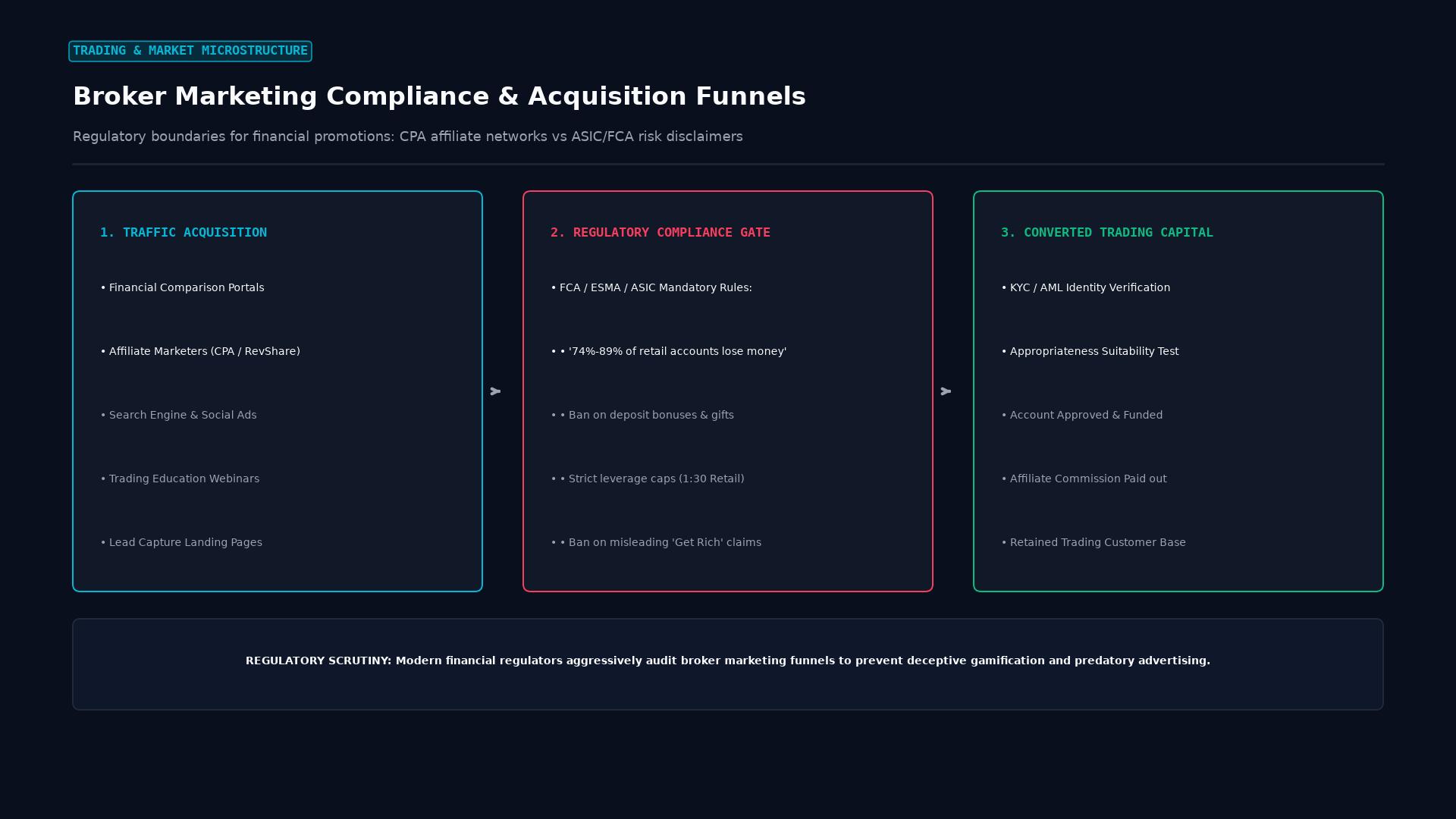 Figure: Retail brokerage marketing economics: customer acquisition costs (CAC), conversion channels, lifetime value (LTV), and regulatory compliance.
Theoretical Foundations: From the 4 Ps to Digital Growth Loops
The strategic framework of marketing has progressed through distinct analytical methodologies:
1. The Classical 4 Ps Framework (McCarthy and Kotler)
Formulated by E. Jerome McCarthy in 1960 and popularized by Philip Kotler, the traditional marketing mix organizes managerial decisions around four pillars:
- Product: The physical good, financial instrument, or digital software service offered to resolve a customer problem.
- Price: The pricing model (fixed commission, variable bid-ask spread, subscription SaaS fee, or percentage of assets under management).
- Place: The distribution conduit (physical retail bank branch, direct web interface, mobile app store, or institutional FIX API connection).
- Promotion: The combination of advertising, public relations, content publishing, and direct personal sales used to generate commercial awareness.
2. The Customer Lifetime Value (LTV) vs Acquisition Cost (CAC) Paradigm
In modern digital finance, traditional brand advertising metrics (impressions, gross reach, and brand awareness) have been superseded by quantitative unit economics. The primary sustainability equation for any marketing initiative is the ratio between Customer Lifetime Value ($LTV$) and Customer Acquisition Cost ($CAC$):
$$\text{Unit Economic Health Ratio} = \frac{\text{LTV}}{\text{CAC}}$$
Where:
- A ratio of $\frac{\text{LTV}}{\text{CAC}} < 1.0$ indicates financial insolvency (the enterprise burns more cash acquiring a customer than the customer generates in gross margin).
- A ratio of $\frac{\text{LTV}}{\text{CAC}} \approx 3.0$ is the standard benchmark for institutional venture capital and scalable growth.
- A ratio exceeding $5.0$ indicates potential underinvestment in marketing growth, signaling that the enterprise could acquire market share more aggressively.
       LTV/CAC SUSTAINABILITY AND EXPANSION CORRIDOR

LTV / CAC Ratio
   ^
   |        High Capital Efficiency (Under-investing in Growth)
5.0|-----------------------------------------------------------
   |
   |        Target Institutional Efficiency Zone (Scale Phase)
3.0|...........................................................
   |
1.0|-----------------------------------------------------------
   |        Value Destruction (Cash Burn / Insolvent CAC)
   +----------------------------------------------------------->
   0                          Time
Quantitative Mechanics: Unit Economics in Brokerage Marketing
Online brokerage firms and trading platforms calculate marketing returns by analyzing transactional volume, churn rates, and affiliate commission structures.
1. Calculating Customer Acquisition Cost (CAC)
Blended Customer Acquisition Cost quantifies the total capital expended across all marketing, sales, and referral channels to acquire a single funded account over period $t$:
$$\text{CAC}_t = \frac{\text{Direct Paid Advertising} + \text{Affiliate / IB Commissions} + \text{Marketing Headcount Overhead}}{\text{Number of Newly Funded Active Accounts Acquired}_t}$$
If a retail forex broker spends $450,000 on digital pay-per-click search ads, $250,000 in affiliate commissions, and $100,000 on marketing agency retainers in a quarter, generating 2,000 newly funded live trading accounts:
$$\text{CAC} = \frac{450,000 + 250,000 + 100,000}{2,000} = \frac{800,000}{2,000} = $400 \text{ per funded account}$$
2. Calculating Customer Lifetime Value (LTV)
Customer Lifetime Value estimates the net gross profit a newly acquired trader generates over their entire active tenure with the platform:
$$\text{LTV} = \frac{\text{ARPU} \times \text{Gross Margin %}}{\text{Churn Rate}}$$
Where:
- $\text{ARPU}$ is the Average Revenue Per User per month (derived from bid-ask spread markups, overnight financing swaps, and ticket commissions).
- $\text{Gross Margin %}$ is net revenue after payment processing fees, liquidity provider clearing costs, and server hosting expenses.
- $\text{Churn Rate}$ is the monthly percentage of active traders who stop trading or deplete their accounts ($0 \le \text{Churn} \le 1.0$).
If a retail forex trader generates an average of $85 per month in gross trading spreads, the broker operates at a 70% gross margin, and monthly account churn is 8.5%:
$$\text{LTV} = \frac{85 \times 0.70}{0.085} = \frac{59.50}{0.085} = $700$$
Comparing this to the $400 CAC:
$$\frac{\text{LTV}}{\text{CAC}} = \frac{700}{400} = 1.75$$
The marketing program is cash-flow positive, but leaves a narrow margin to absorb sudden increases in digital ad bidding costs.
3. The Introducing Broker (IB) and Affiliate Channel
A distinct structural feature of retail financial trading marketing is the reliance on third-party referral networks:
- Cost Per Acquisition (CPA): The broker pays a one-time fixed cash bounty (e.g., $300 to $800) to an affiliate website or influencer once a referred client completes identity verification and deposits a minimum threshold (e.g., $500) and trades a qualifying volume of lots.
- Revenue Share (RevShare): The broker contracts an Introducing Broker (IB) who receives an ongoing percentage rebate (e.g., 20% to 50%) of the net bid-ask spread or commission generated by their referred traders on every trade executed.
- Hybrid Agreements: A blended model offering a lower upfront CPA coupled with a residual trailing revenue share.
       BROKER MARKETING ACQUISITION MODELS

+--------------------+-----------------------+-------------------------+
| Commercial Model   | Cash Outflow Profile  | Primary Strategic Risk  |
+--------------------+-----------------------+-------------------------+
| Paid Search (PPC)  | Upfront Cash Burn     | High Bidding Inflation  |
| Affiliate CPA      | Fixed Cash per Client | Fraud / Inactive Leads  |
| IB Revenue Share   | Variable Recurring    | Margin Compression      |
| Organic Content    | Fixed Capital Upfront | Delayed Ranking Horizon |
+--------------------+-----------------------+-------------------------+
Regulatory Compliance and Financial Promotion Restrictions
Because marketing financial instruments involves complex leverage and capital loss risks, global financial regulators enforce stringent restrictions on advertising practices:
1. Mandatory Risk Warnings (ESMA and FCA Mandates)
Following interventions by the European Securities and Markets Authority (ESMA) and the UK Financial Conduct Authority (FCA), all promotional marketing materials targeting retail clients for Contracts for Difference (CFDs) and retail forex must prominently display a standardized risk warning:
$$\text{“Between 74% and 89% of retail investor accounts lose money when trading CFDs with this provider.”}$$
The exact loss percentage must be recalculated quarterly based on actual platform client loss data and displayed in font size equal to or larger than surrounding promotional copy.
2. Prohibitions on Trading Bonuses and Inducements
Regulators in tier-1 jurisdictions strictly ban marketing incentives that encourage speculative overtrading:
- Deposit matching bonuses (e.g., “Deposit $1,000, Get $500 Free Trading Credit”) are prohibited.
- Trading contests, prize drawings (e.g., “Win a Luxury Sports Car by Trading the Highest Volume”), and volume-based trading rebates targeting retail clients are illegal under FCA and ESMA frameworks.
3. US Financial Marketing Standards (FINRA Rule 2210)
In the United States, broker-dealer marketing communications are governed by FINRA Rule 2210 (Communications with the Public):
- Fair and Balanced Standard: All marketing communications must be fair, balanced, and based on principles of good faith. Promising potential upside without equal, prominent disclosure of corresponding downside risks constitutes a regulatory violation.
- Prohibition on Exaggerated or Misleading Claims: Statements promising “guaranteed returns”, “foolproof trading algorithms”, or “financial freedom” trigger immediate enforcement sanctions.
- Registered Principal Approval: A designated Series 24 General Securities Principal must review and approve all retail marketing materials before public dissemination.
Real-World Case Study: Retail Broker Customer Acquisition Pivot
In 2021, an international retail brokerage firm, Horizon Trading Markets, faced a 65% surge in digital search ad costs (Google Ads and Meta Ads) across Western Europe as bidding competition for keywords such as “forex trading platform” reached $45 per click.
+--------------------------------------------------------------------+
|            HORIZON TRADING MARKETS ACQUISITION PIVOT               |
+--------------------------------------------------------------------+
| Initial Regime (Q1 2021):                                          |
| - Marketing Budget: $1,200,000 per month (85% allocated to PPC)    |
| - Blended CAC: $920 per funded account                             |
| - Client LTV: $850 per funded account                              |
| - Net Unit Margin: -$70 per client (Destructive Cash Burn)         |
+--------------------------------------------------------------------+
| Strategic Marketing Re-Architecture (Q3 2021 - Q2 2022):          |
| 1. Slashed Paid PPC Budget by 60%, redirecting capital into:       |
| 2. Proprietary Financial Research Portal: Published institutional- |
|    grade daily economic analysis and trading tool calculators.     |
| 3. High-Quality Web Content: Targeted organic search queries       |
|    (e.g., "how to calculate currency carry trade yield").          |
| 4. Tiered IB Commission Restructuring: Replaced flat $600 CPA      |
|    with a 25% trailing RevShare linked to trader active tenure.    |
+--------------------------------------------------------------------+
| Results (Q3 2022 Audit):                                           |
| - Organic Search Inbound Traffic: +310% YoY                        |
| - Blended CAC: Reduced from $920 down to $340                      |
| - Average Client Retention: Expanded from 4.2 months to 9.8 months |
| - Recalculated LTV: Increased from $850 to $1,420                  |
| - Unit Health Ratio: Rebounded from 0.92x to 4.17x (Highly Sound)  |
+--------------------------------------------------------------------+
By substituting expensive paid advertising auctions with organic educational content, technical tools, and tenure-aligned affiliate commissions, Horizon reversed its marketing cash burn and quadrupled its unit profitability.
Modern Trends: Finfluencers, Algorithmic Social Media, and Gamification
Financial marketing continues to transform under modern digital media dynamics:
- The “Finfluencer” Scrutiny: Regulatory agencies worldwide (including the SEC, FCA, and Australian ASIC) actively police social media financial influencers (“finfluencers”). Content creators on YouTube, TikTok, and Instagram who promote trading platforms, proprietary trading “funded challenges”, or speculative assets without appropriate regulatory licensing or clear paid-sponsorship disclosures face substantial civil fines and criminal prosecution.
- Gamification Restrictions: Regulatory guidelines discourage app designs that incorporate casino-style behavioral prompts: confetti animations upon trade execution, frequent push notifications celebrating high-frequency trading, and leaderboard rankings that exploit behavioral biases to drive excessive transaction turnover.
- Algorithmic Attribution Modeling: Institutional marketing teams deploy multi-touch attribution (MTA) software to track complex prospective trader journeys across podcasts, search engines, mobile apps, and programmatic display ads, replacing simplistic “last-click” attribution with data-driven regression models.
Frequently Asked Questions
What constitutes a financial promotion under regulatory law?
Under statutory definitions (such as Section 21 of the UK Financial Services and Markets Act 2000), a financial promotion is any communication that invites or induces a person to engage in investment activity. This includes website landing pages, sponsored podcasts, display banners, social media posts, print advertisements, email newsletters, and verbal sales pitches. If a communication induces investment activity, it must comply with statutory disclosure rules and be approved by an authorized financial institution.
Why is retail forex marketing prohibited in certain countries?
Several jurisdictions (such as India under FEMA regulations, or China under capital control laws) restrict or ban retail cross-border forex margin trading to protect domestic foreign exchange reserves, prevent unauthorized capital flight, and shield retail consumers from high-leverage speculative losses. In these jurisdictions, foreign retail brokers are prohibited from marketing or soliciting citizens directly.
What is the difference between CPA and Revenue Share in financial marketing?
Cost Per Acquisition (CPA) is a fixed one-time payment made by a broker to an affiliate once a referred client meets minimum deposit and trading criteria. The affiliate receives no further compensation regardless of how much the client trades in the future. Revenue Share (RevShare) provides ongoing commission payments to the affiliate based on a percentage of the actual trading spreads or commissions generated by the client over their entire trading lifetime.
Ready to trade forex?
Open a free demo account with a regulated broker. Practice with virtual funds before risking real money.