Make a market
To make a market is to maintain continuous, firm two-sided quotations to buy and sell a financial security or currency pair, providing liquidity and committing proprietary capital to facilitate immediate trade execution.
To “make a market” is the continuous operational function wherein an authorized financial institution, broker-dealer, or electronic trading firm commits proprietary capital to display continuous, firm two-sided price quotations (a bid to buy and an ask or offer to sell) for a specific financial instrument. By standing ready to transact at displayed prices up to specified volume sizes, market makers provide immediate trade execution (liquidity) to other market participants.
Market makers operate across all major asset classes, including equity exchanges (NASDAQ, NYSE), interbank and retail foreign exchange networks, government and corporate bond desks, and options clearing houses. Rather than speculating on long-term directional price appreciation, market makers generate gross revenue by capturing the bid-ask spread and volume rebates, while actively managing inventory volatility, counterparty credit exposure, and adverse selection risk.
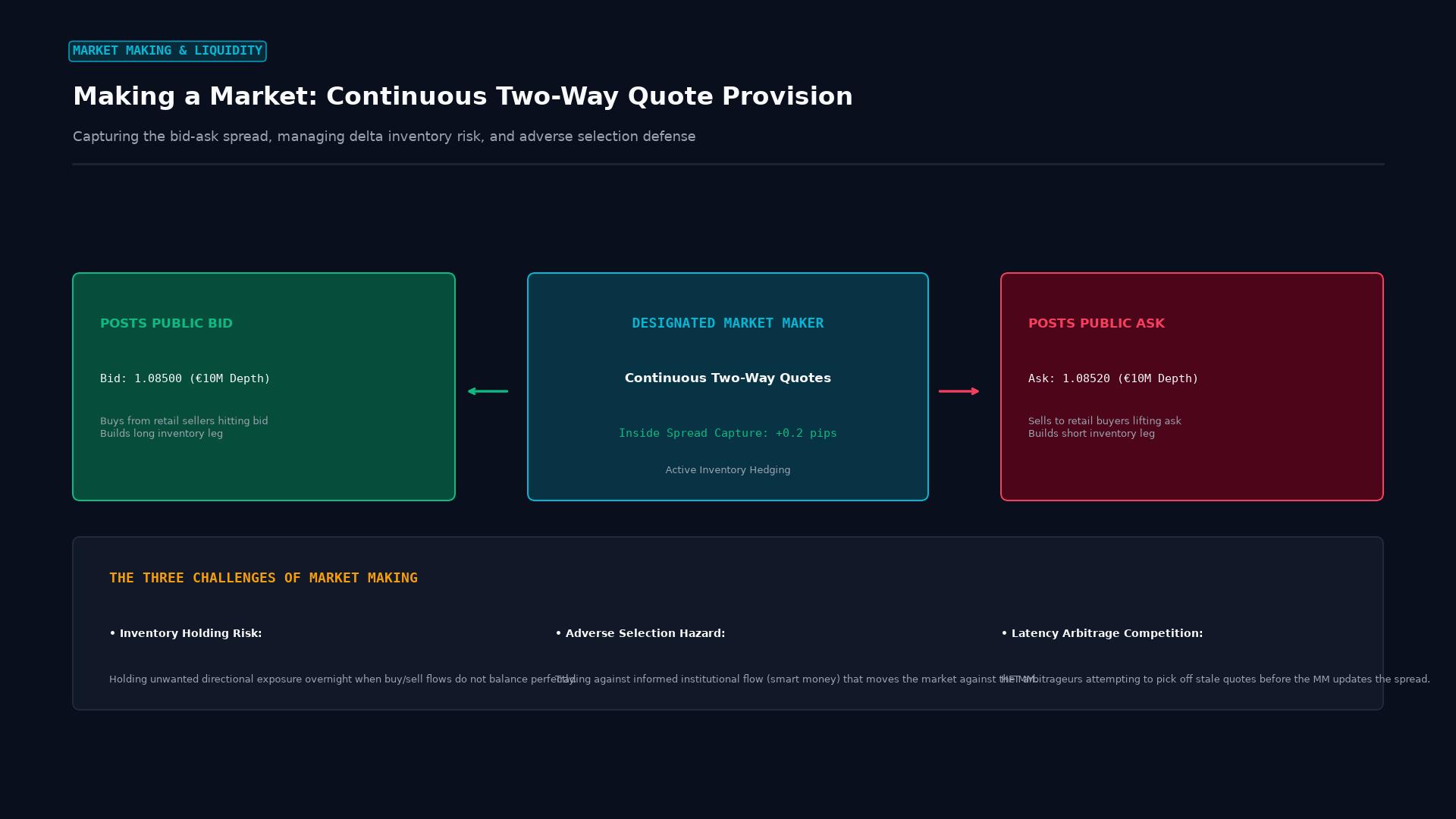 Figure: Market maker obligations: continuous quoting of firm bid and ask prices, absorbing customer order flow, and capturing the bid-ask spread.
Historical Evolution: From Trading Pits to Algorithmic Liquidity
The institutional structure of market making has evolved from human-negotiated open outcry floor trading into automated high-frequency algorithmic liquidity provision:
1. The Specialist System on Exchange Floors
Historically, the New York Stock Exchange (NYSE) operated through designated human “specialists” assigned to specific physical trading posts. Under NYSE Rule 104, specialists held an affirmative obligation to maintain a “fair and orderly market,” acting as dealers of last resort by leaning against prevailing market trends to dampen excessive price swings. On the over-the-counter NASDAQ market, competing broker-dealers quoted prices over telephone lines, negotiating trades bilaterally.
2. The Electronic Transition and SEC Regulation NMS (2005)
The introduction of electronic communication networks (ECNs) in the late 1990s, followed by the adoption of Regulation NMS (National Market System) by the US Securities and Exchange Commission (SEC) in 2005, restructured modern trading.
Rule 611 (the Order Protection Rule) mandated that trading venues route orders to the platform displaying the National Best Bid and Offer (NBBO), eliminating manual specialist privileges. Concurrently, decimalization in 2001 narrowed bid-ask spreads from fractional sixteenths ($0.0625) to single pennies ($0.01) or sub-pennies, compressing traditional dealer margins.
3. Modern Quantitative High-Frequency Market Makers
Human floor specialists have been largely replaced by quantitative market-making firms such as Citadel Securities, Virtu Financial, Jane Street, and XTX Markets. Operating low-latency colocation servers situated inside exchange data centers (such as Equinix NY4 in Secaucus, New Jersey), these quantitative market makers deploy mathematical algorithms that update bid and ask quotes millions of times per second across global equities, options, futures, and currency pairs.
Microstructure Mechanics and Theoretical Models
Academic market microstructure models demonstrate how market makers establish optimal spreads and manage inventory risk.
1. Spread Decomposition: The Three Components
The gross bid-ask spread ($S$) quoted by a market maker comprises three core economic components:
$$S = C_{\text{order}} + C_{\text{inventory}} + C_{\text{adverse}}$$
Where:
- $C_{\text{order}}$ represents Order Processing Costs: Administrative exchange fees, clearing and settlement expenses, hardware colocation rent, and software licensing.
- $C_{\text{inventory}}$ represents Inventory Holding Costs: The financing cost (repo borrowing rate) and capital charge incurred to carry unhedged securities overnight on the firm’s balance sheet.
- $C_{\text{adverse}}$ represents Adverse Selection (Information Cost): The expected loss incurred when transacting with “informed traders” who possess superior analytical models or faster access to market-moving news.
2. The Ho-Stoll Inventory Control Model (1981)
Thomas Ho and Hans Stoll formalized how a market maker adjusts bid and ask prices to control inventory imbalances. If a dealer accumulates an excess long inventory ($q > 0$), holding that position exposes the firm to downward price risk.
The market maker shifts the midpoint of their quotes downward to deter incoming sell orders and attract incoming buy orders:
$$r(s, q) = s - q \gamma \sigma^2 \Delta t$$
Where:
- $r(s, q)$ is the reservation (indifference) price of the market maker.
- $s$ is the true unobserved fundamental value of the asset.
- $q$ is the current net inventory position (positive if long, negative if short).
- $\gamma$ is the market maker’s risk aversion parameter.
- $\sigma^2$ is the instantaneous variance (volatility) of the asset price.
- $\Delta t$ is the remaining trading horizon.
When inventory is heavily long ($q \gg 0$), the reservation price falls ($r < s$), causing the market maker to quote an aggressive ask (low offer) to liquidate inventory, while dropping the bid price to prevent further inventory accumulation.
       MARKET MAKER QUOTE SKEW BASED ON INVENTORY

Asset Price
   ^
   |        [Ask: $100.05]
   |        [Bid: $100.01]  <- Flat Inventory: Symmetric around Mid ($100.03)
   |
   |        [Ask: $100.02]  <- Heavy Long Inventory (q > 0):
   |        [Bid: $99.98]      Both quotes skewed downward to attract buyers
   |                           and discourage sellers
   +------------------------------------------------------------------------>
   Time
Market Making in Foreign Exchange (FX)
The foreign exchange market is the largest financial market in the world, trading over $7.5 trillion daily. Because foreign exchange is decentralized without a single central clearing exchange, market making operates across a multi-tier over-the-counter (OTC) architecture:
Tier 1: The Interbank Wholesale Market
Global money-center investment banks (such as JPMorgan Chase, Deutsche Bank, UBS, and Citi) make two-sided markets directly to each other and through primary interdealer broker platforms (such as EBS and Refinitiv Dealing). They quote tight spreads in benchmark currency pairs (EUR/USD, USD/JPY, GBP/USD) for standard institutional lot sizes ranging from $1 million to $50 million.
Tier 2: Non-Bank Liquidity Providers (NBLPs)
Over the past two decades, quantitative non-bank trading firms (such as XTX Markets and Citadel Securities) have become dominant liquidity providers on electronic multi-bank platforms (FXall, 360T, Currenex). These firms continuously quote streaming prices to regional banks, institutional asset managers, and corporate treasuries.
Tier 3: Retail FX Brokers
Retail foreign exchange brokers utilize two distinct operational models:
- Dealing Desk (B-Book / Internalization): The retail broker acts as the direct market maker to its retail clients. When a trader buys EUR/USD, the broker takes the opposite side (sells EUR/USD) without routing the order externally. Since retail retail traders statistically suffer net losses over time, the broker captures both the bid-ask spread and the client’s trading loss.
- Straight-Through Processing (STP / A-Book): The broker aggregates quotes from wholesale market makers and streams the best bid and ask to clients, adding a transparent markup or commission. The client’s trade is matched with an external liquidity provider.
               FOREIGN EXCHANGE LIQUIDITY PIPELINE

+--------------------------------------------------------------+
| Primary Interbank Venues: EBS Market & Refinitiv Dealing     |
+--------------------------------------------------------------+
                               |
                               v
+--------------------------------------------------------------+
| Wholesale Market Makers: Top Global Banks & Non-Bank LPs     |
| (JPMorgan, Deutsche Bank, Citadel Securities, XTX Markets)   |
+--------------------------------------------------------------+
                               |
                               v Multi-Bank Aggregation (FXall / 360T)
+--------------------------------------------------------------+
| Electronic Brokerage Conduits & Retail Dealing Desks         |
+--------------------------------------------------------------+
                               |
                               v Retail Trading Interfaces (MT4 / MT5)
+--------------------------------------------------------------+
| Individual Retail Currency Traders                           |
+--------------------------------------------------------------+
Payment for Order Flow (PFOF) and Internalization
In US retail equity and options markets, the mechanics of market making are tied to Payment for Order Flow (PFOF):
- Uninformed Retail Flow: Retail retail orders (orders from individual investors trading 100 shares on mobile apps) are characterized by market microstructure as “uninformed flow”. Unlike hedge fund orders, retail trades carry zero information regarding imminent institutional block allocations or corporate news.
- Wholesaler Internalization: Off-exchange market-making wholesalers (Citadel Securities, Virtu, Two Sigma) pay retail retail brokers (such as Charles Schwab and Robinhood) cash rebates per share to route non-directed retail market orders directly to their proprietary internalizers rather than routing them to public lit exchanges (NYSE or NASDAQ).
- Price Improvement: Wholesalers fill the retail buyer at a price slightly better than the National Best Offer and fill the retail seller at a price slightly better than the National Best Bid (providing sub-penny “price improvement”), while pocketing the vast majority of the bid-ask spread risk-free.
Critics and regulatory bodies (including the SEC and European regulators under MiFID II) have scrutinized PFOF for potential conflicts of interest, prompting European bans on PFOF while US authorities mandate detailed execution-quality reporting under SEC Rules 605 and 606.
Real-World Case Study: Managing Volatility During Non-Farm Payrolls
To observe how a foreign exchange market maker manages risk during high-impact macroeconomic events, consider a quantitative dealing desk quoting the EUR/USD pair during a monthly US Non-Farm Payrolls (NFP) release.
+--------------------------------------------------------------------+
|               EUR/USD MARKET MAKING DURING NFP RELEASE             |
+--------------------------------------------------------------------+
| 1. Normal Regime (08:29:50 EST):                                   |
|    - Bid: 1.08500 | Ask: 1.08502 (Spread: 0.2 pips)               |
|    - Displayed Depth: $20,000,000 per side                         |
|    - Market Maker Net Inventory: Flat ($0)                         |
+--------------------------------------------------------------------+
| 2. Pre-News De-Risking (08:29:58 EST):                             |
|    - Automated algorithm cuts displayed size from $20M to $2M.     |
|    - Spread widens defensively from 0.2 pips to 1.5 pips.          |
+--------------------------------------------------------------------+
| 3. Data Shock (08:30:00 EST):                                      |
|    - US NFP surprises heavily to upside (+350k vs +180k expected). |
|    - Algorithmic traders rush to buy USD (dump EUR/USD).           |
|    - Market Maker hit with massive wave of EUR sell orders:        |
|      Fills $15M of client sells; desk becomes involuntarily LONG EUR|
+--------------------------------------------------------------------+
| 4. Inventory Skew & Defensive Spread (08:30:01 EST):               |
|    - Spot price drops 40 pips to 1.08100.                          |
|    - Desk unhedged inventory: Long $15,000,000 EUR at 1.08450.     |
|    - Algorithm skews quote: Drops Bid to 1.08050, Ask to 1.08110.  |
|    - Desk unloads $15M EUR inventory via CME Euro FX futures and   |
|      EBS spot matching, neutralizing delta within 1.8 seconds.     |
+--------------------------------------------------------------------+
During the event, the market maker protected capital by widening spreads, shrinking displayed quotation depth, skewing quotes to deter further toxic sell orders, and instantly hedging residual inventory across liquid futures exchanges.
Regulatory and Capital Standards
Market makers must adhere to stringent regulatory mandates to maintain their licensed status:
- SEC Rule 602 (The Firm Quote Rule): Market makers are legally required to execute transactions against displayed quotes at prices at least as favorable as their published quotations, up to their published quotation size.
- SEC Rule 15c3-1 (Net Capital Rule): Broker-dealers engaging in market making must maintain substantial liquid regulatory capital reserves, calculating specific haircuts on proprietary securities inventory to absorb market declines.
- Regulation SHO Bona Fide Market Making Exemption: Under US securities laws, registered market makers engaged in bona fide market making enjoy specific exemptions from pre-borrow locate requirements when executing short sales, ensuring continuous liquidity provision even during sharp market dislocations.
Frequently Asked Questions
How does a market maker generate profit if asset prices fall?
A market maker does not rely on asset price appreciation. Its primary revenue model is capturing the difference between the price at which it buys from sellers (the bid) and the price at which it sells to buyers (the ask). If an asset drops from $100 to $50, a market maker that continuously buys at $49.99 and sells at $50.01 captures the $0.02 spread on each transaction, remaining neutral to the broader price trend.
What is the primary difference between a broker and a market maker?
A broker acts purely as an agent for the client, routing the client’s order to an external trading exchange or liquidity provider in exchange for a commission fee; the broker never assumes ownership of the security. A market maker acts as a dealer (principal), maintaining an inventory of securities on its own balance sheet and trading directly against the client as counterparty.
Why do bid-ask spreads widen dramatically during economic news releases?
During major macroeconomic announcements (such as central bank interest rate decisions or employment figures), the risk of adverse selection rises exponentially. Market makers face the risk that faster, better-informed traders will execute orders before quotes can be adjusted. To compensate for this heightened inventory and information risk, market-making algorithms widen the spread between their bid and ask quotes and reduce their displayed quote size.
Ready to trade forex?
Open a free demo account with a regulated broker. Practice with virtual funds before risking real money.