Martingale System
The Martingale system is a high-risk position-sizing strategy where a trader doubles their trade volume after every losing trade, aiming to recover all accumulated losses and lock in a net profit equal to the original stake upon the next single winning trade.
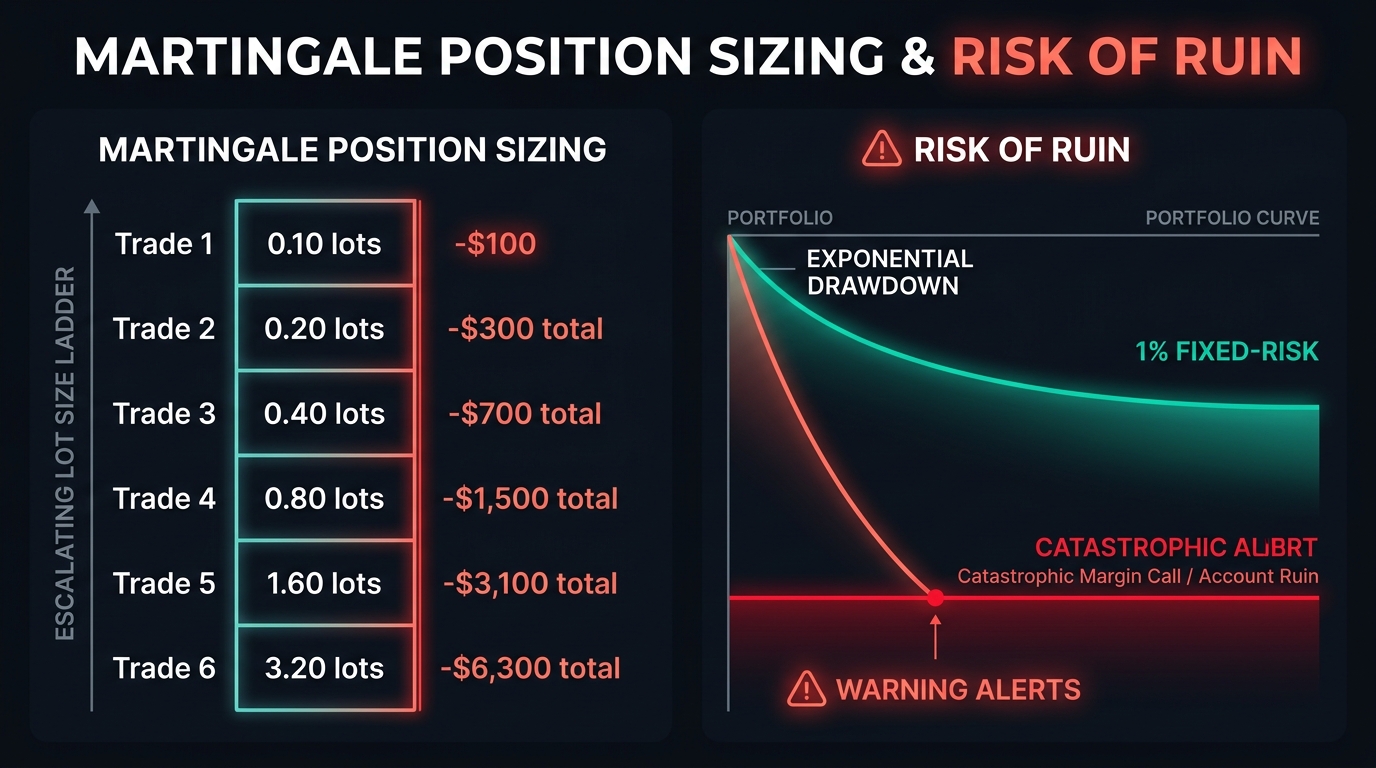
The Martingale system is an aggressive capital allocation method adapted from 18th-century gambling theory. Its core premise states that if a trader continuously doubles their position size after each loss, an eventual winning trade will offset all previous losses and generate a net profit equal to the initial stake.
While theoretically sound in a frictionless mathematical model with infinite capital and no exposure limits, real-world financial markets expose Martingale traders to rapid catastrophic failure. In currency markets, prolonged unidirectional trends and leverage constraints frequently trigger catastrophic margin calls before the winning trade ever occurs.
How the Martingale System Works
In retail forex trading, Martingale mechanics are most commonly packaged into automated Expert Advisors (EAs) or grid trading algorithms. The process follows a strict sequence:
- Initial Entry: The trader opens a baseline trade—for example, buying 0.10 lots on EUR/USD with a 30-pip profit target and a 30-pip spacing threshold.
- First Loss / Drawdown: If the exchange rate drops 30 pips against the position, the algorithm opens a new long position of 0.20 lots (doubling the prior size) rather than taking a disciplined loss.
- Escalating Exposure: If the pair drops another 30 pips, the trader opens 0.40 lots. With each subsequent adverse movement, the order volume scales exponentially: 0.80 lots, 1.60 lots, 3.20 lots, and so forth.
- The Target Resolution: Because the largest position sits at the lowest purchase price, the combined average entry price drops closer to the current market quote. A minor retracement (as small as 15 to 20 pips) allows the entire basket of trades to close in aggregate net profit.
The Exponential Risk Progression
The fundamental flaw in this progression lies in exponential growth. While the reward remains capped at the initial small profit target, capital commitment expands at a geometric rate:
| Trade Step | Trade Size (Lots) | Step Loss ($) | Cumulative Loss ($) | Cumulative Margin Required (1:100) |
|---|---|---|---|---|
| Trade 1 | 0.10 | $30 | $30 | $100 |
| Trade 2 | 0.20 | $60 | $90 | $300 |
| Trade 3 | 0.40 | $120 | $210 | $700 |
| Trade 4 | 0.80 | $240 | $450 | $1,500 |
| Trade 5 | 1.60 | $480 | $930 | $3,100 |
| Trade 6 | 3.20 | $960 | $1,890 | $6,300 |
| Trade 7 | 6.40 | $1,920 | $3,810 | $12,700 |
| Trade 8 | 12.80 | $3,840 | $7,650 | $25,500 |
By step 8, a trader risking an initial $30 gain must deploy 12.80 lots. They hold an open floating loss of $7,650 and require $25,500 in reserved margin on a standard 1:100 leverage account. Any trader with a $10,000 balance suffers an unavoidable stop-out long before the market offers a rebound.
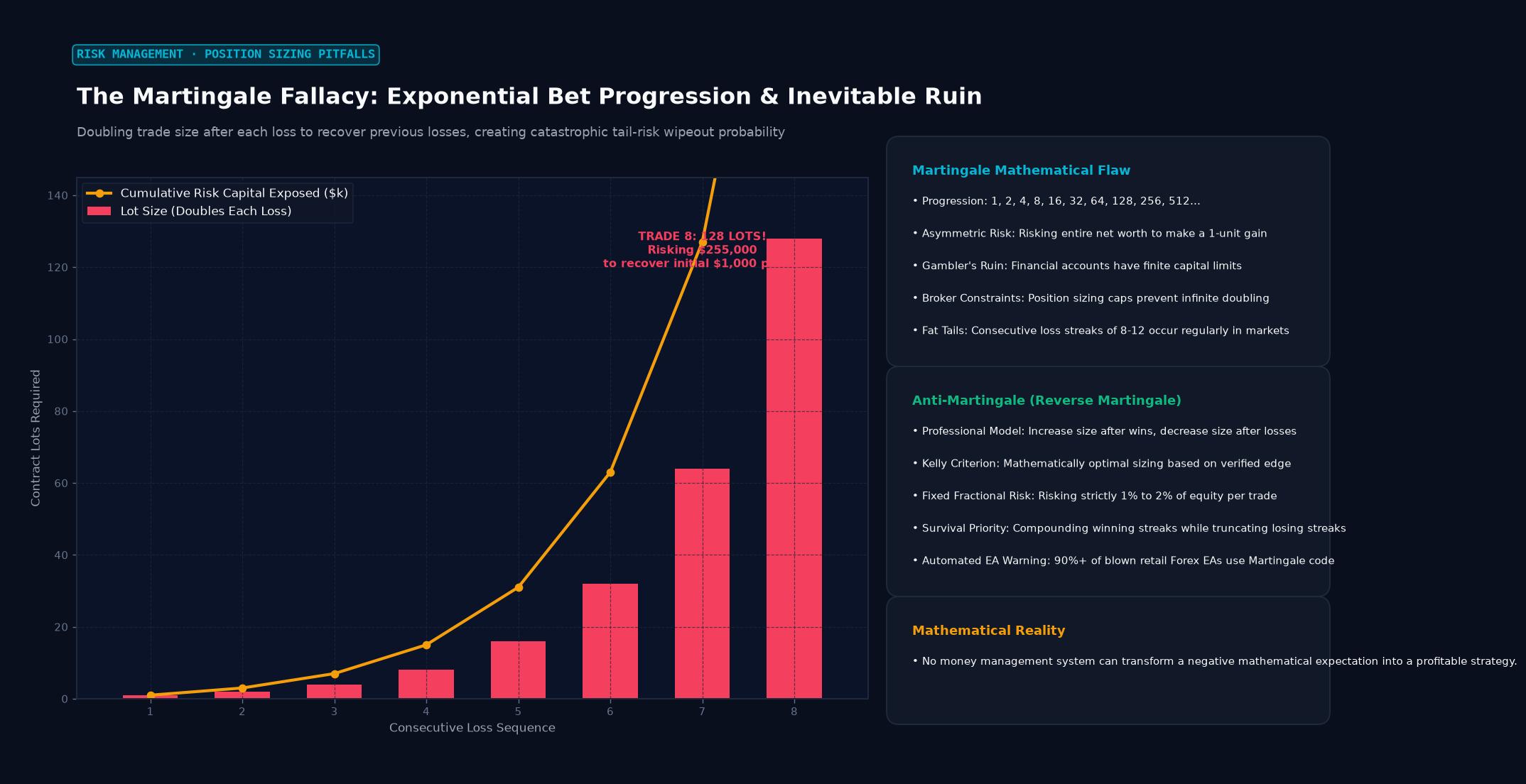 Figure: Doubling trade size after each loss to recover previous losses, creating catastrophic tail-risk wipeout probability
The Mathematical Trap: Negative Skewness and Gambler’s Ruin
In statistical terminology, the Martingale system creates an equity curve characterized by high probability of small gains and a low probability of total account destruction. This dynamic represents severe negative skewness.
Automated Martingale systems often produce equity charts that climb smoothly for months with a 90% or 95% win rate. Retail traders mistake this smooth trajectory for an infallible trading edge. However, the system does not alter the underlying expected value ($EV$) of the market. Because currency pairs incur bid-ask spreads, overnight swap fees, and slippage, the actual expected return per trade remains negative:
$$EV = \sum (P_i \times W_i) - \text{Trading Costs}$$
When an extended macroeconomic trend arrives—such as a 400-pip central bank intervention or a geopolitical shock—the market moves through dozens of grid tiers without a corrective pullback. The trader runs out of usable margin, and the broker initiates a forced liquidation.
Martingale vs. Anti-Martingale
To mitigate the fatal vulnerability of doubling down on losses, many quantitative risk managers favor the Anti-Martingale (or reverse Martingale) framework:
- Martingale Approach: Increase position sizing following losing trades; reset to base size following a win. This risks mounting leverage when the trader is wrong.
- Anti-Martingale Approach: Halve or minimize position sizing during a losing streak; double or pyramid position sizing only when trades are profitable and moving with the prevailing trend.
The Anti-Martingale model prevents Gambler’s Ruin because position sizes shrink during drawdowns, protecting capital until market conditions align with the trading strategy.
Practical Example: A Failed GBP/USD Long Basket
Consider a retail trader with an account balance of $5,000 trading GBP/USD using a 1:200 leverage account.
- The trader enters a long position of 0.05 lots at 1.2800, setting a 25-pip take-profit ($12.50) with no hard stop-loss.
- A hawkish U.S. inflation report triggers an aggressive USD rally. GBP/USD declines rapidly.
- At 1.2775, the trader doubles to 0.10 lots. At 1.2750, they add 0.20 lots. At 1.2725, they add 0.40 lots. At 1.2700, they add 0.80 lots.
- Across these five entries, the trader now controls 1.55 lots ($155,000 of currency).
- At 1.2675, GBP/USD has dropped just 125 pips from the initial entry. The floating unrealized loss across the basket exceeds $2,100, while the used margin required to support 1.55 lots sits at $775.
- As the price touches 1.2640, total floating losses surpass $4,200. Account equity drops below 20% of required margin, triggering an automatic broker liquidation that wipes out 85% of the account balance in a single afternoon.
Key Takeaways
- Doubling Down on Losses: The Martingale system doubles trade size following each loss to ensure that a single win recoups all prior losses plus the initial target.
- Illusory Performance: Backtests often display months of steady gains and an exceptionally high win rate, hiding the inevitable tail risk of catastrophic liquidation.
- Capital Ceiling Constraint: Real trading accounts have finite capital, regulatory leverage caps, and maximum lot limits, making infinite doubling impossible.
- Negative Asymmetry: Traders risk thousands of dollars in floating drawdown simply to extract an original target profit of a few dollars.
- Superior Alternatives: Modern risk management relies on fixed fractional position sizing, strict stop-loss orders, and trend-following pyramiding (Anti-Martingale).
Frequently Asked Questions
Can the Martingale system be profitable in forex long term?
No. While it can produce consistent short-term gains during quiet, range-bound market conditions, any sustained trend or liquidity gap will inevitably trigger a drawdown larger than the trader’s total account balance.
Why do automated forex robots (EAs) use Martingale logic?
EA vendors utilize Martingale algorithms because they produce nearly flawless backtests with upward-sloping equity curves. This makes the software easy to market to novice retail traders who focus on win rate rather than maximum drawdown and risk-adjusted return.
What is the difference between Martingale and grid trading?
Grid trading places pending buy or sell orders at regular intervals across a price range. Martingale refers specifically to the doubling of volume across those consecutive levels. A grid strategy can operate with fixed or decreasing lot sizes, whereas a Martingale grid increases order volume exponentially.
Ready to trade forex?
Open a free demo account with a regulated broker. Practice with virtual funds before risking real money.