Maintenance Margin
Maintenance margin is the minimum account equity threshold required by a broker or clearinghouse to keep leveraged positions open, below which margin calls are triggered or positions are automatically liquidated.
What Is Maintenance Margin?
Maintenance margin is the essential financial safety cushion required by brokerage firms, prime brokers, and central clearinghouses to keep active leveraged positions open. While initial margin represents the collateral required to enter a new trade, maintenance margin represents the ongoing equity boundary that must remain in the account as market prices fluctuate.
If an adverse market movement causes open floating losses to erode account equity below the maintenance margin requirement, the account is immediately in default. To prevent the account from plunging into a negative balance and transferring debt onto the brokerage, the broker issues an urgent margin call demanding additional capital, or activates automated risk algorithms to forcefully close out the trader’s positions at current market prices.
+-------------------------------------------------------------------------+
|                        THE MARGIN RISK LIFECYCLE                        |
|                                                                         |
|  [Entry Stage]     ===> Initial Margin Deposited (Trade Opens)          |
|                                 |                                       |
|                                 v                                       |
|  [Floating Loss]   ===> Equity Drops Toward Maintenance Threshold       |
|                                 |                                       |
|                                 v                                       |
|  [Breach Event]    ===> MARGIN CALL (Deposit Funds or Liquidate)        |
|                                 |                                       |
|                                 v                                       |
|  [Stop-Out Level]  ===> AUTOMATED FORCED LIQUIDATION (Positions Closed) |
+-------------------------------------------------------------------------+
Futures Exchanges vs. Retail Forex: Two Operational Models
Maintenance margin is enforced through two distinct operational frameworks depending on the traded asset class:
1. The Centralized Futures Model (CME Group)
On regulated futures exchanges, maintenance margin is a fixed dollar amount per contract established by the exchange clearinghouse:
- Euro FX Futures (6E): Exchange Initial Margin = $2,800 USD; Maintenance Margin = $2,500 USD.
- If a daily mark-to-market loss drives account equity below $2,500, a margin call is triggered requiring the trader to deposit funds to restore the balance all the way back to the initial margin level ($2,800), not merely the maintenance level.
2. The Retail Forex Broker Model (Margin Level %)
In retail spot forex trading, brokers evaluate maintenance requirements dynamically using the Margin Level percentage:
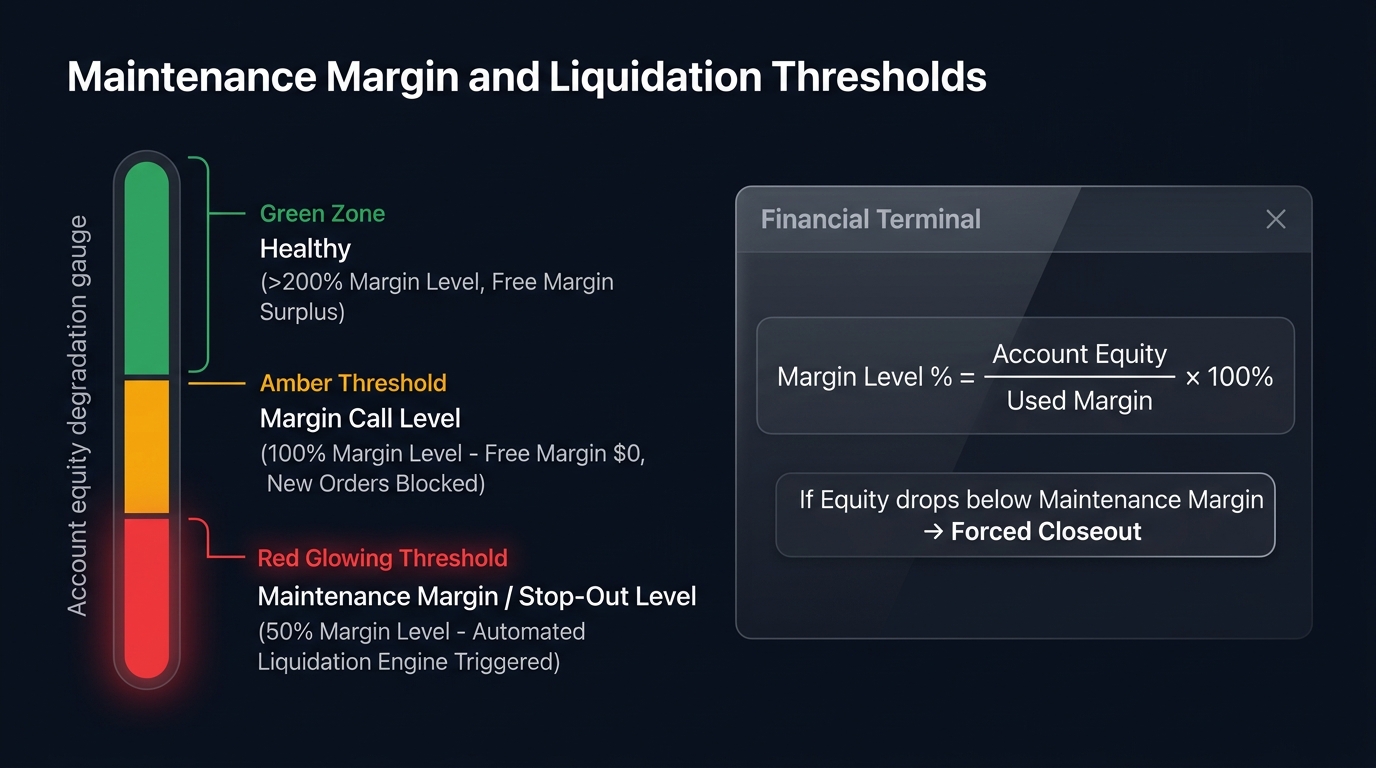
$$\text{Margin Level} = \left(\frac{\text{Account Equity}}{\text{Used Margin}}\right) \times 100%$$
Where:
- Account Equity = Account Balance + Floating Profits - Floating Losses
- Used Margin = Cumulative initial margin locked across all open trades
In retail forex, maintenance margin rules are governed by two progressive percentage thresholds:
- The Margin Call Level (Typically 100%): When equity falls to equal used margin (Free Margin hits $0), the broker issues a visual warning. The platform locks the account, prohibiting the trader from opening any new positions.
- The Stop-Out Level (Typically 50% to 20%): If losses worsen and equity drops to 50% of used margin, the broker’s automated liquidation engine executes a forced closeout.
Detailed Numerical Walkthrough: Account Degradation to Stop-Out
Consider a trader with a $5,000 USD retail account trading EUR/USD at 50:1 leverage (2.0% margin):
- Trade Opened: Long 1.0 standard lot EUR/USD at 1.0850 (Notional value: $108,500 USD).
- Used Initial Margin: $108,500 / 50 = $2,170 USD.
- Free Margin at Entry: $5,000 - $2,170 = $2,830 USD.
- Initial Margin Level: $($5,000 / $2,170) \times 100% = \mathbf{230.4%}$ (Healthy).
Phase 1: Adverse Movement of 200 Pips
EUR/USD collapses 200 pips to 1.0650 ($2,000 floating loss):
- Equity: $$5,000 - $2,000 = \mathbf{$3,000 \text{ USD}}$.
- Margin Level: $($3,000 / $2,170) \times 100% = \mathbf{138.2%}$.
- Status: Free margin shrinks to $830 USD; positions remain open.
Phase 2: Adverse Movement of 283 Pips (Margin Call Triggered)
EUR/USD drops to 1.0567 ($2,830 floating loss):
- Equity: $$5,000 - $2,830 = \mathbf{$2,170 \text{ USD}}$.
- Margin Level: $($2,170 / $2,170) \times 100% = \mathbf{100.0%}$.
- Status: MARGIN CALL ACTIVATED. Free margin hits $0. New trades are blocked.
Phase 3: Adverse Movement of 391 Pips (Stop-Out Forced Liquidation)
EUR/USD plunges further to 1.0459 ($3,915 floating loss):
- Equity: $$5,000 - $3,915 = \mathbf{$1,085 \text{ USD}}$.
- Margin Level: $($1,085 / $2,170) \times 100% = \mathbf{50.0%}$.
- Status: STOP-OUT LEVEL BREACHED. The broker’s server immediately closes the trade at market price. The trader realizes a catastrophic $3,915 loss, leaving an account balance of only $1,085.
Initial Margin vs. Maintenance Margin
| Dimension | Initial Margin | Maintenance Margin |
|---|---|---|
| Purpose | Collateral required to open a trade | Collateral required to maintain an open trade |
| Timing | Checked at the exact moment of order entry | Monitored continuously in real time |
| Relative Size | Higher requirement (e.g., $2,800 on CME) | Lower threshold (e.g., $2,500 on CME) |
| Consequence of Breach | Order execution rejected (“Not Enough Money”) | Forced liquidation and positions closed |
Best Practices to Avoid Maintenance Margin Liquidation
- Maintain Margin Levels Above 500%: Conservative risk managers keep total used margin below 20% of total account equity, ensuring a massive buffer to withstand routine market volatility.
- Enforce Hard Stop Losses: Never rely on the broker’s stop-out level as a risk management strategy. A hard stop-loss order placed at a predetermined technical invalidation level limits losses to 1% to 2% of equity, far before maintenance margin is threatened.
- Account for Spreads During News Events: In volatile markets or during roll-over (5:00 PM ET), broker spreads widen drastically. In accounts with thin margin buffers, a temporary 5-pip spread blowout can instantly trigger a stop-out liquidation.
Key Takeaways
- Maintenance margin is the minimum equity required to prevent positions from being forcefully liquidated.
- In futures, it is a fixed dollar amount; in retail forex, it is governed by Margin Level percentage (100% call, 50% stop-out).
- If equity breaches the stop-out threshold, the broker closes positions automatically starting from the largest losing trade.
- Initial margin opens the trade; maintenance margin sustains the trade.
- Professional traders maintain Margin Levels well above 500% and use stop-loss orders to eliminate liquidation risk.
Frequently Asked Questions
Which trade does a broker close first during a stop-out liquidation?
When an account hits the stop-out level, the broker’s automated risk engine identifies the specific open position holding the largest unrealized floating loss and closes it first. If equity remains below the stop-out threshold, the engine continues closing positions ticket-by-ticket until the Margin Level climbs back above 50%.
Can an account balance go negative if a stop-out is executed?
In ultra-fast markets, weekend gaps, or flash crashes (such as the 2015 Swiss Franc collapse), liquidity can vanish completely. Stop-out market orders may slip far past the liquidation price, resulting in a negative account balance. However, regulated retail brokers in the UK, EU, and Australia provide mandatory Negative Balance Protection, legally forgiving the deficit.
Does adding funds cancel a margin call?
Yes. Depositing fresh funds immediately expands account equity, lifting the Margin Level back above 100% and restoring positive Free Margin.
Ready to trade forex?
Open a free demo account with a regulated broker. Practice with virtual funds before risking real money.